
In the realm of power transmission, spiral bevel gears are indispensable components for transferring motion and power between intersecting axes, typically at 90 degrees. Their curved, oblique teeth allow for smoother and quieter operation compared to straight bevel gears, enabling higher speeds and greater load capacity. The design and manufacturing of these gears are complex, governed by intricate three-dimensional geometry. A significant advancement in this field, particularly within unique design methodologies, has been the development of the non-zero modification design theory. This theory liberates designers from the traditional constraint of standard zero-modification designs, offering a potent method to enhance tooth strength and improve meshing performance. However, this increased design freedom introduces a critical challenge: avoiding undercut.
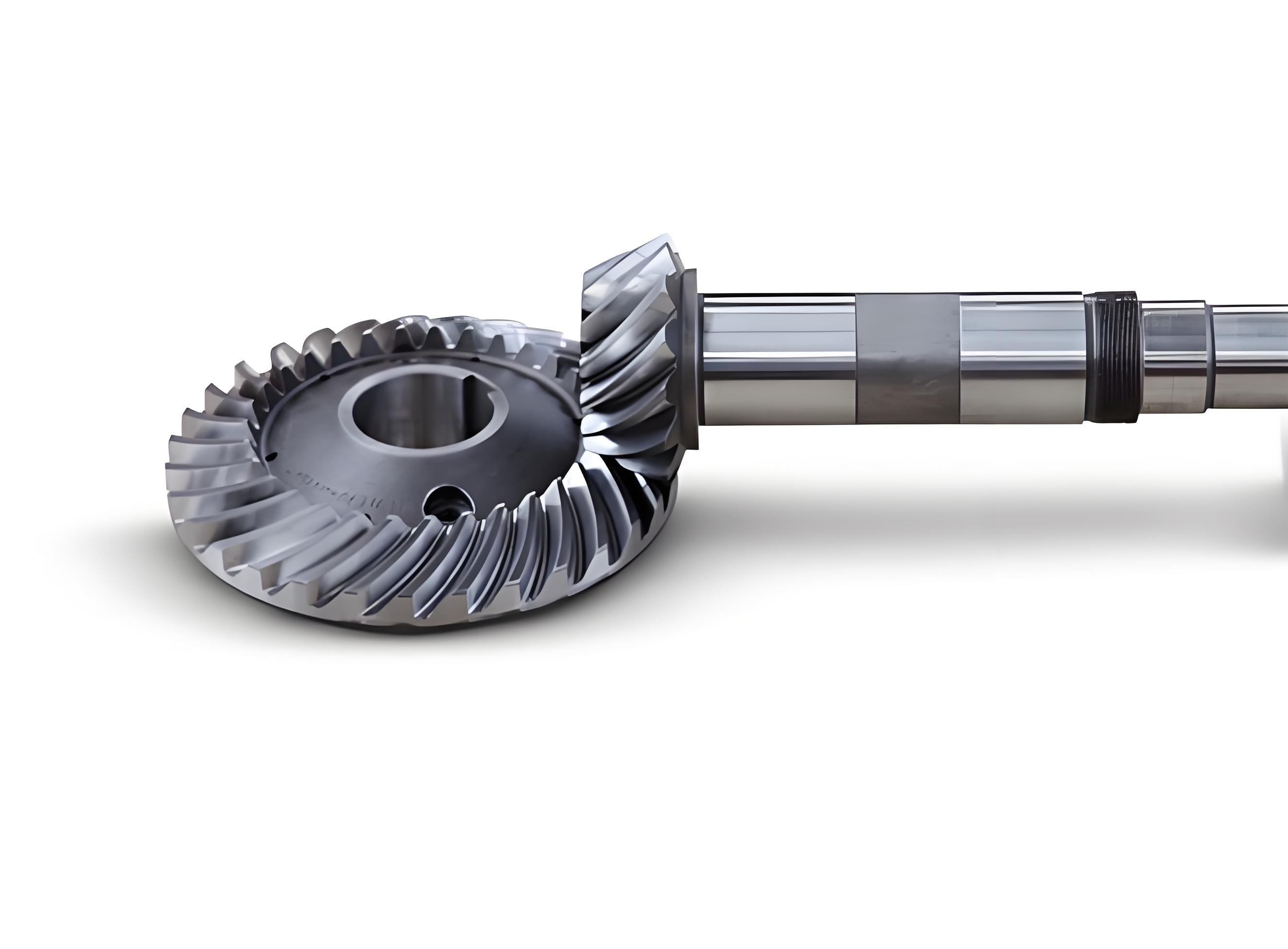
Undercut is a destructive phenomenon in gear machining where the cutting tool removes material from the root of the gear tooth, weakening the tooth profile and reducing its effective contact area. For spiral bevel gears with low tooth counts, which are often desired for high reduction ratios, the risk of undercut is particularly acute. Therefore, determining the minimum modification coefficient required to prevent undercut is a fundamental and necessary step in the reliable design of non-zero modified spiral bevel gears. Historically, approximations were used, such as applying the minimum tooth number rule for spur gears to the equivalent virtual spur gear of the spiral bevel gear. This approach is inherently inaccurate due to the complex spatial geometry. Later, standards provided specific curves or simplified rules, but these were typically limited to zero-modification or a single spiral angle, rendering them unsuitable for the general case of non-zero modification design. This article presents a rigorous derivation of the undercutting limit for spiral bevel gears based on three-dimensional gearing theory, culminating in a practical and accurate formula for the minimum modification coefficient.
1. The Spatial Gearing Principle and the Undercut Condition
The geometry of a spiral bevel gear tooth is generated as the envelope of the cutting tool’s surface (e.g., a cutter head) relative to the gear blank. Undercut occurs during this generation process when the motion of the tool causes it to intrude into and cut away the already-formed part of the tooth flank. Mathematically, this is associated with the existence of singular points on the generated surface. A powerful method for analyzing this condition is the velocity stop or stationary velocity method derived from spatial meshing theory. This method states that on the limiting curve (the line of undercut) that separates the regular from the undercut region of the tooth surface, the relative velocity between the tool and the workpiece becomes zero in a specific direction.
The analysis involves establishing several key vector equations. First, the surface of the cutting tool (the generating surface) is defined in a coordinate system attached to the tool. Its position can be described by a vector function:
$$ \mathbf{r} = \mathbf{r}(u, v, \psi) $$
where \( u \) and \( v \) are surface parameters, and \( \psi \) is a motion parameter representing the rotation of the cutter.
For this surface to generate the gear tooth as its envelope, the Meshing Equation must be satisfied at every point of contact. This equation relates the normal vector to the surface and the relative velocity:
$$ f(u, v, \psi) = \mathbf{n} \cdot \mathbf{v}^{(12)} = 0 $$
where \( \mathbf{n} \) is the unit normal to the tool surface and \( \mathbf{v}^{(12)} \) is the relative velocity of the tool (1) with respect to the gear workpiece (2).
The condition for the existence of the undercutting limit is given by the Velocity Stop Equation, which in its general form requires:
$$ \mathbf{v}^{(2)} = \mathbf{v}^{(1)} + \mathbf{v}^{(12)} = \mathbf{0} $$
This signifies a point where the absolute velocity of the generated point on the gear tooth (2) is zero relative to the cutting tool’s coordinate system. By projecting these vector equations onto a coordinate system that represents the actual machining setup of spiral bevel gears—incorporating parameters like the cutter mean point radius \( r_c \), machine root angle \( \delta \), cutter blade pressure angle \( \alpha \), and spiral angle \( \beta \)—the complex spatial relationships are converted into a solvable system of algebraic equations. The specific geometry is shown in the following schematic, which defines key parameters such as the cutter offset and tilt.
The resulting equations, after substantial algebraic manipulation, are expressed in terms of critical design angles. The primary variables become the gear’s root angle \( \theta_f \) and the machine setting angles \( \phi \) and \( \psi \), alongside a normalized cutter radius parameter \( c = r_c / R \), where \( R \) is the outer cone distance. The pressure angle \( \alpha \), spiral angle \( \beta \), and pitch cone angle \( \delta \) are treated as independent input variables. The core system of equations to solve for the undercut boundary is:
Meshing Equation:
$$ \sin^2\alpha \sin\tau (c\sin\alpha – \sin\theta_f \cos\alpha) – (\cos^2\theta_f + c^2 – 2c\cos\theta_f \sin\beta)^{1/2} (\sin\alpha \sin\tau_1 + \cos\alpha \sin\phi \tan\theta_j) = 0 \quad (4) $$
Velocity Stop Equation:
$$ (c\sin\alpha – \sin\theta_f \cos\alpha)^2 \sin^3\alpha \cos\alpha \sin\tau \cos\tau \cos\theta_f \sin\delta_b – (c\sin\alpha – \sin\theta_f \cos\alpha)^2 \sin^2\alpha \sin\tau \cos\theta_f \cos\delta_b (1 – \cos^2\alpha \cos^2\tau) + (c\sin\alpha – \sin\theta_f \cos\alpha) (\cos^2\theta_f + c^2 – 2c\cos\theta_f \sin\beta)^{1/2} [\sin^2\alpha \cos\alpha \sin\tau (\sin\delta \cos\tau_1 + \cos\phi \cos\tau \cos\delta_b \sin\theta_f) + \sin\alpha \cos\delta_b \cos\theta_f (\sin\tau_1 + \cos^2\alpha \sin\tau \cos\phi \tan^2\theta_f) + \cos\alpha \cos\tau \sin\tau_1 \cos\delta_b \sin\theta_f] – (\cos^2\theta_f + c^2 – 2c\cos\theta_f \sin\beta)^{1/2} \cos^2\alpha \cos\delta_b \sin\tau_1 (\sin\theta_f + \cos\theta_f \tan\alpha \cos\tau) [(c\sin\alpha – \sin\theta_f \cos\alpha) \cos\alpha \cos\tau + (\cos^2\theta_f + c^2 – 2c\cos\theta_f \sin\beta)^{1/2} \cos\phi \tan\theta_f] = 0 \quad (5) $$
where:
$$ \tau = \phi – q + \psi, \quad \tau_1 = q – \psi, \quad \delta_b = \delta – \theta_f $$
and \( q \) is an intermediate angle defined by:
$$ \cos q = \frac{\cos\theta_f – c\sin\beta}{(\cos^2\theta_f + c^2 – 2c\cos\theta_f \sin\beta)^{1/2}}, \quad \sin q = \frac{c\cos\beta}{(\cos^2\theta_f + c^2 – 2c\cos\theta_f \sin\beta)^{1/2}} $$
For a given set of \( \alpha \), \( \beta \), and \( \delta \), this system has an infinite set of solutions in \( \theta_f, \phi, \psi, c \). According to enveloping theory, the undercut boundary points form a convex set. Therefore, for a specific gear configuration, there exists a maximum allowable root angle, \( \theta_{f_{max}} \), beyond which undercut will occur. Determining this \( \theta_{f_{max}} \) for various \( \delta \) is the primary computational goal.
2. Computational Solution and Curve Fitting
The system of equations (4) and (5) constitutes a constrained optimization problem: find the maximum \( \theta_f \) such that the equations are satisfied within feasible bounds for \( \phi, \psi, \) and \( c \). A penalty function method is well-suited for solving this problem. The model can be formulated as:
$$ \min \Phi = -\theta_f + \frac{1}{D} \sum_{j=1}^{2} [H_j]^2 + D \sum_{i=1}^{8} \frac{1}{G_i} $$
where \( H_j \) (for \( j=1,2 \)) represent equations (4) and (5), \( G_i \) represent the bounds for the search variables \( \theta_f, \phi, \psi, c \), and \( D \) is a penalty factor. Minimizing \( \Phi \) effectively maximizes \( \theta_f \) while penalizing violations of the governing equations and search boundaries.
By implementing this algorithm, a series of \( \delta – \theta_{f_{max}} \) curves are calculated for different combinations of pressure angle \( \alpha \) and spiral angle \( \beta \). A sample of the resulting curves is shown below. It is noteworthy that for the specific case of \( \alpha = 14.5^\circ – 25^\circ \) and \( \beta = 35^\circ \), the computed results are in perfect agreement with the classic curves found in U.S. gear design standards, validating the spatial gearing approach.
While these curves provide an accurate design limit, a direct formula is far more convenient for design engineers. Observing the shape of the \( \delta – \theta_{f_{max}} \) curves suggests they are not simple polynomials. However, a clever transformation leads to a high-precision fit. For straight bevel gears, an exact formula exists for the maximum root angle \( \theta_z \) to avoid undercut:
$$ \tan \theta_z = \frac{ \sqrt{1 + 4 \tan^2\delta \sin^2\alpha \cos^2\alpha} – 1 }{ 2 \tan\delta \cos^2\alpha } \quad (9) $$
Analysis reveals that the difference \( \Delta\theta = \theta_z – \theta_{f_{max}} \) for spiral bevel gears, when plotted against \( \delta \), closely follows a parabolic trend. This allows for an accurate quadratic fitting:
$$ \Delta\theta(\delta) = \theta_z – \theta_{f_{max}} = A_1 \delta^2 – A_2 \delta \quad (10) $$
where \( A_1 \) and \( A_2 \) are fitting coefficients that depend on \( \alpha \) and \( \beta \). Consequently, the maximum allowable root angle for a spiral bevel gear is:
$$ \theta_{f_{max}} = \theta_z – (A_1 \delta^2 – A_2 \delta) = \theta_z – A_1 \delta^2 + A_2 \delta \quad (11) $$
Using the least squares method on the computed data points, the coefficients \( A_1 \) and \( A_2 \) are determined for common ranges of pressure and spiral angles. The results are tabulated below, providing a crucial lookup table for designers.
| Pressure Angle α (°) | Spiral Angle β (°) | Coefficient A₁ | Coefficient A₂ |
|---|---|---|---|
| 14.5 | 35 | 0.039506 | 0.017329 |
| 16 | 35 | 0.046100 | 0.018500 |
| 20 | 15 | 0.035662 | 0.008339 |
| 20 | 20 | 0.042829 | 0.009579 |
| 20 | 25 | 0.047667 | 0.009732 |
| 20 | 30 | 0.053540 | 0.011395 |
| 20 | 35 | 0.062422 | 0.018506 |
| 20 | 40 | 0.071959 | 0.029061 |
| 22.5 | 35 | 0.071350 | 0.016505 |
| 25 | 35 | 0.079242 | 0.011993 |
The root-mean-square error of this fitting method is exceptionally low, ranging from 0.018° to 0.077°, confirming its suitability for precision engineering design of spiral bevel gears.
3. The Minimum Modification Coefficient Formula
The modification coefficient \( x \) in bevel gears is directly related to the root angle \( \theta_f \) and other basic gear parameters. The standard relationship for the addendum modification is given by:
$$ x = h_a^* + c^* – \frac{z_v}{2} \sin \delta \tan \theta_f $$
where \( h_a^* \) is the transverse addendum coefficient, \( c^* \) is the transverse clearance coefficient, and \( z_v \) is the number of teeth. To absolutely prevent undercut in spiral bevel gears, the actual root angle \( \theta_f \) used in design must be less than or equal to the maximum allowable value \( \theta_{f_{max}} \). Therefore, the minimum modification coefficient \( x_{min} \) required to just avoid undercut is obtained by substituting \( \theta_{f_{max}} \) from Equation (11) into this relationship:
$$ x_{min} = h_a^* + c^* – \frac{z}{2} \sin \delta \tan \left( \theta_z – A_1 \delta^2 + A_2 \delta \right) \quad (12) $$
In this formula, all angles (\( \delta, \theta_z \)) must be in radians. The coefficients \( A_1 \) and \( A_2 \) are selected from the table above based on the gear’s pressure angle \( \alpha \) and spiral angle \( \beta \).
Design Procedure:
- Define basic gear parameters: Number of teeth \( z \), Pitch cone angle \( \delta \), Pressure angle \( \alpha \), Spiral angle \( \beta \), Addendum coefficient \( h_a^* \), Clearance coefficient \( c^* \).
- Calculate \( \theta_z \) for the equivalent straight bevel gear using Equation (9).
- Look up or interpolate coefficients \( A_1 \) and \( A_2 \) from the table for the given \( \alpha \) and \( \beta \).
- Compute \( \theta_{f_{max}} \) using Equation (11).
- Calculate the required minimum modification coefficient \( x_{min} \) using Equation (12).
- In the final gear design, ensure the chosen modification coefficient \( x \) satisfies \( x \ge x_{min} \) to prevent undercut.
Example: Consider a spiral bevel pinion with: \( z = 15 \), \( \delta = 20^\circ \) (0.3491 rad), \( \alpha = 20^\circ \), \( \beta = 35^\circ \), \( h_a^* = 0.85 \), \( c^* = 0.188 \).
1. \( \theta_z = \arctan\left( \frac{ \sqrt{1 + 4 \tan^2(0.3491) \sin^2(20^\circ) \cos^2(20^\circ)} – 1 }{ 2 \tan(0.3491) \cos^2(20^\circ) } \right) \approx 3.95^\circ \) (0.0689 rad).
2. From table: \( A_1 = 0.062422 \), \( A_2 = 0.018506 \).
3. \( \theta_{f_{max}} = 0.0689 – 0.062422*(0.3491)^2 + 0.018506*0.3491 \approx 0.0689 – 0.0076 + 0.0065 = 0.0678 \) rad (\( \approx 3.88^\circ \)).
4. \( x_{min} = 0.85 + 0.188 – \frac{15}{2} \sin(0.3491) \tan(0.0678) \approx 1.038 – 7.5 * 0.3420 * 0.0679 \approx 1.038 – 0.174 = 0.864 \).
Therefore, a modification coefficient of at least +0.864 is required for this pinion to be free from undercut.
4. Significance and Application in Spiral Bevel Gear Design
The derivation and resulting formula presented here have significant practical implications for the design of robust spiral bevel gears. The three-dimensional spatial gearing approach provides a fundamentally sound and reliable theoretical foundation for determining the undercut limit, superior to earlier approximate methods. By condensing this complex analysis into a simple formula (12) complemented by a coefficient table, the method bridges the gap between advanced theory and everyday engineering practice.
This tool is indispensable for implementing non-zero modification designs in spiral bevel gears. It allows designers to confidently push the limits of tooth geometry—using lower tooth counts for compactness or applying positive modification to improve bending strength and contact patterns—without the hidden danger of undercut. The formula is equally useful for manual calculations and for integration into computer-aided design (CAD) and gear design software, where it can serve as an automatic check in the design logic for spiral bevel gears. Ensuring \( x \ge x_{min} \) guarantees the geometric integrity of the tooth root, which is a prerequisite for achieving the desired performance and longevity in demanding applications of spiral bevel gears, such as in automotive differentials, aerospace transmissions, and heavy industrial machinery.
In summary, the determination of the minimum modification coefficient is a critical step in the modern design process for spiral bevel gears. The method outlined, based on spatial gearing principles and curve fitting, delivers an accurate, practical, and essential criterion for preventing undercut, thereby enabling the full potential of non-zero modification design strategies for these complex and vital mechanical components.