
In my experience working on heavy-duty machine tools, I encountered a challenging project that required the design of a spindle box for a 14-meter CNC gantry boring and milling machine destined for export. The client specified a rotational speed range from 0 to 5 revolutions per minute and a maximum working torque of 80,000 N·m, which translates to an output force of 8 tons at a 1-meter radius. Traditional spindle box designs, which typically rely on a single main motor coupled with a gear transmission system, were inadequate for such low-speed, high-torque demands. These conventional systems often prioritize higher speeds with relatively lower torque outputs. To meet these stringent requirements, my team and I abandoned the traditional approach and innovated a dual-servo-motor drive system that incorporates a mechanical reduction gearbox and a worm gear set. The core challenge was achieving such immense torque without exceeding the spatial constraints of the machine tool’s overall dimensions. After extensive research and prototyping, we successfully implemented a solution centered on planar double enveloping worm gears. This type of worm gear set proved pivotal in overcoming the size limitations associated with standard worm gears while ensuring reliable, high-torque transmission.
The heart of our design lies in the meticulous parameter calculation and selection of components. We selected Siemens servo main motors, model 1FT6136-6SF71, each with a rated speed of 3000 rpm, a power of 45.5 kW, and a rated torque of 145 N·m. The power from these two motors is transmitted through a parallel gear reduction system before engaging the worm and worm wheel. The gearbox consists of four shafts (I, II, III, and IV) with specific gear pairs. The detailed gear parameters and the calculation for the final output speed are as follows.
The total speed reduction ratio from the motor to the spindle is the product of all individual gear stages and the worm gear stage. The formula for the final spindle speed (N_spindle) is given by:
$$ N_{\text{spindle}} = N_{\text{motor}} \times \left( \frac{Z_{I}}{Z_{II\_1}} \right) \times \left( \frac{Z_{II\_2}}{Z_{III\_1}} \right) \times \left( \frac{Z_{III\_2}}{Z_{IV}} \right) \times \left( \frac{K}{Z_{\text{worm wheel}}} \right) $$
Where:
– $N_{\text{motor}}$ is the motor speed (3000 rpm),
– $Z$ represents the number of teeth on respective gears,
– $K$ is the number of threads (starts) on the worm shaft.
Using the specific values from our design:
| Shaft | Gear Description | Number of Teeth (Z) | Module (mm) |
|---|---|---|---|
| I | Input Gear | 36 | 3.5 |
| II | First Intermediate Gear | 55 | 3.5 |
| II | Second Intermediate Gear | 27 | 4.5 |
| III | First Intermediate Gear | 55 | 4.5 |
| III | Second Intermediate Gear | 25 | 4.5 |
| IV | Output Gear (connected to worm shaft) | 63 | 4.5 |
For the worm gear set:
– Worm: Number of threads (starts), $K = 1$, axial module $m_x = 12$ mm, lead angle $\gamma = 3.814^\circ$.
– Worm Wheel: Number of teeth, $Z_{\text{worm wheel}} = 85$, axial module $m_x = 12$ mm, lead angle $\gamma = 3.814^\circ$.
Substituting these values into the speed formula:
$$ N_{\text{spindle}} = 3000 \times \left( \frac{36}{55} \right) \times \left( \frac{27}{55} \right) \times \left( \frac{25}{63} \right) \times \left( \frac{1}{85} \right) $$
$$ N_{\text{spindle}} = 3000 \times 0.6545 \times 0.4909 \times 0.3968 \times 0.01176 \approx 5 \text{ rpm} $$
This confirms the design meets the required output speed of 5 rpm. The next critical calculation is the output torque. The theoretical torque from a single motor-drive train, before considering efficiencies, can be derived from the power equation: $P = T \times \omega$, where $\omega = 2\pi N / 60$. However, a more direct approach for motor torque conversion is:
$$ T_{\text{output (theoretical per drive)}} = T_{\text{motor}} \times i_{\text{total}} $$
Where $i_{\text{total}}$ is the total reduction ratio. Alternatively, using power continuity and accounting for efficiencies:
$$ T_{\text{output (actual per drive)}} = \left( \frac{9550 \times P_{\text{motor}} \times \eta_{\text{gearbox}}}{N_{\text{spindle}}} \right) \times \eta_{\text{worm gear}} $$
Here, $P_{\text{motor}} = 45.5$ kW, $N_{\text{spindle}} = 5$ rpm, $\eta_{\text{gearbox}}$ is the efficiency of the gear stages (estimated at 85% or 0.85), and $\eta_{\text{worm gear}}$ is the efficiency of the worm gear set (estimated at 70% or 0.70 for this design). The constant 9550 arises from unit conversion ( $9550 \approx \frac{60 \times 1000}{2\pi}$ ) for power in kW, speed in rpm, and torque in N·m.
$$ T_{\text{output (actual per drive)}} = \left( \frac{9550 \times 45.5 \times 0.85}{5} \right) \times 0.70 $$
$$ T_{\text{output (actual per drive)}} = \left( \frac{9550 \times 38.675}{5} \right) \times 0.70 = \left( 73886.75 \right) \times 0.70 \approx 51720.7 \text{ N·m} $$
With two identical drive trains operating in synchrony, the total output torque is:
$$ T_{\text{output (total)}} = 2 \times T_{\text{output (actual per drive)}} \approx 2 \times 51720.7 = 103441.4 \text{ N·m} $$
This value significantly exceeds the required 80,000 N·m, providing a substantial safety margin and ensuring reliable operation under load. The calculations underscore the capability of the dual-drive system coupled with high-reduction worm gears.
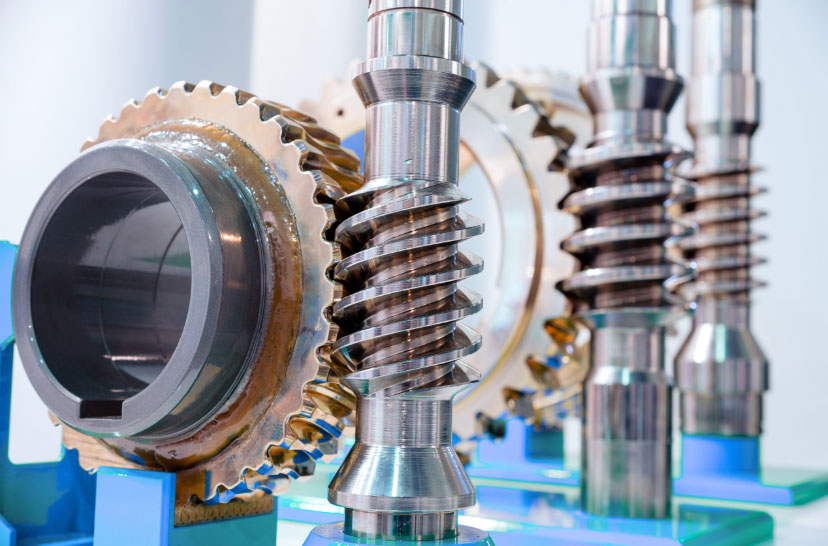
The structural design of this spindle box incorporates three pivotal technological features that collectively ensure its performance, durability, and precision. The first and most critical feature is the adoption of planar double enveloping worm gears. Unlike standard cylindrical worm gears, planar double enveloping worm gears involve a generation process where a planar surface serves as the generatrix. This plane undergoes a relative circular motion to envelop the tooth surface of the toroidal worm. Subsequently, this worm tooth surface acts as the generatrix to envelop the tooth surface of the worm wheel through another relative motion. This two-step enveloping process results in a gear set with exceptional characteristics. The contact between the worm and worm wheel is multi-tooth engagement, with each tooth experiencing instantaneous double-line contact. The contact area can exceed 70% of the tooth surface, which dramatically increases load-bearing capacity. The comprehensive curvature radius of the meshing surfaces is large, reducing contact stress. Furthermore, the angle between the contact line and the relative velocity direction is favorable, promoting the formation and maintenance of a hydrodynamic lubricant film, which minimizes wear. The worm in this setup is typically made from hardened steel (surface hardness ≥58 HRC), often nitrided and precision-ground, resulting in high surface smoothness (Ra ≤0.8 µm) and excellent accuracy. These worm gears are renowned for their high load capacity, transmission efficiency, wear resistance, and long service life. The ability of these worm gears to handle extreme torque in a compact form factor was the cornerstone of our design success. In our application, the worm gears are subjected to immense stresses, but their design ensures that the torque is distributed across multiple teeth, preventing premature failure.
The second major feature is the dual-servo-motor drive synchronization technology. Employing two motors to drive two independent mechanical transmission chains that converge on a single spindle effectively doubles the input torque capability. However, the paramount challenge is achieving perfect synchronization between the two chains. Any phase difference or speed mismatch could lead to internal forces, binding, excessive wear, or even catastrophic failure. Our solution addressed this on two fronts: mechanical precision and electronic control. Mechanically, we ensured that both transmission paths were mirror images of each other. All components—gears, shafts, bearings, and housings—were manufactured to the highest tolerances. Precise alignment during assembly was critical to ensure that both worm gears engage the worm wheel with identical meshing conditions. Electronically, the two Siemens servo motors are driven by a sophisticated CNC system. The control program is designed to operate both motors in a master-slave or electronic gearing mode, where the position and velocity loops are tightly coupled. Feedback from high-resolution encoders on each motor shaft allows the control system to continuously monitor and correct any deviation, maintaining perfect angular synchronization. This harmony between mechanical symmetry and electronic control guarantees that the torque from both motors is summed constructively at the spindle without inducing parasitic loads.
The third key feature is the application of high-precision, imported double-row cylindrical roller bearings for spindle support. The spindle, which carries the massive worm wheel and the workpiece load, is estimated to bear a total weight of around 50 metric tons. For such demanding service, ordinary bearings would succumb to deformation, excessive clearance, or rapid fatigue. We selected NSK high-precision tapered bore double-row cylindrical roller bearings with a P4 accuracy grade. These bearings feature line contact between the cylindrical rollers and the raceways, offering a very high radial load capacity—ideal for supporting the predominant radial forces in our spindle. The tapered bore design allows for precise clearance adjustment via a fine-threaded locknut. By tightening the nut, the inner ring expands slightly, taking up internal clearance and creating a preload. This preload enhances the spindle’s rigidity, minimizes runout, and ensures consistent rotational accuracy under varying loads. The high precision (P4 grade) of these bearings directly contributes to the overall positioning accuracy and surface finish quality of machined parts.
Delving deeper into the mechanics of worm gears, it’s essential to understand the fundamental relationships that govern their performance. The lead angle $\gamma$ of the worm is a critical parameter affecting efficiency and self-locking tendency. It is related to the worm’s axial pitch $p_x$ and pitch diameter $d_1$ by:
$$ \tan \gamma = \frac{p_x}{\pi d_1} = \frac{m_x \cdot K}{\pi d_1} $$
Where $m_x$ is the axial module. For our worm with $K=1$, $m_x=12$ mm, and $\gamma = 3.814^\circ$, the pitch diameter can be derived. The efficiency $\eta$ of a worm gear set is often approximated by:
$$ \eta \approx \frac{\tan \gamma}{\tan(\gamma + \phi)} $$
Where $\phi$ is the friction angle, dependent on the coefficient of friction $\mu$ ($\phi = \arctan \mu$). The relatively low lead angle in our design (3.814°) contributes to a high reduction ratio but also results in moderate efficiency, which we accounted for in our torque calculations. However, the planar double enveloping design, with its superior contact conditions, often achieves higher efficiencies than standard worm gears for a given lead angle.
The load capacity of worm gears can be analyzed using the Lewis bending equation and Hertzian contact stress theory, but for enveloping worm gears, the contact stress $\sigma_H$ is a more limiting factor. A simplified formula for the nominal contact stress at the pitch point is:
$$ \sigma_H = Z_E \sqrt{ \frac{F_t}{d_1 b} \cdot \frac{i+1}{i} } $$
Where:
– $Z_E$ is the elasticity factor (material property),
– $F_t$ is the tangential force on the worm wheel,
– $b$ is the effective face width of the worm wheel,
– $i$ is the gear ratio ($i = Z_{\text{worm wheel}} / K$).
For our design with $i = 85/1 = 85$, the large ratio helps reduce the stress. The tangential force $F_t$ is related to the output torque $T_{\text{output}}$ and the worm wheel pitch diameter $d_2$:
$$ F_t = \frac{2 T_{\text{output}}}{d_2} \quad \text{with} \quad d_2 = m_x \cdot Z_{\text{worm wheel}} = 12 \times 85 = 1020 \text{ mm} $$
For a single drive’s torque of ~51,720 N·m, the force on one worm gear set is:
$$ F_t \approx \frac{2 \times 51720}{1.020} \approx 101411 \text{ N} $$
The large diameter $d_2$ of the worm wheel helps distribute this force over a considerable area, which, combined with the multi-tooth contact of the enveloping design, keeps contact stresses within safe limits for the hardened materials used.
To further illustrate the design parameters and performance expectations, the following table summarizes key aspects of the worm gear set in our spindle box:
| Parameter | Symbol | Value | Unit |
|---|---|---|---|
| Worm Axial Module | $m_x$ | 12 | mm |
| Number of Worm Threads (Starts) | $K$ | 1 | – |
| Worm Lead Angle | $\gamma$ | 3.814 | degrees |
| Worm Wheel Teeth | $Z_2$ | 85 | – |
| Gear Ratio | $i$ | 85 | – |
| Center Distance (approx.) | $a$ | Calculated from diameters | mm |
| Estimated Worm Gear Efficiency | $\eta_{\text{worm gear}}$ | 70% | – |
| Material (Worm) | – | Hardened & Ground Steel (≥58 HRC) | – |
| Material (Worm Wheel) | – | Bronze or Hardened Steel | – |
The selection of materials for worm gears is crucial. Typically, the worm is made from case-hardened or nitrided steel to achieve high surface hardness, while the worm wheel is often made from a softer material like phosphor bronze to accommodate run-in and reduce the risk of galling. However, in heavy-duty applications like ours, where extreme torque is involved, both elements might be made from hardened steels with special lubricants and surface treatments to manage friction and wear. The planar double enveloping process allows for this material combination while maintaining good performance.
Another aspect worth exploring is the thermal management of worm gears. Due to sliding friction, worm gears can generate significant heat, especially at low speeds and high torque. The efficiency $\eta$ we used (70%) implies that about 30% of the transmitted power is dissipated as heat. For a single drive transmitting ~45.5 kW, the heat generation is approximately:
$$ P_{\text{heat per drive}} = P_{\text{motor}} \times (1 – \eta_{\text{overall}}) $$
With an overall efficiency from motor to spindle for one path being $\eta_{\text{overall}} = \eta_{\text{gearbox}} \times \eta_{\text{worm gear}} = 0.85 \times 0.70 = 0.595$, the heat generated is:
$$ P_{\text{heat per drive}} = 45.5 \times (1 – 0.595) = 45.5 \times 0.405 \approx 18.43 \text{ kW} $$
This substantial heat load necessitates effective cooling strategies. In our design, we likely incorporated a forced oil lubrication and cooling system. The oil serves both to lubricate the worm gear mesh, gear teeth, and bearings, and to carry away heat. The oil viscosity and additives are carefully chosen to maintain a protective film under the high-pressure conditions in the worm gear contact zone. The housing design would include cooling channels or an external heat exchanger to maintain the system within a safe operating temperature range, preventing thermal expansion from altering precise clearances.
The advantages of using planar double enveloping worm gears extend beyond just high torque capacity. Their inherent accuracy and multi-tooth contact provide excellent torsional stiffness and minimal backlash, which is critical for precision machining applications like the CNC gantry mill. Backlash, the play between meshing teeth, can cause positional errors and chatter during machining. The enveloping action and the ability to preload the worm against the worm wheel (often through adjustable center distance or dual worm arrangements) allow for backlash to be minimized or even eliminated. In our dual-drive system, synchronization control also helps manage any residual backlash by maintaining constant torque direction.
In conclusion, the development of this dual-drive spindle box was a comprehensive exercise in advanced mechanical design, precision manufacturing, and integrated motion control. The pivotal decision to employ planar double enveloping worm gears enabled us to achieve an extraordinary torque density, packing 80,000 N·m of output into a space-constrained spindle box. The dual-servo-motor architecture, with its emphasis on mechanical symmetry and electronic synchronization, reliably doubles the input power while maintaining operational harmony. The selection of ultra-precision bearings ensures that this power is delivered with the rigidity and accuracy demanded by modern CNC machining. Throughout the design process, every parameter—from gear tooth counts to worm lead angle—was analytically justified and validated through calculations. This project underscores the enduring relevance and capability of worm gears, particularly advanced types like planar double enveloping worm gears, in solving modern industrial challenges requiring low-speed, high-torque rotary motion. The successful implementation in the 14-meter gantry mill stands as a testament to the robust performance of these worm gears under the most demanding conditions.