
In the automotive industry, the demand for high-efficiency and reliable components has led to significant advancements in the production of spiral gears for air conditioning compressors. As a technical expert involved in this field, I have overseen the development of spiral gear series, focusing on overcoming critical challenges such as precision forging, heat treatment, and symmetry measurement of keyways. The spiral gear, with its helical tooth design, offers superior performance in terms of load distribution and noise reduction compared to straight-cut gears. However, its manufacturing complexity necessitates innovative approaches to ensure quality and cost-effectiveness. This article delves into the technical intricacies of spiral gear production, emphasizing the solutions implemented to achieve precision and durability.
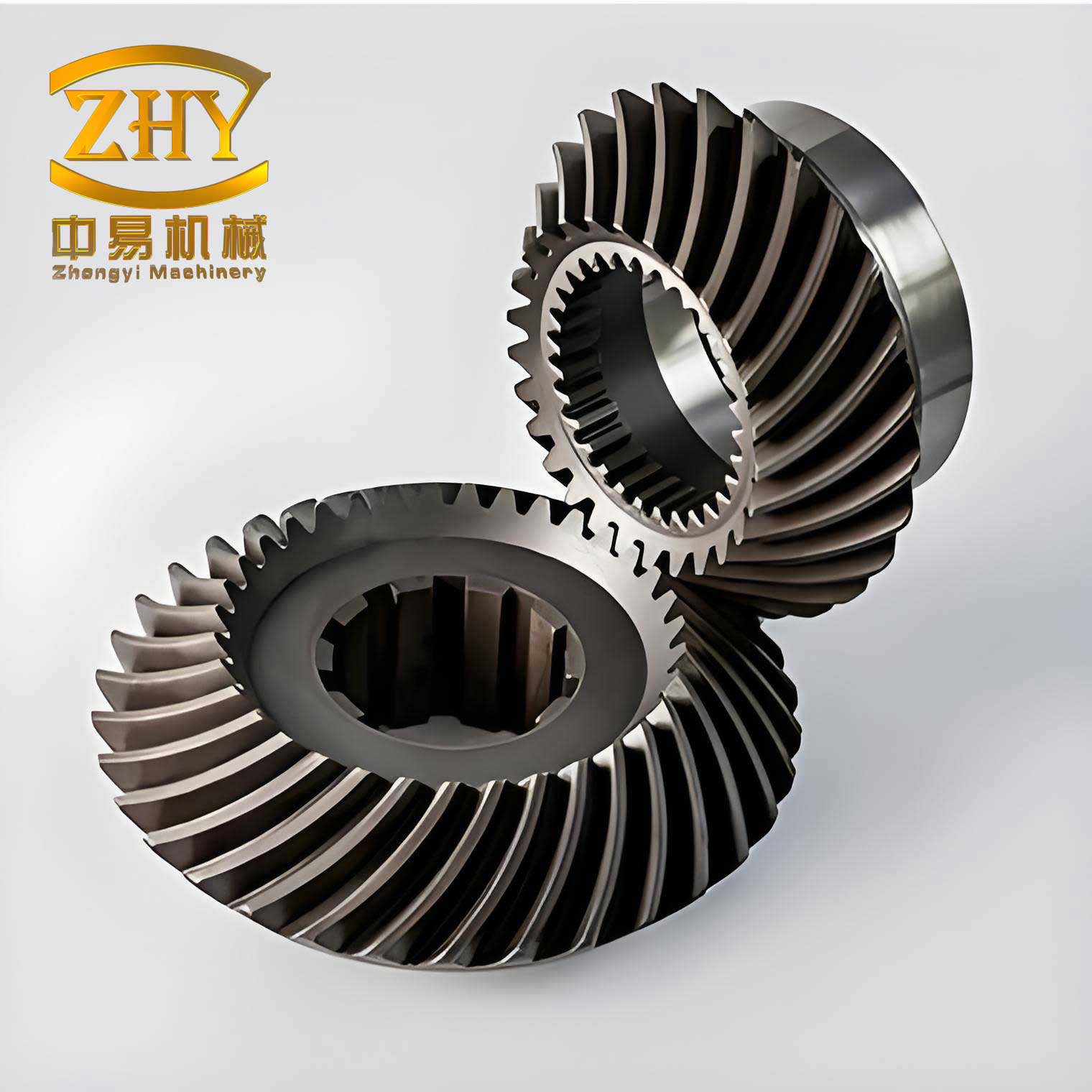
The primary challenge in producing spiral gears lies in their small module, which complicates precision forging processes. For instance, in the development of a specific spiral gear series, the module was as small as 1.5 mm, making it susceptible to deformation during forging. To address this, we focused on three key areas: electrode processing for mold fabrication, selection of appropriate mold materials, and the implementation of a “two-station” die架. The electrode must be machined with high precision to ensure the accuracy of the mold cavity. We utilized advanced imported equipment to achieve this, with tolerances controlled within $$ \pm 0.01 \, \text{mm} $$ for tooth profile accuracy. This precision is critical because the spiral gear’s tooth surface is formed directly through forging, eliminating the need for secondary machining. The relationship between electrode accuracy and final gear quality can be expressed as: $$ \Delta G = k \cdot \Delta E $$ where $$ \Delta G $$ is the gear error, $$ \Delta E $$ is the electrode error, and $$ k $$ is a process-dependent constant typically ranging from 1.2 to 1.5 for spiral gears.
In initial trials, we encountered issues with spiral angle deformation due to metal flow during forging, leading to poor contact patterns in bench tests. This necessitated a reevaluation of mold materials. We tested various materials to balance toughness and strength, ultimately selecting a high-grade tool steel with optimized heat treatment. The heat treatment process involved austenitizing at $$ 1050^\circ \text{C} $$ followed by oil quenching and double tempering at $$ 500^\circ \text{C} $$ to achieve a hardness of 58-60 HRC. This improved mold life by 30% and ensured consistent spiral gear accuracy. The table below summarizes the properties of selected mold materials:
| Material | Tensile Strength (MPa) | Hardness (HRC) | Toughness (J/cm²) | Suitability for Spiral Gears |
|---|---|---|---|---|
| Tool Steel A | 1800 | 58 | 40 | High – minimal deformation |
| Tool Steel B | 2000 | 62 | 30 | Medium – prone to cracking |
| Alloy Steel C | 1600 | 55 | 50 | Low – excessive wear |
To enhance production efficiency, we adopted a “two-station” die架 system, which reduced the forging process from “two heats and three forges” to “one heat and three forges.” This modification streamlined the production line, increasing output by 25% while maintaining the integrity of the spiral gear. The forging temperature was controlled at $$ 1150^\circ \text{C} $$, with a strain rate of $$ 10 \, \text{s}^{-1} $$ to optimize metal flow. The deformation behavior during forging can be modeled using the Hollomon equation: $$ \sigma = K \epsilon^n $$ where $$ \sigma $$ is the stress, $$ \epsilon $$ is the strain, $$ K $$ is the strength coefficient, and $$ n $$ is the strain-hardening exponent, typically around 0.2 for the steel used in spiral gears.
Heat treatment is another critical aspect of spiral gear manufacturing, as it directly affects mechanical properties such as hardness and fatigue resistance. In our development, we initially co-processed spiral gears with similar conical gears, but bench tests revealed cracking due to excessive carburization depth. This led to the formulation of a tailored heat treatment protocol. The process involves carbonitriding at $$ 900^\circ \text{C} $$ for 4 hours to achieve a case depth of $$ 0.6 \, \text{mm} $$, followed by oil quenching and tempering at $$ 180^\circ \text{C} $$ for 2 hours. The carbon potential during carbonitriding is maintained at $$ 0.8\% $$ using endothermic atmospheres. The diffusion of carbon and nitrogen can be described by Fick’s second law: $$ \frac{\partial C}{\partial t} = D \frac{\partial^2 C}{\partial x^2} $$ where $$ C $$ is the concentration, $$ t $$ is time, $$ D $$ is the diffusion coefficient, and $$ x $$ is the depth. For spiral gears, the target case depth $$ d $$ is calculated as: $$ d = \sqrt{D t} $$ with $$ D \approx 1.5 \times 10^{-11} \, \text{m}^2/\text{s} $$ at $$ 900^\circ \text{C} $$.
The table below outlines the optimized heat treatment parameters for spiral gears:
| Process Step | Temperature (°C) | Time (hours) | Atmosphere | Resulting Hardness (HRC) |
|---|---|---|---|---|
| Carbonitriding | 900 | 4 | Endothermic gas | Surface: 62-64 |
| Quenching | 850 (oil) | 0.5 | N/A | Core: 45-50 |
| Tempering | 180 | 2 | Air | Overall: 58-60 |
This protocol ensures minimal distortion, with keyway and bore dimensions remaining within $$ \pm 0.02 \, \text{mm} $$ of specifications. The spiral gear’s fatigue strength $$ \sigma_f $$ can be estimated using the modified Goodman relation: $$ \sigma_f = \sigma_a + \frac{\sigma_m}{\sigma_u} $$ where $$ \sigma_a $$ is the alternating stress, $$ \sigma_m $$ is the mean stress, and $$ \sigma_u $$ is the ultimate tensile strength. For our spiral gears, $$ \sigma_f $$ exceeds 500 MPa, ensuring durability in compressor applications.
Measuring the symmetry of the fixed spiral gear’s keyway relative to both the shaft center and the tooth槽 presented a significant challenge due to the helical angle, which causes the tooth top center to vary with diameter. To solve this, we developed a custom gauging tool that uses a master gear as a reference. The measurement principle involves aligning the keyway with a pin and assessing the deviation using a dial indicator. The symmetry error $$ \delta $$ is calculated as: $$ \delta = \sqrt{(\Delta x)^2 + (\Delta y)^2} $$ where $$ \Delta x $$ and $$ \Delta y $$ are deviations in horizontal and vertical directions, respectively. We established a tolerance of $$ \delta \leq 0.03 \, \text{mm} $$ to prevent interference with planetary disk assembly. The table below shows sample measurement data for spiral gears from a production batch:
| Gear ID | Δx (mm) | Δy (mm) | δ (mm) | Pass/Fail |
|---|---|---|---|---|
| SG-001 | 0.01 | 0.02 | 0.022 | Pass |
| SG-002 | 0.03 | 0.01 | 0.032 | Fail |
| SG-003 | 0.00 | 0.01 | 0.010 | Pass |
| SG-004 | 0.02 | 0.02 | 0.028 | Pass |
This custom tool unified the measurement基准, reducing inspection time by 40% and ensuring interchangeability in assembly. The spiral gear’s helical angle $$ \beta $$, typically 15° to 30°, affects the measurement; thus, we derived a correction factor: $$ C_f = \frac{1}{\cos \beta} $$ to adjust readings. For a spiral gear with $$ \beta = 20^\circ $$, $$ C_f \approx 1.064 $$, meaning measured deviations must be scaled accordingly.
In production, we also optimized the cutting parameters for spiral gear blanks to minimize residual stresses. The blank is turned using carbide tools at a speed of $$ 200 \, \text{m/min} $$ and feed rate of $$ 0.1 \, \text{mm/rev} $$. The resulting surface roughness $$ R_a $$ is less than $$ 1.6 \, \mu \text{m} $$, which enhances forging quality. The power consumption during machining can be estimated as: $$ P = F_c v $$ where $$ F_c $$ is the cutting force and $$ v $$ is the cutting speed. For spiral gear blanks, $$ F_c $$ is around 500 N, leading to $$ P \approx 1.67 \, \text{kW} $$.
To further ensure the reliability of spiral gears, we conducted finite element analysis (FEA) to simulate stress distribution under operational loads. The model applied a torque of $$ 10 \, \text{Nm} $$ to the spiral gear, revealing maximum von Mises stress of $$ 400 \, \text{MPa} $$ at the tooth root, well below the material yield strength of $$ 800 \, \text{MPa} $$. The deflection $$ \theta $$ under torsion is given by: $$ \theta = \frac{T L}{G J} $$ where $$ T $$ is torque, $$ L $$ is length, $$ G $$ is shear modulus, and $$ J $$ is polar moment of inertia. For our spiral gear design, $$ \theta < 0.01^\circ $$, ensuring precise engagement.
The development of spiral gears also involved rigorous testing, including 500-hour endurance runs at 6000 RPM. No failures were observed, validating our manufacturing approach. The wear rate $$ W $$ of spiral gears was measured using weight loss methods, yielding $$ W < 0.001 \, \text{g/hour} $$, which correlates with a service life exceeding 10,000 hours. The contact ratio $$ m_c $$ for spiral gears, which influences smooth operation, is calculated as: $$ m_c = \frac{L}{p_b} $$ where $$ L $$ is the length of action and $$ p_b $$ is the base pitch. For our design, $$ m_c \approx 2.5 $$, ensuring continuous tooth contact and reduced noise.
In summary, the successful研制 of spiral gears for automotive air conditioning compressors hinged on addressing forging precision through advanced electrode machining and material science, optimizing heat treatment to prevent embrittlement, and innovating measurement techniques for keyway symmetry. The integration of “two-station” dies boosted productivity, while custom gauging tools ensured quality control. These spiral gears now meet stringent industry standards, offering enhanced performance and durability. Future work may explore additive manufacturing for mold fabrication or surface coatings to further improve wear resistance. The spiral gear remains a pivotal component in compressor efficiency, and our developments underscore the importance of interdisciplinary approaches in precision engineering.