
In recent years, the demand for bevel gear pairs in commercial vehicles has been steadily increasing, with product varieties expanding to over 22 types for heavy, medium, and light-duty applications. To accelerate the implementation of intelligent manufacturing, reduce labor intensity associated with manual loading and unloading (especially for larger bevel gears weighing over 20 kg), and enhance the machining quality of bevel gears, our company embarked on a project to upgrade existing semi-automated production lines into highly automated flexible manufacturing lines (FMLs). This initiative, often referred to as “machine replacement,” involved retrofitting two existing流水式 semi-automated bevel gear production lines with advanced robotics and control systems. The primary goal was to transform these lines into efficient, flexible systems capable of handling multiple bevel gear variants with minimal human intervention.
The original production lines consisted of CNC lathes, gear hobbing machines, and bevel gear cutting machines, all interconnected via linear conveyors. However, these lines required significant manual operation for part handling, leading to inefficiencies and potential quality inconsistencies. By integrating a six-axis articulated robot and enhancing the control capabilities of each machine tool, we aimed to create a seamless, automated workflow. This article details the entire development process from my first-person perspective as a lead engineer on the project, covering the design, implementation, challenges, and outcomes of the bevel gear flexible manufacturing line.
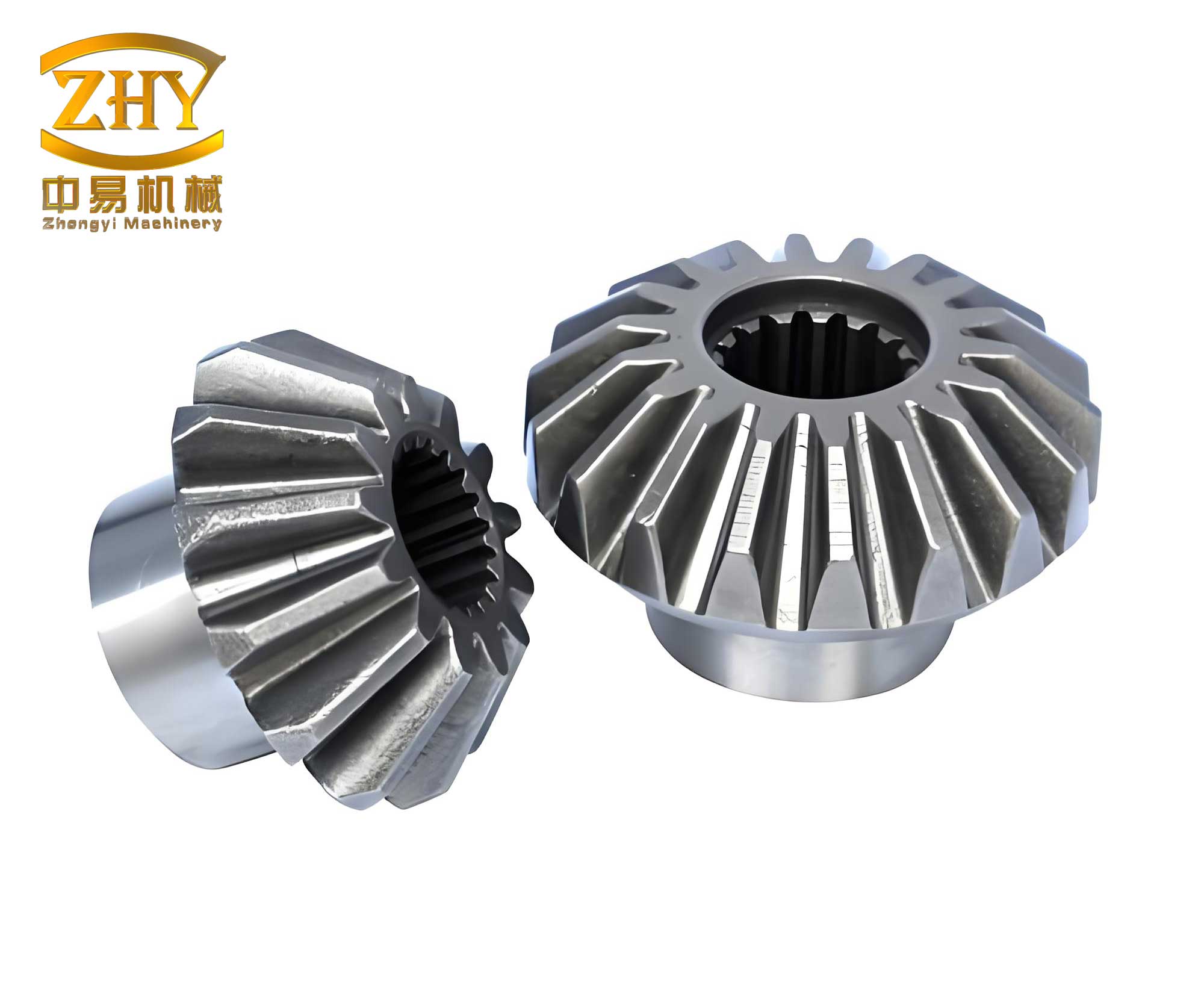
The core of the flexible manufacturing line revolves around the bevel gear, a critical component in vehicle differential systems. The machining process for bevel gears involves multiple steps, including turning, hobbing, and grinding, each requiring precise coordination. Our upgrade focused on automating these steps to improve throughput and consistency. Below, I outline the key aspects of the FML development, supported by tables and formulas to summarize technical details.
Flexible Manufacturing Line Design and Architecture
The design phase involved a comprehensive analysis of the existing layout and process flow. We decided to integrate a KAWASAKI BX200L six-degree-of-freedom articulated robot with an 8-meter travel range for each production line. This robot would handle all material handling tasks, including loading raw bevel gear blanks, transferring parts between machines, and unloading finished bevel gears. The FML architecture included the following components:
- Two WIA L280 CNC horizontal lathes (with FANUC 0iTD systems) for turning operations on bevel gears.
- Two YKX3132M CNC gear hobbing machines (with SINUMERIK 802D solution line systems) for hobbing bevel gear teeth.
- Two Oerlikon C50 bevel gear cutting machines (with SINUMERIK 840D power line systems) for finishing bevel gear profiles.
- Linear conveyors and ring-type loading systems for inter-machine transport.
- A central control platform with SIEMENS S7-200 PLC for overall coordination.
- Auxiliary devices such as a loading conveyor, part orientation conversion station, and dual-station inspection unit.
To quantify the system configuration, Table 1 summarizes the equipment and their roles in the bevel gear machining process.
| Equipment Type | Quantity per Line | Primary Function | Control System |
|---|---|---|---|
| CNC Horizontal Lathe | 2 | Turning of bevel gear shafts | FANUC 0iTD |
| CNC Gear Hobbing Machine | 2 | Hobbing of bevel gear teeth | SINUMERIK 802Dsl |
| Bevel Gear Cutting Machine | 2 | Finishing of bevel gear profiles | SINUMERIK 840D |
| Articulated Robot | 1 | Automatic loading/unloading | KAWASAKI Controller |
| Ring Loading System | 1 | Intermediate part transfer | SIEMENS S7-300 PLC |
The overall efficiency of the FML can be modeled using a production rate formula. For a bevel gear line, the theoretical output \( Q \) in parts per hour is given by:
$$ Q = \frac{3600}{T_c} $$
where \( T_c \) is the cycle time in seconds. However, in a flexible system with multiple machines, the effective output depends on bottleneck processes and robot coordination. We can extend this to:
$$ Q_{\text{eff}} = \min\left( \frac{3600}{T_{\text{lathe}}}, \frac{3600}{T_{\text{hob}}}, \frac{3600}{T_{\text{cut}}} \right) \times \eta $$
where \( T_{\text{lathe}}, T_{\text{hob}}, T_{\text{cut}} \) are cycle times for turning, hobbing, and cutting, respectively, and \( \eta \) is a system efficiency factor (0 < η ≤ 1) accounting for robot transfer times and machine availability. For our bevel gear line, we targeted \( \eta > 0.85 \) to ensure high utilization.
Implementation Details: Upgrading Individual Machine Tools
The implementation involved retrofitting each machine tool to enable robot interaction. This required hardware modifications, software updates, and control program development. Below, I detail the key steps for different equipment types.
1. Retrofitting CNC Lathes for Robot Integration
The WIA L280 CNC lathes were initially operated manually for loading bevel gear blanks. To automate this, we added pneumatic systems for automatic door control and enhanced the PMC (Programmable Machine Controller) programs. The process included:
- Data Backup: Using Ladder-III software, we backed up existing PMC data and part programs via Ethernet connection. This ensured no loss of original settings for bevel gear machining.
- Pneumatic Circuit Design: We installed SMC single-rod double-acting cylinders (800 mm stroke) and solenoid valves to control the lathe doors. The pneumatic circuit, similar to Figure 3 in the original text, included filters, regulators, and lubricators for reliability.
- PMC Program Development: New ladder logic was written to handle robot (RT) signals. This included input/output (I/O) mapping for door control, tailstock advancement, and cycle start commands. For example, the door open/close was triggered by M61/M62 codes in the bevel gear part program.
- Part Program Modification: Existing G-code programs for bevel gears were updated to include M-codes for automatic operations, ensuring seamless integration with the robot.
The I/O signal assignment for the lathe-robot interface is summarized in Table 2.
| Signal Type | PMC Address | Function | Description |
|---|---|---|---|
| Input (RT to Lathe) | X10.0 | Robot Ready | Indicates robot is in position for loading bevel gear |
| Input | X10.1 | Door Open Request | Robot requests door opening |
| Output (Lathe to RT) | Y10.0 | Cycle Complete | Lathe signals completion of bevel gear machining |
| Output | Y10.1 | Door Open Status | Confirms door is fully open |
The tailstock control logic was critical for securing bevel gear blanks during turning. We implemented a dual-pressure clamping system to prevent part deformation, which can be expressed as:
$$ F_c = P \times A \times \mu $$
where \( F_c \) is the clamping force, \( P \) is pneumatic pressure, \( A \) is the piston area, and \( \mu \) is the friction coefficient. For bevel gears, we set \( F_c \geq 500 \, \text{N} \) to ensure stability during high-speed turning.
2. Retrofitting CNC Gear Hobbing Machines
The YKX3132M gear hobbing machines required similar upgrades to handle bevel gear hobbing automatically. Key activities included:
- PLC Program Backup: Using PLC802 software, we uploaded the existing SINUMERIK 802Dsl PLC programs for bevel gear hobbing cycles.
- Automatic Door and Chip Blowing: Pneumatic cylinders were added for door control, and solenoid valves enabled automatic chip blowing via M54/M55 codes. This reduced manual cleaning for bevel gear teeth.
- PLC Program Development: New logic was written for robot handshake, door control, and tailstock clamping. A two-step clamping sequence was implemented for bevel gears to improve accuracy.
The cycle time for hobbing a bevel gear can be approximated by:
$$ T_{\text{hob}} = \frac{L}{f} + T_{\text{aux}} $$
where \( L \) is the hob travel length, \( f \) is the feed rate, and \( T_{\text{aux}} \) includes tool approach and retract times. For our bevel gears, \( L \) varied from 50 to 150 mm depending on gear size.
3. Upgrading Ring Loading Systems
The ring loading systems acted as buffers between the hobbing machines and bevel gear cutting machines. We modified the existing SIEMENS S7-300 PLC programs to add robot interaction modes. This involved:
- Adding I/O signals for robot unloading completion and conveyor positioning.
- Developing new ladder logic for automatic, manual, and linked modes to coordinate bevel gear transfer.
The conveyor speed \( v_c \) was tuned to match the robot cycle time:
$$ v_c = \frac{d}{T_r} $$
where \( d \) is the distance between stations and \( T_r \) is the robot transfer time per bevel gear.
4. Robot End-Effector and Tooling Design
We selected a SCHUNK pneumatic gripper with dual jaws capable of handling bevel gears up to 30 kg. The gripper included V-shaped PP pads to prevent damage to bevel gear surfaces. The gripping force \( F_g \) was calculated based on part weight and acceleration:
$$ F_g = m \cdot (g + a) \cdot k_s $$
where \( m \) is the bevel gear mass, \( g \) is gravity, \( a \) is robot acceleration, and \( k_s \) is a safety factor (typically 2–3). For a 20 kg bevel gear, \( F_g \approx 600 \, \text{N} \).
Robot trajectories were programmed via teach pendant to ensure smooth loading/unloading for each bevel gear variant. The inverse kinematics for the six-axis robot can be represented as:
$$ \theta = f^{-1}(x, y, z, \alpha, \beta, \gamma) $$
where \( \theta \) is the joint angle vector and \( (x, y, z, \alpha, \beta, \gamma) \) define the bevel gear’s pose in Cartesian space.
5. Auxiliary Devices: Loading Conveyor and Inspection Stations
We designed a loading conveyor with 32-position trays for raw bevel gear blanks. A secondary positioning station ensured accurate placement for robot pickup. The dual-station inspection unit allowed random sampling of bevel gears during unmanned operation. Statistical process control (SPC) formulas were applied to monitor quality:
$$ \bar{X} = \frac{1}{n} \sum_{i=1}^n X_i, \quad \sigma = \sqrt{\frac{1}{n-1} \sum_{i=1}^n (X_i – \bar{X})^2} $$
where \( \bar{X} \) is the mean dimension (e.g., tooth thickness) and \( \sigma \) is the standard deviation for a sample of \( n \) bevel gears.
6. Seventh Axis for Robot Mobility
A servo-driven linear track (7th axis) was installed to extend the robot’s reach across all machines. The track length \( L_t = 8 \, \text{m} \) allowed coverage of the entire bevel gear line. The positioning accuracy \( \delta \) was critical for repeatability:
$$ \delta \leq \pm 0.1 \, \text{mm} $$
achieved through precision gear racks and closed-loop control.
7. Central Control Platform Development
A SIEMENS S7-200 PLC-based central control system was implemented to coordinate all devices. The PLC program comprised an OB1 main block and several subroutines for robot signaling, inspection control, and timing functions. A SMART700 HMI provided real-time monitoring of bevel gear production data, including machine status, part counts, and alarm messages.
The overall system reliability \( R_s \) can be modeled as a series system:
$$ R_s = \prod_{i=1}^n R_i $$
where \( R_i \) is the reliability of each subsystem (e.g., lathe, robot, conveyor). We aimed for \( R_s > 0.95 \) over an 8-hour shift.
Development Challenges and Solutions
The project faced several difficulties, which I summarize below:
- Technical Barriers from OEMs: Some machine tools, like the Oerlikon C50, had encrypted PLC programs. We had to reverse-engineer the logic and bypass passwords to integrate them into the bevel gear FML.
- Diversity of Control Systems: Managing multiple CNC systems (FANUC, SINUMERIK) and PLCs (SIEMENS S7-200, S7-300) required expertise in different programming environments. We developed cross-platform communication protocols using digital I/O and Ethernet.
- Software Complexity: We used various backup and development tools, such as Ladder-III, Step7, and PLC802, each with its own learning curve. Standardizing documentation was key for bevel gear program maintenance.
- Integration Hurdles: Ensuring precise synchronization between the robot and machines for bevel gear handling involved extensive testing and tuning of timing sequences.
To address these, we adopted a modular approach, upgrading one machine at a time and validating each step with bevel gear prototypes. Table 3 lists the main challenges and mitigation strategies.
| Challenge | Impact on Bevel Gear Production | Solution Implemented |
|---|---|---|
| Encrypted PLC programs | Delayed integration of bevel gear cutting machines | Reverse-engineering and hardware bypass |
| Multiple control systems | Increased programming complexity for bevel gear cycles | Unified I/O mapping and central PLC coordination |
| Robot path planning | Risk of collisions during bevel gear transfer | Simulation and teach pendant optimization |
| System reliability | Potential downtime affecting bevel gear output | Redundant sensors and preventive maintenance schedules |
Operational Results and Benefits
After commissioning, the bevel gear flexible manufacturing line demonstrated significant improvements:
- Increased Productivity: The daily output for bevel gears rose from 120 to 160 pieces per line, representing a 33% increase. This can be expressed as:
$$ \text{Productivity Gain} = \frac{Q_{\text{new}} – Q_{\text{old}}}{Q_{\text{old}}} \times 100\% = \frac{160 – 120}{120} \times 100\% = 33.3\% $$
- Labor Reduction: Manual operators per shift decreased from 3 to 1, saving approximately 28,000 USD annually per line based on average wages. For bevel gear production, this reduced labor cost per part significantly.
- Quality Enhancement: Automated handling minimized human errors, improving consistency in bevel gear dimensions. SPC data showed a 20% reduction in dimensional variance.
- Flexibility: The FML could switch between different bevel gear types with minimal changeover time, typically under 15 minutes, by adjusting robot programs and fixture trays.
- Safety and Ergonomics: Eliminating manual lifting of heavy bevel gears reduced injury risks and worker fatigue.
The overall equipment effectiveness (OEE) for the bevel gear line improved from 65% to 85%, calculated as:
$$ \text{OEE} = \text{Availability} \times \text{Performance} \times \text{Quality} $$
where Availability increased due to reduced downtime, Performance rose from higher cycle rates, and Quality improved with automated inspection.
Conclusion
In summary, the development of a flexible manufacturing line for bevel gears involved comprehensive upgrades to machine tools, integration of robotics, and enhancement of control systems. By overcoming technical challenges and implementing automated solutions, we achieved a robust system capable of high-mix, high-volume bevel gear production. The success of this project not only benefits our company but also serves as a reference for similar applications in automotive, aerospace, and other industries requiring precision bevel gears. Future work may involve adding AI-based predictive maintenance and further optimizing robot paths for even greater efficiency in bevel gear manufacturing.
The key takeaway is that flexibility and automation are essential for modern manufacturing, especially for complex components like bevel gears. Through this project, we have demonstrated that with careful planning and execution, traditional production lines can be transformed into agile, intelligent systems ready for the challenges of Industry 4.0.