
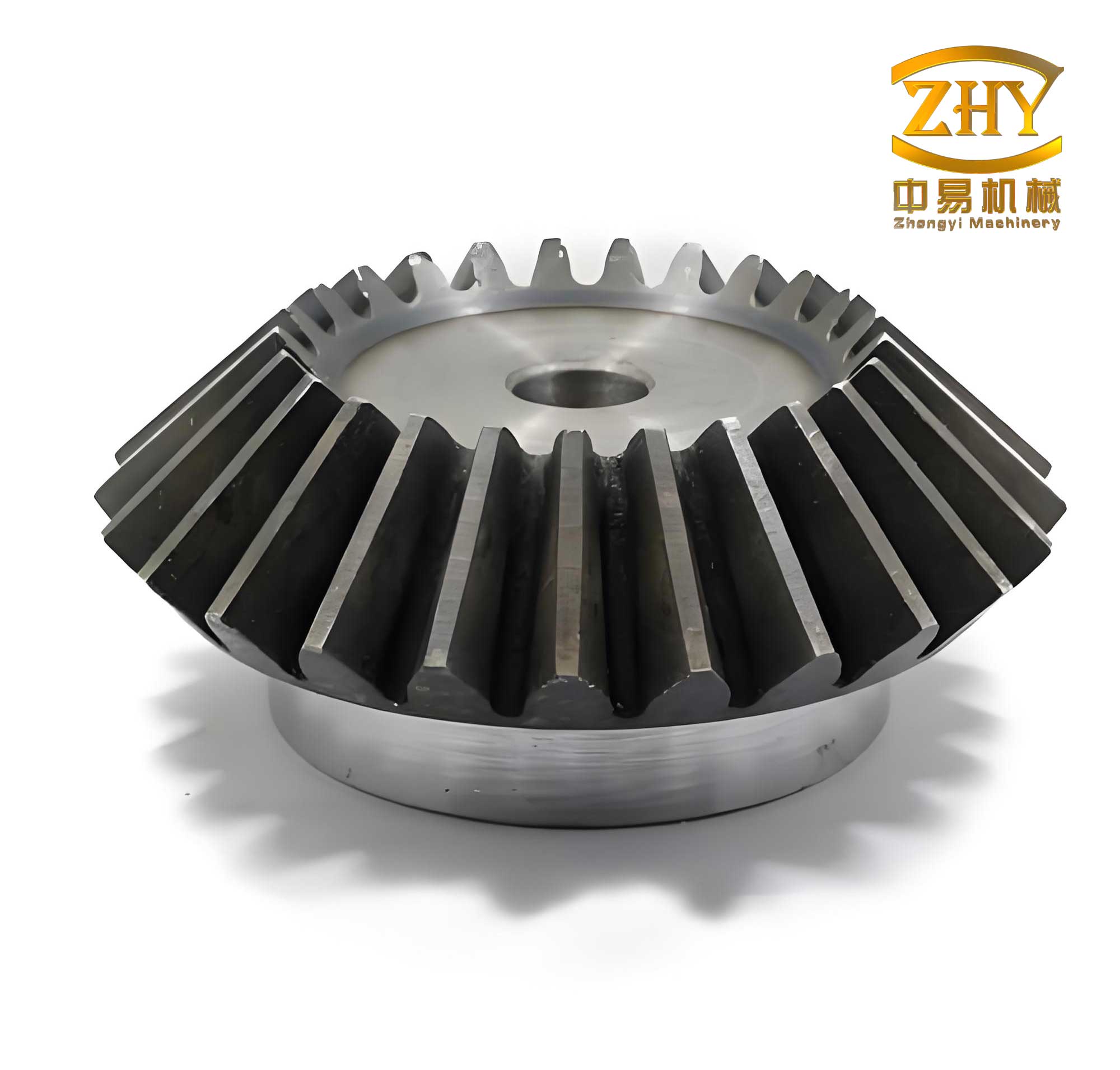
In recent years, the demand for bevel gear pairs in commercial vehicles has increased significantly, with a variety of types required for heavy, medium, and light-duty vehicles. As an engineer involved in advanced manufacturing, I was tasked with upgrading existing semi-automated production lines into a flexible manufacturing line (FML) to enhance automation, reduce labor intensity, and improve the quality of bevel gears. This project focused on active bevel gears, which are critical components in vehicle differential systems. The original lines consisted of CNC lathes, gear hobbing machines, and milling machines, arranged in a流水式 layout. By integrating robotics and reengineering control systems, we successfully transformed these lines into an efficient FML capable of handling multiple bevel gear variants.
The core objective was to implement “machine replacement” by adding a KAWASAKI BX200L six-axis articulated robot with a 8m travel range to each line. This robot would handle automatic loading/unloading for lathes and hobbing machines, manage material flow via conveyors, and enable offline inspection. Additionally, the system would incorporate SMS alerts for machine failures and real-time data logging for management. The upgraded FML, as visualized, includes multiple workstations interconnected through automated material handling. One key aspect was ensuring that the bevel gears—ranging from small to large ratios, with some weighing over 20kg—could be processed without manual intervention, thereby addressing ergonomic concerns and boosting productivity.
To achieve this, we designed a comprehensive scheme covering hardware modifications and software upgrades. The FML integrates two WIA L280 CNC lathes with FANUC 0iTD systems, two YKX3132M CNC hobbing machines with SINUMERIK 802D solution line systems, and Oerlikon C50 milling machines with SINUMERIK 840D power line systems, along with SIMATIC-300 PLC-controlled loop conveyors. The robot, equipped with a SCHUNK pneumatic gripper, moves along a seventh axis to service these stations. A central control platform based on SIEMENS S7-200 PLC coordinates all operations, while a SMART700 HMI provides monitoring. Below is a summary of the development scope, which highlights the multifaceted nature of this bevel gear FML project.
| No. | Development Area | Key Tasks |
|---|---|---|
| 1 | CNC Lathes Retrofit | Backup of PMC programs and machining codes; pneumatic circuit design for automatic doors; I/O signal assignment; development of Robot (RT)機能 PMC programs; modification of machining programs; creation of operation manuals. |
| 2 | CNC Hobbing Machines Retrofit | Backup of PLC and machining programs; pneumatic design for doors and chip blowing; I/O signal assignment; development of RT機能 PLC programs; modification of bevel gear machining programs. |
| 3 | Loop Conveyors Integration | Backup of existing PLC programs; I/O signal assignment and circuit design; development of RT機能 PLC programs for material handoff. |
| 4 | Robot End-Effector Selection | Selection of dual-grip pneumatic fixtures with V-shaped pads; determination of robot unloading postures for each station to ensure bevel gear handling safety. |
| 5 | Auxiliary Devices Development | Design of loading conveyors, workpiece orientation changers, and dual-station inspection units for bevel gear quality checks. |
| 6 | Robot Seventh Axis | Design and调试 of a servo-driven dual-rack system for 8m linear travel, enabling robot mobility across the FML. |
| 7 | Central Control System | Design of a总控 platform with S7-200 PLC; programming for device communication; development of HMI software with fault报警 features. |
| 8 | Process Optimization | Design of multi-variant trays for raw bevel gears and chip management solutions for turning operations. |
The implementation began with retrofitting the CNC lathes, which perform roughing and finishing of shaft necks, back cones, and arcs on bevel gears. We started by backing up all PMC data and machining programs using Ladder-III software and CF cards. This step was crucial to preserve original settings and facilitate modifications. For pneumatic control, we selected SMC single-rod double-acting cylinders with 800mm strokes, along with solenoid valves and filters, to automate the operation doors. The I/O signals were mapped to enable communication between the robot and lathes: for instance, inputs from the robot indicated readiness, while outputs from the lathes signaled cycle completion. The PMC program was rewritten to include logic for door control via M-codes (e.g., M61 for open, M62 for close), tailstock advance/retract under robot command, and interlock safety checks. The pneumatic circuit, as implemented, can be described by the flow equation: $$Q = C_v \sqrt{\frac{\Delta P}{SG}}$$ where \(Q\) is the flow rate, \(C_v\) is the valve coefficient, \(\Delta P\) is the pressure drop, and \(SG\) is the specific gravity, ensuring efficient actuation for bevel gear handling.
Similarly, for the CNC hobbing machines that cut splines on bevel gears, we backed up PLC programs using PLC802 tools and CF cards. The pneumatic system was extended to include automatic chip blowing via M54/M55 codes, and the tailstock was modified for two-step clamping to enhance bevel gear定位精度. The PLC program incorporated new functions for door control (M46/M47), robot handshake signals, and吹屑 automation. A key challenge was integrating these changes without disrupting existing operations, especially since bevel gears require precise alignment during hobbing. The gear hobbing process for bevel gears can be modeled using the following formula for chip load: $$h = f_z \cdot \sin(\alpha)$$ where \(h\) is the chip thickness, \(f_z\) is the feed per tooth, and \(\alpha\) is the pressure angle. This ensured that automated cycles maintained quality standards.
The loop conveyors, which feed bevel gears to the milling machines, were upgraded with additional I/O points for robot interaction. We used Step7 software to modify the SIMATIC-300 PLC programs, adding modes for联机 operation where the robot places machined bevel gears onto conveyor pallets. The signal mapping included inputs for robot卸料 completion and outputs for conveyor readiness, creating a seamless material flow. This integration is vital for handling diverse bevel gear types without manual intervention.
Robot end-effector selection was critical for handling bevel gears securely. We chose a SCHUNK pneumatic gripper with dual grips and PP plastic pads to prevent damage to gear surfaces. The robot’s unloading postures were taught manually via the teach pendant to ensure collision-free paths across all stations. The gripper’s force can be calculated using: $$F = P \cdot A \cdot \eta$$ where \(F\) is the gripping force, \(P\) is the pneumatic pressure, \(A\) is the cylinder area, and \(\eta\) is the efficiency. This ensures reliable clamping for bevel gears weighing up to 20kg.
Auxiliary devices, such as the loading conveyor and orientation changer, were designed in-house. The conveyor uses stepper motors to advance trays of raw bevel gears, with a secondary positioning station to improve accuracy before robot pickup. The orientation changer rotates bevel gears 180 degrees to facilitate transfer between machines. The inspection units allow random sampling of bevel gears for quality control, with pneumatic clamps and probes. These devices enhance the FML’s flexibility for various bevel gear sizes.
The robot’s seventh axis was custom-designed with a dual-rack and pinion system driven by a servo motor. This enables the robot to cover the 8m span of the FML, accessing all machines. The motion profile can be optimized using kinematic equations: $$\theta(t) = \theta_0 + \omega t + \frac{1}{2} \alpha t^2$$ where \(\theta\) is the position, \(\omega\) is the angular velocity, and \(\alpha\) is the acceleration, ensuring swift and precise movements for bevel gear transportation.
The central control system, based on a SIEMENS S7-200 PLC, acts as the FML’s brain. It processes signals from all devices, manages production schedules, and displays real-time data on a SMART700 HMI. The PLC program includes subroutines for robot communication, inspection cycles, and tool life monitoring. For bevel gear production, tool wear can be预测 using: $$T = C \cdot V^{-n} \cdot f^{-m}$$ where \(T\) is tool life, \(V\) is cutting speed, \(f\) is feed rate, and \(C, n, m\) are constants. This helps in scheduling maintenance and ensuring consistent bevel gear quality.
Throughout the development, we encountered several difficulties. First, technical封锁 from original machine manufacturers posed hurdles; for example, PLC programs for some equipment were password-protected or lacked annotations, requiring reverse-engineering. Second, the variety of CNC systems—FANUC, SINUMERIK, and different PLC platforms—demanded expertise in multiple software tools. Third, the comprehensive nature of the project involved mechanical, electrical, and software integration, necessitating cross-disciplinary skills. Fourth, ensuring interoperability between old and new systems for bevel gear processing required meticulous testing. Below is a table summarizing these challenges and our mitigation strategies.
| Difficulty Category | Specific Issues | Mitigation Approaches |
|---|---|---|
| Technical Barriers | Password-protected PLCs, undocumented code from OEMs for bevel gear machines. | Used debugging tools to analyze logic; developed custom programs from scratch; collaborated with open-source communities. |
| System Diversity | Multiple CNC systems (FANUC 0iTD, SINUMERIK 802Dsl/840D) and PLCs (Step7-300, Step7-200). | Standardized communication protocols; trained team on all platforms; created backup procedures for each system. |
| Software Complexity | Need for various programming tools: Ladder-III, PLC802, Step7, SIMATIC Micro/WIN. | Established a centralized software repository; automated backups; used virtual machines for compatibility. |
| Integration Scope | Combining pneumatics, robotics, conveyors, and controls for bevel gear lines. | Adopted modular design; conducted phased testing; used simulation software to validate interactions. |
Despite these challenges, the FML’s投用效果 has been remarkable. The automation of door controls and tailstock movements reduced manual operations, while robot-led material handling increased throughput. Specifically, for bevel gear production, the daily output rose from 120 to 160 pieces per line, with a reduction in operators from three to one per shift. This translates to significant labor savings—approximately 280,000 CNY annually for two lines—while eliminating physical strain from handling heavy bevel gears. Quality improved due to consistent positioning and automated inspection, and the system’s flexibility allows quick changeovers for different bevel gear types. The table below quantifies the benefits before and after FML implementation.
| Performance Metric | Before FML (Semi-Automated Line) | After FML (Flexible Manufacturing Line) |
|---|---|---|
| Daily Production of Bevel Gears | 120 pieces per line | 150-160 pieces per line |
| Operators per Shift | 3 | 1 |
| Labor Cost Savings | Baseline | ~28万元 per year for two lines |
| Manual Handling | Required for loading/unloading bevel gears | Fully automated via robot |
| Quality Control | Periodic manual checks | Automated sampling with HMI alerts |
| Changeover Time for Bevel Gear Variants | Hours | Minutes due to programmable trays |
From a technical perspective, the FML’s efficiency can be analyzed using production theory formulas. For instance, the overall equipment effectiveness (OEE) for bevel gear machining is given by: $$OEE = Availability \times Performance \times Quality$$ where Availability is the ratio of operating time to planned time, Performance considers speed losses, and Quality accounts for defects. Post-upgrade, we observed OEE improvements of over 20%, driven by reduced downtime and higher yield. Additionally, the economic impact can be modeled with: $$ROI = \frac{Net Benefits}{Investment Cost} \times 100\%$$ where the investment included robot and retrofit costs, and benefits accrued from labor savings and increased bevel gear output.
In conclusion, this project successfully transformed traditional production lines into a state-of-the-art flexible manufacturing line for bevel gears. By leveraging robotics, reprogramming PLCs, and designing auxiliary systems, we achieved higher automation, productivity, and quality. The experience underscores the importance of interdisciplinary collaboration and systematic planning in manufacturing upgrades. The FML not only serves the automotive industry but also offers insights for aerospace, rail, and marine sectors where bevel gears are prevalent. Future work could explore AI-driven predictive maintenance for further optimization. Throughout this journey, the focus on bevel gears has been paramount, ensuring that every modification enhanced their manufacturing precision and efficiency.