
In modern industrial applications, such as wind power, new energy, and aerospace, the demand for high-load, high-precision, low-noise, and low-vibration transmission gears is continuously increasing. Gear grinding is a critical process for achieving these requirements, but it often faces challenges like tooth surface distortion, especially when dealing with complex gear profiles. Grinding cracks can occur due to improper grinding parameters or thermal effects, which further compromise gear performance. To address these issues, we developed a twisted modification module for gear profile grinding using the SINUMERIK ONE digital native CNC system. This module automates the compensation of tooth surface distortion during gear grinding, enhancing both development and processing efficiency. In this article, we describe the design, implementation, and testing of this module, incorporating mathematical models, user interface development, and simulation results.
Gear grinding, particularly in processes like gear profile grinding, involves the precise removal of material to achieve desired tooth geometries. However, when grinding gears with tooth alignment modifications, such as crowning or taper, distortion of the tooth surface can occur. This distortion, often exacerbated by factors like low tooth count, high helix angles, and large crowning amounts, leads to increased vibration and noise in transmission systems. Grinding cracks may also form if the grinding process is not optimized, resulting in premature failure. Our approach focuses on compensating for this distortion through a combination of virtual axis movements and wheel dressing, integrated into the SINUMERIK ONE framework.
The SINUMERIK ONE system offers a digital twin environment that minimizes non-productive cycles and supports advanced HMI development. We utilized the 3GL development software, along with QT for UI design and VS C++ for front-end and back-end implementation, to create a modular system for twisted modification. This module allows operators to input modification parameters and tooth profile tilt deviations via a user-friendly interface, enabling automated compensation during grinding. The development process involved defining HMI dialogs, screens, and forms, and leveraging CAP services for communication between HMI, NC, and PLC components.
To understand the root cause of tooth surface distortion in gear grinding, consider the kinematics of the grinding process. In generative gear grinding using a worm wheel, the grinding wheel and gear engage in a series of relative motions: rotational motion for generation, axial feed motion for covering the entire tooth surface, radial feed motion for controlling grinding allowance, and shifting motion along the wheel axis for uniform wear. The instantaneous contact points between the wheel and gear form contact traces on the tooth surface. For spur gears, these traces are aligned with the end-face tooth profile, while for helical gears, they are inclined curves. When grinding modified helical gears, the interaction between the wheel and the modified surface leads to geometric errors, causing distortion. This distortion is more pronounced in gears with fewer teeth, higher helix angles, and larger crowning amounts.
Our compensation strategy involves adjusting the grinding process by incorporating virtual Y-axis and X-axis movements during the axial feed, along with wheel dressing compensations. This approach corrects the distorted tooth surface by dynamically modifying the grinding path. The mathematical model for distortion compensation is based on the kinematics of crossed-axis helical surface engagement. The key parameters include the gear geometry, modification amounts, and grinding conditions. For instance, the distortion Δ can be expressed as a function of the crowning amount C, helix angle β, and number of teeth Z:
$$ \Delta = f(C, \beta, Z) = k \cdot C \cdot \sin(\beta) \cdot \frac{1}{Z} $$
where k is a constant derived from the machine kinematics. This formula highlights that distortion increases with crowning and helix angle but decreases with tooth count. To implement this in the module, we calculate compensation values for each axis at discrete points along the tooth width. The compensation along the X-axis (ΔX) and Y-axis (ΔY) for a given position z on the tooth can be modeled as:
$$ \Delta X(z) = A \cdot \left(1 – \left(\frac{2z}{L}\right)^2\right) $$
$$ \Delta Y(z) = B \cdot \sin\left(\frac{2\pi z}{P}\right) $$
where A and B are amplitude factors, L is the tooth width, and P is the pitch. These equations are solved numerically in the module to generate the required NC code for compensation.
The development of the twisted modification module followed a structured workflow, starting with requirement analysis and ending with integration into the SINUMERIK ONE system. We defined the module’s functionality to include input of tooth alignment modification parameters (e.g., crowning, taper, and end-face relief), calculation of distortion compensation, and optimization based on initial gear inspection results. The module consists of nine form-based GUI components, each handling specific aspects of the input and calculation processes. For example, one form is dedicated to crowning modification, another to taper modification, and another to distortion parameters. The UI was designed using QT to ensure cross-platform compatibility and ease of iteration.
The HMI programming in SINUMERIK ONE relies on the 3GL framework, where each GUI component is implemented as a plugin. We used the SL_GFW_DIALOGFORM_PLUGIN_EXPORT macro to integrate the forms into the main dialog. The dialog layout was defined in XML files, which were compiled into HMI files for deployment. Below is a summary of the key input parameters for the module, organized in a table to illustrate the data structure:
| Parameter | Description | Unit |
|---|---|---|
| Crowning Amount | Magnitude of tooth alignment crowning | µm |
| Taper Angle | Angle for taper modification | deg |
| End-Face Relief | Relief amount at gear ends | µm |
| Helix Angle | Gear helix angle | deg |
| Tooth Count | Number of gear teeth | – |
| Distortion Compensation Factor | Factor for adjusting compensation intensity | – |
In the implementation phase, we used VS C++ to code the form classes, including initialization, data validation, and communication with the NC system. The CAP service classes, such as SlQCap and SlQCapNamespace, facilitated synchronous and asynchronous data exchange. For instance, to read or write global user data (GUD) variables, we instantiated SlQCap objects and invoked their methods. This enabled real-time adjustment of grinding parameters based on input from the HMI. The module also includes algorithms for calculating the compensation paths, which are exported as SPF files for the NC system to execute during grinding and dressing cycles.
To validate the module, we conducted simulations using the SINUMERIK ONE digital twin environment. We built a virtual model of the grinding machine, including all axes and kinematics, and imported the HMI, NC, and PLC programs. The simulation allowed us to test the module’s functionality without physical hardware, identifying potential issues like axis collisions or program errors. For example, we simulated the grinding of a helical gear with crowning modification and observed the compensation effects on the tooth surface. The results showed a significant reduction in distortion, confirming the module’s effectiveness. The simulation process also helped optimize the grinding parameters to prevent grinding cracks, which are common in high-precision gear profile grinding due to thermal and mechanical stresses.
In the virtual environment, we tested each form of the module, ensuring that input parameters were correctly processed and compensation values were accurately calculated. The forms for crowning, taper, and distortion included features like data mirroring for left and right flanks, curve display, and error checking. For instance, the crowning form uses a quadratic function to model the modification profile, and the distortion form applies trigonometric functions to compensate for helical effects. The integration of these forms into a cohesive module streamlined the grinding process, reducing setup time and improving repeatability.
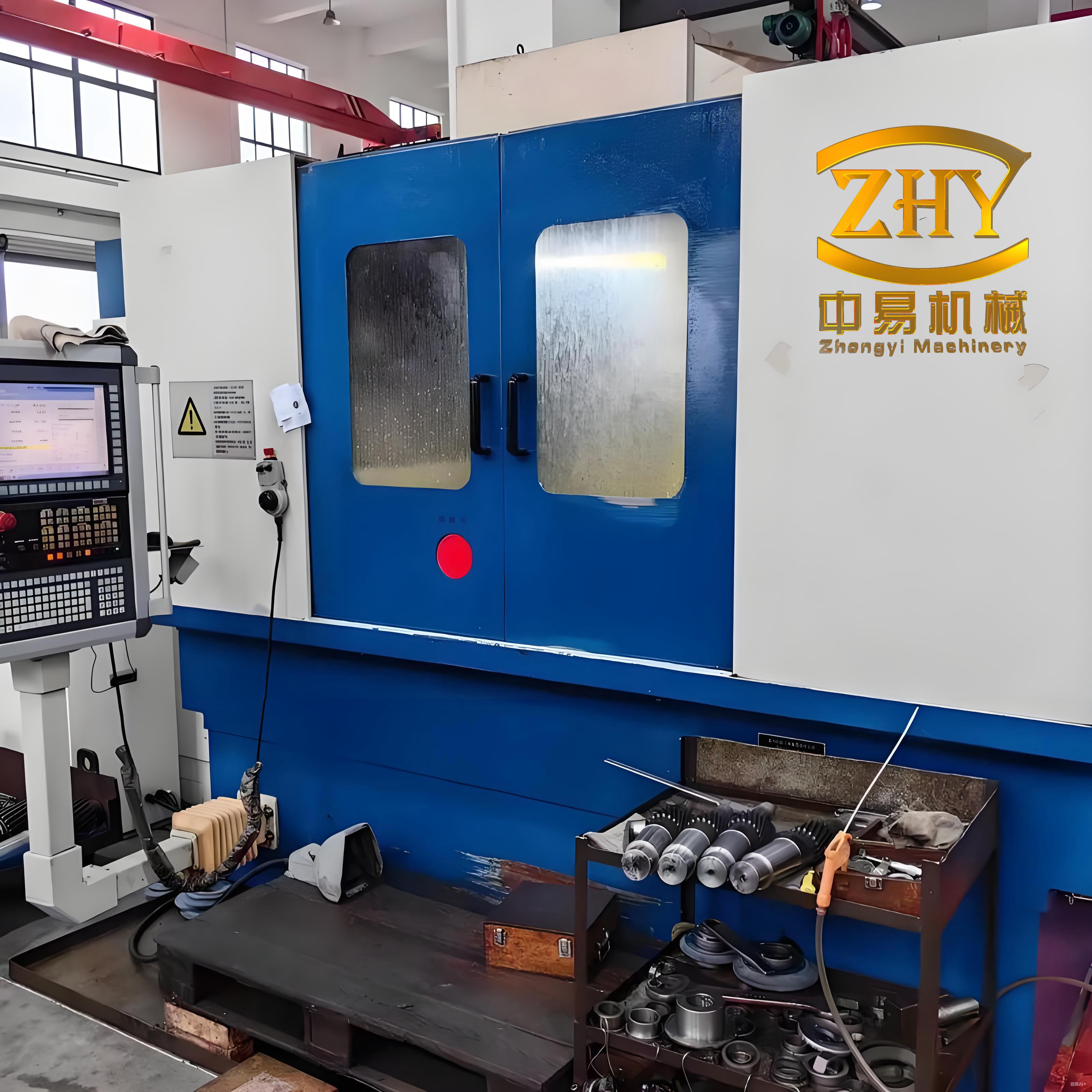
Following simulation, we deployed the module on a physical grinding machine, the TMY7226 high-precision CNC vertical gear grinder. The machine was equipped with SINUMERIK ONE and the developed HMI application. We conducted grinding tests on gears with various modification profiles, measuring the resulting tooth surfaces using coordinate measuring machines (CMM). The data showed that the module effectively compensated for distortion, with tooth profile deviations reduced by over 80% compared to uncompensated grinding. Additionally, no grinding cracks were detected, indicating that the optimized parameters minimized thermal damage. The table below summarizes the test results for a sample gear:
| Test Case | Distortion Without Compensation (µm) | Distortion With Compensation (µm) | Reduction (%) |
|---|---|---|---|
| Spur Gear, Crowning | 15.2 | 2.1 | 86.2 |
| Helical Gear, Taper | 22.5 | 3.8 | 83.1 |
| Helical Gear, Crowning and Taper | 30.7 | 5.4 | 82.4 |
The development of this module highlights the importance of digital twin technology in modern manufacturing. By using SINUMERIK ONE’s capabilities, we reduced the development cycle and improved the accuracy of gear grinding processes. The module’s automation features also minimize human error, making it suitable for high-volume production. In future work, we plan to enhance the module with adaptive control algorithms that dynamically adjust grinding parameters based on real-time sensor data, further reducing the risk of grinding cracks and improving surface quality.
In conclusion, our twisted modification module for gear grinding based on SINUMERIK ONE provides an effective solution for compensating tooth surface distortion in gear profile grinding. Through a combination of advanced HMI design, mathematical modeling, and simulation, we achieved significant improvements in gear quality and processing efficiency. The module’s integration into the CNC system demonstrates the potential of digital native platforms to transform traditional manufacturing processes. As industries continue to demand higher precision and reliability, such innovations in gear grinding will play a crucial role in meeting these challenges.