
In the realm of mechanical power transmission, the spur gear reducer stands as a fundamental and widely deployed component. Its primary function is to reduce rotational speed and increase torque between a prime mover and a driven machine. The design of such reducers, while based on established mechanical engineering principles, involves iterative calculations, extensive referencing of standard tables and charts, and meticulous modeling—processes that are both time-consuming and prone to human error. To address these challenges and significantly enhance design quality and efficiency, I developed a comprehensive optimization system for single-stage spur gear reducers. This system synthesizes classical spur gear design theory, modern parametric modeling techniques, and database management to create a streamlined, automated design workflow.
The core philosophy behind this system is to liberate engineers from repetitive computational and drafting tasks, allowing them to focus on conceptual design and performance validation. The system is built upon a structured analysis and object-oriented design methodology, ensuring robustness, reliability, and practical utility. It integrates several key technologies: a parameterized three-dimensional model library, an automated design calculation and verification engine, and a user-friendly graphical interface. The feasibility of this approach has been validated through the rapid generation and analysis of multiple reducer configurations, demonstrating substantial reductions in design cycle time while maintaining adherence to design standards.
Fundamentals of Spur Gear Reducer Design
The design of a single-stage spur gear reducer is a systematic process that begins with the definition of operational requirements and proceeds through the sizing of gears, shafts, bearings, and housing. The spur gears, characterized by their straight, parallel teeth, are the primary torque-transmitting elements. Their design is governed by strength criteria (bending and contact stress) and geometric relationships.
The fundamental geometric parameters for a pair of mating spur gears are defined by the following key formulas. The pitch diameter \(d\) is a function of the number of teeth \(z\) and the module \(m\), a standardized parameter defining tooth size:
$$d = m \cdot z$$
For a pinion (gear 1) and a gear (gear 2), the center distance \(a\), a critical parameter for housing design, is calculated as:
$$a = \frac{m(z_1 + z_2)}{2}$$
The design process involves selecting appropriate materials, determining the module and number of teeth to satisfy power, speed, and life requirements, and then verifying the safety factors against bending and pitting (contact) stresses using equations derived from standards like AGMA or ISO. The Lewis bending stress equation and the Hertzian contact stress equation form the theoretical basis for these verifications.
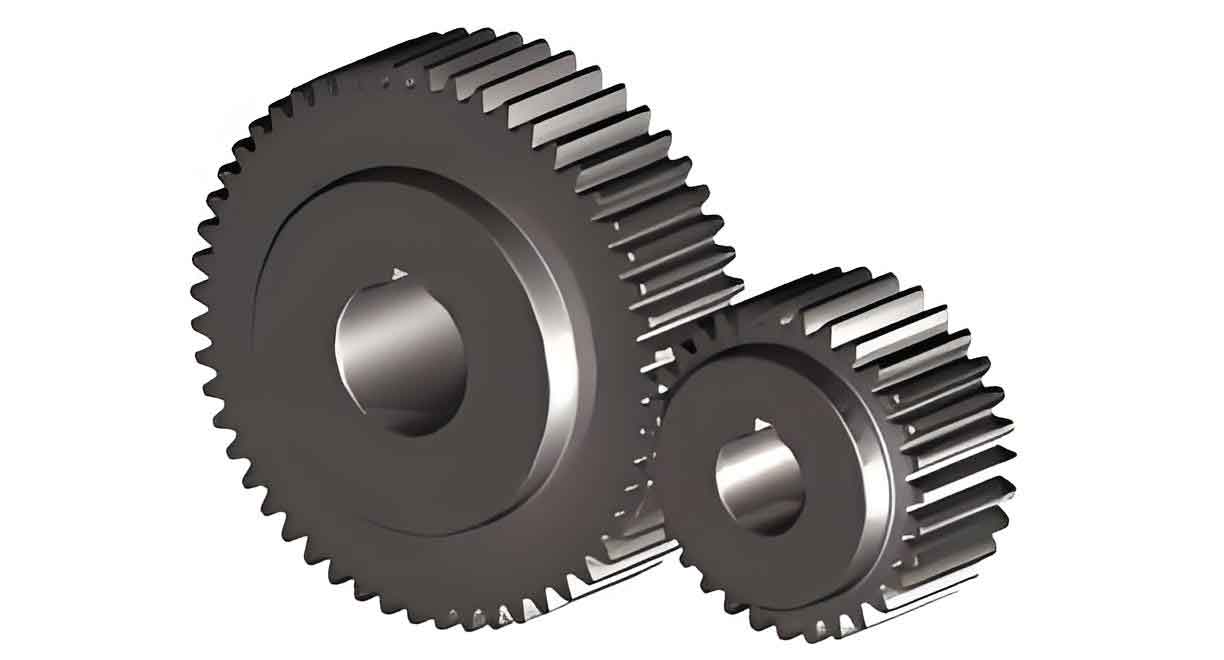
The design of the remaining components is largely driven by the dimensions of the spur gears. Shafts are designed for torsional shear stress and bending moments, with diameters stepped to accommodate bearings, gears, and seals. Rolling-element bearings are selected based on dynamic load ratings and required life. Finally, the housing is designed to provide precise alignment for the bearings, contain lubricant, and offer structural support. This interdependent design sequence is ideally suited for automation through a systematic software system.
System Architecture and Overall Design Workflow
The optimization system was developed using a modular, top-down approach. The primary development environment consists of a 3D CAD platform (utilizing its native API for modeling and automation), a high-level programming language for the application logic, and a relational database for managing standard parts and design knowledge. The overall system flow is designed to mirror the traditional design process but with automation at every stage.
The high-level workflow proceeds as follows:
- Requirement Input & Initialization: The user specifies the fundamental input requirements: input power, input speed, desired output speed (or transmission ratio), and service conditions.
- Automated Spur Gear Design & Verification: The system’s calculation engine processes the inputs. It accesses material property databases, applies design algorithms to propose initial spur gear parameters (module, number of teeth, face width), and performs rigorous bending and contact stress checks. Optimization routines may run to minimize center distance or weight.
- Parametric Model Generation: Based on the calculated geometric parameters, the system drives the 3D CAD software via its API to instantiate fully-parameterized models of all components. Each dimension is controlled by a named variable.
- Assembly and Interference Check: The individual component models are automatically assembled. The system performs a basic spatial check to ensure no gross interference exists, particularly between the spur gear teeth and the housing interior.
- Design Output: The system generates a comprehensive output report containing all design parameters, safety factors, a bill of materials, and the associated 3D model and 2D drawing files.
This seamless flow is enabled by the deep integration of calculation logic with geometric modeling. The following sections detail the implementation of the core modules.
Parameterized Component Modeling and Database Foundation
The cornerstone of the system is a library of fully parameterized 3D models for every standard component in a spur gear reducer. This ensures that any valid set of design parameters yields a geometrically correct and manufacturable model. The parameters for each component family were meticulously defined.
Transmission Components (Spur Gears)
The spur gear model is the most critical. Its parameters control not only the gear geometry but also features like hubs, keyways, and bolt circles. A comprehensive set of driving parameters was established.
| Parameter Name | Symbol / Expression | Unit | Description |
|---|---|---|---|
| Number of Teeth | \(z\) | – | Defines the gear ratio. |
| Module | \(m\) | mm | Standardized measure of tooth size. |
| Face Width | \(b\) | mm | Axial length of the gear teeth. |
| Pitch Diameter | \(d = m \cdot z\) | mm | Reference diameter for meshing. |
| Addendum Diameter | \(d_a = m(z + 2)\) | mm | Outer diameter of the gear. |
| Hub Diameter | \(d_{hub}\) | mm | Diameter of the central hub. |
| Hub Length | \(l_{hub}\) | mm | Length of the central hub. |
| Bore Diameter | \(d_{bore}\) | mm | Diameter of the central mounting hole. |
| Keyway Width | \(w_{key}\) | mm | Standard keyway dimension. |
| Keyway Depth | \(h_{key}\) | mm | Standard keyway dimension. |
Shaft Components
Shafts are modeled as a series of stepped cylinders. Each segment’s diameter and length are parameters, determined by the mounted components (bearings, gears, couplings) and stress analysis.
| Parameter Name | Symbol | Unit | Description |
|---|---|---|---|
| Minimum Diameter (Segment I) | \(d_{min}\) | mm | Based on pure torsion under transmitted torque: \(d_{min} \approx \sqrt[3]{\frac{16T}{\pi \tau_{allow}}}\). |
| Segment II Diameter & Length | \(d_{II}, l_{II}\) | mm | For bearing seating. |
| Segment III Diameter & Length | \(d_{III}, l_{III}\) | mm | For gear seating and shoulder. |
| Segment IV Diameter & Length | \(d_{IV}, l_{IV}\) | mm | Central span, sized for bending stiffness. |
| Segment V Diameter & Length | \(d_{V}, l_{V}\) | mm | For second bearing seating. |
| Segment VI Diameter & Length | \(d_{VI}, l_{VI}\) | mm | For coupling or external connection. |
Housing and Structural Components
The housing parameters are derived from the gear centers and outer dimensions. Empirical formulas from design handbooks are codified into the system.
| Parameter Name | Symbol / Basis | Unit | Description |
|---|---|---|---|
| Wall Thickness | \(\delta\) | mm | Empirical function of center distance. |
| Flange Thickness (Cover & Base) | \(t_1, t_2\) | mm | Thicker than wall for bolt seating. |
| Bearing Bore Diameters | \(D_{bearing1}, D_{bearing2}\) | mm | Matched to selected bearing outer diameters. |
| Housing Length & Width | \(L, W\) | mm | Determined by gear face width, bearing spacing, and internal clearances. |
| Housing Height | \(H\) | mm | Determined by gear addendum diameter plus clearance \(\Delta\): \(H \approx d_{a2} + 2\Delta\). |
| Bolt Sizes (Foundation, Bearing Cap, Cover) | \(d_f, d_1, d_2\) | mm | Standard sizes selected from tables based on loads. |
These parameter sets are not isolated; they are linked through mathematical relations. For example, the shaft segment III diameter \(d_{III}\) must be equal to the gear bore diameter \(d_{bore}\), and the housing bearing bore \(D_{bearing}\) must be slightly larger than the bearing’s outer diameter, which itself is related to the shaft segment II diameter \(d_{II}\). The system manages these relationships through a central parameter manager, ensuring global consistency.
Implementation of the Design Calculation and Knowledge Engine
The intelligence of the system resides in its calculation engine, which automates the decision-making and verification processes typically done manually by an engineer. This engine is built on a combination of procedural algorithms and a knowledge database.
The spur gear design sequence is fully automated. Given input power \(P\) (kW) and input speed \(n_1\) (rpm), the transmitted torque \(T_1\) is calculated:
$$T_1 = 9549 \frac{P}{n_1} \quad \text{Nm}$$
Using an initial estimate for center distance or based on surface durability, the engine proposes a module \(m\) and tooth numbers \(z_1\) and \(z_2\). It then calculates the tangential force \(F_t\), the dynamic factor \(K_v\), and the application factors to determine the actual bending and contact stresses, \(\sigma_b\) and \(\sigma_H\):
$$\sigma_b = \frac{F_t}{b m} K_v K_o Y_J$$
$$\sigma_H = Z_E \sqrt{\frac{F_t}{b d_1} \frac{u+1}{u} K_v K_o Z_I}$$
where \(Y_J\) is the geometry factor for bending, \(Z_E\) is the elasticity coefficient, \(Z_I\) is the pitting geometry factor, and \(u\) is the gear ratio \(z_2/z_1\). These stresses are compared against allowable stresses for the selected material (e.g., SAE 1045 hardened), which are retrieved from the material database. The engine iterates on parameters like face width \(b\) or module \(m\) until the safety factors meet specified minimums.
Shaft design proceeds similarly. Based on the forces from the spur gears (tangential \(F_t\), radial \(F_r\)), bearing reaction forces are calculated. Bending moment diagrams and torque diagrams are constructed algorithmically. Diameters at critical sections are then checked using the distortion energy theory (von Mises stress) for combined bending and torsion:
$$d = \sqrt[3]{\frac{32 N_f}{\pi S_e} \sqrt{(M_a + K_f M_m)^2 + \frac{3}{4}(T_a + K_fs T_m)^2}}$$
Here, \(S_e\) is the endurance limit, \(N_f\) is the design factor, \(K_f\) are stress concentration factors, and \(M\) and \(T\) are bending and torsional moments (alternating and mean components). The system selects the smallest standard shaft diameter that satisfies this condition at all sections.
Bearing selection is automated by calculating the equivalent dynamic load \(P\) on each bearing and using the basic rating life equation:
$$L_{10} = \left( \frac{C}{P} \right)^p$$
where \(C\) is the basic dynamic load rating from a bearing database, and \(p=3\) for ball bearings. The system queries the database to find the smallest bearing whose calculated \(L_{10}\) life exceeds the required service life.
All empirical data—standard module series, preferred numbers of teeth, material properties (allowable bending stress \(\sigma_{FP}\), allowable contact stress \(\sigma_{HP}\)), stress concentration factors, bearing catalog data, and standard fastener sizes—are stored in a structured relational database. This separation of logic and data makes the system maintainable and easy to update with new standards or parts.
Graphical User Interface and System Integration
To make the powerful calculation and modeling engine accessible, a dedicated graphical user interface (GUI) was created. The interface is designed to follow the natural design workflow.
The main GUI is structured as a sequential process with clear navigation:
- Project Initialization Panel: The user selects the project type (single-stage spur gear reducer) and enters the core operational requirements (Power, Input RPM, Desired Ratio, Service Factor).
- Gear Design Panel: This panel displays the calculated spur gear parameters (module, teeth, face width, center distance) and the resulting safety factors. Users can override suggestions and select materials from a dropdown list linked to the database.
- Shaft Design Panel: This panel allows visualization of the shaft geometry with its segments. Key diameters and lengths are displayed and can be fine-tuned if necessary, though the system provides validated defaults.
- Bearing & Housing Selection Panel: The system proposes bearings based on the shaft diameters and loads. Housing dimensions are displayed, derived from the gear and bearing positions. Clearances are automatically applied.
- Assembly & Review Panel: A lightweight 3D preview of the complete reducer assembly is generated. A report generation button compiles all inputs, calculations, selected components, and final safety factors into a PDF document.
The integration between the GUI, the calculation engine, and the 3D CAD system is achieved through application programming interfaces (APIs). When the user clicks “Generate Model,” the GUI passes the final parameter set to the CAD API. The API then opens the template files for each component, updates the named parameters within the CAD system, rebuilds the geometry, and assembles the parts. This process is executed in the background, making the automation seamless to the user. The entire system, from interface to database to CAD templates, is packaged so that it loads as an add-in module within the host CAD environment, appearing as a custom toolbar or menu.
System Validation and Example Execution
The feasibility and performance of the optimization system were tested through multiple design cases. A representative example is outlined below.
Design Case: A conveyor drive requires a speed reducer. The input is an electric motor providing \(P = 7.5 \text{ kW}\) at \(n_1 = 1450 \text{ rpm}\). The desired output speed is approximately \(n_2 = 320 \text{ rpm}\), implying a gear ratio of \(i \approx 4.53\). The service is moderate shock, 16 hours per day.
Execution within the System:
- The user enters the requirements into the Project Initialization panel and clicks “Calculate Gears.”
- The system’s spur gear module runs its algorithms. It might propose a pinion with \(z_1 = 21\) teeth, a gear with \(z_2 = 95\) teeth, and a module \(m = 2.5 \text{ mm}\). The face width is calculated as \(b = 25 \text{ mm}\). The contact safety factor is verified to be \(S_H > 1.3\) and the bending safety factor \(S_F > 1.6\) for case-hardened steel spur gears.
- The shaft design module then computes forces. The tangential force on the pinion is \(F_t \approx 2900 \text{ N}\). Using this, it calculates minimum shaft diameters. For the high-speed shaft, the minimum diameter based on torque might be 18mm. After considering bending and standard bearing sizes, the system designs a stepped shaft with key diameters of 20mm (for bearings), 25mm (for the pinion), and 18mm (for the coupling).
- The bearing selection module queries its database. For the 20mm shaft diameter and calculated radial load of ~1100N, it might select a 6004 deep groove ball bearing (20mm bore, 42mm OD, 12mm width) with a calculated \(L_{10}\) life exceeding 30,000 hours.
- The housing module calculates the center distance: \(a = \frac{2.5(21+95)}{2} = 145 \text{ mm}\). It then determines housing wall thickness (e.g., 8mm), overall length, width, and height based on the gear and bearing outer dimensions plus standard clearances.
- Finally, the user clicks “Generate Full Model.” The system executes the CAD API scripts, updating all template files with the new parameters: \(z_1=21, m=2.5, b=25, d_{shaft1}=25\), etc. Within minutes, a complete 3D assembly of the single-stage spur gear reducer is generated, along with detailed drawings and a summary report.
This process, which could take a human designer several hours or even days for a thorough job, is completed in a matter of minutes with consistent, documentable results. The generated spur gear reducer model is ready for downstream processes such as finite element analysis for detailed stress validation, generation of manufacturing drawings, or assembly into a larger machine layout.
Conclusion
The development of this integrated optimization system demonstrates a significant advancement in the methodology for designing single-stage spur gear reducers. By synthesizing established mechanical design principles for spur gears with modern software engineering techniques—including parametric modeling, database management, and algorithmic calculation—the system successfully automates the tedious and repetitive aspects of the design process. It enforces consistency, reduces the likelihood of calculation errors, and drastically shortens the design cycle. The modular, data-driven architecture ensures that the system is not a static tool but can be extended and updated with new component libraries, design standards (e.g., ISO 6336, AGMA 2001), or analysis modules (e.g., thermal analysis, efficiency prediction under mixed lubrication). Ultimately, this system empowers engineers to function at a higher conceptual level, exploring more design alternatives and optimizing for factors like cost, weight, or efficiency, rather than being burdened by routine calculations and drafting. The core technology and methodology are broadly applicable, providing a template for the intelligent and automated design of other complex mechanical systems centered on standardized components like spur gears.