
As a team specializing in advanced manufacturing technologies, we have focused on addressing the challenges in producing internal gears and splines, particularly for applications in aerospace and automotive industries. Traditional methods like cutting and extrusion face limitations in efficiency, tool wear, and suitability for high-strength materials. Electrochemical machining (ECM) offers a promising alternative due to its ability to handle complex geometries without tool wear or burr formation. In this article, we present the development of a multi-station electrolytic machining system tailored for internal gear manufacturer needs, emphasizing the production of high-quality internal gears. Our work covers system design, control strategies, and experimental validation, with extensive use of formulas and tables to summarize key aspects.
The growing demand for precision components in sectors such as electric vehicles and aviation has highlighted the inefficiencies of conventional internal gear manufacturing processes. For instance, machining internal gears in blind holes often involves slow, tooth-by-tooth operations, leading to high costs and poor surface integrity. Electrolytic machining, however, enables simultaneous multi-station processing, making it ideal for mass production of internal gears. Our system leverages a novel flat-jet electrolyte supply method, which eliminates the need for complex fixtures and enhances machining consistency. Throughout this project, we aimed to create a robust platform that integrates mechanical design, electronic control, and fluid dynamics to optimize the fabrication of internal gears.
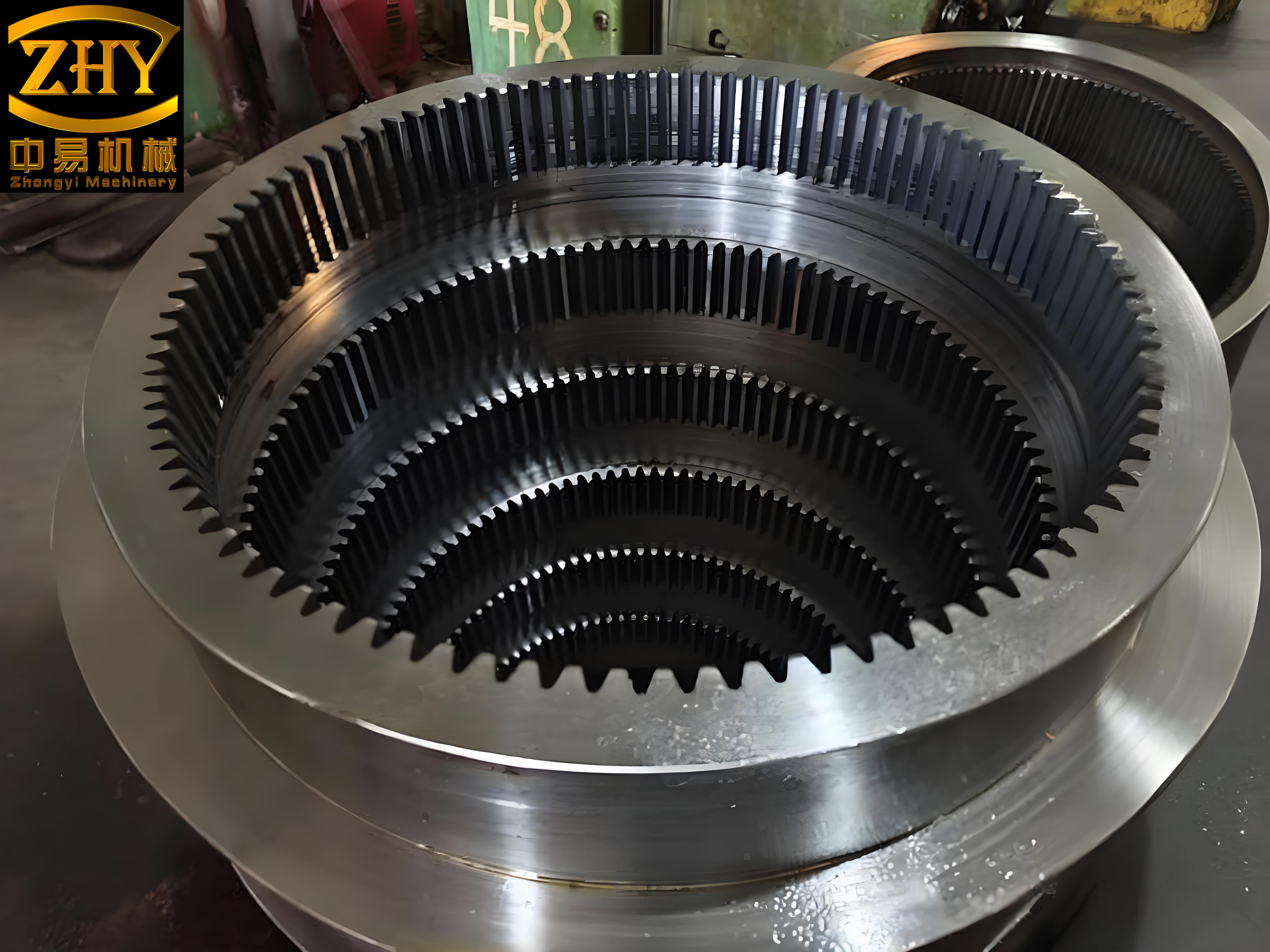
In the following sections, we detail the overall system design, including structural components and motion mechanisms. We also explore the control system architecture and electrolyte flow management, which are critical for maintaining uniformity across multiple workstations. Experimental results demonstrate the system’s performance, with data presented through tables and mathematical models. By emphasizing terms like “internal gear manufacturer” and “internal gears,” we underscore the relevance of our work to industrial applications. For visual reference, an illustration of typical internal gears is provided below:
Overall System Design
Our multi-station electrolytic machining system employs a vertical single-axis configuration to accommodate the cylindrical nature of internal gears. This design ensures stability and precision during the machining of internal gears in blind holes. The core components include a marble-based bed and worktable for corrosion resistance, dual columns for structural integrity, and a sealed working chamber to contain electrolyte mist. We incorporated a U-shaped acrylic door with automated controls for operator safety and process visibility. The worktable features pre-embedded stainless steel nuts for aligning cathodes and workpieces, crucial for maintaining concentricity in internal gear production. This setup supports up to three workstations, allowing simultaneous machining of multiple internal gears, which aligns with the goals of an internal gear manufacturer seeking high throughput.
The system’s dimensions are 900 mm × 900 mm × 900 mm, with a worktable that includes circular drainage ports and grooves for efficient electrolyte management. By using marble, we mitigate the corrosive effects of the electrolyte, extending the machine’s lifespan. The motion system is driven by a servo motor and ball screw assembly, selected based on calculated load parameters. For instance, the maximum load moment of inertia \( J \) and torque \( T \) were determined using the formulas:
$$ J = \sum m_i r_i^2 $$
$$ T = J \alpha + F r $$
where \( m_i \) represents mass elements, \( r_i \) their radii, \( \alpha \) angular acceleration, and \( F \) the applied force. These calculations ensured the selection of a Siemens SIMOTICS S-1FL6 servo motor with a 1:20 reducer, enabling precise feed rates as low as 0.3 mm/min for delicate internal gear profiles.
Component Analysis and Process Strategy
We analyzed the workpiece structure, focusing on internal gears with modules of 2 mm, 18 teeth, and a pressure angle of 20°. To reduce experimental costs, we designed a split configuration comprising a base and replaceable internal gear components. This approach simulates real-world传动轴 machining while allowing low-cost iterations. The flat-jet electrolyte supply method directs multiple streams into the machining gap, enhancing flow uniformity and reducing the risk of sparking or short circuits. This innovation is particularly beneficial for an internal gear manufacturer aiming to minimize setup times and improve part consistency.
Key parameters for the internal gears are summarized in Table 1, which outlines the geometric specifications critical for quality assurance. The table emphasizes the importance of precise dimensional control in internal gear production.
| Parameter | Symbol | Value |
|---|---|---|
| Module | m | 2 mm |
| Number of Teeth | z | 18 |
| Pressure Angle | α | 20° |
The alignment of cathodes and workpieces is achieved through V-blocks and fixed rods, ensuring concentricity within tight tolerances. This design eliminates the need for custom fixtures, streamlining the process for internal gear manufacturer applications. The electrolyte flow dynamics were modeled using the Navier-Stokes equations to optimize pressure distribution:
$$ \rho \left( \frac{\partial \mathbf{v}}{\partial t} + \mathbf{v} \cdot \nabla \mathbf{v} \right) = -\nabla p + \mu \nabla^2 \mathbf{v} + \mathbf{f} $$
where \( \rho \) is density, \( \mathbf{v} \) velocity, \( p \) pressure, \( \mu \) viscosity, and \( \mathbf{f} \) body forces. This theoretical foundation supports our practical approach to multi-station machining of internal gears.
Structural Design of the Machine
The machine’s frame is constructed from marble to resist electrolytic corrosion, with a worktable that includes embedded stainless steel nuts for flexible fixture arrangements. The dual-column design provides rigidity, while sealed panels prevent electrolyte leakage. We integrated a transparent acrylic door with brush seals for enhanced visibility and containment. This structural integrity is vital for maintaining accuracy in internal gear manufacturing, as any deflection could lead to dimensional errors.
For the motion mechanism, we calculated the load requirements to select appropriate components. The ball screw and servo motor system offers a positioning accuracy of ±2 μm, sufficient for the fine features of internal gears. The reduction gear ratio of 1:20 allows for slow, controlled feed rates, which are essential for achieving high surface quality in internal gears. The electrical insulation uses copper bars with wooden separators to prevent stray currents, a common concern in electrolytic processes for internal gear manufacturer setups.
Sealing, Corrosion Protection, and Electrical Insulation
To protect sensitive components from electrolyte exposure, we implemented bellows-style covers for the ball screws and guides. Additional U-shaped stainless steel plates shield the slides, with threaded holes for accessory mounting. The working chamber’s sealing system employs acrylic and aluminum grooves with brush seals, effectively containing mist and splashes. These measures extend the machine’s operational life, reducing maintenance costs for an internal gear manufacturer.
Electrical insulation is achieved through copper conductors isolated by wooden boards, minimizing the risk of short circuits. The pulse power supply delivers up to 18 V, with current sensors used for gap monitoring. This setup ensures stable machining conditions for internal gears, even in multi-station configurations.
Control System Development
We developed a PLC-based control system to manage the single-axis feed motion, electrolyte flow, and power supply integration. The system includes features such as automatic tool setting using Hall effect sensors, which detect current thresholds to establish zero gaps. This functionality is crucial for repeatable internal gear machining. The control architecture also supports manual overrides and real-time monitoring via a touchscreen interface.
Key equations governing the control logic include the PID algorithm for motion control:
$$ u(t) = K_p e(t) + K_i \int_0^t e(\tau) d\tau + K_d \frac{de(t)}{dt} $$
where \( u(t) \) is the control output, \( e(t) \) the error, and \( K_p \), \( K_i \), \( K_d \) the tuning parameters. This ensures precise positioning during the production of internal gears. The system’s reliability was validated through extensive testing, highlighting its suitability for internal gear manufacturer environments.
Electrolyte Flow Equalization Control
Maintaining consistent electrolyte flow across multiple stations is essential for uniform internal gear quality. We implemented a flow control system using proportional valves and flow meters, managed by the PLC. The control circuit modules include AD and DA converters for real-time adjustments. This design compensates for pressure variations, ensuring each workstation receives equal flow rates.
The flow dynamics can be described by the continuity equation and Bernoulli’s principle:
$$ A_1 v_1 = A_2 v_2 $$
$$ p + \frac{1}{2} \rho v^2 + \rho g h = \text{constant} $$
where \( A \) is cross-sectional area, \( v \) velocity, \( p \) pressure, \( \rho \) density, \( g \) gravity, and \( h \) height. By applying these principles, we achieved flow uniformity, which is critical for an internal gear manufacturer processing multiple parts simultaneously. Table 2 compares flow rates with and without equalization control, demonstrating the improvement in consistency for internal gears.
| Condition | Left Station (L/min) | Center Station (L/min) | Right Station (L/min) |
|---|---|---|---|
| Without Control | 5.2 | 4.8 | 5.1 |
| With Control | 5.0 | 5.0 | 5.0 |
Process Experiments and Results
We conducted experiments to validate the system’s performance, including single-station and multi-station machining of internal gears. The parameters included an average voltage of 18 V and feed rates optimized for stability. In single-station mode, the machining speed reached 3.9 mm/min, while three-station operation achieved 2.7 mm/min with flow equalization. Without equalization, the speed dropped to 2.1 mm/min, highlighting the importance of flow control for internal gear manufacturer efficiency.
Post-machining analysis involved slicing the internal gears and measuring key dimensions at six points per sample. The data, summarized in Table 3, show the consistency in slot depth and width for internal gears. The standard deviations calculated from these measurements indicate improved uniformity with flow control, essential for high-volume production of internal gears.
| Measurement Point | Slot Depth (μm) | Slot Width (μm) |
|---|---|---|
| 1 | 2456 | 3745 |
| 2 | 2500 | 3799 |
| 3 | 2419 | 3722 |
| 4 | 2461 | 3794 |
| 5 | 2491 | 3808 |
| 6 | 2467 | 3781 |
| Average | 2465 | 3775 |
Further, we evaluated the tooth tip lengths under different conditions, as shown in Table 4. The standard deviations decreased with flow equalization, confirming its role in enhancing the precision of internal gears. For an internal gear manufacturer, this translates to higher part consistency and reduced scrap rates.
| Condition | Left Station (mm) | Center Station (mm) | Right Station (mm) |
|---|---|---|---|
| Without Equalization | 39.53 ± 0.029 | 39.48 ± 0.041 | 39.53 ± 0.036 |
| With Equalization | 39.50 ± 0.018 | 39.49 ± 0.022 | 39.51 ± 0.022 |
The experimental results were analyzed using statistical models, such as the standard deviation formula:
$$ \sigma = \sqrt{\frac{1}{N} \sum_{i=1}^N (x_i – \mu)^2} $$
where \( \sigma \) is standard deviation, \( N \) the number of samples, \( x_i \) individual measurements, and \( \mu \) the mean. This quantitative approach underscores the system’s capability to produce uniform internal gears, meeting the demands of an internal gear manufacturer.
Conclusion and Future Work
Our multi-station electrolytic machining system has successfully demonstrated its ability to produce high-quality internal gears with improved efficiency and consistency. The integration of structural design, control systems, and flow management has resulted in a robust platform suitable for industrial applications. The experimental data confirm that flow equalization significantly enhances multi-station performance, making it a valuable asset for any internal gear manufacturer.
Looking ahead, we plan to refine the process by developing mathematical models that correlate machining gaps with operational parameters. Optimization algorithms, such as gradient descent, will be applied to maximize feed rates and surface quality for internal gears. Additionally, expanding the number of workstations could further boost productivity, solidifying the system’s role in advanced internal gear manufacturing.
In summary, this project highlights the potential of electrolytic machining as a superior method for producing internal gears, offering a competitive edge to internal gear manufacturer stakeholders. By continuously improving the technology, we aim to set new standards in precision and efficiency for the industry.