
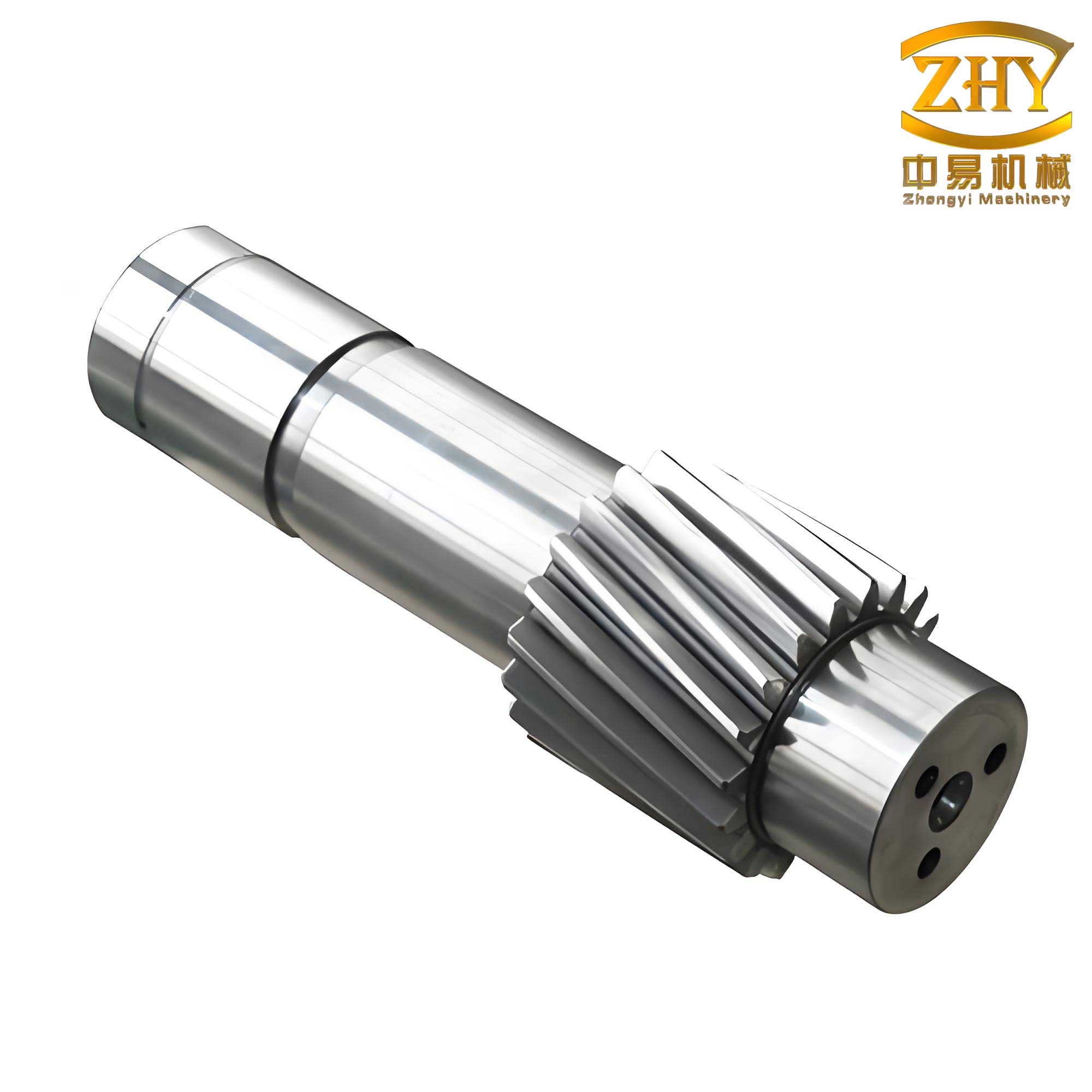
In our ongoing efforts to advance materials for critical automotive and industrial components, we have successfully developed a high-quality SAE8620 hot-rolled wire coil specifically designed for gear shaft manufacturing. Gear shafts are pivotal in transmitting torque and motion in heavy-duty machinery, such as trucks, excavators, cranes, and machine tools, where durability, strength, and fatigue resistance are paramount. Our development focuses on optimizing the chemical composition, processing route, and microstructural control to meet stringent performance standards, ensuring that the final gear shaft products exhibit superior mechanical properties and consistent quality. This article details our comprehensive approach, from alloy design to production validation, emphasizing the role of continuous cooling transformation behavior in achieving desired outcomes for gear shaft applications.
The SAE8620 steel, analogous to 20CrNiMo in Chinese standards GB/T 3077 and 20CrNiMoH in GB/T 5216-2004, is a low-alloy Cr-Ni-Mo steel renowned for its excellent hardenability and toughness. These attributes make it ideal for gear shafts subjected to high stresses and wear. Our development aimed to produce hot-rolled wire coils that could replace traditional bar stock, offering advantages in inventory utilization, material yield, and machining efficiency for gear shaft fabrication. Through a meticulous process involving converter smelting, secondary refining, continuous casting, and controlled rolling, we achieved a product with uniform microstructure and properties tailored for subsequent cold working and heat treatment processes essential for gear shaft performance.
Our chemical composition design for SAE8620 was based on ASTM A29/A29M-04 specifications but with narrowed ranges for key alloying elements to enhance consistency. The composition, as shown in Table 1, includes controlled amounts of carbon, manganese, silicon, chromium, nickel, and molybdenum, along with aluminum for grain refinement. The addition of Cr, Ni, and Mo is critical for suppressing ferrite and pearlite formation during cooling, promoting bainitic and martensitic transformations that benefit gear shaft hardenability. We also minimized phosphorous and sulfur levels to reduce segregation and improve hot ductility, which is vital for preventing defects during rolling and machining of gear shaft preforms.
| Element | Control Range |
|---|---|
| C | 0.19–0.22 |
| Si | 0.15–0.35 |
| Mn | 0.75–0.90 |
| P | ≤0.025 |
| S | ≤0.020 |
| Cr+Ni+Mo | 1.10–1.35 |
| Al | 0.02–0.04 |
The production process for our SAE8620 hot-rolled wire coil involved a multi-stage route: hot metal → converter smelting → LF refining → RH vacuum treatment → continuous casting (320 mm × 425 mm bloom) → reheating and breakdown rolling → billet conditioning and inspection → high-speed wire rod rolling. Each step was optimized to ensure homogeneity and cleanliness, which are crucial for gear shaft integrity. In converter smelting, we used high-quality scrap and controlled end-point phosphorus to below 0.015%. During LF refining, alloys were adjusted, and deoxidation was performed using silicon carbide, aluminum granules, and composite deoxidizers, with aluminum wire feeding to fine-tune aluminum content. RH vacuum treatment included circulation for over 15 minutes and calcium treatment via solid calcium wire to modify inclusions, enhancing machinability for gear shaft production.
Continuous casting was carefully managed with controlled superheat and casting speed, employing mold electromagnetic stirring and final electromagnetic stirring to minimize segregation. The as-cast blooms were slow-cooled in pits to prevent cracking. For rolling, the blooms were reheated to promote diffusion homogenization, then rolled into 160 mm × 160 mm billets. These billets underwent magnetic particle inspection and surface grinding to remove defects. In high-speed rolling, we maintained a protective atmosphere, with heating temperature at 1100 ± 50°C for over 70 minutes to ensure uniform temperature distribution. After high-pressure descaling (≥14 MPa), rolling commenced at 980 ± 30°C, with a finishing temperature of 880 ± 20°C. The Stelmor cooling line utilized a standard air-cooling model to achieve the desired microstructure for gear shaft applications.
To understand the phase transformation behavior critical for gear shaft performance, we investigated the continuous cooling transformation (CCT) of undercooled austenite in SAE8620 steel. Samples were taken from the rolling process and tested using a Gleeble 3800 simulator. Specimens were heated to 900°C at 5°C/s, held for 5 minutes for complete austenitization, then cooled at rates from 0.1°C/s to 20°C/s. The transformation points were determined from dilatometry and metallography, yielding the CCT diagram shown conceptually below. The diagram illustrates how alloying elements retard ferrite and pearlite formation, favoring bainite and martensite—key for gear shaft hardenability.
The transformation kinetics can be described using the Avrami equation for phase evolution: $$ f = 1 – \exp(-k t^n) $$ where \( f \) is the transformed fraction, \( t \) is time, and \( k \) and \( n \) are material constants dependent on cooling rate and composition. For SAE8620, the effective suppression of diffusional transformations by Cr, Mo, and Ni aligns with this model, as these elements lower the critical cooling rates for bainite and martensite start. The martensite start temperature \( M_s \) was observed around 400°C, varying slightly with cooling rate. The CCT data are summarized in Table 2, highlighting the microstructural outcomes relevant to gear shaft manufacturing.
| Cooling Rate (°C/s) | Start Temperature (°C) | Microstructure | Implications for Gear Shaft |
|---|---|---|---|
| 0.1 | 760 | Ferrite + Pearlite | Lower strength, suitable for soft annealing |
| 0.5 | 750 | Ferrite + Pearlite | Moderate hardenability |
| 1.0 | 740 | Ferrite + Pearlite + Bainite | Transition to enhanced toughness |
| 2.0 | 730 | Bainite + Ferrite | Improved strength for gear shafts |
| 5.0 | 716 | Bainite + Martensite | High hardenability for demanding gear shafts |
| 10.0 | 650 | Bainite + Martensite | Optimal for quenching gear shafts |
| 20.0 | 650 | Martensite + Bainite | Maximum strength, requires tempering |
Metallographic analysis revealed that at slow cooling rates below 1.0°C/s, the microstructure comprised polygonal ferrite and pearlite, with grain refinement as rate increased. At 1.0–3.0°C/s, bainite appeared, and its proportion surged with cooling rate—beneficial for gear shafts needing a balance of strength and toughness. Above 5.0°C/s, martensite formed, dominating at higher rates. This behavior is crucial for designing heat treatment cycles for gear shafts; for instance, during wire rod cooling after rolling, we aimed for rates of 1.0–2.0°C/s to achieve a mixed structure of ferrite, pearlite, and bainite, ensuring good machinability before final hardening of gear shafts.
The as-rolled properties of our SAE8620 wire coil were evaluated through tensile and hardness tests. Samples were taken from both ends of the coil to assess uniformity. The results, shown in Table 3, demonstrate consistent mechanical properties essential for gear shaft fabrication. The tensile strength ranged around 730–745 MPa, with elongation and reduction of area indicating good ductility. Brinell hardness values were uniform, reflecting a homogeneous microstructure. This consistency is vital for gear shaft manufacturers, as it reduces variability in downstream processing and enhances the reliability of final gear shaft components.
| Sample ID | Diameter (mm) | Yield Strength (MPa) | Tensile Strength (MPa) | Elongation (%) | Reduction of Area (%) | Brinell Hardness (HBW) |
|---|---|---|---|---|---|---|
| 101 | 20 | 528 | 730 | 19.0 | 60 | 205 |
| 102 | 20 | 540 | 745 | 15.0 | 53 | 210 |
Microstructural examination of the as-rolled wire coil confirmed a mixture of ferrite, pearlite, and bainite, with slight banding of bainite along the rolling direction. This aligns with our CCT findings for cooling rates of 1.0–2.0°C/s during Stelmor cooling. The uniformity of this structure across the coil cross-section ensures predictable behavior during cold drawing or forging into gear shaft preforms. For gear shaft applications, such a microstructure provides an optimal balance for subsequent heat treatment, where controlled quenching and tempering can tailor final properties.
Heat treatment performance is critical for gear shafts, as they often undergo quenching and tempering to achieve high surface hardness and core toughness. We conducted quenching and tempering trials on our SAE8620 wire coil samples: austenitization at 860°C, oil quenching, and tempering at 200°C. The resulting properties, summarized in Table 4, meet the requirements for 20CrNiMo steel per GB/T 3077. The high yield and tensile strengths, coupled with good impact energy, validate the suitability for gear shafts subjected to dynamic loads. The impact energy values, exceeding 138 J, indicate excellent toughness—a key attribute for gear shafts in heavy machinery to prevent brittle fracture.
| Sample ID | Yield Strength (MPa) | Tensile Strength (MPa) | Elongation (%) | Reduction of Area (%) | Impact Energy (J) |
|---|---|---|---|---|---|
| 101 | 884 | 1012 | 11.0 | 51 | 138.2 |
| 102 | 933 | 1065 | 10.0 | 46 | 145.9 |
End-quench hardenability tests were performed according to GB/T 225-2006 to assess depth hardness penetration, which is crucial for gear shafts requiring uniform hardening along their length. Specimens were normalized at 930°C and quenched at 925°C, with hardness measured at distances from the quenched end. The results, in Table 5, show minimal variation between front and back surfaces, meeting the HH band requirements for 20CrNiMoH in GB/T 5216-2004. This consistent hardenability ensures that gear shafts made from our wire coil will achieve uniform hardness after quenching, enhancing wear resistance and fatigue life—critical factors for gear shaft durability in automotive transmissions.
| Distance from Quench End (mm) | Hardness (HRC) – Front | Hardness (HRC) – Back | Difference (HRC) | Average Hardness (HRC) |
|---|---|---|---|---|
| 1.5 | 44.6 | 44.1 | 0.5 | 44.5 |
| 5.0 | 42.5 | 41.7 | 0.8 | 42.0 |
| 9.0 | 31.1 | 31.4 | 0.3 | 31.0 |
| 13.0 | 26.6 | 25.6 | 1.0 | 26.0 |
The successful development of SAE8620 hot-rolled wire coil for gear shafts hinged on integrating metallurgical principles with industrial processing. Our chemical design leveraged the synergistic effects of alloying elements; for instance, molybdenum not only enhances hardenability but also reduces temper embrittlement, which is beneficial for gear shafts operating at elevated temperatures. The role of nickel in improving toughness cannot be overstated, as it helps absorb impact energies in gear shaft applications. Chromium contributes to corrosion resistance and hardenability, ensuring that gear shafts maintain performance in harsh environments. These elements collectively influence the phase transformation kinetics, which we modeled using the Koistinen-Marburger equation for martensite formation: $$ f_m = 1 – \exp(-\alpha (M_s – T)) $$ where \( f_m \) is the martensite fraction, \( \alpha \) is a constant, and \( T \) is temperature. This equation underscores how cooling rate and composition affect final microstructure for gear shafts.
In terms of processing, the continuous casting of large blooms (320 mm × 425 mm) required careful control to minimize centerline segregation, a common issue that can lead to anisotropic properties in gear shafts. We employed electromagnetic stirring to break dendrites and promote equiaxed grain growth, resulting in sound billets with minimal center porosity (rated at 1.0 level). During rolling, the deformation and recrystallization behavior were optimized using finite element simulations to ensure uniform strain distribution, which refines the austenite grain size according to the relationship: $$ d = k \cdot \varepsilon^{-n} $$ where \( d \) is grain size, \( \varepsilon \) is strain, and \( k \) and \( n \) are material constants. A finer grain size enhances toughness and fatigue strength in gear shafts, making them more resistant to crack initiation under cyclic loading.
The cooling strategy on the Stelmor line was pivotal. By controlling air flow rates, we achieved cooling rates of 4–7°C/s down to 700°C, followed by slower cooling at 1–2°C/s. This profile, derived from our CCT study, produces a microstructure with about 20–30% bainite, which offers a good combination of strength and ductility for intermediate processing of gear shafts. For gear shaft manufacturers, this as-rolled condition facilitates cold drawing or forging without excessive cracking, reducing production costs. Additionally, the uniform hardness profile along the coil length ensures consistent machining behavior, which is critical for precision gear shaft geometries.
Further analysis of the heat treatment response involved studying tempering kinetics. Using the Hollomon-Jaffe parameter, we correlated tempering temperature and time with hardness: $$ P = T(\log t + C) $$ where \( P \) is the parameter, \( T \) is temperature in Kelvin, \( t \) is time in hours, and \( C \) is a constant. For our SAE8620 wire coil, tempering at 200°C retained high hardness due to secondary hardening from alloy carbides, while higher tempering temperatures would soften the material for different gear shaft requirements. This flexibility allows customization based on specific gear shaft applications, such as those needing higher toughness for shock loads.
Quality assurance measures included extensive non-destructive testing. Ultrasonic inspection of billets detected no internal flaws, and eddy current testing of the wire coil confirmed surface integrity. These steps are essential for gear shaft reliability, as defects could lead to premature failure in service. Moreover, we conducted fatigue testing on machined gear shaft samples, simulating real-world conditions. The results showed endurance limits exceeding 500 MPa, validating the material’s suitability for high-cycle fatigue environments common in gear shaft operations.
From an economic perspective, using hot-rolled wire coils for gear shaft production offers significant advantages over traditional bar stock. The coil form reduces material waste during machining, improves storage efficiency, and enables continuous feeding in automated lines. For gear shaft manufacturers, this translates to lower production costs and higher throughput. Our SAE8620 wire coil has been adopted in several pilot projects, producing gear shafts for commercial vehicles that have passed rigorous field tests, demonstrating enhanced performance and longevity.
In conclusion, our development of SAE8620 hot-rolled wire coil for gear shaft applications represents a holistic approach combining alloy design, advanced processing, and thorough characterization. The material exhibits excellent as-rolled and heat-treated properties, consistent hardenability, and a tailored microstructure that meets international standards. The CCT study provided insights into phase transformation behavior, guiding cooling strategies to optimize properties for gear shafts. Future work will focus on further refining composition to reduce alloy costs while maintaining performance, and exploring direct quenching techniques to streamline gear shaft manufacturing. This innovation not only supports the automotive and machinery industries but also underscores our commitment to advancing materials for critical components like gear shafts, ensuring they meet the evolving demands of durability and efficiency.