
In modern automotive and heavy machinery industries, gear shafts are critical components that transmit torque and motion, requiring high strength, toughness, and wear resistance. The demand for high-performance gear shafts has driven the development of advanced steel grades, such as SAE8620, which is analogous to 20CrNiMo steel in Chinese standards. This steel is widely used in heavy-duty vehicles, excavators, cranes, and machine tools due to its excellent hardenability and mechanical properties. Traditionally, gear shafts are manufactured from bar products, but with the advancement of high-speed wire rod rolling technology, hot rolled wire coils have emerged as a viable alternative, offering benefits like improved inventory utilization and higher yield. In this article, we present our comprehensive development of SAE8620 hot rolled wire coil specifically tailored for gear shafts, focusing on chemical composition design, production process optimization, continuous cooling transformation behavior, and final product performance. Our goal is to provide a detailed technical account that highlights the suitability of this material for demanding gear shaft applications.
The development of SAE8620 hot rolled wire coil for gear shafts began with a meticulous chemical composition design. SAE8620 is a Cr-Ni-Mo alloy steel where elements like chromium, nickel, and molybdenum are added to enhance hardenability by suppressing the transformation of supercooled austenite to ferrite and pearlite, thereby promoting bainite and martensite formation. To ensure uniform microstructure and properties in the final wire coil, we narrowed the control ranges of key alloying elements compared to the ASTM A29/A29M-04 standard, while also incorporating aluminum for grain refinement. Strict limits were placed on phosphorus and sulfur content to minimize impurities. The designed chemical composition range is summarized in Table 1.
| Element | C | Si | Mn | P | S | Cr+Ni+Mo | Al |
|---|---|---|---|---|---|---|---|
| Range | 0.19–0.22 | 0.15–0.35 | 0.75–0.90 | ≤0.025 | ≤0.020 | 1.10–1.35 | 0.02–0.04 |
This composition is pivotal for achieving the desired phase transformation characteristics and mechanical properties in gear shafts, as it balances hardenability with processability. The addition of Cr, Ni, and Mo not only inhibits ferrite and pearlite formation but also contributes to solid solution strengthening and tempering resistance, which are essential for gear shafts operating under high stress and fatigue conditions.
Our production process for SAE8620 hot rolled wire coil involved a integrated route from ironmaking to high-speed wire rod rolling. The detailed workflow is as follows: hot metal → converter smelting → LF refining → RH vacuum treatment → continuous casting (slab size: 320 mm × 425 mm) → heating → breakdown rolling → billet finishing and inspection → reheating → high-speed wire rod rolling → finishing → inspection → bundling → weighing → storage. Each step was optimized to ensure high internal quality and consistency. During converter smelting, we used high-quality scrap and controlled the endpoint phosphorus content to ≤0.015%. Alloying and deoxidation were performed during tapping with additions of ferromanganese, ferrosilicon, ferrochromium, ferroaluminum, and carburizer. In the LF station, composition adjustments were made, and slag deoxidation was carried out using silicon carbide, aluminum granules, and composite deoxidizers. Aluminum wire was fed to control the aluminum content, and sulfur was reduced to ≤0.010%. The RH vacuum treatment included a circulation time of at least 15 minutes, followed by calcium treatment with solid pure calcium wire to modify inclusions. Continuous casting was conducted with strict control over superheat and casting speed, employing mold electromagnetic stirring and final electromagnetic stirring to minimize segregation and defects. The cast slabs were slowly cooled in pits to prevent cracking.
For breakdown rolling, the slabs were heated at elevated temperatures with extended holding times to promote homogenization through diffusion. The rolled billets, sized 160 mm × 160 mm, underwent magnetic particle inspection and surface grinding to ensure defect-free conditions. In wire rod rolling, a protective atmosphere was used during reheating to prevent decarburization, which is critical for gear shafts where surface integrity matters. The heating temperature was maintained at 1100 ± 50 °C for over 70 minutes to achieve uniform temperature distribution. After descaling with high-pressure water (pressure ≥14 MPa), rolling commenced at an initial temperature of 980 ± 30 °C. The finishing and coiling temperature was controlled at 880 ± 20 °C, followed by cooling on a Stelmor conveyor with a standard air-cooling model. This process design aimed to produce a fine and uniform microstructure suitable for subsequent cold working and heat treatment of gear shafts.
To understand the phase transformation behavior of SAE8620 steel, which directly influences the microstructure and properties of gear shafts, we conducted a study on the continuous cooling transformation (CCT) of supercooled austenite. Samples were taken from the wire rod during rolling and machined into cylindrical specimens (ϕ6 mm × 81 mm). Using a Gleeble 3800 thermomechanical simulator, the samples were heated to 900 °C at 5 °C/s, held for 5 minutes for complete austenitization, and then cooled at rates ranging from 0.1 °C/s to 20 °C/s to room temperature. Based on dilatometric curves and metallographic examination, the CCT diagram was plotted, as shown in Figure 1 (described textually). The critical transformation points were determined, revealing that the austenite transformation start temperature decreases with increasing cooling rate: from 760 °C at 0.1 °C/s to 650 °C at cooling rates ≥15 °C/s. The CCT diagram illustrates the suppression of ferrite and pearlite regions and the expansion of bainite and martensite zones due to alloying elements.
The microstructure evolution under different cooling rates was analyzed. At slow cooling rates (below 1.0 °C/s), the transformed structure consisted of polygonal ferrite and pearlite. As the cooling rate increased to 1.0–3.0 °C/s, bainite began to appear alongside ferrite and pearlite, with its fraction rising sharply. At rates above 5.0 °C/s, martensite started to form, and its proportion grew with further increases in cooling rate. Above 10 °C/s, the microstructure comprised predominantly bainite and martensite with minimal ferrite. This behavior can be described using phase transformation kinetics. For instance, the start temperature for bainite transformation (Bs) can be approximated by an empirical formula: $$ B_s = 830 – 270 \times \text{(C content)} – 90 \times \text{(Mn content)} – 37 \times \text{(Ni content)} – 70 \times \text{(Cr content)} – 83 \times \text{(Mo content)} $$ where element contents are in weight percent. Similarly, the martensite start temperature (Ms) is given by: $$ M_s = 539 – 423 \times \text{C} – 30.4 \times \text{Mn} – 17.7 \times \text{Ni} – 12.1 \times \text{Cr} – 7.5 \times \text{Mo} $$ These formulas highlight the influence of alloying elements on phase transformation, which is crucial for designing heat treatment processes for gear shafts.
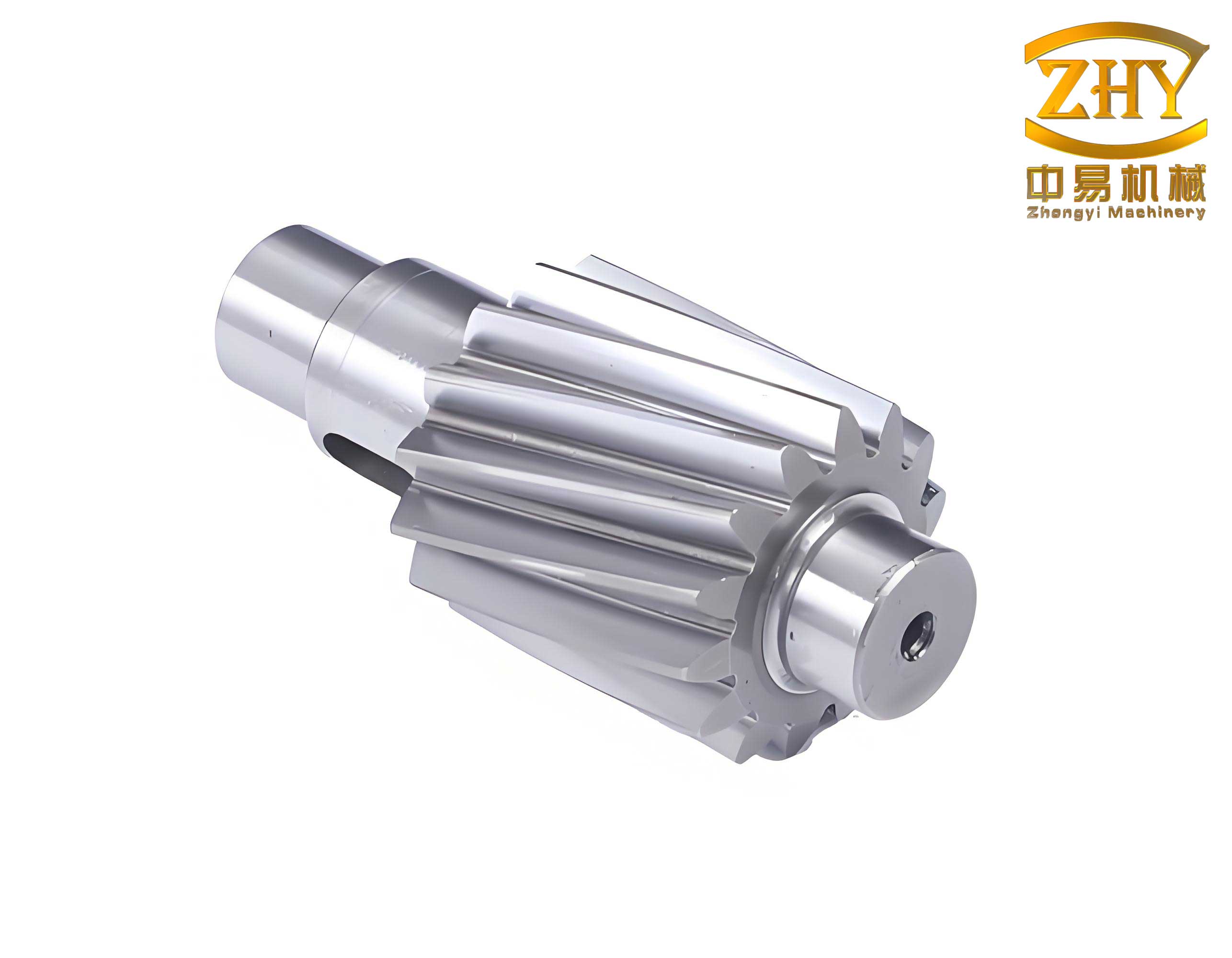
The image above illustrates a typical gear shaft, underscoring the importance of material properties like strength and toughness. In our development, the as-rolled wire coil exhibited excellent microstructure and mechanical properties. Transverse and longitudinal metallographic samples were prepared, etched with 4% nital, and examined under an optical microscope. The as-rolled microstructure consisted of ferrite, pearlite, and bainite, with a slight banding of bainite along the rolling direction in longitudinal sections. This is consistent with the CCT study, as the actual cooling rate on the Stelmor line from 700 °C to 500 °C was approximately 1.0–2.0 °C/s, leading to a mixed structure. The mechanical properties of the as-rolled wire coil are summarized in Table 2, showing high tensile strength, good elongation, and uniform hardness, which are favorable for subsequent cold drawing or forging into gear shafts.
| Sample ID | Yield Strength (MPa) | Tensile Strength (MPa) | Elongation (%) | Reduction of Area (%) | Brinell Hardness (HBW) |
|---|---|---|---|---|---|
| 101 | 528 | 730 | 19.0 | 60 | 205 |
| 102 | 540 | 745 | 15.0 | 53 | 210 |
The low spread in properties (e.g., tensile strength range of 15 MPa) indicates excellent consistency, which is vital for mass production of gear shafts where dimensional stability and performance reliability are paramount. Furthermore, we evaluated the heat-treated performance of the wire coil to simulate typical conditioning for gear shafts. Samples were quenched at 860 °C in oil and tempered at 200 °C, followed by air cooling. The resulting mechanical properties, presented in Table 3, meet the requirements for 20CrNiMo steel per GB/T 3077, with high strength and good impact toughness, ensuring that gear shafts can withstand dynamic loads and shock.
| Sample ID | Yield Strength (MPa) | Tensile Strength (MPa) | Elongation (%) | Reduction of Area (%) | Impact Energy (Aku, J) |
|---|---|---|---|---|---|
| 101 | 884 | 1012 | 11.0 | 51 | 138.2 |
| 102 | 933 | 1065 | 10.0 | 46 | 145.9 |
Hardenability is a key attribute for gear shafts, as it determines the depth of hardening and uniformity of properties after heat treatment. We performed end-quench hardenability tests according to GB/T 225-2006. Samples were normalized at 930 °C and quenched at 925 °C, then hardness was measured at distances of 1.5 mm, 5 mm, 9 mm, and 13 mm from the quenched end. The results, shown in Table 4, demonstrate minimal variation between front and back surfaces (hardness difference ≤1.0 HRC) and comply with the HH band requirements for 20CrNiMoH steel per GB/T 5216-2004. This ensures that gear shafts made from this wire coil will have consistent hardness profiles, enhancing their fatigue resistance and service life.
| Distance from Quenched End (mm) | Front Surface | Back Surface | Difference | Average |
|---|---|---|---|---|
| 1.5 | 44.6 | 44.1 | 0.5 | 44.5 |
| 5.0 | 42.5 | 41.7 | 0.8 | 42.0 |
| 9.0 | 31.1 | 31.4 | 0.3 | 31.0 |
| 13.0 | 26.6 | 25.6 | 1.0 | 26.0 |
Our discussion delves into the role of alloying elements and cooling rate on the microstructure and properties of SAE8620 steel for gear shafts. Chromium, nickel, and molybdenum collectively enhance hardenability by lowering the critical cooling rate for martensite formation and stabilizing austenite, which delays ferrite and pearlite transformation. This is quantified using the ideal critical diameter (DI) formula: $$ D_I = \sum (k_i \times \text{Element}_i) $$ where ki are multiplying factors for each element. For gear shafts, a high DI ensures deep hardening, which is beneficial for components with large cross-sections. Additionally, the cooling rate during wire rod processing directly influences the as-rolled microstructure. From the CCT study, we derived that at cooling rates above 1.0 °C/s, bainite formation becomes significant, contributing to strength and toughness. At rates above 5.0 °C/s, martensite appears, offering high hardness but requiring tempering to avoid brittleness. In production, the Stelmor cooling strategy was tuned to achieve a cooling rate of 1.0–2.0 °C/s, resulting in an optimal mix of ferrite, pearlite, and bainite that balances formability and strength for subsequent gear shaft manufacturing.
Moreover, the uniformity of the wire coil is critical for gear shafts, as any segregation or banding can lead to anisotropic properties and premature failure. Our use of electromagnetic stirring during continuous casting and high-temperature diffusion during slab heating minimized centerline segregation and promoted homogeneous distribution of alloying elements. The low sulfur and phosphorus content reduced the risk of inclusion-related defects, which is especially important for gear shafts subjected to cyclic loading. The as-rolled wire coil exhibited a fine grain size, aided by aluminum addition, further enhancing toughness and fatigue resistance. These factors collectively ensure that the SAE8620 hot rolled wire coil meets the stringent demands of gear shafts in heavy machinery.
In conclusion, we have successfully developed SAE8620 hot rolled wire coil for gear shafts through optimized chemical composition, controlled production processes, and detailed phase transformation analysis. The wire coil demonstrates excellent as-rolled microstructure and mechanical properties, with heat-treated performance satisfying standard requirements for alloy structural steels. End-quench hardenability tests confirm uniform hardenability, making it suitable for high-stress gear shaft applications. The continuous cooling transformation study revealed that alloy elements effectively inhibit ferrite and pearlite formation while promoting bainite and martensite, with critical cooling rates identified for phase transitions. This development not only provides a viable alternative to traditional bar products for gear shafts but also highlights the potential for further advancements in high-strength wire rod technology. Future work may focus on refining cooling strategies to tailor microstructure for specific gear shaft designs, exploring additive manufacturing integration, or enhancing surface quality for precision machining. Overall, our efforts contribute to the advancement of material science for critical components like gear shafts, ensuring reliability and efficiency in industrial applications.