
In the pursuit of advancing automotive component technology, the development of high-precision spiral gears for air conditioning compressors presented a significant engineering challenge. From a first-person perspective, our team embarked on a comprehensive project to overcome critical technical hurdles in forging, heat treatment, and metrology. The successful creation of a reliable series of spiral gears demanded innovative solutions across the entire manufacturing chain. This article details our methodology, the obstacles encountered, and the systematic approaches we developed, heavily utilizing data summarization via tables and engineering formulas to encapsulate our findings.
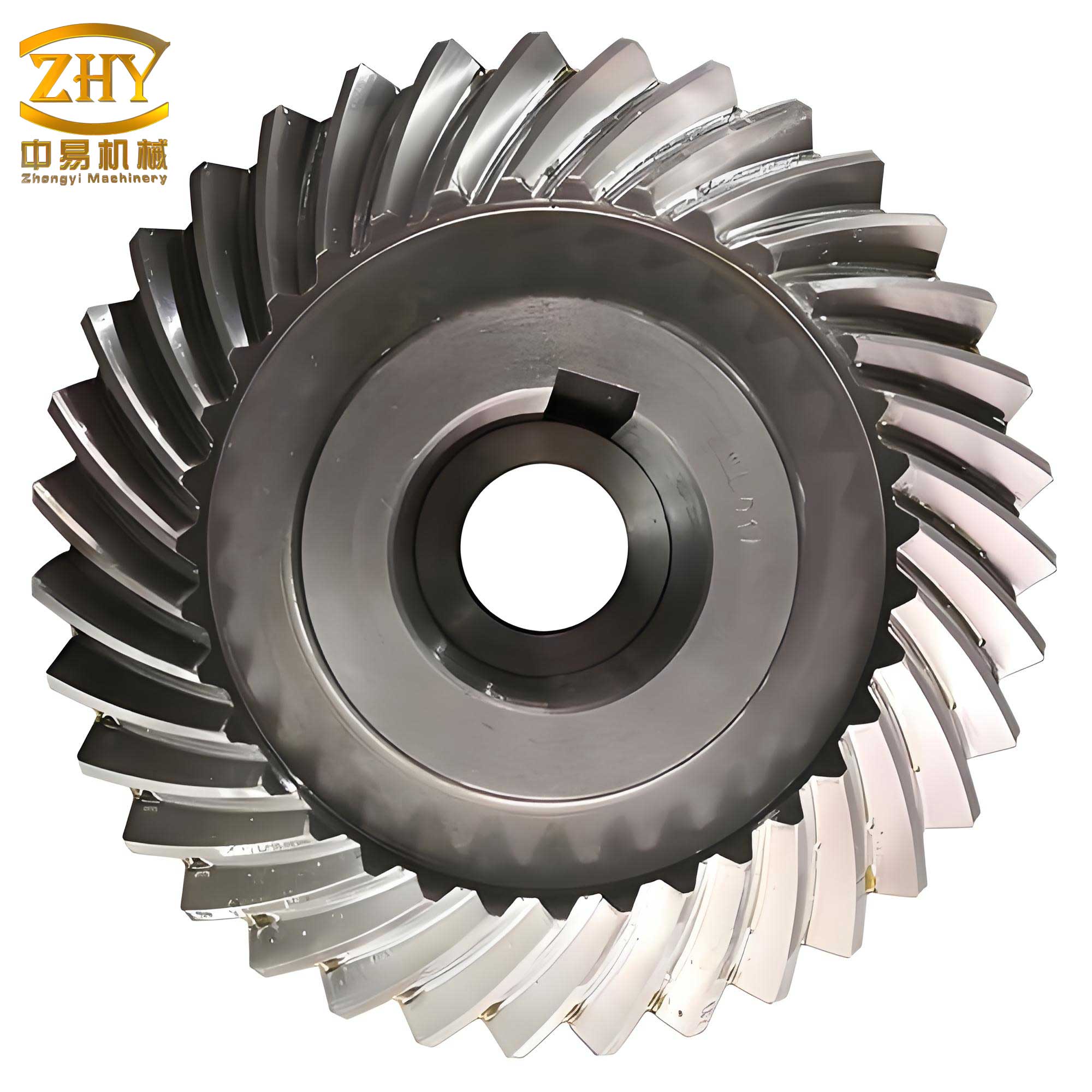
The core component, the spiral gear, is integral to the compressor’s function. Its compact design, with a small module, immediately imposed constraints on the forming process. Precision forging was selected as the primary manufacturing route to achieve net-shape gears, eliminating secondary machining on the tooth flanks. However, the inherent geometry of spiral gears complicates metal flow during deformation. The helix angle induces asymmetric forces, leading to potential fill issues and dimensional inaccuracies. The forging equation for required force can be approximated considering the flow stress and contact area:
$$ F = Y_f \cdot A \cdot K $$
Where \( F \) is the forging force, \( Y_f \) is the flow stress of the material at the forging temperature, \( A \) is the projected area of the forging, and \( K \) is a factor accounting for shape complexity and friction. For spiral gears, the factor \( K \) is significantly higher due to the helical tooth form. A summary of initial forging trials and defects is presented in Table 1.
| Trial Batch | Helix Angle (Degrees) | Preform Design | Major Defect Observed | Fill Percentage (%) |
|---|---|---|---|---|
| 1 | 15 | Simple Cylinder | Incomplete tooth root fill | 78 |
| 2 | 15 | Stepped Preform | Flash formation at tooth tip | 92 |
| 3 | 15 | Preform with lobes | Helix angle distortion | 95 |
To address these forging challenges, the journey began at the very origin: the mold cavity. The accuracy of the forged spiral gears is directly contingent upon the precision of the die. We initiated stringent control from the manufacturing of the electrode used for Electrical Discharge Machining (EDM). High-precision imported CNC machines were employed to fabricate the electrode in a single setup, ensuring its profile accuracy was within a stringent tolerance band, typically below 5 microns. This provided a foundational guarantee for the final gear tooth geometry.
Subsequently, the selection of die material emerged as a pivotal challenge. The material needed to withstand high cyclic stresses without failure while maintaining sufficient toughness to resist cracking. Initial trials with standard hot-work tool steels resulted in premature wear and subtle plastic deformation of the helix profile, which translated into unacceptable gear accuracy. After extensive testing, an optimized material system was identified. The key properties of the selected material versus conventional options are compared in Table 2.
| Material Grade | Hardness (HRC) | Impact Toughness (J) | Thermal Conductivity (W/m·K) | Estimated Life (Cycles) |
|---|---|---|---|---|
| Conventional H13 | 48-50 | 25 | 24 | ~15,000 |
| Optimized Premium Grade | 50-52 | 30 | 28 | >50,000 |
Coupled with material selection, a dedicated heat treatment protocol was developed. The tempering curve was carefully designed to maximize toughness while retaining necessary hardness. The relationship between tempering temperature and hardness can be described by an empirical formula for tool steels:
$$ H = H_0 – k(T – T_0)^n $$
Where \( H \) is the resulting hardness, \( H_0 \) is the as-quenched hardness, \( T \) is the tempering temperature, \( T_0 \) is a reference temperature, and \( k, n \) are material constants. This optimized process not only secured the dimensional fidelity of the forged spiral gears but also dramatically extended die service life.
To enhance production efficiency for these spiral gears, a significant process innovation was implemented: the transition from a single-cavity die holder to a “two-station” die configuration. This redesign integrated two forging operations into a coherent sequence within one press stroke, effectively streamlining the workflow. The impact on the thermal and operational cycle is summarized below. The original process involved multiple reheats (“two-fire, three-forge”), which was energy-intensive and time-consuming. The new “one-fire, three-forge” process can be modeled by analyzing the heat loss. The temperature decay during transfer follows a simplified law:
$$ T(t) = T_{\text{env}} + (T_{\text{start}} – T_{\text{env}}) e^{-bt} $$
Here, \( T(t) \) is the billet temperature at time \( t \), \( T_{\text{env}} \) is the ambient temperature, \( T_{\text{start}} \) is the initial heating temperature, and \( b \) is a cooling constant. Reducing the number of reheats minimizes the integral of heat loss, conserving energy. The comparative analysis is shown in Table 3.
| Process Scheme | Number of Heats | Number of Forging Strokes | Estimated Cycle Time (s) | Energy Consumption Index |
|---|---|---|---|---|
| Traditional Single-Station | 2 | 3 | 45 | 1.00 |
| Innovative Two-Station | 1 | 3 | 28 | 0.65 |
Following successful forging, the spiral gears undergo heat treatment to achieve the required surface hardness and core toughness for enduring operational loads. Initial batches were processed alongside similar bevel gears using established carburizing parameters. While standard hardness and metallographic checks passed, subsequent rigorous bench testing revealed localized spalling on the tooth flanks of some spiral gears. Failure analysis indicated excessive case depth, which increased brittleness in the highly stressed helical teeth. This underscored that spiral gears, due to their complex stress state under torque, require tailored thermal processing. The case depth \( d \) in carburizing is governed by the diffusion equation (Fick’s second law):
$$ \frac{\partial C}{\partial t} = D \frac{\partial^2 C}{\partial x^2} $$
Where \( C \) is carbon concentration, \( t \) is time, \( D \) is the diffusion coefficient (temperature-dependent via \( D = D_0 \exp(-Q/RT) \)), and \( x \) is the depth. For spiral gears, the target effective case depth needed tighter control. We established a new set of parameters for carbonitriding, quenching, and tempering. A critical requirement was dimensional stability: the keyway in the fixed gear and the bore must remain within drawing tolerances, and the outer diameter contraction of the orbiting gear must be controlled to a specific limit, \( \Delta D \leq 0.05 \, \text{mm} \). The optimized thermal process window is defined in Table 4.
| Process Stage | Temperature (°C) | Time (Minutes) | Atmosphere/Coolant | Target Case Depth (mm) |
|---|---|---|---|---|
| Carbonitriding | 850-870 | 90-110 | Endothermic + Ammonia | 0.20-0.25 |
| Quenching | 820-840 | – | Fast oil agitation | – |
| Tempering | 180-200 | 120 | Air | – |
The final, and perhaps most intricate, technical hurdle involved the metrology of the fixed spiral gear’s keyway. For proper assembly and function, this keyway must be symmetric both to the shaft’s central axis and to the space between the helical teeth. The presence of the helix angle means the tooth space centerline is not axial but follows a helical path. This makes establishing a measurement datum exceptionally difficult. Conventional coordinate measuring machines (CMM) struggled with consistent alignment. The geometric relationship is complex. The theoretical center of a tooth space at any cross-section is offset from the gear axis. This offset \( \delta \) varies along the face width \( W \) depending on the helix angle \( \beta \) and the base circle radius \( r_b \):
$$ \delta(z) = \frac{P_z \cdot z}{2\pi} = \frac{W \cdot \tan(\beta) \cdot (z/W)}{2\pi} $$
Simplified for a given end face: $$ \delta \approx \frac{r_b \cdot \tan(\beta)}{2} $$
Where \( P_z \) is the lead, and \( z \) is the axial coordinate. To solve this, we designed and fabricated a dedicated functional gauge. This gauge simulates the mating planetary disk, providing an integral check for assembly interference. It also established a unified measurement baseline and protocol for production quality control. Statistical data from gauge measurement versus theoretical calculation for keyway symmetry is presented in Table 5.
| Gear Sample # | Theoretical Offset \( \delta \) (mm) | Measured Misalignment (mm) | Pass/Fail (Spec: ≤0.03mm) |
|---|---|---|---|
| 1 | 0.125 | 0.012 | Pass |
| 2 | 0.125 | 0.028 | Pass |
| 3 | 0.125 | 0.009 | Pass |
| 4 | 0.125 | 0.035 | Fail |
In conclusion, the development of these automotive compressor spiral gears was a multidimensional engineering endeavor. By systematically addressing the challenges in precision forging through advanced die-making and material science, innovating the forging process layout, meticulously tailoring the heat treatment to the unique demands of spiral gears, and developing novel metrology solutions for geometric verification, a robust and manufacturable design was achieved. The successful series of spiral gears now in production stands as a testament to the integration of fundamental engineering principles with practical problem-solving. The lessons learned, particularly regarding the sensitivity of helical forms to processing parameters, continue to inform our approach to other complex power transmission components. The entire journey reaffirms that mastering the manufacture of precision spiral gears requires a holistic view of the system, from the first spark of the electrode to the final quality audit of the assembled unit.