
In the manufacturing of gear shafts, the isothermal normalizing process plays a critical role in refining the microstructure and improving machinability, which directly impacts the performance in subsequent carburizing and quenching stages. Traditional methods, such as roller hearth furnaces, often lead to inconsistencies in cooling rates and microstructure uniformity, resulting in suboptimal gear shaft properties. To address these challenges, I have developed an intelligent walking beam production line for isothermal normalizing of gear shaft blanks, focusing on green, precise, and intelligent manufacturing. This production line leverages advanced mechanical design, controlled cooling systems, and automated controls to achieve superior results in gear shaft processing.
The walking beam production line comprises several key components: a stepwise controlled cooling chamber, an austenitizing furnace, a material transfer cart, a rapid cooling chamber, an isothermal furnace, a final cooling chamber, and an integrated control system. Each component is designed to handle gear shaft blanks with diameters ranging from 200 to 350 mm, lengths of 400 to 950 mm, and weights of 15 to 50 kg. The production capacity reaches up to 860,000 units annually, with a cycle time of 30 seconds per gear shaft. The austenitizing furnace operates at temperatures up to 1000°C with a uniformity of ±8°C, while the isothermal furnace maintains temperatures up to 700°C with a uniformity of ±5°C, ensuring consistent heat treatment for every gear shaft.
The production process begins with robotic handling of gear shaft blanks from the rolling mill to the controlled cooling chamber, where they are cooled to approximately 450°C. This step utilizes the residual heat from rolling, reducing energy consumption. The gear shafts then enter the austenitizing furnace, where they are heated to 900°C and held for 45 minutes to achieve full austenitization. Afterward, they are transferred to the rapid cooling chamber for cooling to 600–650°C, followed by isothermal treatment at 650°C for 3 hours in the isothermal furnace. Finally, the gear shafts are cooled to room temperature in the final cooling chamber. This seamless automation eliminates manual intervention, enhancing efficiency and consistency in gear shaft production.
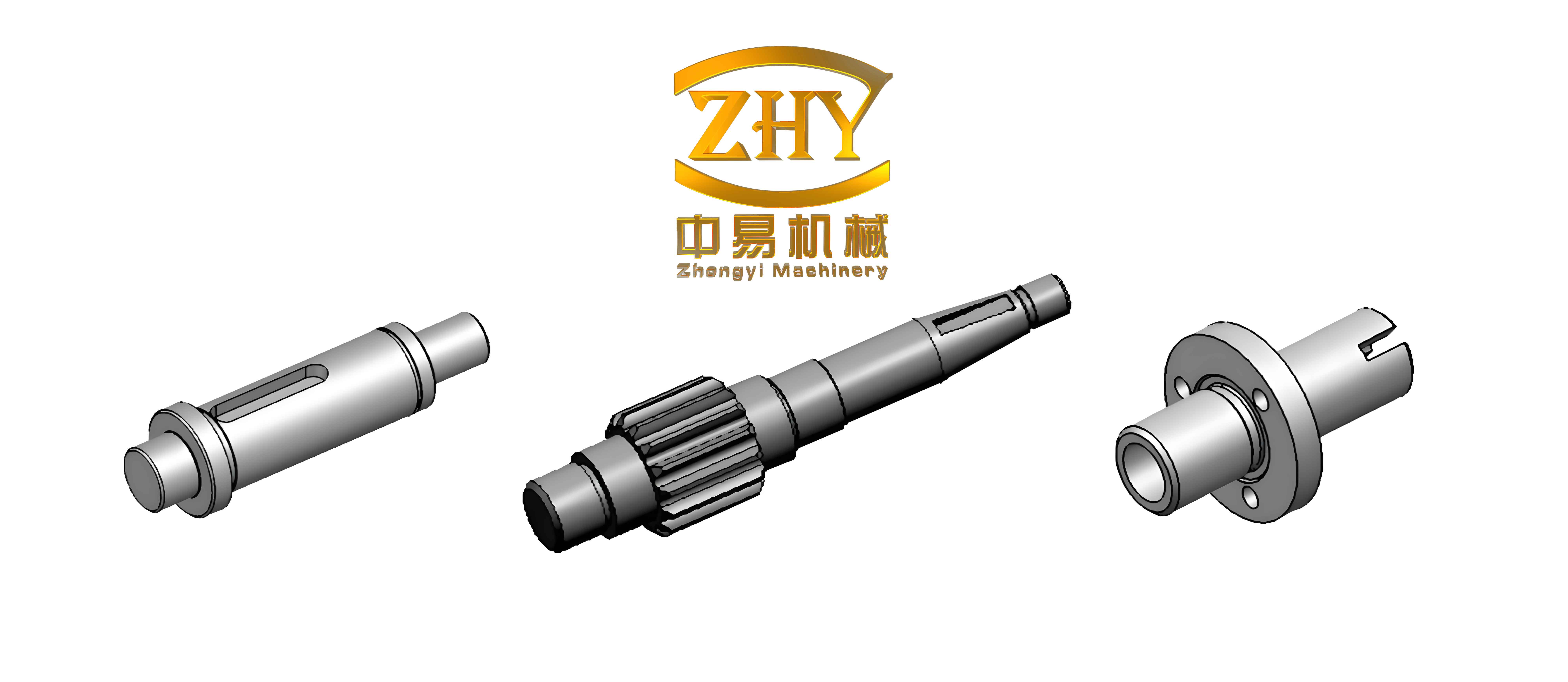
To achieve green manufacturing, the production line optimizes energy usage by leveraging the continuous cooling transformation behavior of gear shaft materials like 8620RH steel. The cooling rate during controlled cooling is maintained at around 0.24°C/s, which ensures the formation of fine ferrite and pearlite microstructures without excessive energy input. The elimination of loading baskets further reduces heat loss and energy consumption. The stepwise motion mechanism, with V-shaped fixed and moving beams, allows gear shafts to rotate during processing, promoting uniform heating and cooling. This design minimizes thermal stress and distortion, contributing to the overall sustainability of gear shaft manufacturing.
Precision in heat treatment is achieved through innovative cooling and heating systems. The cooling chambers employ wedge-shaped air jets, optimized using fluid dynamics simulations to ensure uniform airflow and pressure across all nozzles. This, combined with the rotational movement of gear shafts during stepwise advancement, ensures consistent cooling rates and microstructure development. The temperature uniformity in furnaces is maintained within tight tolerances, leading to homogeneous ferrite and pearlite structures in the gear shaft blanks. This precision reduces the need for excessive machining allowances, improving the overall efficiency of gear shaft production.
The intelligent control system integrates Siemens S7-1500 PLCs with Profibus-DP interfaces and an upper-level human-machine interface (HMI) for real-time monitoring and data logging. This system enables precise parameter control, fault diagnostics, and seamless communication with broader production networks. For instance, the HMI allows operators to set and adjust process parameters, track gear shaft movement, and export production data, ensuring high repeatability and quality in gear shaft treatment. The automation reduces human error and enhances the reliability of the isothermal normalizing process for gear shafts.
In practical applications, the production line has been used to process 8620RH steel gear shaft blanks, resulting in uniform hardness and microstructure. The hardness values measured at various sections of the gear shaft blanks show minimal variation, with an average of 155 HBW and a scatter of ±1 HBW. This consistency improves machinability and reduces grinding allowances by approximately 0.05 mm. Microstructural analysis reveals fine and evenly distributed ferrite and pearlite, which provides an ideal foundation for subsequent carburizing and quenching of the gear shaft. The table below summarizes the hardness test results at different positions on the gear shaft blanks, demonstrating the high uniformity achieved.
| Section | Surface Hardness (HBW) | Hardness at 1/4 Diameter (HBW) |
|---|---|---|
| A | 155, 156, 154, 155 | 155, 155, 155, 154 |
| B | 156, 156, 155, 156 | 155, 156, 155, 155 |
| C | 155, 156, 154, 155 | 154, 156, 155, 156 |
| D | 154, 155, 155, 156 | 154, 156, 155, 156 |
| E | 154, 155, 156, 155 | 155, 156, 155, 154 |
| F | 155, 155, 155, 156 | 156, 156, 155, 155 |
| G | 154, 155, 156, 155 | 156, 155, 155, 155 |
| H | 155, 156, 154, 154 | 155, 156, 156, 156 |
The microstructural uniformity in gear shaft blanks can be described using phase transformation kinetics. For example, the time-temperature-transformation (TTT) diagram for 8620RH steel indicates that isothermal holding at 650°C promotes the formation of ferrite and pearlite. The cooling rate $v_c$ during controlled cooling is critical and can be expressed as:
$$v_c = \frac{\Delta T}{\Delta t}$$
where $\Delta T$ is the temperature drop and $\Delta t$ is the time interval. For gear shaft blanks, maintaining $v_c < 0.93\,^\circ\text{C/s}$ ensures the avoidance of bainite or martensite formation. The stepwise cooling process in the production line adheres to this requirement, resulting in optimal microstructure for the gear shaft.
Furthermore, the heat transfer during cooling can be modeled using Newton’s law of cooling:
$$q = h \cdot A \cdot (T_s – T_\infty)$$
where $q$ is the heat flux, $h$ is the heat transfer coefficient, $A$ is the surface area of the gear shaft, $T_s$ is the surface temperature, and $T_\infty$ is the ambient temperature. The wedge-shaped jet design ensures uniform $h$ across the gear shaft surface, minimizing thermal gradients and distortion.
The walking beam mechanism enhances heating uniformity by rotating the gear shaft during each step. The step sequence—lift, advance, lower, retreat—ensures that every part of the gear shaft is exposed evenly to the furnace environment. This reduces radial temperature differences and improves the overall quality of the gear shaft. The table below outlines the key technical parameters of the production line for gear shaft processing.
| Parameter | Value |
|---|---|
| Maximum Diameter of Gear Shaft | 350 mm |
| Length of Gear Shaft | 400–950 mm |
| Weight of Gear Shaft | 15–50 kg |
| Production Capacity | 860,000 units/year |
| Cycle Time | 30 seconds/unit |
| Austenitizing Temperature | Up to 1000°C |
| Isothermal Temperature | Up to 700°C |
| Temperature Uniformity | ±8°C (Austenitizing), ±5°C (Isothermal) |
In conclusion, the walking beam isothermal normalizing production line represents a significant advancement in gear shaft heat treatment technology. By integrating green, precise, and intelligent features, it ensures consistent microstructure and hardness in gear shaft blanks, leading to improved machinability and reduced energy consumption. The automated system enhances productivity and reliability, making it ideal for high-volume manufacturing of gear shafts. Future developments could focus on further optimizing cooling strategies and expanding the application to other types of gear shaft materials.