
In my years of experience in the manufacturing industry, I have witnessed a significant transformation in the production of spiral bevel gears. These gears are crucial components in various applications, including automotive transmissions, aerospace systems, and industrial machinery, due to their ability to transmit power between non-parallel shafts with high efficiency and smooth operation. However, traditional manufacturing methods for spiral bevel gears have long been plagued by inefficiencies, inconsistencies, and low precision, which hinder productivity and quality. The advent of digital manufacturing technologies has revolutionized this field, enabling high-precision, consistent, and efficient production. In this article, I will delve into the key technologies involved in the digital manufacturing process of spiral bevel gears, emphasizing how these advancements address the limitations of conventional approaches.
Traditional manufacturing of spiral bevel gears typically involves a trial-and-error process where the pinion is adjusted based on contact pattern observations until it matches the gear. This method relies heavily on operator skill and experience, leading to prolonged setup times, variable quality, and non-unique tooth surfaces that complicate replacement. In contrast, digital manufacturing integrates design, simulation, machining, and inspection into a cohesive digital thread, ensuring repeatability and accuracy. The core of this approach lies in several key technologies: digital modeling of tooth surfaces, simulation of contact patterns, intelligent acquisition and adjustment of machining parameters, digital machining, and digital inspection. These elements work together to achieve tooth surface errors as low as ±0.005 mm, a feat unattainable with traditional methods.
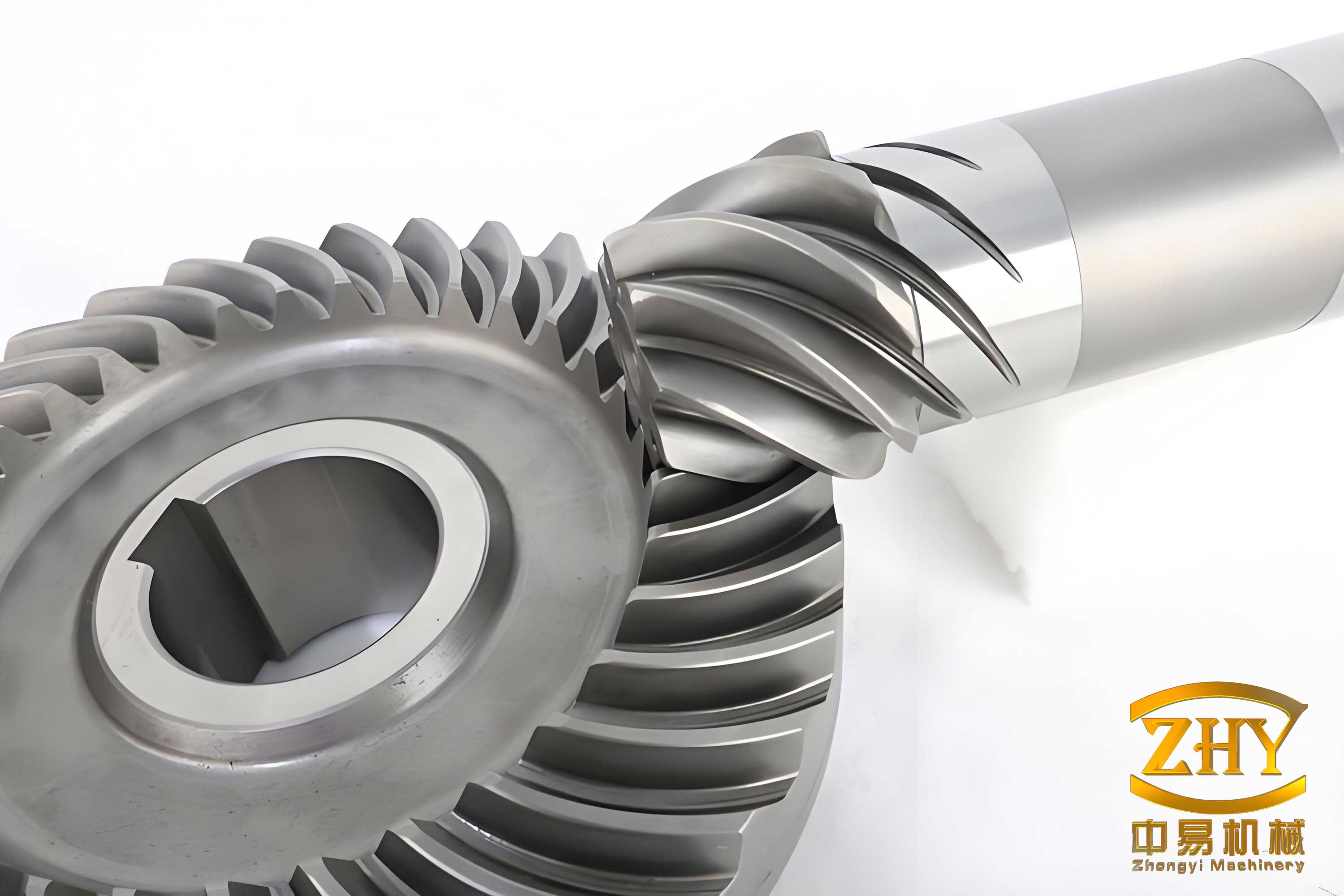
The digital manufacturing process for spiral bevel gears begins with precise three-dimensional modeling of the tooth surfaces. Based on design specifications such as module, pressure angle, spiral angle, and number of teeth, software tools like KIMOS from Klingelnberg or G-AGE from Gleason are commonly used in industry to generate accurate digital models. These models serve as the foundation for all subsequent steps. The tooth surface geometry can be described mathematically using complex equations. For instance, the position vector of a point on the tooth surface of a spiral bevel gear can be expressed in a coordinate system related to the gear blank. A simplified representation involves parametric equations that account for the curvature and spiral nature. For example, the surface may be defined as:
$$ \mathbf{r}(u, v) = \begin{bmatrix} x(u, v) \\ y(u, v) \\ z(u, v) \end{bmatrix} $$
where \( u \) and \( v \) are parameters, and the functions \( x, y, z \) incorporate design parameters like pitch cone angle and spiral curve. In practice, these models are built using numerical methods to ensure they match the theoretical design. This digital representation allows for easy manipulation and analysis, forming the basis for simulation and machining.
Once the digital model is established, the next step is simulation of the contact pattern, also known as tooth contact analysis (TCA). This involves virtually meshing the gear and pinion to predict their contact behavior under load. The simulation helps optimize the tooth surface for desired contact patterns, ensuring proper load distribution and minimal noise. The contact pattern is visualized as an elliptical area on the tooth flank, and its position and size are critical for performance. Through iterative simulations, engineers can adjust design parameters to achieve an ideal contact pattern before any physical machining occurs. This process eliminates the need for physical trial assemblies, saving time and resources. The simulation output includes data on transmission errors, stress distribution, and contact pressures, which are used to refine the design. For spiral bevel gears, the contact pattern simulation is often based on solving equations of meshing, which can be expressed as:
$$ f(\phi_1, \phi_2, \mathbf{r}) = 0 $$
where \( \phi_1 \) and \( \phi_2 \) are the rotation angles of the gear and pinion, and \( \mathbf{r} \) is the position vector on the tooth surface. Advanced software automates this simulation, providing detailed reports that guide the manufacturing process.
After simulation, the digital model is used to generate machining parameters automatically. This is a key advantage of digital manufacturing: the ability to derive machine settings and tool designs directly from the digital twin. For spiral bevel gears, machining parameters include machine axis positions, cutter geometry, feed rates, and speeds. These parameters are encapsulated in a “setup sheet” or adjustment card that controls the gear cutting or grinding machine. The relationship between design parameters and machining parameters can be summarized using mathematical models. For example, the machine settings for a spiral bevel gear grinding process might involve calculations based on the following formula for cutter head tilt:
$$ \theta = \arctan\left(\frac{\Delta y}{\Delta x}\right) $$
where \( \theta \) is the tilt angle, and \( \Delta x, \Delta y \) are offsets derived from the tooth surface model. Tables are often used to organize these parameters for clarity. Below is a simplified table summarizing key machining parameters for spiral bevel gears:
| Parameter | Description | Typical Range |
|---|---|---|
| Cutter Diameter | Diameter of the grinding or cutting tool | 100-300 mm |
| Spiral Angle | Angle of the tooth spiral | 25°-45° |
| Pressure Angle | Angle defining tooth profile | 20°-25° |
| Machine Center Distance | Distance between gear and tool axes | Variable based on design |
| Cutter Head Tilt | Adjustment for tooth surface curvature | ±5° |
These parameters are optimized through digital simulations to ensure the machined tooth surfaces match the theoretical model. The automation of this step reduces human error and enables consistent production across batches.
With the machining parameters set, the actual manufacturing of spiral bevel gears proceeds using CNC (Computer Numerical Control) machines. These machines interpret the digital instructions to cut or grind the gear teeth with high precision. The process involves multiple operations, such as rough cutting, finishing, and heat treatment, all controlled digitally. During machining, real-time monitoring systems may be employed to detect deviations and make corrections. The accuracy of digital machining for spiral bevel gears is significantly higher than traditional methods, with tooth surface tolerances achievable within micrometers. This precision is crucial for applications requiring high performance and durability. The digital thread ensures that each gear is produced identically, facilitating interchangeability and reducing waste.
Post-machining, digital inspection plays a vital role in verifying the quality of spiral bevel gears. Instead of relying on manual contact pattern checks, coordinate measuring machines (CMMs) or dedicated gear measuring instruments are used to capture the actual tooth surface geometry. These devices are equipped with software that can import the digital model of the gear, automatically generate measurement programs, and compare the measured data with the theoretical surfaces. The inspection report typically includes a topography map of the tooth surface, showing deviations at specific points. For spiral bevel gears, it is common to evaluate 45 points arranged in a 9-column by 5-row grid across the tooth flank. The coordinates of these points are compared to the theoretical values, and the differences are visualized in a color-coded map. The deviation at each point can be calculated as:
$$ \delta_i = \sqrt{(x_i – X_i)^2 + (y_i – Y_i)^2 + (z_i – Z_i)^2} $$
where \( (x_i, y_i, z_i) \) are the measured coordinates and \( (X_i, Y_i, Z_i) \) are the theoretical coordinates for point \( i \). This quantitative assessment allows for precise identification of errors, such as crowning or twist, which can then be corrected by adjusting machining parameters.
The most critical aspect of digital manufacturing for spiral bevel gears is the feedback loop for parameter adjustment. Based on the inspection results, machining parameters are refined iteratively to minimize deviations from the theoretical surface. This process, known as parameter reverse adjustment or compensation, leverages optimization algorithms to compute optimal changes. For example, if the topography map shows a systematic error, the software might suggest modifications to the cutter path or machine settings. The goal is to achieve a tooth surface that not only matches the design but also produces the desired contact pattern under load. This optimization can be formulated as a least-squares problem:
$$ \min_{\mathbf{p}} \sum_{i=1}^{45} \left( \mathbf{r}_{\text{meas},i} – \mathbf{r}_{\text{theo},i}(\mathbf{p}) \right)^2 $$
where \( \mathbf{p} \) is the vector of machining parameters, and \( \mathbf{r}_{\text{meas},i} \) and \( \mathbf{r}_{\text{theo},i} \) are the measured and theoretical position vectors, respectively. Through this digital feedback, adjustments that once required numerous physical trials can now be completed in one or two iterations, dramatically reducing time and cost while improving accuracy.
To illustrate the overall digital manufacturing workflow for spiral bevel gears, I have summarized the key steps in the table below, highlighting the technologies involved and their benefits:
| Step | Technology Used | Key Activities | Outcome |
|---|---|---|---|
| Digital Modeling | CAD/CAE Software (e.g., KIMOS, G-AGE) | Create 3D tooth surface model from design specs | Theoretical digital twin of spiral bevel gears |
| Simulation | Tooth Contact Analysis (TCA) | Simulate meshing and contact patterns under load | Optimized design with predicted performance |
| Parameter Generation | Automated Algorithm | Derive machining parameters from digital model | Setup sheet for CNC machines |
| Digital Machining | CNC Gear Grinding/Cutting Machines | Execute machining with digital instructions | Physical spiral bevel gears with high precision |
| Digital Inspection | CMM or Gear Measuring Machines | Measure actual tooth surface and compare to model | Topography map showing deviations |
| Parameter Adjustment | Optimization Software | Adjust machining parameters based on inspection data | Refined process for improved accuracy |
The integration of these technologies into a digital manufacturing ecosystem enables a seamless flow of information from design to production, ensuring that spiral bevel gears meet stringent quality standards. Moreover, the use of digital twins allows for virtual testing and validation, reducing the need for physical prototypes. This is particularly beneficial in industries like aerospace and automotive, where reliability and performance are paramount.
In terms of mathematical foundations, the design and manufacturing of spiral bevel gears involve complex geometry and kinematics. The tooth surface is often generated based on the principle of conjugate surfaces, where the gear and pinion surfaces are derived from a common generating process. For example, in the Gleason method, the tooth surface is generated by simulating the rolling of a virtual crown gear. The equations governing this process can be expressed using coordinate transformations. Let \( \mathbf{r}_g \) be the position vector in the gear coordinate system, and \( \mathbf{r}_c \) in the cutter coordinate system. The transformation involves rotation matrices \( \mathbf{R} \) and translation vectors \( \mathbf{d} \):
$$ \mathbf{r}_g = \mathbf{R}(\phi) \cdot \mathbf{r}_c + \mathbf{d} $$
where \( \phi \) is the rotation angle. These transformations are embedded in the digital modeling software, allowing for accurate representation of the tooth surfaces. Additionally, the contact conditions between mating spiral bevel gears are described by equations that ensure continuous tangency along the contact path. These equations are solved numerically during simulation to predict the contact pattern.
Looking ahead, the digital manufacturing of spiral bevel gears is poised to benefit from advancements in artificial intelligence and machine learning. Predictive algorithms could further optimize machining parameters based on historical data, and real-time adaptive control could enhance accuracy during production. The trend towards Industry 4.0 and smart factories will likely integrate spiral bevel gear manufacturing into interconnected systems, where data from sensors and machines is analyzed to improve efficiency and quality. As a practitioner in this field, I believe that embracing these digital technologies is essential for staying competitive and meeting the evolving demands of modern engineering applications.
In conclusion, the digital manufacturing process for spiral bevel gears represents a paradigm shift from traditional, skill-dependent methods to a data-driven, precise, and efficient approach. By leveraging digital modeling, simulation, intelligent parameter acquisition, digital machining, and inspection, manufacturers can achieve unprecedented levels of accuracy and consistency. The key technologies discussed here—from tooth contact analysis to parameter reverse adjustment—form a cohesive framework that ensures high-quality production of spiral bevel gears. As these technologies continue to evolve, they will further enhance the capabilities of industries relying on spiral bevel gears, driving innovation and performance in mechanical power transmission systems.