
In the field of mechanical engineering, hyperboloid gears are critical components widely used in automotive, aerospace, and industrial applications due to their ability to transmit motion between non-parallel and non-intersecting shafts. The dynamic performance and longevity of hyperboloid gear systems heavily depend on the accuracy and condition of the tooth surfaces. However, during operation, factors such as manufacturing errors, installation misalignments, and poor lubrication can lead to tooth surface wear, which degrades performance. To accurately predict the dynamic behavior and service life of hyperboloid gears with worn surfaces, it is essential to develop precise digital models of the real tooth surfaces. Traditional modeling approaches often struggle with limited measurement data and the irregular nature of wear patterns. This paper presents a novel method for constructing digital real tooth surfaces of hyperboloid gears using non-geometric-feature segmentation and advanced interpolation techniques, addressing the challenges of wear-inclusive modeling.
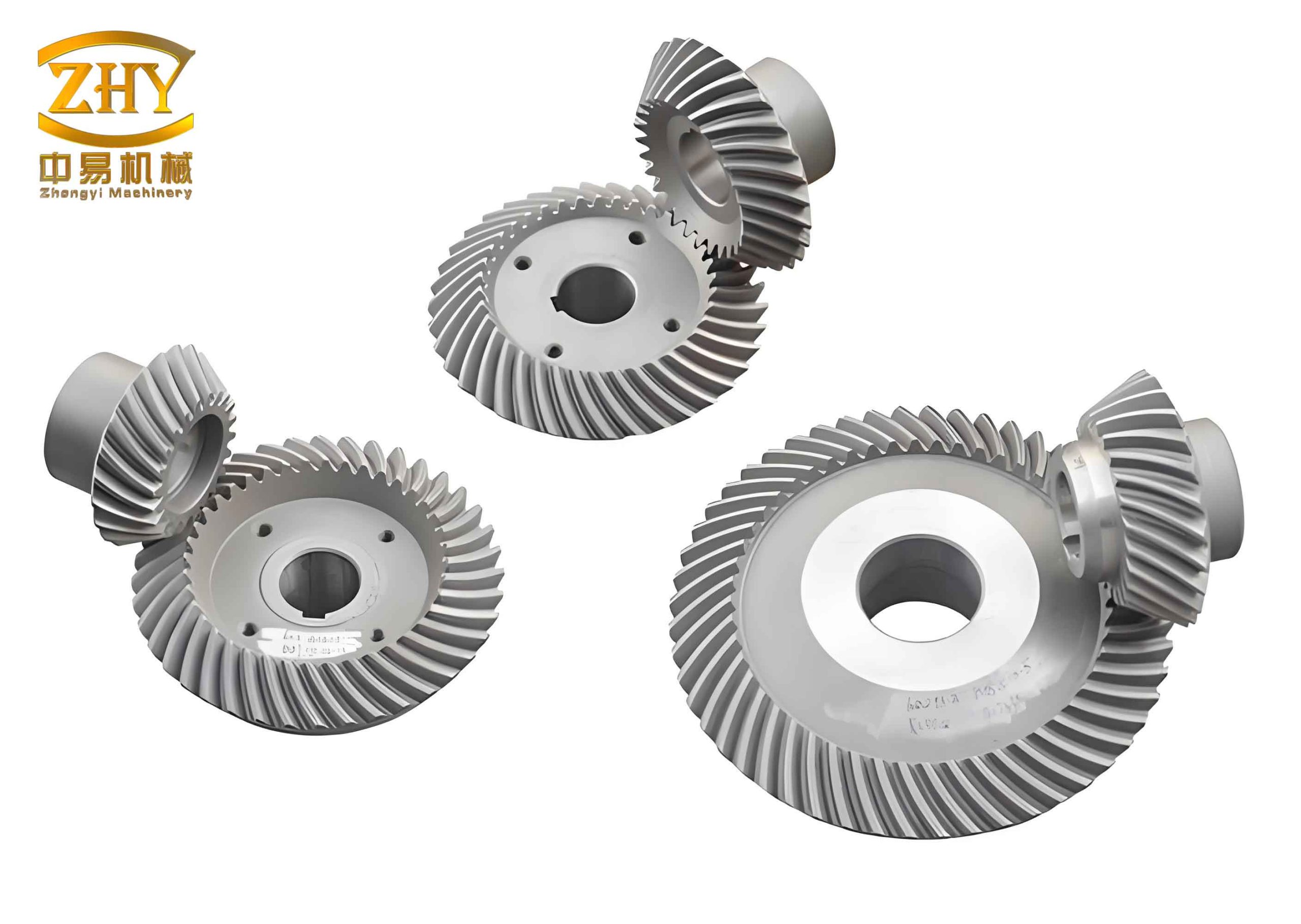
The importance of hyperboloid gears in high-performance transmissions cannot be overstated. These gears enable efficient power transfer in compact designs, but their complex geometry makes surface modeling challenging. Existing methods for digital tooth surface reconstruction primarily fall into two categories: interpolation-based and fitting-based approaches. Interpolation methods, such as linear or area-weighted interpolation, aim to construct surfaces that pass through measured data points, offering high accuracy but often requiring extensive smoothing operations that can compromise computational efficiency. Fitting methods, like NURBS (Non-Uniform Rational B-Spline) surface approximation, provide smoother surfaces but may not fully capture local deviations, such as wear zones, as they prioritize global smoothness over point-wise accuracy. For hyperboloid gears with wear, these limitations become pronounced, as wear regions exhibit irregular patterns that are not easily represented by standard techniques. Therefore, a method that combines accurate local interpolation with efficient data segmentation is needed to model hyperboloid gear surfaces realistically.
Our approach focuses on leveraging non-geometric-feature segmentation to identify wear areas on hyperboloid gear tooth surfaces, followed by a refined interpolation algorithm that compensates for construction errors. This method minimizes computational load while enhancing the precision and smoothness of the digital model. We begin by discussing the theoretical foundation of hyperboloid gear tooth surfaces, then detail the segmentation and interpolation processes, and finally validate the method through comparative examples. The goal is to provide a robust framework for hyperboloid gear digital twin creation, facilitating dynamic simulation and lifecycle analysis.
The theoretical tooth surface of a hyperboloid gear can be derived from the cutting tool kinematics. In the gear coordinate system \( S_g \), the theoretical surface \( \Sigma_g \) is represented by position vector \( \mathbf{r}_g \) and unit normal vector \( \mathbf{n}_g \), parameterized by tool coordinates \( u \) and \( \theta \):
$$ \mathbf{r}_g = \mathbf{r}_g(u, \theta), \quad \mathbf{n}_g = \mathbf{n}_g(u, \theta). $$
The surface is generated as the envelope of the cutter edge trajectory. Using coordinate transformations, the surface in the measurement coordinate system \( S_m \) is given by:
$$ \mathbf{r}_m = \mathbf{M}_{mg} \mathbf{r}_g, $$
where \( \mathbf{M}_{mg} \) is the transformation matrix from \( S_g \) to \( S_m \). For real tooth surfaces with wear, the measured points deviate from the theoretical surface. The measured data from a coordinate measuring machine (CMM) includes offsets \( \lambda \) due to wear, expressed as:
$$ \mathbf{R}_m(u, \theta) = \mathbf{r}_m(u, \theta) + \lambda \mathbf{n}_m(u, \theta). $$
This deviation is critical for modeling wear zones accurately. Our method processes these discrete measured points to construct a digital surface that reflects real-world conditions.
To handle the discrete data efficiently, we first perform Delaunay triangulation directly in 3D space. Unlike traditional 2D projection methods, 3D triangulation preserves spatial angles, improving mesh quality. Given scan lines \( \lambda_i \) with measured points, we connect adjacent lines and apply the minimum interior angle maximization criterion to form triangles. This results in a triangular mesh that approximates the tooth surface topology. The process ensures that all measured points are incorporated into a coherent structure, which is essential for subsequent segmentation.
The core of our method is non-geometric-feature segmentation, which partitions the triangular mesh into regions based on surface normal variations rather than predefined geometric features. This is particularly effective for identifying wear areas, which often lack regular shapes. For each triangle in the mesh, termed the center triangle \( \text{CenTri} \), we calculate its normal vector \( \mathbf{n} \) and the normals of its adjacent triangles \( \mathbf{n}_i \) (where \( i = 1, 2, 3 \)). The angles \( \delta_i \) between \( \mathbf{n} \) and \( \mathbf{n}_i \) are computed. We then evaluate a parameter \( T \) for each center triangle:
$$ T = \max(|\delta_1 – \delta_2|, |\delta_2 – \delta_3|, |\delta_1 – \delta_3|) – \min(|\delta_1 – \delta_2|, |\delta_2 – \delta_3|, |\delta_1 – \delta_3|). $$
The triangle with the smallest \( T \) value is selected as the starting triangle \( \text{StaTri} \). Segmentation proceeds by iteratively adding adjacent triangles with minimal normal angle differences, forming regions of consistent surface behavior. Triangles that do not satisfy the angle consistency criteria are flagged as potential wear zones. This segmentation isolates irregular areas, allowing for targeted interpolation and reducing overall computation.
Once wear regions are identified, we apply a localized interpolation algorithm to reconstruct the surface in these areas. We use NURBS surfaces for their flexibility and accuracy. A bicubic NURBS surface is defined as:
$$ P(u,v) = \frac{\sum_{i=1}^m \sum_{j=1}^n B_{i,3}(u) B_{j,3}(v) \omega_{ij} V_{ij}}{\sum_{i=1}^m \sum_{j=1}^n B_{i,3}(u) B_{j,3}(v) \omega_{ij}}, \quad u,v \in [0,1], $$
where \( V_{ij} \) are control points, \( \omega_{ij} \) are weights, and \( B_{i,3}(u) \) and \( B_{j,3}(v) \) are cubic B-spline basis functions. The basis functions are computed recursively:
$$ B_{i,0}(u) = \begin{cases} 1 & \text{if } u_i \leq u \leq u_{i+1} \\ 0 & \text{otherwise} \end{cases}, $$
$$ B_{i,k}(u) = \frac{u – u_i}{u_{i+k} – u_i} B_{i,k-1}(u) + \frac{u_{i+k+1} – u}{u_{i+k+1} – u_{i+1}} B_{i+1,k-1}(u), \quad k \geq 1. $$
For interpolation, we adjust control points and weights to minimize the error between the NURBS surface and measured points in wear zones. The interpolation error \( \Delta E_i \) at a point is compensated by solving linear systems for control point adjustments \( \Delta V_i \) and weight adjustments \( \Delta \omega_i \). The equations are derived from the NURBS formulation:
$$ \sum B_{i,3}(u_j) \omega_i V_i + \sum B_{i,3}(u_j) (\omega_i \Delta V_i + V_i \Delta \omega_i + \Delta \omega_i \Delta V_i) – \sum B_{i,3}(u_j) \omega_i V_i(u_j) = \Delta E_i. $$
For computational efficiency, we solve for \( \Delta V_i \) with \( \Delta \omega_i = 0 \) and for \( \Delta \omega_i \) with \( \Delta V_i = 0 \) separately. The matrix forms are:
$$ \begin{bmatrix} b_{1,2} & b_{1,3} & 0 & \cdots & 0 \\ b_{2,2} & b_{2,3} & b_{2,4} & \cdots & 0 \\ \vdots & \vdots & \vdots & \ddots & \vdots \\ 0 & \cdots & b_{n,n-1} & b_{n,n} & b_{n,n+1} \\ 0 & \cdots & 0 & b_{n+1,n} & b_{n+1,n+1} \end{bmatrix} \begin{bmatrix} \Delta V_2 \\ \Delta V_3 \\ \vdots \\ \Delta V_n \\ \Delta V_{n+1} \end{bmatrix} = \begin{bmatrix} a_1 \Delta E_1 \\ a_2 \Delta E_2 \\ \vdots \\ a_n \Delta E_n \\ a_{n+1} \Delta E_{n+1} \end{bmatrix}, $$
where \( a_j = \sum B_{i,3}(u_j) \omega_i \) and \( b_{j,i} = \sum B_{i,3}(u_j) \omega_i \). Similarly, for weight adjustments:
$$ \begin{bmatrix} J_{1,2} & J_{1,3} & 0 & \cdots & 0 \\ J_{2,2} & J_{2,3} & J_{2,4} & \cdots & 0 \\ \vdots & \vdots & \vdots & \ddots & \vdots \\ 0 & \cdots & J_{n,n-1} & J_{n,n} & J_{n,n+1} \\ 0 & \cdots & 0 & J_{n+1,n} & J_{n+1,n+1} \end{bmatrix} \begin{bmatrix} \omega_1 \Delta \omega_1 \\ \omega_2 \Delta \omega_2 \\ \vdots \\ \omega_n \Delta \omega_n \\ \omega_{n+1} \Delta \omega_{n+1} \end{bmatrix} = \begin{bmatrix} \sum N_{i,3}(u_1) \Delta E_1 \\ \sum N_{i,3}(u_2) \Delta E_2 \\ \vdots \\ \sum N_{i,3}(u_n) \Delta E_n \\ \sum N_{i,3}(u_{n+1}) \Delta E_{n+1} \end{bmatrix}, $$
where \( J_{j,i} = B_{i,3}(u_j) \cdot \Gamma_i \Delta E_i \), with \( \Gamma_i \) as the tangential vector of \( V_i – V_i(u) \), and \( N_{i,3} \) as the normal vector. This localized interpolation ensures that wear zone data is accurately represented without affecting the entire surface.
To enhance surface smoothness while preserving wear details, we improve traditional fairing algorithms. Instead of removing “noise points,” we relocate them based on curvature analysis. The curvature \( \kappa(u_i) \) at a point \( P(u_i) \) on the NURBS curve is calculated as:
$$ \kappa(u_i) = \frac{|\mathbf{P}'(u_i) \times \mathbf{P}”(u_i)|}{|\mathbf{P}'(u_i)|^3}, $$
where \( \mathbf{P}'(u_i) \) and \( \mathbf{P}”(u_i) \) are first and second derivatives. Points where the curvature product with neighbors is negative are identified as noise:
$$ \Delta \kappa_i^- \cdot \Delta \kappa_i^+ < 0, \quad \Delta \kappa_i^- = \kappa(u_i) – \kappa(u_{i-1}), \quad \Delta \kappa_i^+ = \kappa(u_{i+1}) – \kappa(u_i). $$
For such points, we compute a new position \( V_j’ \) to smooth the surface:
$$ V_j’ = \frac{(t_{j+2} – t_j)^2 l_j + (t_j – t_{j-2})^2 h_j}{(t_{j+2} – t_j)^2 – (t_j – t_{j-2})^2}, $$
$$ l_j = \frac{(t_{j+1} – t_{j-1}) V_{j-1} – (t_{j+1} – t_{j-2}) V_j}{t_{j+1} – t_{j-2}}, \quad h_j = \frac{(t_{j+1} – t_{j-1}) V_{j+1} – (t_{j+2} – t_{j-1}) V_j}{t_{j+2} – t_{j-1}}, $$
where \( t_j \) are node vectors. This relocation maintains data integrity while improving continuity, crucial for hyperboloid gear dynamic simulations.
We validate our method with an example of a hyperboloid gear pair used in automotive applications. The gear parameters are summarized in Table 1, and the pinion machine settings in Table 2. The gears were tested under load for wear simulation, and tooth surfaces were measured using a scanning CMM. We compare our non-geometric-feature segmentation and interpolation method with a traditional area-weighted interpolation method. The wear zones were identified through segmentation, and interpolation was applied locally.
| Parameter | Pinion | Gear |
|---|---|---|
| Number of Teeth | 6 | 37 |
| Module (mm) | 8.243 | — |
| Hand of Spiral | Left | Right |
| Shaft Angle (°) | 90 | |
| Offset Distance (mm) | 31.75 | |
| Face Width (mm) | 45.12 | 40 |
| Pitch Cone Angle (°) | 11°43′ | 77°58′ |
| Face Cone Angle (°) | 16°3′ | 78°26′ |
| Root Cone Angle (°) | 11°15′ | 73°31′ |
| Outer Cone Distance (mm) | 155.35 | 155.92 |
| Outer Diameter (mm) | 84.07 | 305.52 |
| Parameter | Concave Side | Convex Side |
|---|---|---|
| Cutter Diameter (cm) | 22.7 | 22.2 |
| Cutter Blade Angle (°) | 14 | 35 |
| Workpiece Installation Angle (°) | -3 | -4°5′ |
| Machine Center to Workpiece Distance (mm) | 5.26 | 10.57 |
| Blank Offset (mm) | 22.60 | 37.56 |
| Eccentric Angle (°) | 55°53′ | 68°4′ |
| Ratio of Roll | 0.6802 | 0.8301 |
The accuracy of the digital surfaces was evaluated by comparing constructed points with measured points in wear zones. The absolute error \( \Delta e \) is defined as the difference in position vector magnitudes. For a constructed point \( p_i \) with coordinates \( (x_i, y_i, z_i) \) and a measured point \( p_i’ \) with coordinates \( (x_i’, y_i’, z_i’) \), the error is:
$$ \Delta e = | \sqrt{x_i^2 + y_i^2 + z_i^2} – \sqrt{x_i’^2 + y_i’^2 + z_i’^2} |. $$
Table 3 shows the error comparison for a scan line in the wear zone after 5,000 km of simulated operation, using the area-weighted interpolation method. Table 4 presents the results using our proposed method. The data clearly indicates that our method reduces errors significantly, achieving precision within 3.6 μm, compared to over 20 μm with the traditional method. This demonstrates the effectiveness of non-geometric-feature segmentation in targeting wear areas and the improved interpolation algorithm in enhancing accuracy.
| Point | Measured Point (x’, y’, z’) mm | Constructed Point (x, y, z) mm | Absolute Error Δe (μm) |
|---|---|---|---|
| 1 | (63.3807, -26.2622, 171.2455) | (63.3807, -26.2622, 171.2455) | 0.245 |
| 2 | (61.4428, -21.3597, 166.5882) | (61.4428, -21.3597, 166.5882) | 4.051 |
| 3 | (59.4737, -16.6866, 161.7131) | (59.4737, -16.6866, 161.7130) | 15.553 |
| 4 | (57.4743, -12.2529, 156.6297) | (57.4743, -12.2529, 156.6297) | 21.798 |
| 5 | (55.4455, -8.0690, 151.3496) | (55.4455, -8.0690, 151.3496) | 17.128 |
| 6 | (53.3881, -4.1443, 145.8840) | (53.3881, -4.1443, 145.8840) | 11.975 |
| 7 | (51.3031, -0.4880, 140.2448) | (51.3031, -0.4880, 140.2448) | 10.240 |
| 8 | (49.1915, 2.8913, 134.4445) | (49.1915, 2.8913, 134.4445) | 9.986 |
| 9 | (47.0542, 5.9853, 128.4961) | (47.0542, 5.9853, 128.4961) | 5.383 |
| 10 | (44.8922, 8.7866, 122.4128) | (44.8922, 8.7866, 122.4128) | 3.437 |
| 11 | (41.0500, 6.0853, 124.1855) | (41.0499, 6.0853, 124.1855) | 1.375 |
| Point | Measured Point (x’, y’, z’) mm | Constructed Point (x, y, z) mm | Absolute Error Δe (μm) |
|---|---|---|---|
| 1 | (63.3807, -26.2622, 171.2455) | (63.3807, -26.2622, 171.2455) | 0.224 |
| 2 | (61.4428, -21.3597, 166.5882) | (61.4428, -21.3597, 166.5882) | 0.539 |
| 3 | (59.4737, -16.6866, 161.7131) | (59.4737, -16.6866, 161.7131) | 3.146 |
| 4 | (57.4743, -12.2529, 156.6297) | (57.4743, -12.2529, 156.6297) | 3.265 |
| 5 | (55.4455, -8.0690, 151.3496) | (55.4455, -8.0690, 151.3496) | 3.176 |
| 6 | (53.3881, -4.1443, 145.8840) | (53.3881, -4.1443, 145.8840) | 2.550 |
| 7 | (51.3031, -0.4880, 140.2448) | (51.3031, -0.4880, 140.2448) | 3.544 |
| 8 | (49.1915, 2.8913, 134.4445) | (49.1915, 2.8913, 134.4445) | 3.164 |
| 9 | (47.0542, 5.9853, 128.4961) | (47.0542, 5.9853, 128.4961) | 2.538 |
| 10 | (44.8922, 8.7866, 122.4128) | (44.8922, 8.7866, 122.4128) | 2.335 |
| 11 | (41.0500, 6.0853, 124.1855) | (41.0450, 6.0853, 124.1855) | 0.860 |
The improved smoothness of the digital surface is also evident from visual inspections and curvature continuity checks. The fairing algorithm reduced abrupt normal changes, which is vital for contact stress calculations in hyperboloid gear dynamics. By integrating segmentation, interpolation, and fairing, our method offers a comprehensive solution for hyperboloid gear digital twin development, especially under wear conditions.
In conclusion, this paper presents a novel approach for digital real tooth surface modeling of hyperboloid gears, emphasizing non-geometric-feature segmentation and advanced interpolation. The method efficiently identifies wear zones through normal-based segmentation, applies localized NURBS interpolation with error compensation, and enhances smoothness via curvature-driven fairing. Comparative results show significant accuracy improvements over traditional methods, with errors reduced to within micrometers. This work lays a foundation for accurate dynamic performance prediction and lifecycle analysis of hyperboloid gears in practical applications. Future research could extend this method to other gear types or incorporate real-time wear monitoring data for adaptive modeling.
The application of hyperboloid gears in industries demands reliable digital models for simulation and optimization. Our method addresses key challenges in wear-inclusive modeling, providing a robust tool for engineers. By leveraging computational geometry and numerical analysis, we enable precise reconstruction of hyperboloid gear tooth surfaces, facilitating advancements in gear design and maintenance strategies.