
The pursuit of higher strength, greater load capacity, and more efficient power transmission in drivetrains has been a constant engineering endeavor. Among the various gear types, the spiral bevel gear stands out for its ability to transmit power smoothly and quietly between intersecting, typically perpendicular, shafts. The curved, oblique teeth of a spiral bevel gear provide gradual engagement, reducing noise and vibration compared to straight bevel gears, making them indispensable in automotive differentials, aerospace transmissions, and heavy industrial machinery. The quest for further performance enhancement led to a significant innovation: the bi-arc tooth profile applied to spiral bevel gears. This design replaces the standard involute or circular-arc profile with a conjugate pair of convex and concave circular arcs, forming a “divided-step” or “double-circular-arc” tooth form. This configuration promises a more favorable stress distribution, increased bending strength at the root, and improved contact conditions. However, the complex spatial geometry of a bi-arc spiral bevel gear presents a formidable challenge for creating accurate digital models, which are the bedrock of modern analysis techniques like Finite Element Analysis (FEA) and computational fluid dynamics (CFD).
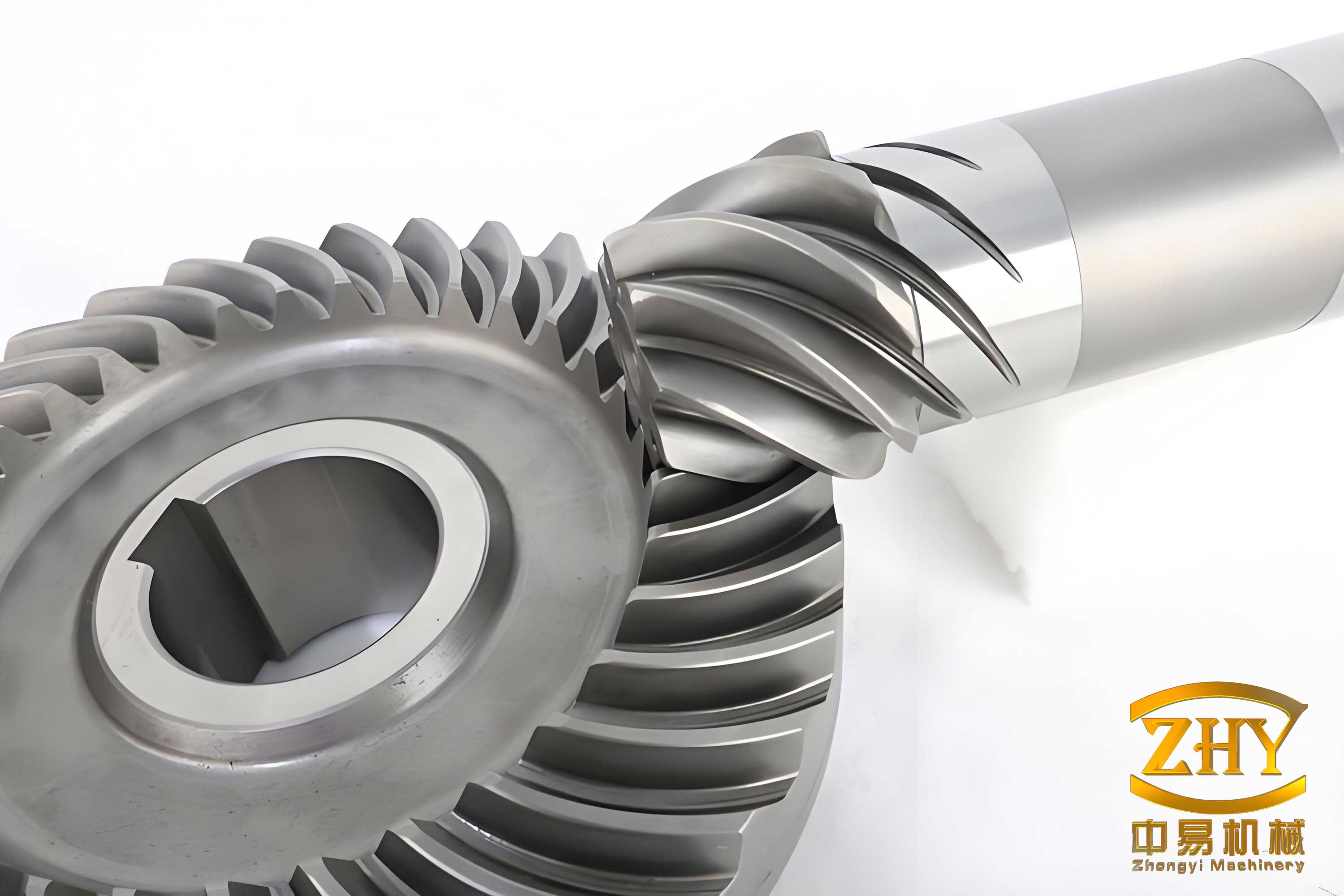
Traditional modeling methods often relied on simplified approximations or laborious surface-splicing techniques in CAD software, which could compromise geometric fidelity. My research focuses on developing a high-fidelity modeling methodology that transcends these limitations. The core philosophy is to virtually replicate the physical manufacturing process within a digital environment. By constructing a digital twin of a Gleason-type spiral bevel gear milling machine and a bi-arc cutting tool within PTC Creo (Pro/ENGINEER), and then simulating the material removal process on a gear blank, I can generate a three-dimensional model that is inherently accurate because it is born from the same kinematic principles that govern actual production. This first-person account details the complete workflow, from foundational theory to final validated geometry, for the digital sculpting of a bi-arc spiral bevel gear pair.
1. Foundational Geometry and Blank Modeling
The journey begins with a thorough understanding of the gear pair’s basic geometric parameters. For this study, a specific set of parameters based on the FSPH-79 standard tooth form is adopted. These parameters define the macro-geometry of the spiral bevel gear pair before the unique bi-arc profile is cut.
| Basic Parameter | Pinion | Gear |
|---|---|---|
| Number of Teeth (Z) | 12 | 35 |
| Mean Normal Module (mn) | 6 mm | |
| Mean Cone Distance (Rm) | 135.506 mm | |
| Mean Spiral Angle (βm) | 35° | |
| Face Width (b) | 46 mm | |
| Shaft Angle (Σ) | 90° | |
Using these parameters within Pro/E, the first step is to create the gear blanks. This involves defining the conical backbones, the front and back cone angles, and the gear face width. The model is built using solid extrusion and rotational features, ensuring precise control over dimensions. Crucially, the blanks are modeled as solid bodies, representing the raw material before the cutting operation. The coordinate systems are carefully aligned to match the theoretical positioning used in later machining simulations. The generation of these accurate blanks is the essential canvas upon which the complex tooth form will be digitally carved.
2. Reconstructing the Virtual Machine Tool
The heart of this simulation-based modeling approach lies in replicating the manufacturing kinematics. A spiral bevel gear is generated using the principle of a imaginary crown gear (or generating gear) in mesh with the workpiece. In a physical Gleason-type mill, this is achieved through coordinated motions of several axes: the rotation of the cutter head (simulating a tooth of the crown gear), the rotation of the workpiece, and adjusting motions for setting the machine (swivel, tilt, etc.). In the digital realm, I construct an assembly that mimics this behavior.
The virtual machine model in Pro/E consists of several key components assembled with appropriate constraints (connections):
- Cradle/Workpiece Carrier Assembly: This sub-assembly holds the gear blank. It is given rotational degrees of freedom about its own axis (work rotation) and is positioned relative to the machine center.
- Cutter Head Assembly: This sub-assembly holds the virtual cutting tool (to be defined in the next section). It is positioned to represent the radial distance (machine center to back) and can rotate about its axis to simulate the cutting action.
- Machine Base & Slide System: While simplified, the assembly includes constraints that define the relative motion between the workpiece and the cutter head, encapsulating the essential kinematic chain.
The goal is not a photorealistic model of the machine but a kinematically accurate one. The assembly constraints in Pro/E (such as pin, slider, and planar connections) are used to define the necessary relative motions between the cutter head and the gear blank. This digital mechanism will later be “driven” to simulate the cutting path.
3. Defining the Bi-Arc Cutting Tool Profile
The defining characteristic of the bi-arc spiral bevel gear is its tooth profile, which originates from the shape of the cutting tool. The铣刀盘 (cutter head) for a bi-arc spiral bevel gear uses a series of inside and outside cutting blades. The profile of these blades is not involute but is composed of multiple circular arcs. For the FSPH-79 standard, the basic rack tooth profile is defined by eight consecutive circular arcs, alternating between convex and concave segments.
The profile is defined in a two-dimensional coordinate system (On-XnYn) on the normal plane. The Xn axis lies on the symmetry line of the basic rack profile, and the Yn axis lies on the pitch plane. The coordinates of any point on the i-th circular arc segment of this basic profile can be generically expressed by the following parametric equation:
$$
\begin{bmatrix}
x_{ni} \\
y_{ni} \\
z_{ni}
\end{bmatrix}
=
\begin{bmatrix}
\rho_i \sin \alpha_i + E_i \\
\rho_i \cos \alpha_i + F_i \\
0
\end{bmatrix}
$$
Where:
- $\rho_i$ is the radius of the i-th circular arc.
- $(E_i, F_i)$ are the coordinates of the center of the i-th circular arc in the On-XnYn coordinate system.
- $\alpha_i$ is the parameter, representing the angle from the Yn axis to the radial line connecting the arc center to the point on the profile. It varies within a specific interval $[\alpha_i’, \alpha_i”]$ for each arc.
- $i = 1, 2, …, 8$, representing the eight arcs that constitute one side of the symmetric basic tooth profile.
The following table summarizes a typical definition for the sequence of arcs, where positive $\rho$ indicates a convex arc (material outside the circle) and negative $\rho$ indicates a concave arc (material inside the circle):
| Arc Segment (i) | Type | Radius ($\rho_i$) | Center Coordinates ($E_i$, $F_i$) | Parameter Range ($\alpha_i)$ |
|---|---|---|---|---|
| 1 | Tip Fillet (Convex) | +r_t | E1, F1 | [α1min, α1max] |
| 2 | Top Arc (Concave) | -r_a | E2, F2 | [α2min, α2max] |
| 3 | Transition (Convex) | +r_{tr1} | E3, F3 | [α3min, α3max] |
| 4 | Main Working Arc (Convex) | +r_1 | E4, F4 | [α4min, α4max] |
| 5 | Root Fillet (Concave) | -r_f | E5, F5 | [α5min, α5max] |
| 6 | Main Working Arc (Concave) | -r_2 | E6, F6 | [α6min, α6max] |
| 7 | Transition (Convex) | +r_{tr2} | E7, F7 | [α7min, α7max] |
| 8 | Bottom Arc (Concave) | -r_b | E8, F8 | [α8min, α8max] |
In Pro/E, this complex 2D profile is created using the “Equation-Driven Curve” feature or by sketching individual arcs based on calculated coordinate points. This profile is then revolved around the cutter head axis, but with a crucial modification: it is projected onto a surface with a specific tilt angle (the blade angle) to account for the helical nature of the spiral bevel gear tooth. The resulting 3D solid body represents one cutting blade. This blade is then patterned circumferentially around the cutter head body to create the full set of inside and outside blades, completing the virtual cutting tool assembly. The contact point radii for inner (ri1, ri2) and outer (re1, re2) blades are calculated based on the cutter radius (Rr), arc radii (r1, r2), and center offsets (c1, c2), ensuring correct gear tooth geometry.
4. The Simulation Machining Process
With the virtual machine assembled (containing the gear blank and the cutter head), the simulation machining commences. This process is not a single Boolean operation but a sequential, discrete simulation of the relative motion between the tool and the workpiece. The kinematics are derived from the fundamental equation of gear generation. For a given machine setting and a specific instant in time t, the relative position and orientation of the workpiece are calculated.
Let the initial machine setup parameter (the basic cradle angle) be $q_0$. If the cradle (representing the generating gear) rotates with a unit angular velocity for simplicity, its angle at time $t$ is $q_0 + t$. The coordinated motion of the machine axes (often simplified to essential translations X, Y, Z and rotations A, B) to maintain the generating roll between the imaginary crown gear and the workpiece can be described by functions of time. A simplified representation of these kinematic equations is:
$$
\begin{aligned}
X(t) &= u \cdot \cos(q_0 + t) \\
Y(t) &= u \cdot \sin(q_0 + t) \\
Z(t) &= f(t) \quad \text{(Feed motion, often a function of time)} \\
A(t) &= t \cdot \sin \Phi \quad \text{(Work rotation)} \\
B(t) &= \phi \quad \text{(A fixed setting angle)}
\end{aligned}
$$
Where $u$ is the radial distance, and $\Phi$ is the root angle of the gear. In Pro/E, this motion is simulated using the Mechanism module or, for a more controlled approach, via a series of assembly steps. The procedure is as follows:
- Initial Positioning: The gear blank is assembled into the virtual machine at the starting position (t=0).
- Discrete Motion Steps: The assembly is re-defined for a new, incremented value of time (t = Δt, 2Δt, 3Δt…). This involves modifying the constraint values (angles, offsets) that define the position of the blank relative to the stationary cutter head, according to the kinematic equations above. Each step represents a “snapshot” of the machining process.
- Boolean Subtraction (Material Removal): At each recorded position, a Boolean “Cut” operation is performed. The solid volume of the cutter head (representing the cutting tool envelope) is subtracted from the solid volume of the gear blank. In Pro/E, this is done using the “Component Operation” -> “Cut Out” feature.
- Iteration: Steps 2 and 3 are repeated over the entire calculated roll cycle, which covers the generation of one tooth space. The result is a gear blank with one perfectly generated bi-arc tooth slot. The surfaces of this slot are exact because they are the inverse of the swept volume of the cutting tool following the precise generation motion.
Once a single tooth space is created, the process for the remaining teeth is efficient. The cut blank is patterned around its axis using a rotational pattern feature with an increment of $360^\circ / Z$, where Z is the number of teeth. Since the tooth space is a feature resulting from a cut operation, patterning it creates all tooth spaces simultaneously, resulting in the complete, geometrically accurate digital model of the bi-arc spiral bevel gear.
5. Model Verification and Accuracy Assessment
Generating a model is one task; validating its geometric accuracy is paramount. For gears, critical dimensions include the tooth thickness at various sections. The theoretical design tooth thickness (S) at the mean point is modified by manufacturing allowances and tolerances. The final permissible tooth thickness on the convex ($S_{aj}$) and concave ($S_{fj}$) flanks are given by:
$$
S_{aj} = S_{1} – \Delta S_{1} – \delta S_{1}
$$
$$
S_{fj} = S_{1} – \Delta S_{2} – \delta S_{2}
$$
Where $S_1$ is the theoretical mean point tooth thickness of the pinion. The allowances $\Delta S_i$ and tolerances $\delta S_i$ for gear $i$ (i=1 for pinion, 2 for gear) are typically calculated as:
$$
\Delta S_i = 0.02 \cdot m_{se} \left( \frac{D_i}{D_1 + D_2} \right)
$$
$$
\delta S_i = k \cdot 0.02 \cdot m_{se} \left( \frac{D_i}{D_1 + D_2} \right)
$$
In these equations, $m_{se}$ is the outer end transverse module, $D_i$ is the pitch diameter of gear $i$, and $k$ is a coefficient between 1 and 2, selected based on the desired gear accuracy grade.
To verify the simulated bi-arc spiral bevel gear model, I extract the tooth thickness from the 3D model at the specified mean point. This is done by creating a measuring cross-section in Pro/E. For the example gear pair modeled:
| Measurement | Convex Flank (Saj) | Concave Flank (Sfj) |
|---|---|---|
| Theoretical (with allowances) | 7.2881 – 0.04 – 0.08 = 7.1681 mm | 12.7760 – 0.04 – 0.08 = 12.6560 mm |
| Measured from Simulated Model | 7.1702 mm | 12.6583 mm |
| Deviation | +0.0021 mm | +0.0023 mm |
The minuscule deviation (on the order of 2 microns) between the simulated model’s dimensions and the calculated permissible range falls well within acceptable engineering tolerances for gear design. This high level of agreement validates the simulation machining methodology, proving that the digital model accurately reflects the intended geometry of the bi-arc spiral bevel gear. It confirms that the virtual machine kinematics, tool profile, and material removal process have been correctly implemented.
6. Advantages and Applications of the Simulation-Based Model
The creation of a high-fidelity bi-arc spiral bevel gear model via simulation machining offers significant advantages over conventional direct CAD modeling.
1. Inherent Geometric Accuracy: The model is not an approximation but a direct consequence of the manufacturing process. Any profile error, misalignment, or kinematic deviation inherent in the design is naturally reflected in the model, making it a true digital twin.
2. Educational and Diagnostic Tool: The step-by-step simulation provides profound insight into the complex generation process of spiral bevel gears. It allows for the visualization of tooth contact patterns, the effect of machine settings on geometry, and potential interference issues before any physical part is made.
3. Foundation for Advanced Analysis: This accurate model serves as the perfect input for downstream engineering analyses. It can be directly used for:
- Finite Element Analysis (FEA): Performing static, dynamic, and contact stress analysis to evaluate bending strength, contact fatigue life, and optimize the bi-arc profile parameters.
- Kinematic and Dynamic Simulation: Importing the gear pair into Multi-Body Dynamics (MBD) software to study transmission error, vibration characteristics, and system-level performance.
- Manufacturing Preparation: The model can be used to generate CNC tool paths for modern 5-axis machining centers or to create drawings for inspection using Coordinate Measuring Machines (CMM).
4. Design Exploration: By parametrically linking the machine settings and tool profile equations in Pro/E, one can rapidly generate models for different design variations (spiral angle, pressure angle, profile radius ratios) and assess their geometric and meshing properties.
7. Conclusion and Future Direction
This detailed first-person exposition has outlined a comprehensive and robust methodology for the digital creation of bi-arc spiral bevel gears. By moving beyond simple shape modeling to embrace a simulation of the physical generation process, we achieve a level of geometric fidelity that is critical for modern engineering design and analysis. The process integrates fundamental gear theory, manufacturing kinematics, and advanced CAD software capabilities. Starting from basic parameters, constructing a kinematically correct virtual machine, defining the intricate bi-arc tool profile, and executing a discrete material removal simulation, we successfully sculpt a precise three-dimensional model of this advanced spiral bevel gear variant. The subsequent verification against theoretical tooth thickness calculations confirms the model’s exceptional accuracy.
The resulting digital model of the bi-arc spiral bevel gear is not merely a visual representation; it is a functional geometric entity ready to drive innovation. It enables rigorous virtual testing, performance prediction, and design optimization, reducing reliance on costly physical prototypes. Future work can seamlessly build upon this foundation. The logical next steps include automating the process through full parametrization and programmatic control within Pro/E, linking it to optimization algorithms to find the optimal bi-arc profile for specific load cases, and performing detailed thermo-mechanical coupled field analyses to study lubrication and efficiency. This methodology, therefore, establishes a vital digital pipeline for advancing the development and application of high-performance bi-arc spiral bevel gears in demanding powertrain systems.