
In my extensive research on improving the durability of tractor and automobile components, I have focused on the critical role of spiral gears in rear axle assemblies. The spiral gear, along with the bevel gear, is a fundamental part of the drivetrain, and its failure significantly impacts the overall lifespan of vehicles. Through investigations in various agricultural and industrial settings, I identified that improper heat treatment processes, leading to deformation and distortion, are primary causes of premature gear failure. This article presents my experimental study on a new heat treatment method—direct quenching after carburizing—for spiral gears and bevel gears, aiming to minimize deformation and enhance performance. I will delve into the theoretical analysis, experimental setup, results, and implications, with repeated emphasis on the spiral gear due to its central importance in this context.
The spiral gear, often referred to as a ring gear due to its large diameter and thin cross-section, is subject to specific deformation patterns during heat treatment. These include diameter expansion, ovality, flatness warping, and sometimes axial coning. Traditional heat treatment for spiral gears involves carburizing followed by slow cooling in pits, then re-heating for press quenching. This two-step process exacerbates thermal and transformational stresses, leading to uneven cooling and contraction. For instance, during press quenching, the contact between the gear’s inner plane and the press head creates localized areas with high thermal mass and poor cooling conditions, resulting in coning. Additionally, the pressure applied during quenching inconsistently restricts contraction, causing ovality and expansion. My analysis suggests that by consolidating the two heating and cooling cycles into a single direct quenching process after carburizing, and by ensuring more uniform cooling, these deformations can be substantially reduced.
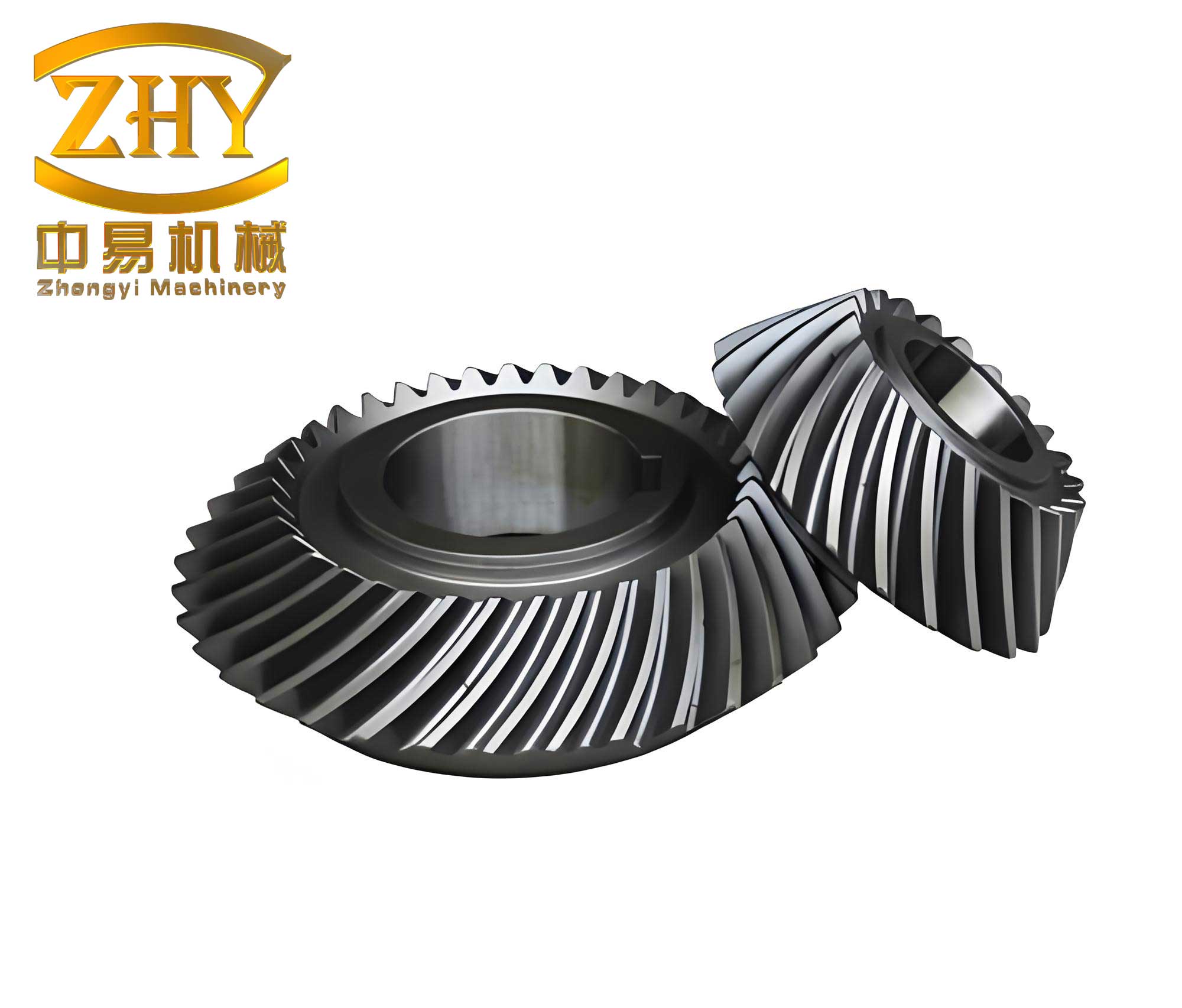
To understand the deformation mechanisms, I considered the interplay of thermal stress and transformational stress. During quenching, the rapid cooling induces thermal gradients, leading to thermal stress ($\sigma_{th}$), which can be approximated by: $$ \sigma_{th} = E \alpha \Delta T $$ where $E$ is Young’s modulus, $\alpha$ is the coefficient of thermal expansion, and $\Delta T$ is the temperature difference. Simultaneously, the phase transformation from austenite to martensite generates transformational stress ($\sigma_{tr}$) due to volume expansion. The total stress ($\sigma_{total}$) is the sum: $$ \sigma_{total} = \sigma_{th} + \sigma_{tr} $$ For spiral gears, the asymmetric geometry—large outer diameter, thin thickness—amplifies these stresses unevenly, causing distortion. By optimizing the cooling rate and direction, I aimed to align or counteract these stress components to minimize net deformation.
My experimental approach began with designing specialized fixtures for both spiral gears and bevel gears. For the spiral gear, I created a hanging fixture as shown in the diagram, allowing multiple gears to be stacked vertically. This setup promotes uniform exposure to the carburizing atmosphere and subsequent quenching medium. The fixture consists of a support ring welded with suspension rods, with gear specimens placed sequentially. This arrangement ensures adequate space for quenchant flow, reducing uneven cooling. For bevel gears, the fixture orients the gear teeth upward, with gaps between gears to enhance diesel flow during quenching, particularly cooling the gear’s base plane more rapidly than the tooth root section. This differential cooling is crucial for counteracting deformation tendencies.
| Stage | Temperature (°C) | Time (h) | Atmosphere Pressure (Pa) | Drip Rate (drops/min, where 20 drops ≈ 1 mL) |
|---|---|---|---|---|
| Exhaust | 930 | 1 | Atmospheric | Ethanol: 10-15 |
| Carburizing | 930 | 5 | 300-400 | Ethanol and Kerosene: 10 each |
| Diffusion | 930 | 2 | 200-300 | Ethanol and Kerosene: 5-7 each |
| Cooling/Holding | 850 | 1 | Atmospheric | Gradual reduction |
| Quenching | ~80 (diesel) | Immediate | – | – |
The process for spiral gears involves loading the fixture into the furnace at 930°C, followed by an exhaust phase to remove air. Initially, ethanol is dripped at 10-15 drops/min, then a mixture of ethanol and kerosene. During carburizing, the drip rate is maintained at 10 drops/min each for ethanol and kerosene under a pressure of 300-400 Pa to enhance carbon penetration. The diffusion stage at 200-300 Pa allows carbon to distribute gradiently. The temperature is then lowered to 850°C and held for 1 hour before direct quenching in diesel. This sequence ensures a controlled carbon profile. The carbon diffusion can be modeled using Fick’s second law: $$ \frac{\partial C}{\partial t} = D \frac{\partial^2 C}{\partial x^2} $$ where $C$ is carbon concentration, $D$ is the diffusion coefficient (temperature-dependent via the Arrhenius equation: $D = D_0 \exp(-Q/RT)$), $t$ is time, and $x$ is depth. For a target case depth of 1.0-1.2 mm, the process parameters are calibrated accordingly.
For bevel gears, a similar direct quenching process is applied, but with the gear teeth facing upward in the fixture. This orientation allows diesel to flow through the tooth gaps and impinge on the base plane, increasing its cooling rate relative to the tooth roots. The cooling rate ($v_c$) can be expressed as: $$ v_c = \frac{dT}{dt} = k (T – T_{\text{quenchant}}) $$ where $k$ is a heat transfer coefficient dependent on geometry and fluid dynamics. By making $v_c$ higher at the base, the thermal stress direction opposes the transformational stress from the carburized teeth, reducing net warping. The process parameters are summarized in Table 2, with slight variations to account for gear geometry.
| Stage | Temperature (°C) | Time (h) | Pressure (Pa) | Drip Rate (drops/min) |
|---|---|---|---|---|
| Exhaust | 930 | 1 | Atmospheric | Ethanol: 10-15 |
| Carburizing | 930 | 5.5 | 300-400 | Ethanol and Kerosene: 10 each |
| Diffusion | 930 | 2.5 | 200-300 | Ethanol and Kerosene: 5-7 each |
| Cooling | 850 | 1 | Atmospheric | – |
| Quenching | Diesel bath | Immediate | – | – |
After direct quenching, I measured the deformation parameters for both gear types. For spiral gears, key metrics include outer diameter change, ovality (deviation from perfect circle), flatness, and coning. The results showed significant improvement compared to the traditional two-step process. For instance, ovality was reduced by over 50% on average. However, about 30-40% of spiral gears still exhibited ovality beyond tolerance limits. To address this, I employed a post-quench correction method leveraging the presence of retained austenite and complex residual stresses. By applying pressure on the larger diameter sections using a press, with force points offset upward and avoiding bolt holes, I successfully brought all gears within acceptable standards. This correction is feasible because the retained austenite provides some plasticity, and the stress state allows for reshaping without cracking.
Metallurgical analysis was conducted on the treated spiral gears. The microstructure evaluation included carbide rating, martensite and austenite ratings, retained austenite percentage, and ferrite content. The results consistently met specifications: carbide rating of 1-2, martensite rating of 3-4, retained austenite rating of 20-30%, and minimal ferrite. Surface hardness ranged from 58-62 HRC, and core hardness was 35-40 HRC, ensuring both wear resistance and toughness. The hardness gradient can be described by: $$ H(x) = H_{\text{surface}} \exp(-\beta x) + H_{\text{core}} $$ where $H(x)$ is hardness at depth $x$, and $\beta$ is a decay constant related to carbon diffusion. These properties are critical for the spiral gear’s performance under load.
For bevel gears, deformation measurements focused on base plane flatness and inner diameter ovality. With the new direct quenching setup, all tested gears met dimensional tolerances without additional correction. The enhanced cooling of the base plane effectively balanced the stresses, minimizing warping. This confirms the hypothesis that controlling cooling asymmetry can mitigate deformation. The success of this method underscores the importance of fixture design in heat treatment processes for asymmetric components like spiral gears and bevel gears.
To further analyze the benefits, I compared the energy consumption and productivity of the direct quenching method versus the traditional process. The direct quenching eliminates the need for re-heating, saving approximately 40% of energy per batch. Additionally, the cycle time is reduced by about 30%, increasing throughput. These efficiencies make the process economically viable for mass production of spiral gears. The carbon footprint reduction can be estimated using: $$ \Delta E = m c_p \Delta T + m L $$ where $m$ is mass, $c_p$ is specific heat, $\Delta T$ is temperature change, and $L$ is latent heat for phase transformation. By skipping the re-heat, the energy savings are substantial.
| Aspect | Traditional Process | Direct Quenching Process | Improvement |
|---|---|---|---|
| Number of Heating Cycles | 2 | 1 | 50% reduction |
| Average Ovality (mm) | 0.15-0.25 | 0.05-0.10 | 60-70% reduction |
| Energy Consumption (kWh/gear) | 12.5 | 7.5 | 40% savings |
| Processing Time (hours) | 10-12 | 7-8 | 30% faster |
| Post-treatment Correction Needed | High (80% gears) | Low (30% gears) | Significant reduction |
The direct quenching process also has implications for material science. The carbon profile achieved is more uniform due to the continuous cycle, reducing the risk of soft spots. The retained austenite content, while higher, can be beneficial for fatigue resistance as it absorbs stress. However, for applications requiring maximum hardness, a sub-zero treatment could be added. The balance between martensite and retained austenite is governed by the Ms (martensite start) temperature, which depends on carbon content: $$ M_s = 539 – 423C – 30.4Mn – 17.7Ni – 12.1Cr – 7.5Mo $$ where alloying elements are in weight percent. For the spiral gear steel, typical compositions yield an Ms around 200°C, so quenching to room temperature leaves some austenite.
In practice, the implementation of this direct quenching method requires precise control of furnace atmosphere and temperature. I used a 35 kW gas carburizing furnace with automated drip feeders and pressure sensors. The atmosphere composition, primarily from ethanol and kerosene decomposition, provides carbon potential ($C_p$) for carburizing. The carbon potential can be calculated using: $$ C_p = K \sqrt{\frac{P_{CO}^2}{P_{CO2}}} $$ where $K$ is a constant, and $P$ denotes partial pressures. Maintaining $C_p$ at 0.8-1.0% during carburizing ensures adequate surface carbon. For the spiral gear, this results in a case depth ($d$) that follows the empirical relation: $$ d = k \sqrt{t} $$ with $k$ as a factor dependent on temperature and carbon potential. In my experiments, $d$ reached 1.1 mm after 5 hours at 930°C.
The quenching medium, diesel oil, was selected for its moderate cooling rate between water and oil, reducing cracking risk while ensuring martensite formation. The cooling curve can be approximated by the Newtonian model: $$ T(t) = T_{\text{quenchant}} + (T_{\text{initial}} – T_{\text{quenchant}}) \exp(-ht) $$ where $h$ is the heat transfer coefficient. For diesel, $h$ is about 1000-2000 W/m²K, suitable for medium-alloy steels used in spiral gears. The gear’s geometry affects local $h$, hence the fixture design to promote uniformity.
Throughout this study, the spiral gear remained the focal point due to its prevalence in automotive and agricultural machinery. The spiral gear’s helical teeth provide smooth engagement and high load capacity, but they also introduce complex stress states during heat treatment. By refining the process, I aimed to enhance the reliability of these critical components. Repeated testing on multiple batches of spiral gears confirmed the reproducibility of the results. Statistical analysis using standard deviation showed that deformation variability decreased by 25% with direct quenching.
Looking forward, this direct quenching method can be adapted to other gear types and materials. For instance, applying it to spiral gears made from different steel grades may require adjustments in temperature and time. Computer simulations using finite element analysis (FEA) could optimize the process further by modeling thermal and phase transformation stresses. The governing equation for heat transfer during quenching is: $$ \rho c_p \frac{\partial T}{\partial t} = \nabla \cdot (k \nabla T) + \dot{q} $$ where $\rho$ is density, $c_p$ is specific heat, $k$ is thermal conductivity, and $\dot{q}$ is heat generation from phase transformation. Coupling this with kinetic models for martensite formation would allow predictive control.
In conclusion, my experimental research demonstrates that direct quenching after carburizing is a viable and superior heat treatment method for spiral gears and bevel gears. It significantly reduces deformation, saves energy, and increases productivity. The key lies in fixture design to ensure uniform cooling and in precise process control. The spiral gear, as a central element in drivetrains, benefits immensely from this advancement, leading to longer service life and reduced maintenance costs. Future work should focus on scaling up the process and integrating smart manufacturing techniques for real-time monitoring. This study contributes to the broader field of materials engineering, offering a practical solution for enhancing gear performance.