
The pursuit of superior performance in power transmission systems has consistently driven the development of high-strength, durable gear components. Among these, the helical gear stands out due to its smooth and quiet operation, achieved through gradual tooth engagement. To meet the demanding requirements of high-load applications, such gears are typically subjected to thermochemical treatments like carburizing, followed by quenching and tempering. These processes are designed to create a hard, wear-resistant case while maintaining a tough core. However, the intense thermal gradients and associated phase transformations during quenching invariably induce distortion and residual stresses. Uncontrolled distortion can lead to premature failure, noise, and vibration, negating the benefits of the heat treatment. Therefore, predicting and controlling this distortion is paramount in the manufacturing of precision helical gears.
Numerical simulation, particularly the Finite Element Method (FEM), has become an indispensable tool for understanding the complex thermo-metallurgical-mechanical interactions during heat treatment. The accuracy of such simulations hinges on the fidelity of the underlying physical models and the appropriateness of the applied boundary conditions. While significant research has focused on material models and phase transformation kinetics, the selection of displacement boundary conditions—which define how the part is mechanically constrained during simulation—often receives less scrutiny. This article delves into this critical aspect, exploring the implications of different displacement boundary conditions on the predicted distortion and stress state of a heat-treated helical gear.
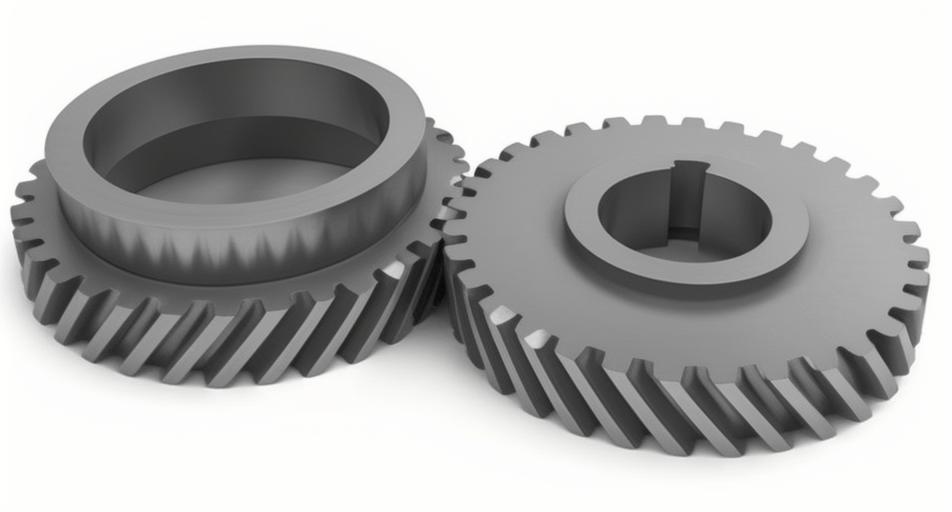
Thermo-Metallurgical-Mechanical Modeling Fundamentals
The simulation of heat treatment for a helical gear requires a coupled analysis that solves for temperature, phase fractions, and stress/strain fields simultaneously. The governing equations for these fields are interconnected, as temperature drives phase change, phase change releases latent heat and causes volumetric expansion, and all these factors collectively determine the stress state.
Heat Transfer with Phase Transformation Latent Heat
The temperature field is governed by the transient heat conduction equation, modified to account for the latent heat generated or absorbed during phase transformations:
$$ \nabla \cdot (\lambda \nabla T) + \dot{Q} = \rho c_p \frac{\partial T}{\partial t} $$
where \( \lambda \) is the thermal conductivity, \( T \) is temperature, \( \rho \) is density, \( c_p \) is specific heat, and \( t \) is time. The source term \( \dot{Q} \) represents the latent heat generation rate due to phase changes. For a transformation from austenite to a new phase \( i \), the latent heat rate can be calculated as:
$$ \dot{Q} = \sum_i \Delta H_i \frac{\Delta V_i}{\Delta t} $$
where \( \Delta H_i \) is the enthalpy change per unit volume for the formation of phase \( i \), and \( \Delta V_i / \Delta t \) is the rate of change of its volume fraction. The thermophysical properties ( \( \lambda, \rho, c_p \) ) are typically treated as functions of both temperature and phase composition.
Phase Transformation Kinetics
The evolution of microstructure is modeled using kinetics laws. For diffusion-controlled transformations like ferrite (F), pearlite (P), and bainite (B), the Johnson-Mehl-Avrami-Kolmogorov (JMAK) equation is commonly used for isothermal conditions:
$$ V_i = 1 – \exp(-b_i t^{n_i}) \quad \text{for } i = F, P, B $$
where \( V_i \) is the transformed volume fraction, and \( b_i \) and \( n_i \) are temperature-dependent parameters. For continuous cooling, the time-temperature path is discretized into small isothermal steps.
For the non-diffusive martensitic (M) transformation, the Koistinen-Marburger relationship is employed:
$$ V_M = 1 – \exp[-\alpha (M_s – T)] $$
where \( \alpha \) is a material constant and \( M_s \) is the martensite start temperature.
Constitutive Model: Accounting for Multiple Strain Contributions
The total strain rate during the heat treatment of a helical gear is an additive combination of several mechanisms:
$$ \dot{\varepsilon}_{ij} = \dot{\varepsilon}_{ij}^{e} + \dot{\varepsilon}_{ij}^{p} + \dot{\varepsilon}_{ij}^{th} + \dot{\varepsilon}_{ij}^{tr} + \dot{\varepsilon}_{ij}^{tp} $$
where the superscripts denote elastic (\(e\)), plastic (\(p\)), thermal (\(th\)), transformation volumetric (\(tr\)), and transformation plasticity (\(tp\)) strains. The thermal strain is calculated from the coefficient of thermal expansion \( \alpha_m \) of each phase \(m\):
$$ \dot{\varepsilon}_{ij}^{th} = \delta_{ij} \sum_m \alpha_m \dot{f}_m \dot{T} $$
The transformation strain arises from the difference in specific volume between austenite and the product phases:
$$ \dot{\varepsilon}_{ij}^{tr} = \delta_{ij} \sum_m \beta_m \dot{f}_m $$
where \( \beta_m \) is the linear expansion coefficient for phase \(m\). Transformation plasticity is a non-linear, stress-assisted strain that occurs even under stresses below the yield strength and is crucial for accurate residual stress prediction:
$$ \dot{\varepsilon}_{ij}^{tp} = \frac{3}{2} K \sum_m (1 – f_m) \dot{f}_m S_{ij} $$
where \( K \) is the transformation plasticity coefficient and \( S_{ij} \) is the deviatoric stress tensor.
The Crucial Role of Displacement Boundary Conditions
In a real quenching process, a helical gear may be placed freely on a fixture or tray. While there is no rigid attachment, gravity and friction provide some restraint. In an FEM simulation, however, some kinematic constraints must be applied to prevent rigid body motion and obtain a unique solution. The choice of these constraints significantly influences the predicted distortion pattern and stress distribution. Three common approaches are analyzed here.
| Boundary Condition Type | Typical Application Method | Physical Rationale | Potential Drawbacks for Helical Gears |
|---|---|---|---|
| Fixed (Statically Determinate) Constraints | Fully restrain 3-6 degrees of freedom (DOFs) at selected nodes (e.g., on the bore). | Simple to apply; eliminates rigid body motion completely. | Introduces artificial reaction forces, severely restricting natural shrinkage/expansion, leading to unrealistic stress and distortion. |
| Symmetric Constraints | Apply symmetry conditions on cut planes (e.g., mid-plane of tooth width). Often combined with fixed points. | Leverages part symmetry to reduce model size; constraints are applied on planes of expected symmetry. | For a helical gear, true geometric symmetry does not exist along the tooth face. This can introduce fictitious bending moments and扭曲. |
| Friction Contact Constraints | Model the gear resting on a rigid or deformable flat plate with Coulomb friction. | Most closely mimics the actual physical setup during furnace charging and quenching. | Requires contact definition, increasing computational cost. The friction coefficient must be estimated. |
Analysis of Constraint Effects
The fundamental issue with Fixed Constraints is that they over-constrain the part. During cooling, different sections of the helical gear contract at different rates. If a point is perfectly fixed, the surrounding material cannot contract freely towards it, generating artificially high tensile stresses near the fixed node and distorting the entire displacement field.
Symmetric Constraints are suitable for bodies with clear planes of symmetry, like a spur gear segment. However, the helix angle of a helical gear breaks the symmetry along the tooth width. Applying symmetry conditions on a plane effectively slices the gear and assumes the behavior of one half perfectly mirrors the other. This ignores the continuous,螺旋 nature of the tooth, which can lead to an unrealistic约束 force that prevents the natural “warping” or drum-shaped distortion often observed in practice.
Friction Contact Constraints provide support against gravity while allowing in-plane sliding and lifting-off, governed by the friction coefficient. This setup permits the most natural distortion. The resulting displacement field contains both rigid body motion (e.g., slight sliding) and the actual distortion. The pure distortion can be extracted by fitting the displaced nodes to a reference geometry (e.g., best-fit cylinder for the bore) and subtracting the rigid body component.
Case Study: Simulation of a Carburized Helical Gear
To illustrate the impact, consider the simulation of a case-hardening process for a medium-sized helical gear made from a low-alloy steel analogous to 17CrNiMo6.
Material Properties and Process Cycle
The simulation incorporates temperature and phase-dependent material properties. Key thermal and transformation data are summarized below.
| Property | Austenite | Martensite | Bainite | Ferrite/ Pearlite |
|---|---|---|---|---|
| Enthalpy Change \( \Delta H \) (J/m³) | – | 6.5e8 | 6.2e8 | ~6.0e8 |
| Martensite Start \( M_s \) (°C) | – | ~380 | – | – |
| Typical Yield Stress at 20°C (MPa) | Low | >1000 | ~800 | ~500 |
The process sequence simulated is: Carburizing (with associated carbon diffusion) → Heating to Austenitizing Temperature (850°C) → Quenching in agitated oil (50°C) → Low-Temperature Tempering (180°C). The heat transfer coefficient (HTC) for the oil quench is a critical input, typically derived from inverse analysis of cooling curve data.
Finite Element Model Setup
A 3D model of a segment or the full helical gear is meshed with coupled temperature-displacement elements (e.g., C3D8T in Abaqus). The three boundary condition sets are applied as described earlier. For the friction case, a rigid plate is modeled beneath the gear’s bottom face.
Simulation Results and Comparative Analysis
The temperature and phase evolution fields are largely unaffected by the mechanical boundary conditions. The quenching results in a predominantly martensitic case. The core may contain some bainite depending on the hardenability and gear module size.
The residual stress and distortion results, however, show marked differences.
1. Residual Stress Field: All simulations predict the characteristic profile of compressive residual stresses in the case and tensile stresses in the core, beneficial for fatigue resistance. The magnitude and gradient, however, vary. Fixed constraints often show the highest stress magnitudes due to the forced restraint. Symmetric and friction constraints yield more comparable stress magnitudes in the core and case. In the helical gear tooth, the highest compressive stresses are typically found at the tooth root fillet, a critical area for bending fatigue.
2. Distortion Prediction: This is where the boundary condition choice has the most pronounced effect.
- Fixed Constraints: Predicts an overall smaller distortion magnitude because the fixed points “hold back” the part. The distortion pattern is heavily biased and often unrealistic.
- Symmetric Constraints: Predicts a more uniform expansion/contraction but can enforce an unnatural flatness or symmetry on the tooth trace. For a helical gear, this might suppress the expected lead angle variation or crown shape.
- Friction Constraints: Predicts a combination of rigid body settlement and free distortion. The intrinsic distortion often shows a “drumming” or “dishing” effect—the bore may contract non-uniformly, and the gear face may develop a crown. The tooth helix may exhibit a slight twist. This pattern is most consistent with empirical observations on heat-treated gears.
| Distortion Metric | Fixed Constraints | Symmetric Constraints | Friction Contact Constraints | Physical Expectation |
|---|---|---|---|---|
| Tooth Tip Diameter Change | Under-predicted, non-uniform | Slightly over-predicted, uniform | Moderate, non-uniform (crowning) | Moderate contraction, often with crowning |
| Tooth Lead Variation | Artificially high due to fixation points | Minimal (enforced by symmetry) | Present, showing a slight twist or bow | Present, often a concave or convex bow |
| Bore Diameter Change | Nearly zero near fixed points | Uniform contraction | Non-uniform contraction (ovality) | Non-uniform contraction/ovality |
| Overall Pattern | Biased, unrealistic | Overly symmetric, stiff | Free, organic, includes rigid body motion | Free, organic |
Extracting Meaningful Data from Friction Contact Simulations
Since the friction constraint allows rigid body motion, the raw displacement output (U) is the sum of distortion (D) and rigid body motion (RBM):
$$ U = D + RBM $$
To analyze the pure distortion \( D \), a post-processing step is required. A common method is the “Best Fit” method:
- Export the nodal coordinates of the heat-treated gear.
- For a feature of interest (e.g., the bore cylinder, the tooth flank), fit the ideal geometric shape (cylinder, involute helix) to the displaced nodes using a least-squares algorithm.
- The deviations of the nodes from this best-fit geometry represent the pure form error or distortion \( D \).
- The transformation (translation, rotation) between the original ideal geometry and the best-fit geometry defines the \( RBM \).
This allows engineers to separate the inconsequential sliding on the tray from the critical shape changes that affect gear meshing quality.
Guidelines for Selecting Boundary Conditions
Based on the analysis, the following guidelines are proposed for simulating the heat treatment of helical gears and similar complex components:
- Avoid Fixed Point Constraints: They should not be used as the primary means of restraint unless simulating a physically clamped condition (which is rare during quenching). Their use is generally limited to suppressing numerical rigid body modes in very simple analyses where distortion is not the focus.
- Use Symmetric Constraints with Extreme Caution: They are valid only if a true geometric and likely distortion symmetry plane exists. For a helical gear, this is generally not the case along the tooth width. If used to model a spur gear or a gear segment with a straight tooth, they can be effective for efficiency.
- Prefer Friction Contact Constraints for Realism: Whenever the goal is to predict realistic distortion patterns and residual stresses for process optimization, modeling the support condition with friction contact is the most reliable approach. The additional computational cost is justified by the significant gain in predictive accuracy.
- Calibrate the Friction Coefficient: If possible, the friction coefficient between the gear material and the support plate (e.g., alloy mesh tray) should be estimated from experiments or literature. A sensitivity study on this parameter can be insightful.
- Implement Post-Processing Best-Fit Analysis: Always incorporate a post-processing step to remove rigid body motion from friction-contact simulations to obtain the true, functionally relevant distortion.
Conclusion
The accurate prediction of heat treatment distortion in a helical gear is a multifaceted challenge requiring robust material models and careful attention to simulation setup. This discussion underscores that the choice of displacement boundary condition is not merely a numerical necessity but a significant physical assumption that directly shapes the results. While fixed and symmetric constraints offer simplicity, they introduce artifacts that can mislead the design and process engineer. The friction contact constraint, despite its higher setup complexity, provides a superior representation of the actual quenching environment, yielding distortion patterns—such as bore ovality, tooth crowning, and helical twist—that align with empirical evidence. For high-fidelity simulation aimed at minimizing distortion and optimizing the heat treatment process of critical components like the helical gear, adopting friction-based boundary conditions followed by appropriate post-processing is strongly recommended as a best practice.