
In modern engineering applications, hyperboloidal gears are widely used in aerospace, automotive, and mining industries due to their high load-bearing capacity, large transmission ratios, and smooth operation. However, with the trend toward high-speed and heavy-duty conditions, hyperboloidal gear systems often generate significant vibration and noise, which directly impact reliability and dynamic performance. Therefore, dynamic optimization design focusing on system responses, such as displacement, velocity, acceleration, and stress, has gained increasing attention. In this study, we explore the dynamic response analysis and optimization of a hyperboloidal gearbox, integrating finite element simulations and experimental validation to minimize vibration while ensuring structural integrity.
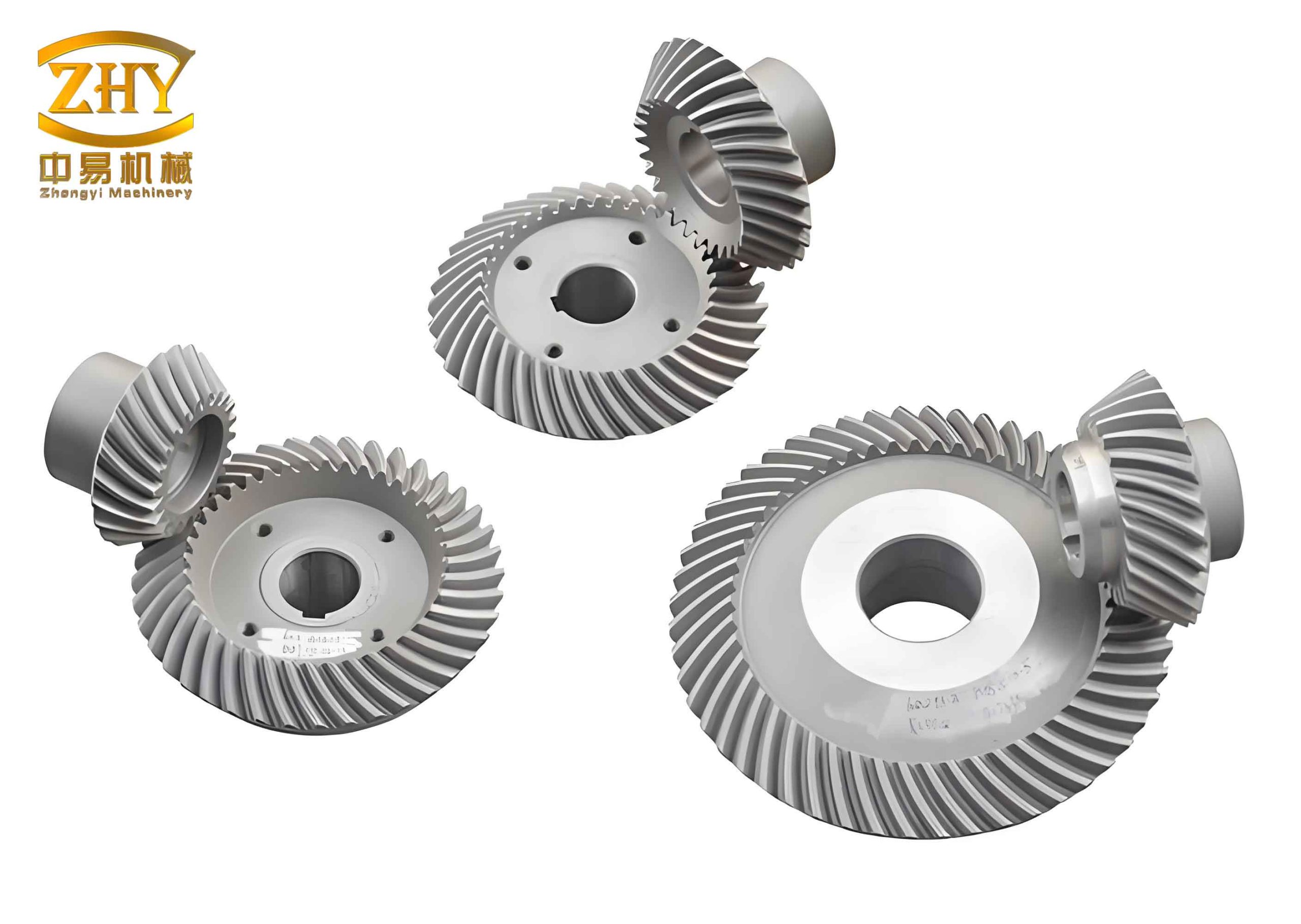
The dynamic behavior of hyperboloidal gears is influenced by factors like time-varying mesh stiffness, tooth deformation, shaft bending, and bearing support stiffness. Traditional lumped-parameter models have limitations in capturing complex interactions, so we adopt a dynamic contact finite element approach. Our methodology involves three main steps: simulating dynamic bearing reactions from the hyperboloidal gear transmission system, analyzing the gearbox housing’s transient response under these excitations, and performing dynamic optimization to reduce vibration. This comprehensive framework ensures a realistic representation of hyperboloidal gear dynamics, leading to improved design insights.
To model the hyperboloidal gear transmission system, we consider the gear pair, shafts, and bearings as an integrated assembly. The geometric parameters of the hyperboloidal gears are summarized in Table 1. The material properties include an elastic modulus of $E = 2.06 \times 10^{11} \, \text{N/m}^2$, Poisson’s ratio of $\nu = 0.3$, and density of $\rho = 7.8 \times 10^3 \, \text{kg/m}^3$. Using UG software, we develop solid models and virtual assemblies, which are then imported into ANSYS/LS-DYNA for finite element analysis. Key connections, such as bolts between the large gear and hub and interference fits between the hub and shaft, are treated as rigid to simplify the model while maintaining accuracy for hyperboloidal gears.
| Parameter | Value |
|---|---|
| Number of teeth, $z_1 / z_2$ | 7 / 39 |
| Module at large end, $m_s$ | 4.254 mm |
| Shaft angle, $\Sigma$ | 90° |
| Mean pressure angle, $\alpha$ | 21.25° |
| Offset distance, $E$ | 23 mm |
| Reference point spiral angle, $\beta_m$ | 35° |
We employ SOLID164 elements for meshing gears, shafts, and bearings, using a hexahedral solid mesh with full integration algorithms to control hourglass effects. Since SOLID164 lacks rotational degrees of freedom, we define rigid shell elements (SHELL163) at the shaft ends connected to flanges to apply rotational speeds and torques. The finite element mesh, as shown in a representative figure, comprises 114,424 nodes and 74,205 elements. Bearing roller support stiffness is simulated with cross-sectional beams, and fixed displacement constraints are applied to the outer races. Five contact pairs are established between the pinion and gear, and between shafts and bearings, using automatic surface-to-surface contact. An input speed of 3,000 rpm and a load torque of 1,114 N·m are applied to simulate operational conditions for hyperboloidal gears.
The dynamic analysis leverages the explicit dynamics algorithm in LS-DYNA, based on the principle of minimum potential energy. The weak form of the motion equation is given by:
$$ \int_V (\rho \ddot{u}_i – f_i) \delta u_i \, dV + \int_V \sigma_{ij} \delta \varepsilon_{ij} \, dV – \int_{S_\sigma} T_i \delta u_i \, dS = 0 $$
where $\rho$ is mass density, $u_i$ is the displacement tensor, $f_i$ is the body force tensor, $\delta u_i$ is the virtual displacement tensor, $\sigma_{ij}$ is the stress tensor, $\delta \varepsilon_{ij}$ is the virtual strain tensor, $S_\sigma$ is the force boundary, and $T_i$ is the surface force tensor. Discretizing the structure into finite elements leads to the equation of motion:
$$ M \ddot{u} = P – F + R + H – C \dot{u} $$
Here, $M$ is the global mass matrix, $P$ is the external load vector, $F$ is the stress divergence vector, $R$ is the contact force vector, $H$ is the hourglass viscous damping force vector, and $C$ is the damping matrix. We solve this using the explicit central difference method:
$$ \ddot{u}^n_t = M^{-1} [P^n_t – F^n_t + R^n_t + H^n_t – C \dot{u}^{n-1/2}_t] $$
$$ \dot{u}^{n+1/2}_t = \dot{u}^{n-1/2}_t + \ddot{u}^n_t \Delta t^n $$
$$ u^{n+1}_t = u^n_t + \dot{u}^{n+1/2}_t \Delta t^{n+1/2} $$
with time steps defined as $t^{n-1/2} = (t^n + t^{n-1})/2$, $t^{n+1/2} = (t^n + t^{n+1})/2$, $\Delta t^n = (t^{n+1} – t^{n-1})/2$, and $\Delta t^{n+1/2} = t^{n+1} – t^n$. This approach effectively captures nonlinear dynamics in hyperboloidal gear systems.
From the simulation, we obtain dynamic support reactions at the bearings. For instance, the bearing near the input pinion shows forces with a large period of 20 ms and a small period of 2.85 ms, corresponding to the input shaft frequency of 50 Hz and gear mesh frequency of 350 Hz. This periodicity aligns with the operational characteristics of hyperboloidal gears. Table 2 summarizes the root-mean-square (RMS) values of acceleration at key nodes on the gearbox housing, derived from transient response analysis using ANSYS. The input loads are the bearing reactions applied at housing bearing holes, with a time step of $\Delta t = 0.2 \, \text{ms}$ over 100 ms.
| Node | $a_X$ (m/s²) | $a_Y$ (m/s²) | $a_Z$ (m/s²) | $a_{\text{sum}}$ (m/s²) |
|---|---|---|---|---|
| 10053 | 2.1289 | 0.6234 | 1.0429 | 2.4512 |
| 2535 | 1.7564 | 0.5566 | 1.020 | 2.1060 |
| 6721 | 1.1386 | 1.4213 | 0.9377 | 2.0484 |
| 4676 | 2.0491 | 0.7780 | 1.0016 | 2.4098 |
| 3004 | 1.2091 | 1.2120 | 0.9233 | 1.9451 |
To validate the finite element model, we conduct experimental tests on a hyperboloidal gearbox dynamic performance test rig. The setup includes a DC speed-regulating motor, the gearbox under test, a torque-speed sensor, and a magnetic powder brake. Vibration acceleration is measured at points corresponding to the simulated nodes. Comparisons show that the simulated and experimental acceleration magnitudes are consistent, confirming the accuracy of our dynamic model for hyperboloidal gears. For example, at a bearing housing point, the acceleration responses in X, Y, and Z directions exhibit similar trends, with minor discrepancies due to real-world factors like assembly tolerances.
Building on the dynamic response analysis, we proceed to optimize the gearbox housing to minimize vibration. The optimization problem is formulated mathematically as:
$$ \min f(x) $$
$$ \text{s.t. } g_i(x) \leq g_i^U \quad (i = 1,2,\dots,m_1) $$
$$ h_i^L \leq h_i(x) \quad (i = 1,2,\dots,m_2) $$
$$ w_i^L \leq w_i(x) \leq w_i^U \quad (i = 1,2,\dots,m_3) $$
$$ x_i^L \leq x_i \leq x_i^U \quad (i = 1,2,\dots,n) $$
where $f(x)$ is the objective function, $x = (x_1, x_2, \dots, x_n)^T$ are design variables, and $g_i$, $h_i$, $w_i$ are state variables with upper and lower bounds. For hyperboloidal gearbox optimization, we select 15 structural parameters as design variables, detailed in Table 3 with initial values. The objective function is defined as the RMS of vibration acceleration at critical nodes (10053, 2535, 6721, 4676, 3004):
$$ \psi(x) = \frac{1}{n} \sqrt{\sum_{i=1}^n a_{mi}^2} $$
where $a_{mi}$ is the acceleration RMS at node $i$, and $n=5$. Constraints include static stress, displacement, and volume limits: $\sigma_{\max} \leq \sigma_s$ (yield strength), $u_{\max} \leq u_0$ (allowable displacement), and $V_{\text{sum}} \leq V_0$ (initial volume).
| Variable | Description | Initial Value (mm) | Optimal Value (mm) |
|---|---|---|---|
| $x_f$ | Front wall thickness | 11.5 | 8.58 |
| $x_b$ | Rear wall thickness | 26.5 | 23.20 |
| $x_r$ | Right wall thickness | 12 | 12.13 |
| $x_l$ | Left wall thickness | 12 | 10.85 |
| $x_{f1}$ | Front wall bearing seat thickness | 62.5 | 76.68 |
| $x_{f2}$ | Front wall outer step height | 8.5 | 3.25 |
| $x_{b1}$ | Rear wall bearing seat height | 29 | 15.94 |
| $x_{b2}$ | Rear wall bearing seat outer groove width | 26 | 15.50 |
| $x_{b3}$ | Rear wall bearing seat outer groove depth | 23 | 25.12 |
| $x_{r1}$ | Right wall inner bearing seat thickness | 16 | 14.45 |
| $x_{r2}$ | Right wall groove radius between bearing seats | 34.5 | 52.65 |
| $x_{r3}$ | Right wall outer step height | 23 | 13.31 |
| $x_{r4}$ | Right wall inner step height | 20 | 16.98 |
| $x_{r5}$ | Right wall inner bearing seat step height | 23 | 19.13 |
| $x_{r6}$ | Right wall outer bearing seat thickness | 45 | 27.26 |
We use the zero-order method in ANSYS for optimization, which approximates the objective and state functions with response surfaces. The approximate functions are expressed as quadratic polynomials with cross-terms:
$$ \hat{f}(x) = a_0 + \sum_{i=1}^n a_i x_i + \sum_{i=1}^n \sum_{j=1}^n b_{ij} x_i x_j + e $$
where $e$ is an error term. The constrained problem is transformed into an unconstrained one via a penalty function:
$$ \min F(x, p_k) = \hat{f} + f_0 p_k \left[ \sum_{i=1}^n X(x_i) + \sum_{i=1}^{m_1} G(\hat{g}_i) + \sum_{i=1}^{m_2} H(\hat{h}_i) + \sum_{i=1}^{m_3} W(\hat{w}_i) \right] $$
Here, $X$, $G$, $H$, $W$ are penalty functions for constraints, $p_k$ is a response surface parameter, and $f_0$ is a reference value. The sequential unconstrained minimization technique (SUMT) iterates until convergence. After 24 iterations, we achieve optimal design parameters for the hyperboloidal gearbox housing.
The optimization results show significant improvement. Table 4 lists the acceleration RMS values at nodes after optimization, and Table 5 compares performance metrics before and after optimization. The objective function, $\psi(x)$, decreases from 2.21 m/s² to 1.56 m/s², a reduction of 29.4%, while the housing volume slightly reduces from 0.0110 m³ to 0.0099 m³. Static stress and displacement remain within limits, ensuring structural integrity for hyperboloidal gears. This demonstrates the effectiveness of dynamic optimization in enhancing the vibrational performance of hyperboloidal gear systems.
| Node | $a_X$ (m/s²) | $a_Y$ (m/s²) | $a_Z$ (m/s²) | $a_{\text{sum}}$ (m/s²) |
|---|---|---|---|---|
| 10053 | 1.5154 | 0.4596 | 0.5369 | 1.6721 |
| 11461 | 1.3736 | 0.5759 | 0.6691 | 1.6328 |
| 6721 | 1.3763 | 0.6659 | 0.3345 | 1.5651 |
| 4676 | 1.2854 | 0.5037 | 0.5911 | 1.5018 |
| 3004 | 1.2437 | 0.5371 | 0.3994 | 1.4124 |
| Performance Metric | Before Optimization | After Optimization |
|---|---|---|
| Acceleration RMS, $a_m$ (m/s²) | 2.21 | 1.56 |
| Volume, $V$ (m³) | 0.0110 | 0.0099 |
| Maximum equivalent stress, $\sigma$ (MPa) | 16.30 | 16.42 |
| Maximum total displacement, $u$ (mm) | 0.0087 | 0.0092 |
In conclusion, our study presents a holistic approach to dynamic analysis and optimization of hyperboloidal gearboxes. By integrating finite element simulations of hyperboloidal gear transmission dynamics with experimental validation, we accurately predict bearing reactions and housing responses. The optimization framework, targeting vibration reduction while adhering to static constraints, yields a 29.4% decrease in acceleration RMS, highlighting the potential for improved design of hyperboloidal gears in high-performance applications. Future work could explore nonlinear effects like bifurcation and chaos in hyperboloidal gear systems, further advancing their reliability and efficiency. This research underscores the importance of dynamic considerations in the development of advanced hyperboloidal gear technologies.