
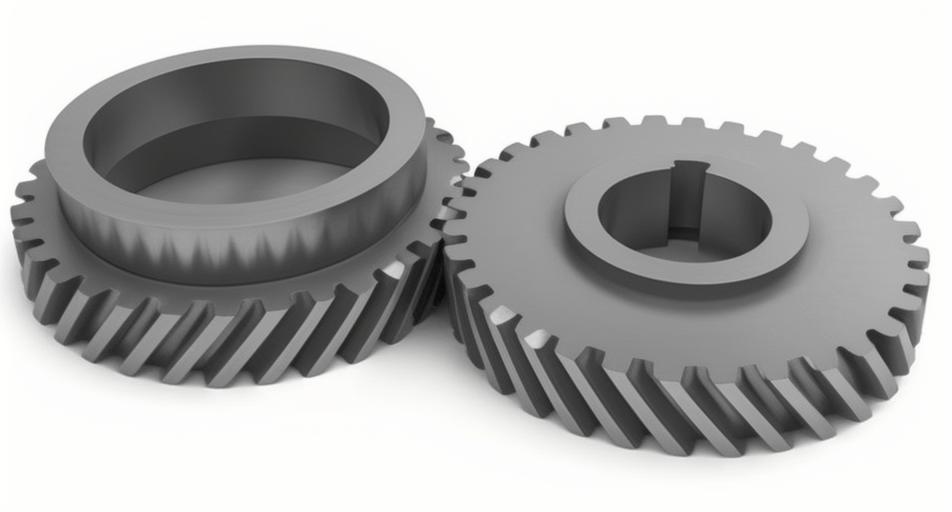
Helical gears are widely used in high-speed and heavy-load applications due to their superior characteristics of smooth transmission, low impact, reduced vibration, and diminished noise. However, the transmission system of helical gears constitutes a complex non-linear dynamic system. Studying the meshing characteristics during the operation of helical gears is of great significance for enhancing their stability and reliability. Tooth surface friction is a major source of vibration and noise in gear systems. To accurately account for its impact, it is essential to develop a comprehensive dynamic model. Most existing models assume ideal gear tooth loading and often neglect the influence of manufacturing errors, assembly errors, and gear modifications on the meshing process. To address this gap, this study integrates Tooth Contact Analysis (TCA) and Loaded Tooth Contact Analysis (LTCA) techniques to propose a dynamic model for a helical gear pair that explicitly incorporates tooth surface friction.
The core objective is to establish a coupled dynamic system that accurately reflects the interaction between mechanical vibration and frictional forces. The methodology involves first determining the kinematic and static conditions of the meshing pair through TCA and LTCA. Subsequently, a multi-degree-of-freedom dynamic model is formulated, which is inherently coupled with the time-varying friction forces calculated from the contact analysis. The overall workflow for establishing the dynamic model considering tooth surface friction is summarized below.
The process begins with the TCA and LTCA of the helical gear pair. From these analyses, fundamental excitation parameters are derived: the time-varying meshing stiffness and the geometric parameters necessary for friction calculation, namely the tooth surface sliding friction coefficient and the friction arm. Simultaneously, a dynamic model of the helical gear pair that includes tooth surface friction is established. This model is solved to compute the dynamic meshing force, velocity, and displacement. Crucially, the calculated dynamic responses (like force and velocity) are fed back to update the calculation of the sliding friction coefficient and friction arm, as these parameters are themselves dependent on the dynamic state. This feedback loop creates the coupled system: the sliding friction coefficient, friction arm, and the dynamic equations together form the meshing dynamics coupling system for the helical gear pair. The system equations are then solved through a decoupling calculation scheme to obtain the final dynamic response.
Determination of Tooth Surface Contact Path for Helical Gears
Tooth Contact Analysis (TCA) is a method used to simulate the gear meshing process under conditions of error and modification. The coordinate system for the TCA model of a helical gear pair is established as shown in the referenced figure. In the fixed coordinate system \(O_fX_fY_fZ_f\), the coordinates of the meshing point on the driving and driven gears must coincide, and their unit normals must be collinear. This condition can be expressed by the following system of equations:
$$
\begin{cases}
\mathbf{r}_f^{(1)}(u_1, \theta_1, \phi_1) = \mathbf{r}_f^{(2)}(u_2, \theta_2, \phi_2) \\
\mathbf{n}_f^{(1)}(u_1, \theta_1, \phi_1) = \mathbf{n}_f^{(2)}(u_2, \theta_2, \phi_2)
\end{cases}
$$
Where \(u_i\) and \(\theta_i\) are the surface parameters of the gear tooth, and \(\phi_i\) is the rotational angle of gear \(i\). For a given rotational angle \(\phi_1\) of the driving gear, the contact condition can also be governed by the equation of meshing:
$$
\begin{cases}
\mathbf{r}_f^{(1)}(u_1, \theta_1, \phi_1) = \mathbf{r}_f^{(2)}(u_2, \theta_2, \phi_2) \\
(\partial \mathbf{r}_f^{(1)} / \partial \theta_1) \cdot \mathbf{n}_f^{(2)}(u_2, \theta_2, \phi_2) = 0
\end{cases}
$$
In the calculation, the rotation angle \(\phi_1\) is treated as a given input. The parameter \(\theta_1\) is discretized over one mesh cycle, for example, into five parts: \(\theta_1^{(i)} = \frac{2\pi}{z_1} / 5 \times i\) where \(i = 1, 2, 3, 4, 5\). Solving the systems of equations above for each increment yields the coordinates of the contact point as functions of the driving gear’s rotation:
$$
\mathbf{r}_i = \mathbf{r}_i(u_i(\theta_1), \theta_i(\theta_1), \phi_i(\theta_1))
$$
The locus of these points on the tooth surface defines the tooth surface contact path. This path is crucial for understanding the load distribution and the locus of points where friction acts.
Calculation of Time-Varying Mesh Stiffness
Loaded Tooth Contact Analysis (LTCA) simulates the gear meshing process under load, providing insights into performance under working conditions. The physical model for LTCA considers the deformation at discrete potential contact points along the contact ellipse. The mathematical formulation aims to find the contact pressure distribution \(\mathbf{p}\) that minimizes the total elastic potential energy while satisfying equilibrium and compatibility conditions. This can be set up as a constrained optimization problem:
$$
\begin{aligned}
&\min \sum_{j=1}^{2n+1} X_j \\
&\text{subject to:} \\
&\mathbf{[F]p + [Z] + [X] = [w]} \\
&\mathbf{[e]^T p} + X_{2n+1} = P \\
&p_j, d_j, Z_j, X_j \ge 0 \\
&p_j = 0 \quad \text{or} \quad d_j = 0
\end{aligned}
$$
Here, \(\mathbf{[F]}\) is the flexibility matrix, \(\mathbf{p}\) is the vector of contact pressures, \(\mathbf{[Z]}\) is the vector of separations (initial gaps), \(\mathbf{[X]}\) is a vector of slack variables, \(\mathbf{[w]}\) is the vector of rigid body approach, \(\mathbf{[e]}\) is a unit vector, \(P\) is the total normal load, and \(d_j\) represents the deformation. Solving this problem yields the normal displacement \(\mathbf{[Z]}\) at the contact positions along the path for one complete meshing cycle. The time-varying mesh stiffness \(k_m(t)\) is then calculated at discrete points as the ratio of the normal force to the corresponding normal displacement:
$$
k_m(t_j) = \frac{P}{Z_j}
$$
These discrete stiffness values are then fitted to a continuous function of time or rotational angle, representing a primary internal excitation in the dynamic system of helical gears.
Dynamic Model of Helical Gear Pair Considering Tooth Surface Friction
The dynamic model considers bending, torsion, and axial vibrations, leading to an eight-degree-of-freedom system. The degrees of freedom are defined for both the driving gear (1) and the driven gear (2):
$$
\{\delta\} = \{ x_1, y_1, z_1, \theta_1, x_2, y_2, z_2, \theta_2 \}^T
$$
Here, \(x_i, y_i, z_i\) are the translational displacements, and \(\theta_i\) is the torsional displacement. The coordinate system is defined with the y-axis along the line of action, the z-axis along the gear axis, and the x-axis completing the right-handed system. A schematic of the coupling model shows springs and dampers supporting the gears in all translational directions, with the gear mesh represented by a spring-damper element along the line of action, influenced by the friction force.
Calculation of Tooth Surface Friction Force
The accurate calculation of the sliding friction coefficient \(\mu\) is critical. It is a function of several parameters related to the contact conditions. An empirical formula based on the slide-to-roll ratio \(SR\), Hertzian pressure \(P_h\), sum velocity \(v_{\Sigma}\), and lubricant parameter \(S\) can be used:
$$
\mu = e^{f(SR, P_h, v_{\Sigma}, S)} |SR|^{b_2} P_h^{b_3} v_{\Sigma}^{b_6} e^{b_7 v_{\Sigma}} R^{b_8}
$$
where
$$
f(SR, P_h, v_{\Sigma}, S) = b_1 + b_4 |SR| P_h \log_{10}(v_{\Sigma}) + b_5 e^{-|SR| P_h \log_{10}(v_{\Sigma})} + b_9 e^{S}
$$
The parameters \(b_1\) to \(b_9\) are determined empirically. Key variables in these formulas include:
- Slide-to-roll ratio (SR): \(SR = (u_1 – u_2) / ((u_1 + u_2)/2)\), where \(u_1\) and \(u_2\) are the surface velocities of the driving and driven gear at the contact point.
- Equivalent radius of curvature (R): \( R = \frac{s_1 \cdot s_2}{s_1 + s_2} \), where \(s_1\) and \(s_2\) are the distances from the contact point to the respective pitch points on the gear bodies.
- Hertzian pressure (P_h): \( P_h = Z_E \sqrt{ F_{1y} / (l R) } \), where \(Z_E\) is the elasticity coefficient, \(F_{1y}\) is the dynamic force along the line of action, and \(l\) is the instantaneous contact line length.
The friction force magnitude is \( F_f = \mu F_{1y} \). Its direction depends on the relative sliding velocity. On the approach path (from the start of active profile to the pitch point), the friction on the driving gear opposes its motion. On the recess path (from the pitch point to the end of active profile), the friction on the driving gear acts in the direction of its motion. A sign function \(\chi\) is introduced, where \(\chi = -1\) on the approach and \(\chi = +1\) on the recess.
The friction arm \(s_1\) (distance from the contact point to the driving gear’s center along the line of action) varies during meshing and is calculated geometrically. For the driving gear:
$$
\begin{aligned}
s_1 &= \sqrt{(r’_1 + r’_2)^2 – (r_{1b} + r_{2b})^2 – \sqrt{r_{2a}^2 – r_{2b}^2}} + r_{1b} \omega_1 t – \lambda \\
\lambda &= y_1 + \theta_1 r_1 – y_2 – \theta_2 r_2 – r_y
\end{aligned}
$$
where \(r’_i\) are operating pitch radii, \(r_{ib}\) are base circle radii, \(r_{2a}\) is the addendum radius of the driven gear, and \(r_y\) is a geometric offset. The friction arm for the driven gear is \(s_2 = L – s_1\), where \(L\) is the total length of the line of action.
Dynamic Meshing Force and System Equations
The dynamic meshing force has components along the line of action (radial direction in the model plane) and the axial direction. They are functions of the relative displacements and velocities, the transmission error excitation \(e(t)\), and the mesh stiffness \(k(t)\).
Line of Action Force:
$$
F_{1y} = \cos\beta \, \left\{ k f_{hv}(y_1 + \theta_1 r_1 – y_2 – \theta_2 r_2 – e(t)) + c (\dot{y}_1 + \dot{\theta}_1 r_1 – \dot{y}_2 – \dot{\theta}_2 r_2 – \dot{e}(t)) \right\}
$$
Axial Force:
$$
F_z = \sin\beta \, \left\{ k \left[ z_1 – z_2 – (y_1 + \theta_1 r_1 – y_2 – \theta_2 r_2) \tan\beta – e(t) \right] + c \left[ \dot{z}_1 – \dot{z}_2 – (\dot{y}_1 + \dot{\theta}_1 r_1 – \dot{y}_2 – \dot{\theta}_2 r_2) \tan\beta – \dot{e}(t) \right] \right\}
$$
Where \(\beta\) is the helix angle, \(k\) and \(c\) are the time-varying mesh stiffness and damping, and \(f_{hv}(\cdot)\) is a backlash function defined as:
$$
f_{hv}(y) =
\begin{cases}
y – b_\xi, & y > b_\xi \\
0, & |y| \le b_\xi \\
y + b_\xi, & y < -b_\xi
\end{cases}
$$
Similar backlash functions \(f_{ix}, f_{iy}, f_{iz}\) apply to the supporting springs in the x, y, z directions for each gear.
Finally, the system of coupled differential equations for the eight-degree-of-freedom model considering tooth surface friction is derived from Newton’s second law:
$$
\begin{aligned}
m_1 \ddot{x}_1 + c_{1x} \dot{x}_1 + k_{1x} f_{1x}(x_1) &= \chi \mu F_{1y} \\
m_1 \ddot{y}_1 + c_{1y} \dot{y}_1 + k_{1y} f_{1y}(y_1) &= -F_{1y} \\
m_1 \ddot{z}_1 + c_{1z} \dot{z}_1 + k_{1z} f_{1z}(z_1) &= -F_{z} \\
I_1 \ddot{\theta}_1 + F_{1y} r_1 – s_1 \chi \mu F_{1y} &= T_1 \\
m_2 \ddot{x}_2 + c_{2x} \dot{x}_2 + k_{2x} f_{2x}(x_2) &= -\chi \mu F_{1y} \\
m_2 \ddot{y}_2 + c_{2y} \dot{y}_2 + k_{2y} f_{2y}(y_2) &= F_{1y} \\
m_2 \ddot{z}_2 + c_{2z} \dot{z}_2 + k_{2z} f_{2z}(z_2) &= F_{z} \\
I_2 \ddot{\theta}_2 – F_{1y} r_2 + s_2 \chi \mu F_{1y} &= -T_2
\end{aligned}
$$
These equations describe the helical gears dynamics, where the friction force \(\mu F_{1y}\) and its moment arms \(s_1, s_2\) create a direct coupling between the tangential/axial vibrations (equations for \(x_i\), \(\theta_i\)) and the primary line-of-action vibration (equations for \(y_i\)).
Simulation Example and Model Validation
The proposed model is validated using the parameters of a specific helical gear pair, as listed in the table below.
| Parameter | Driving Gear | Driven Gear |
|---|---|---|
| Number of Teeth | 48 | 96 |
| Normal Module (mm) | 2 | 2 |
| Normal Pressure Angle (°) | 20 | 20 |
| Helix Angle (°) | 16.43 | 16.43 |
| Tip Clearance Coefficient | 0.35 | 0.35 |
| Face Width (mm) | 20 | 20 |
| Hand of Helix | Right | Left |
| Input Speed (rpm) | 3040 | – |
| Output Torque (Nm) | – | 2.1 |
| Material | 45 Steel | 45 Steel |
Based on these parameters, the meshing period \(T\) and the nominal normal force \(P\) are calculated:
$$
T = \frac{60}{z_1 n_1} = \frac{60}{48 \times 3040} \approx 4.1118 \times 10^{-4} \, \text{s}, \quad P = \frac{2 T_1}{d_1 \cos\alpha_n \cos\beta} \approx 23.28 \, \text{N}
$$
Results of Contact Path, Stiffness, and Friction Coefficient
Performing TCA yields the contact path on the tooth surface of the driving gear. For this example, the path from mesh-in to mesh-out is divided into 13 positions. The contact time is unevenly distributed: the toe edge engages for \(4T/5\), the central region along the face width for \(T\), and the heel edge for \(3T/5\).
The LTCA provides the normal displacement at these contact positions. The time-varying mesh stiffness is then computed, showing a periodic fluctuation with a maximum value around \(2.23 \times 10^8\) N/m.
The sliding friction coefficient is calculated using the described empirical formula. The results show that \(\mu\) is very low near the pitch line (where sliding velocity approaches zero) and reaches its maximum absolute value (approximately 0.0191 in this case) near the points of mesh-in and mesh-out. This trend aligns well with established literature on gear friction, confirming the validity of the friction sub-model.
Dynamic Response and Experimental Comparison
The system of dynamic equations is solved numerically. A key output is the relative vibration acceleration along the line of action, calculated as:
$$
\ddot{\gamma} = \ddot{y}_1 + \ddot{\theta}_1 r_1 – \ddot{y}_2 – \ddot{\theta}_2 r_2 – \ddot{e}(t)
$$
The theoretical frequency spectrum of \(\ddot{\gamma}\) shows dominant peaks at the gear mesh frequency \(f_m = z_1 n_1 / 60 = 2432\) Hz and its multiples (4864 Hz, 7296 Hz, etc.). The amplitudes decay with increasing harmonic order.
Experimental validation was conducted on a gear dynamic test rig. A DC motor provided power, and a magnetic powder brake applied load. Accelerometers were mounted tangentially on the end faces of both gears at the base circle radius to measure torsional vibration. The relative vibration acceleration signal was obtained and analyzed using FFT.
The experimental spectrum also shows a dominant peak near the theoretical mesh frequency (measured at 2450 Hz) and its harmonic at 4900 Hz. The slight discrepancy (18 Hz) is attributed to factors such as accelerometer calibration error and modulation by low-frequency components. The overall agreement in the spectral structure—dominant mesh frequency peaks with decaying harmonics—strongly supports the validity of the proposed dynamic model for helical gears.
Conclusion
This study establishes a comprehensive dynamic model for a helical gear pair that incorporates tooth surface friction. The primary conclusions are as follows:
- By employing Tooth Contact Analysis and Loaded Tooth Contact Analysis, the fundamental excitations for the dynamic model are accurately determined. This includes calculating the time-varying mesh stiffness, the sliding friction coefficient on the tooth surface, and the associated friction arm. These parameters are derived considering the actual meshing geometry under load.
- A coupled bending-torsion-axial vibration model with eight degrees of freedom is formulated for the helical gear pair. The model explicitly includes the friction force and its moment in the equations of motion. The dynamic responses (force, velocity, displacement) calculated from this model feed back into the friction coefficient calculation, creating a coupled system. This system is effectively solved through a decoupling calculation scheme.
- The model is validated through simulation and experiment. The theoretical mesh frequency (2432 Hz) and its harmonics align closely with the dominant frequencies observed in the experimental vibration spectrum (base frequency at 2450 Hz). This convergence confirms the rationality and effectiveness of the proposed modeling approach for analyzing the dynamic characteristics of helical gears with tooth surface friction.
The integrated methodology provides a robust framework for predicting the vibration and noise behavior of helical gears, which is essential for the design and optimization of high-performance gear transmissions in demanding applications.