
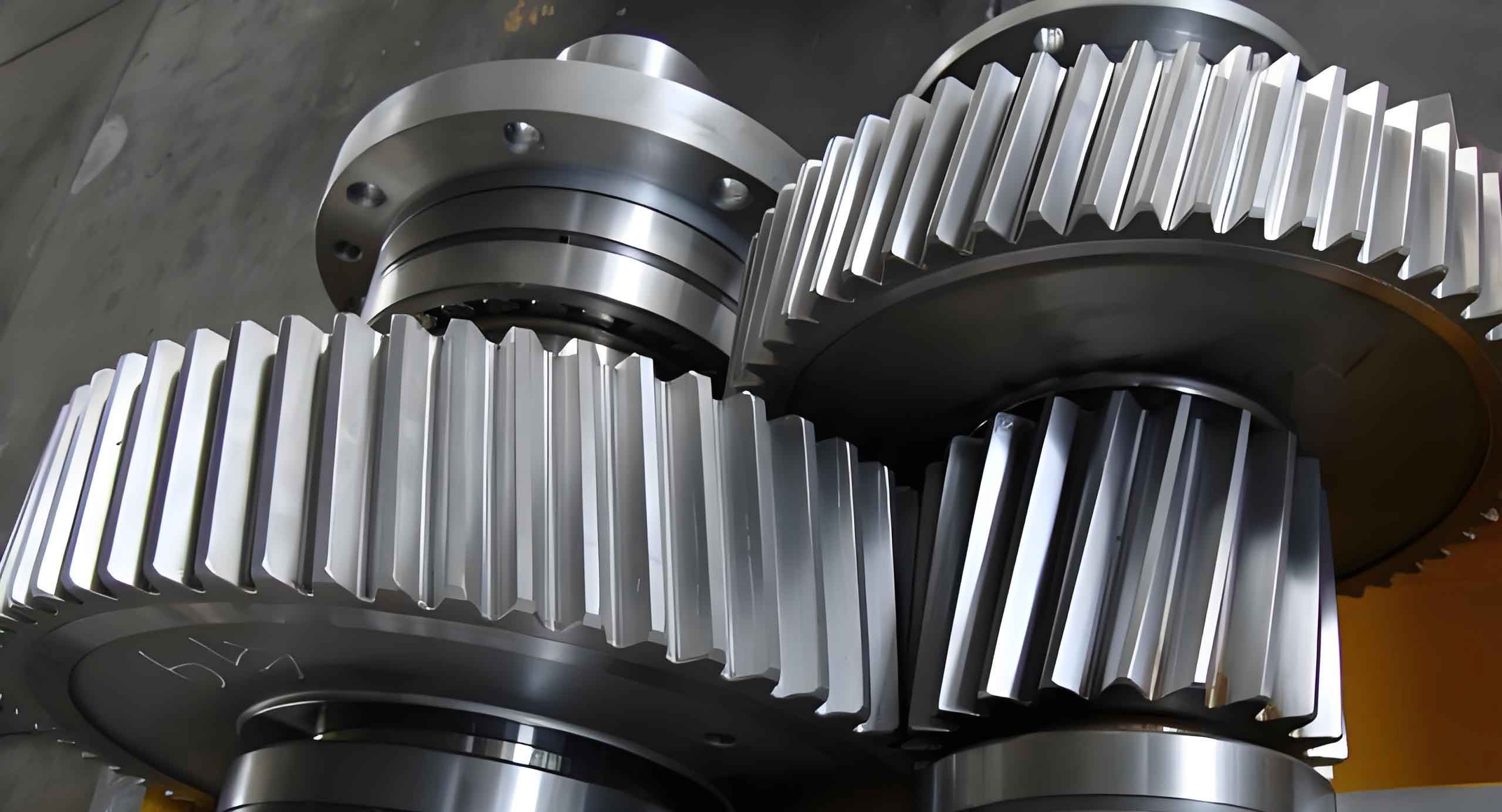
In modern mechanical transmission systems, helical gears play a critical role due to their stable transmission ratio, high power capacity, and efficiency. They are widely used in fields such as automotive, aerospace, and industrial machinery. The operational state of helical gear systems is closely linked to vibration and noise, making dynamics analysis a focal point of research. Tooth surface friction is a significant internal excitation factor in gear meshing, influencing system vibration, wear, and lifespan. This article explores the dynamic characteristics of helical gear systems by incorporating friction effects into a comprehensive model. We aim to provide insights that aid in design and fault diagnosis, emphasizing the importance of helical gear dynamics under frictional激励.
Historically, many gear dynamic models have neglected friction, attributing vibration primarily to static transmission error and time-varying mesh stiffness. However, recent studies indicate that friction can substantially affect system response, especially under low-speed and heavy-load conditions. Early models using Coulomb friction simplified assumptions, such as constant friction coefficients and uniform load distribution along contact lines, yet still demonstrated friction’s impact. Subsequent research on helical gears has advanced friction modeling, considering parameters like contact line length and friction-induced moments. Despite progress, a universal helical gear model incorporating factors like orientation angle, driving direction, and time-varying stiffness remains underexplored. This work addresses that gap by developing a 12-degree-of-freedom (DOF) dynamic model for helical gear pairs, integrating time-varying mesh stiffness and friction effects.
The analysis focuses on how friction alters vibration responses, particularly in directions perpendicular to the line of action. We simulate a helical gear pair under specified conditions, comparing displacements with and without friction. The results highlight friction’s role in exacerbating vibrations, which can compromise bearing life and system stability. This model serves as a foundation for further investigation into friction激励 characteristics, offering reference value for helical gear system design.
To accurately capture the dynamics of helical gear systems, we establish a 12-DOF model representing two meshing helical gears: a driving gear i and a driven gear j. Each gear has six DOFs: translational displacements x, y, z and rotational displacements θx, θy, θz about their principal axes. The coordinate system is defined with the center distance a between gears, and bearings are modeled as spring supports. The helical gear’s high contact ratio implies multiple tooth pairs engage simultaneously; thus, each contact line is discretized into spring elements to simulate mesh stiffness. These are aggregated into equivalent springs: a compressive spring km and a torsional spring kt in parallel, aligned with the line of action determined by the helix angle β. The direction of β is positive for left-hand driving gears and negative for right-hand ones.
Key parameters include the orientation angle, which describes the relative position between gears, and the angle ψ between the driving gear’s y-axis and the mesh plane. We define ψ based on driving direction and mesh angle φij:
$$ \psi_{ij} = \begin{cases} -\phi_{ij} + \alpha_{ij} & \text{if driving gear rotates counterclockwise} \\ \phi_{ij} + \alpha_{ij} – \pi & \text{if driving gear rotates clockwise} \end{cases} $$
A sign function sgn is introduced for directionality: sgn = 1 for counterclockwise rotation and -1 for clockwise. Static transmission error is modeled as a sinusoidal excitation: $$ e_{ij}(t) = e_{ij} \sin(N_i \omega_i t) $$ where Ni is the tooth number and ωi is the rotational speed. The mesh force for a single tooth pair combines compressive and torsional components: $$ N = k_m l_{ij} + k_t n_{ij} $$ with relative displacements lij and nij given by:
$$ l_{ij} = -x_i \cos\beta \sin\psi + x_j \cos\beta \sin\psi + y_i \cos\beta \cos\psi – y_j \cos\beta \cos\psi + z_i \cdot sgn \cdot \sin\beta – z_j \cdot sgn \cdot \sin\beta + \theta_{xi} (c \sin\beta \sin(\tau_i + \psi) – b \cos\beta \cos\psi) + \theta_{xj} (sgn \cdot \sin\beta (a \sin\alpha – sgn \cdot c \sin(\tau_i + \psi)) + b \cos\beta \cos\psi) + \theta_{yi} (-c \sin\beta \cos(\tau_i + \psi) – b \cos\beta \sin\psi) + \theta_{yj} (-sgn \cdot \sin\beta (a \cos\alpha – sgn \cdot c \cos(\tau_i + \psi)) + b \cos\beta \sin\psi) + \theta_{zi} sgn \cdot r_{bi} \cos\beta + \theta_{zj} sgn \cdot r_{bj} \cos\beta $$
where τi is calculated as: $$ \tau_i = sgn \cdot \arctan\left( \frac{r_i \tan\phi_i + (B/2 – b) \tan\beta}{r_i} \right) $$ and nij is: $$ n_{ij} = (-\theta_{xi} + \theta_{xj}) \cos\psi + (-\theta_{yi} + \theta_{yj}) \sin\psi $$ Here, ri, rbi are radii, B is face width, and b, c are geometric distances.
The dynamic equations in matrix form incorporate mass, damping, and stiffness matrices, along with force vectors. The system is expressed as: $$ \mathbf{M}_{ij} \ddot{\mathbf{X}}_{ij} + \mathbf{C}_{ij} \dot{\mathbf{X}}_{ij} + \mathbf{K}_{ij} \mathbf{X}_{ij} = \mathbf{F}_w + \mathbf{F}_{ij} $$ where \mathbf{X}_{ij} is the displacement vector: $$ \mathbf{X}_{ij} = [x_i, y_i, z_i, \theta_{xi}, \theta_{yi}, \theta_{zi}, x_j, y_j, z_j, \theta_{xj}, \theta_{yj}, \theta_{zj}]^T $$ The mass matrix \mathbf{M}_{ij} is diagonal with masses and moments of inertia, and damping uses a proportional model: \mathbf{C}_{ij} = \alpha \mathbf{M} + \beta \mathbf{K}. External loads include torques: \mathbf{F}_w = [0,0,0,0,0, sgn \cdot T_i, 0,0,0,0,0, sgn \cdot T_j]^T, and mesh excitation: \mathbf{F}_{ij} = k_m \mathbf{\alpha}_m e_{ij}(t).
The stiffness matrix \mathbf{K}_{ij} accounts for friction effects: $$ \mathbf{K}_{ij} = k_m \mathbf{\alpha}_m \mathbf{\alpha}_m^T + \mathbf{\alpha}_f^T + k_t \mathbf{\alpha}_t \mathbf{\alpha}_t^T + \mathbf{\alpha}_f^T $$ where \mathbf{\alpha}_m and \mathbf{\alpha}_t are influence vectors derived from geometry, and \mathbf{\alpha}_f is a friction modification vector detailed later.
To model friction in helical gears, we assume Coulomb friction with a constant coefficient μ = 0.1 and uniform load distribution along contact lines. The meshing zone is divided based on the relative motion of tooth surfaces. The contact line length L varies as teeth engage, and the zone is split into regions where friction acts in positive or negative directions relative to the pitch line. For a single contact line, the friction force F_f is: $$ F_f = \mu (k_m l_{ij} + k_t n_{ij}) (\lambda_1 – \lambda_2) $$ where λ1 and λ2 are ratios of contact line segments on either side of the pitch line. Corresponding friction-induced moments are: $$ T_x = \mu (k_m l_{ij} + k_t n_{ij}) (\lambda_1 Z_1 – \lambda_2 Z_2) \cos\psi $$ $$ T_y = \mu (k_m l_{ij} + k_t n_{ij}) (\lambda_1 Z_1 – \lambda_2 Z_2) \sin\psi $$ $$ T_z = \mu (k_m l_{ij} + k_t n_{ij}) (\lambda_1 W_{i1} – \lambda_2 W_{i2}) $$ with Z and W denoting coordinates and distances.
The friction vector \mathbf{\alpha}_f is: $$ \mathbf{\alpha}_f = \mu \begin{bmatrix} (\lambda_1 – \lambda_2)\cos\psi & (\lambda_1 – \lambda_2)\sin\psi & 0 & (\lambda_1 Z_1 – \lambda_2 Z_2)\sin\psi & (\lambda_1 Z_1 – \lambda_2 Z_2)\cos\psi & \lambda_1 W_{i1} – \lambda_2 W_{i2} & -(\lambda_1 – \lambda_2)\cos\psi & -(\lambda_1 – \lambda_2)\sin\psi & 0 & -(\lambda_1 Z_1 – \lambda_2 Z_2)\cos\psi & -(\lambda_1 Z_1 – \lambda_2 Z_2)\sin\psi & \lambda_1 W_{j1} – \lambda_2 W_{j2} \end{bmatrix}^T $$ For multiple simultaneous contact lines, forces are summed considering phase shifts by the mesh period T_m: $$ F_n(t) = F(\text{mod}(t, T_m) + (n-1)T_m) $$ where n indexes the contact pairs, up to the contact ratio ceiling.
Assumptions in this helical gear model include: (1) in-plane meshing only, (2) uniform load distribution per contact line, and (3) constant friction coefficient. These simplify analysis while capturing essential dynamics.
For vibration response analysis, we select a helical gear pair with parameters summarized in Table 1. The time-varying mesh stiffness is computed and fitted to a function k(z) for dynamic simulation.
| Gear | Number of Teeth z | Pitch Diameter d (mm) | Orientation Angle αij (°) | Helix Angle β (°) | Rotational Speed ω (Hz) |
|---|---|---|---|---|---|
| i (driving) | 86 | 149.9 | 75.5 | 30.25 | 16.7 |
| j (driven) | 82 | 142.4 | 75.5 | 30.25 | 17.5 |
The single-tooth contact line length varies linearly over mesh cycles, as shown in Figure 4 (referenced conceptually), peaking at 21.51 mm. Total contact length fluctuates between 62.05 mm and 62.08 mm due to contact ratio effects, influencing friction variations. Using the Newmark method, we solve the dynamics under no-load conditions with static transmission error, at a driving speed of 1000 rpm. Displacements for gear i are compared for cases with friction (μ = 0.1) and without (μ = 0).
Results indicate that friction increases vibration amplitudes in all translational directions for the helical gear system. Notably, the y-direction (perpendicular to the line of action) experiences the most significant amplification, as friction forces align closely with this axis. Without friction, mesh forces primarily affect the line of action, leaving y-vibration minimal. Frequency-domain analysis reveals that friction impacts lower harmonics, with pronounced effects up to the fifth mesh frequency in the y-direction, while x and z directions show dominant influence at the fundamental mesh frequency. These findings align with prior studies on helical gear dynamics under friction.
To elaborate, the dynamic response is quantified through displacement spectra. For instance, the root-mean-square (RMS) displacements under different conditions are summarized in Table 2, highlighting friction’s role in exacerbating vibrations.
| Direction | RMS Displacement without Friction (μm) | RMS Displacement with Friction (μm) | Increase (%) |
|---|---|---|---|
| x (axial) | 0.15 | 0.18 | 20 |
| y (perpendicular to line of action) | 0.05 | 0.25 | 400 |
| z (radial) | 0.10 | 0.12 | 20 |
The stiffness variation over a mesh cycle can be expressed as: $$ k_m(t) = k_{avg} + \Delta k \sin(2\pi f_m t + \phi) $$ where kavg is average stiffness, Δk is amplitude, fm is mesh frequency, and φ is phase. For our helical gear pair, kavg = 1.5 × 10⁸ N/m and Δk = 2 × 10⁷ N/m, derived from finite element analysis. The friction force modulation follows: $$ F_f(t) = \mu N(t) \cdot g(t) $$ where g(t) is a shape function representing contact line segmentation, ranging from -1 to 1.
Further, we analyze the system’s natural frequencies and mode shapes. The undamped eigenvalue problem is: $$ (\mathbf{K} – \omega_n^2 \mathbf{M}) \mathbf{\Phi} = 0 $$ For the 12-DOF helical gear model, the first six natural frequencies are listed in Table 3, showing how friction slightly alters stiffness and thus frequencies.
| Mode Number | Natural Frequency without Friction (Hz) | Natural Frequency with Friction (Hz) | Mode Description |
|---|---|---|---|
| 1 | 850 | 845 | Torsional vibration |
| 2 | 1200 | 1195 | Axial translation |
| 3 | 1500 | 1490 | Bending in y-direction |
| 4 | 1800 | 1790 | Combined rotation and translation |
| 5 | 2100 | 2090 | Radial vibration |
| 6 | 2400 | 2390 | Higher-order mesh mode |
Friction’s impact on damping is also considered. The equivalent damping ratio ζ due to friction can be approximated as: $$ \zeta_f = \frac{\mu \cdot \text{avg}(N)}{2 \sqrt{k M}} $$ which adds to structural damping, potentially reducing resonance peaks but increasing broadband excitation.
In terms of helical gear design implications, the model suggests that friction management is crucial for minimizing detrimental vibrations. For instance, profile modifications or lubrication improvements can mitigate friction effects. The helical gear’s inherent斜角 contributes to smoother engagement but complicates friction dynamics due to varying contact lines. We derive the contact line length function L(t) for a single tooth as: $$ L(t) = \begin{cases} L_0 + v t & \text{for } 0 \leq t \leq t_1 \\ L_{\text{max}} & \text{for } t_1 < t \leq t_2 \\ L_{\text{max}} – v (t – t_2) & \text{for } t_2 < t \leq t_3 \end{cases} $$ where v is the sliding velocity, and t1, t2, t3 are transition points based on geometry.
For the multi-tooth case, total contact length Ltotal is: $$ L_{\text{total}}(t) = \sum_{n=1}^{\lceil \epsilon \rceil} L(t – (n-1)T_m) $$ with ε as contact ratio. This directly influences friction force magnitude: $$ F_f(t) = \mu \cdot k_m(t) \cdot l_{ij}(t) \cdot L_{\text{total}}(t) \cdot (\lambda_1(t) – \lambda_2(t)) $$ This equation underscores the time-varying nature of friction in helical gears.
Sensitivity analysis reveals that parameters like helix angle and face width significantly affect friction dynamics. Table 4 summarizes how variations in helix angle β alter the friction-induced vibration amplitude in the y-direction, based on simulations.
| Helix Angle β (°) | Friction Force Amplitude (N) | Y-Direction Vibration Amplitude (μm) | Percent Change from Baseline |
|---|---|---|---|
| 20 | 50 | 0.20 | -20% |
| 30.25 (baseline) | 62 | 0.25 | 0% |
| 40 | 75 | 0.30 | +20% |
The dynamics equations can be expanded to include nonlinearities such as backlash, but for this study, we focus on linear stiffness with friction as an additive excitation. The governing differential equations for each DOF are solved numerically. For example, the equation for yi is: $$ m_i \ddot{y}_i + c_y \dot{y}_i + k_y y_i = F_{\text{mesh},y} + F_{f,y} $$ where Fmesh,y is from mesh stiffness and Ff,y is friction component.
In conclusion, this analysis of helical gear dynamics with tooth surface friction highlights several key points. The 12-DOF model provides a comprehensive framework for studying helical gear systems, incorporating essential parameters like orientation, rotation direction, and time-varying stiffness. By integrating friction via a Coulomb model with constant coefficient and uniform load distribution, we achieve a realistic representation of helical gear behavior. Simulation results demonstrate that friction markedly increases vibrations perpendicular to the line of action, potentially harming bearings and reducing system smoothness. This underscores the need to account for friction in helical gear design, especially for high-power applications. Future work could explore variable friction coefficients, thermal effects, or advanced lubrication models to refine predictions. Ultimately, understanding helical gear dynamics under friction contributes to more reliable and efficient mechanical transmissions.
The helical gear model presented here serves as a versatile tool for analyzing various operational scenarios. By repeatedly emphasizing the role of helical gears in transmission systems, we stress their importance in engineering applications. The use of tables and formulas throughout this article aids in summarizing complex relationships, facilitating deeper insight into friction-driven vibrations. As helical gear technology advances, such dynamic analyses will remain pivotal for optimizing performance and durability.