
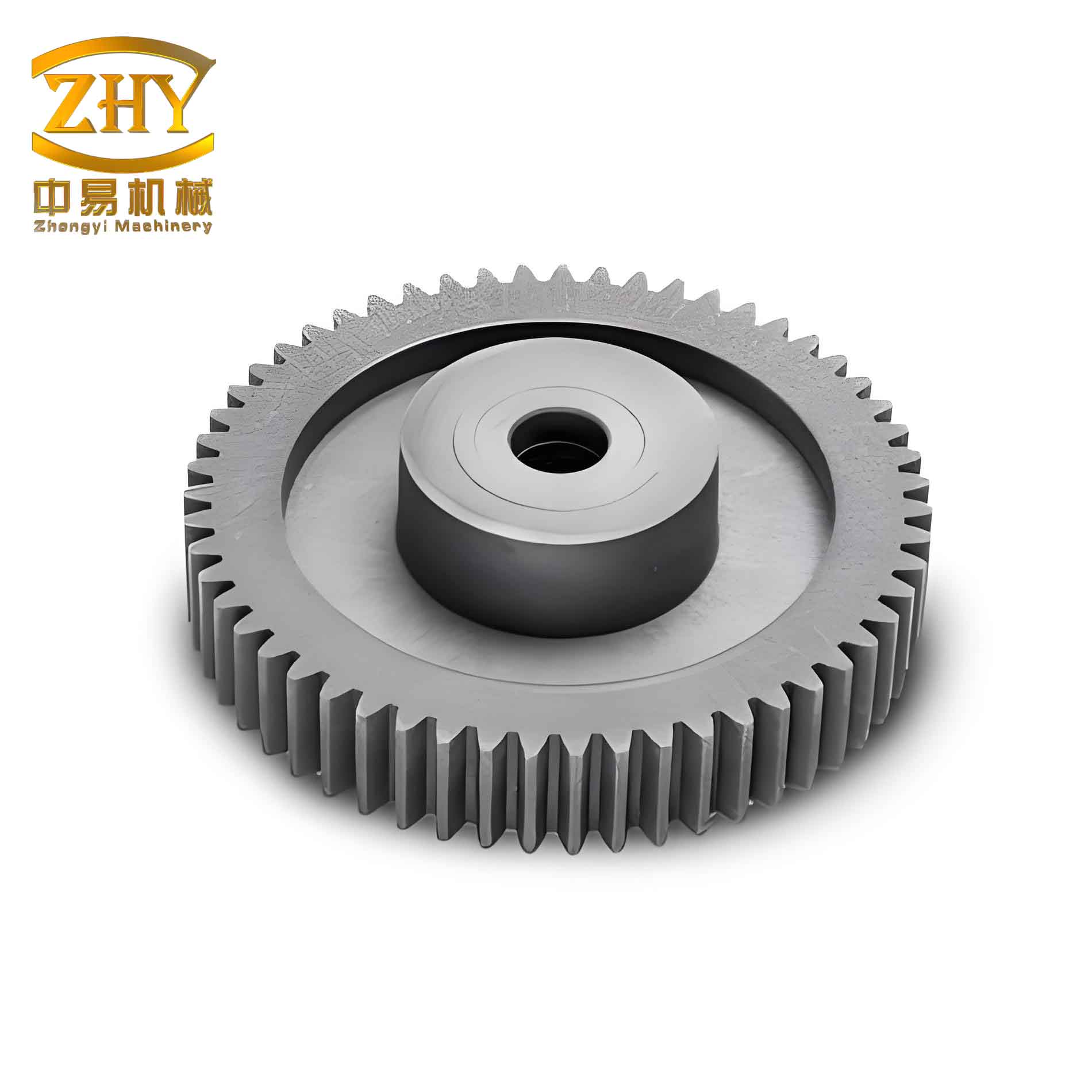
In the field of power transmission, cylindrical gears, particularly spur gears, are fundamental components. Among them, high contact ratio (HCR) cylindrical gears, defined as those with a contact ratio exceeding 2.0, have garnered significant attention due to their superior dynamic characteristics, enhanced load-sharing capability, and reduced operational noise. These advantages make them highly desirable for applications demanding high reliability and quiet operation. However, like all mechanical components, cylindrical gears are subject to progressive degradation mechanisms, with tooth surface wear being one of the most prevalent. This wear alters the tooth profile geometry, which in turn modifies the mesh stiffness—a critical parameter governing the dynamic response of the gear system. Therefore, a comprehensive investigation into the interaction between non-uniform surface wear and the nonlinear dynamics of HCR cylindrical gears is not only necessary but crucial for predicting system longevity, performance decay, and potential failure. In this study, we investigate the dynamic behavior of HCR cylindrical gears by integrating a calculated wear profile into a time-varying mesh stiffness model and solving the resultant nonlinear equations of motion.
The core of any gear dynamics model is the accurate representation of the gear mesh interface. For cylindrical gears, this is typically achieved through a lumped parameter model. In this analysis, a single-degree-of-freedom (SDOF) model is employed, which effectively captures the essential torsional vibrations of the gear pair along the line of action. The governing differential equation is given by:
$$ m_e \ddot{x}(t) + c \dot{x}(t) + k(t) f(x) = F_m + F_h(t) $$
where \( m_e \) is the equivalent mass of the system, \( c \) is the damping coefficient, \( k(t) \) is the crucial time-varying mesh stiffness, and \( f(x) \) is a nonlinear displacement function accounting for gear backlash. The terms on the right side represent the external load \( F_m \) (assumed constant) and the internal static transmission error excitation \( F_h(t) \), often modeled as \( F_h(t) = m_e f_h \omega_h^2 \cos(\omega_h t + \phi_h) \). To generalize the analysis, the equation is normalized using the nominal gear dimensions and the average mesh stiffness \( K_m \), resulting in:
$$ \ddot{\bar{x}}(\tau) + 2\xi \dot{\bar{x}}(\tau) + \bar{K}(\tau) \bar{f}(\bar{x}) = \bar{F}_m + \bar{F}_h(\tau) $$
Here, \( \tau = \omega_n t \) is dimensionless time with \( \omega_n = \sqrt{K_m / m_e} \), \( \xi \) is the damping ratio, \( \bar{K}(\tau)=k(t)/K_m \), and \( \bar{F}_h(\tau) = \bar{\omega}_h^2 \cos(\bar{\omega}_h \tau + \psi) \). The accurate determination of \( \bar{K}(\tau) \), especially one that incorporates the effects of wear, is the pivotal step in this dynamic analysis of cylindrical gears.
| Parameter Category | Symbol | Value (Driving Gear) | Value (Driven Gear) |
|---|---|---|---|
| Basic Gear Geometry | Number of Teeth, \( z \) | 32 | 25 |
| Module, \( m \) (mm) | 3.25 | 3.25 | |
| Pressure Angle, \( \alpha_0 \) | 20° | 20° | |
| Addendum Coefficient | 1.35 | 1.35 | |
| Material & System | Young’s Modulus, \( E \) (GPa) | 206 | |
| Poisson’s Ratio, \( \nu \) | 0.3 | ||
| Face Width, \( L \) (mm) | 20 | ||
| Dynamic Model | Damping Ratio, \( \xi \) | 0.05 | |
| Normalized Backlash, \( \bar{b} \) | 0.5 | ||
| Normalized STE Amplitude, \( \bar{f}_h \) | 0.1 | ||
Calculating the mesh stiffness for HCR cylindrical gears requires a precise geometric model. The tooth profile, generated by a hob cutter, consists of multiple segments: the main involute curve, the tip fillet, and the protuberance or chamfer. The total compliance of a single tooth pair in mesh is computed using the potential energy method, which sums contributions from bending, shear, axial compression, Hertzian contact deformation, and fillet foundation deflection. The bending, shear, and axial stiffnesses for a specific tooth section are derived from integrals of the form:
$$ \frac{1}{k_b} = \int_{x_A}^{x_B} \frac{[M(x)]^2}{E I(x)} dx, \quad \frac{1}{k_s} = \int_{x_A}^{x_B} \frac{1.2 [F \cos \beta(x)]^2}{G A(x)} dx, \quad \frac{1}{k_a} = \int_{x_A}^{x_B} \frac{[F \sin \beta(x)]^2}{E A(x)} dx $$
where \( M(x) \) is the bending moment, \( I(x) \) is the area moment of inertia, \( A(x) \) is the cross-sectional area, \( \beta(x) \) is the load angle relative to the tooth centerline, and \( G \) is the shear modulus. The contact stiffness \( k_h \) and foundation stiffness \( k_f \) are calculated using Hertzian contact theory and Sainsot’s formula, respectively. The overall mesh stiffness for a single tooth pair is then the series combination of these compliances for both the driving and driven cylindrical gears:
$$ k_{single}(t) = \left( \frac{1}{k_{h}} + \frac{1}{k_{b1}+k_{s1}+k_{a1}+k_{f1}} + \frac{1}{k_{b2}+k_{s2}+k_{a2}+k_{f2}} \right)^{-1} $$
For an HCR cylindrical gear pair with a contact ratio \( \varepsilon_\alpha \), the number of tooth pairs in contact alternates between the integer floor and ceiling of \( \varepsilon_\alpha \). The total mesh stiffness \( K(t) \) is the sum of the individual stiffnesses of all concurrently engaged tooth pairs, leading to a periodic piecewise function.
To introduce the wear characteristic, the Archard adhesive wear model is adopted. This model relates the volumetric wear to the normal load and sliding distance. For a point on the tooth flank of cylindrical gears, the incremental wear depth \( dh \) per meshing cycle can be expressed as:
$$ dh = k_w \frac{p \, ds}{H} $$
where \( k_w \) is the dimensionless wear coefficient, \( p \) is the contact pressure, \( ds \) is the sliding distance, and \( H \) is the material hardness. Under constant load conditions and after many cycles \( N \), the accumulated wear depth \( h \) at a specific point (defined by its pressure angle \( \alpha \)) is proportional to the product of the contact half-width \( a(\alpha) \), the specific sliding \( \lambda(\alpha) \), and the number of cycles. A simplified formulation is:
$$ h(\alpha) = C \cdot a(\alpha) \cdot \lambda(\alpha) \cdot N $$
Here, \( C \) is a constant encapsulating material properties, load, and operational speed. The specific sliding \( \lambda(\alpha) \) varies along the tooth profile and is a key differentiator for cylindrical gears, being zero at the pitch point. The calculated wear profile is non-uniform, typically showing a minimum at the pitch point and increasing towards the addendum and dedendum.
| Number of Meshing Cycles, \( N \) | Maximum Wear Depth (μm) | Reduction in Average Mesh Stiffness \( K_m \) | Normalized Load \( \bar{F}_m = 0.04 \) | Normalized Load \( \bar{F}_m = 0.08 \) |
|---|---|---|---|---|
| 0 (No Wear) | 0 | 0% | 5-period quasi-periodic motion | 2-periodic motion |
| 2 × 10⁶ | ~40 | 0.23% | Chaotic motion | 2-periodic motion |
| 6 × 10⁶ | ~70 | 0.72% | Approx. quasi-periodic motion | 2-periodic motion |
| 1 × 10⁷ | ~85 | 1.26% | Chaotic motion | 2-periodic motion |
The wear depth \( h(\alpha) \) effectively reduces the active tooth thickness. This reduction is incorporated into the mesh stiffness calculation by modifying the limits of integration and the cross-sectional geometry parameters \( I(x) \) and \( A(x) \) in the energy equations for the bending, shear, and axial compliances. Consequently, the single-pair stiffness \( k_{single}(t, h) \) becomes a function of both time and the accumulated wear profile. The total mesh stiffness \( K(t, h) \) for the worn HCR cylindrical gear pair is then reconstructed by summing these modified single-pair stiffnesses according to the contact ratio logic. This results in a stiffness function that degrades over time (with increasing \( N \)), primarily manifesting as a reduction in its average value \( K_m \) and a subtle change in its waveform.
The dynamic analysis proceeds by substituting the time- and wear-dependent stiffness function \( \bar{K}(\tau, N) \) into the normalized equation of motion. The equation is solved numerically (e.g., using the Runge-Kutta method) for different wear states (simulated by different values of \( N \)) and under different loading conditions. The dynamic response is analyzed using time-domain waveforms, frequency spectra, and Poincaré maps (sampled once per mesh period). The Poincaré map is particularly effective for distinguishing between periodic, quasi-periodic, and chaotic motions in nonlinear systems like these cylindrical gear dynamics.
Under a light load condition (e.g., \( \bar{F}_m = 0.04 \)), the system exhibits high sensitivity to the wear-induced changes in mesh stiffness. For the unworn cylindrical gears, the response is a 5-period quasi-periodic motion, indicated by five clustered points on the Poincaré map and a dominant spectral peak at 0.2\( \bar{\omega}_h \). With moderate wear (\( N=2 \times 10^6 \)), the dynamics shift dramatically to a chaotic state, characterized by a fractal-like scatter of points on the Poincaré map and a broad, noisy spectrum. As wear progresses further (\( N=6 \times 10^6 \)), the system temporarily moves towards an approximate quasi-periodic state before descending back into chaos under severe wear (\( N=1 \times 10^7 \)). This complex trajectory—quasi-period → chaos → approximate quasi-period → chaos—highlights the strongly nonlinear and sensitive nature of lightly loaded HCR cylindrical gear systems to small parametric changes like those induced by wear.
In stark contrast, under a heavy load condition (e.g., \( \bar{F}_m = 0.08 \)), the dynamic response of the cylindrical gears is dominated by the forcing and the mean load, rendering it remarkably robust against wear. The system maintains a stable 2-periodic motion regardless of the wear state, from no wear up to severe wear (\( N=1 \times 10^7 \)). The Poincaré maps consistently show two distinct points, and the spectra remain clean with distinct harmonics. This insensitivity in heavy-load conditions can be attributed to the “stiffening” effect of the load, which minimizes the influence of the backlash nonlinearity and reduces the system’s susceptibility to the small parametric variations caused by wear.
In conclusion, this integrated study on cylindrical gears demonstrates a critical interaction between operational load, tooth surface wear, and nonlinear dynamic response, specifically for high contact ratio designs. For lightly loaded HCR cylindrical gears, even minor non-uniform wear, causing a small reduction in mesh stiffness, can trigger significant and complex changes in the system’s dynamic state, promoting chaotic vibrations which may accelerate further damage. Conversely, heavily loaded HCR cylindrical gears exhibit remarkable dynamic stability, with their periodic motion largely unaffected by progressive wear over a long duration. These findings underscore the importance of condition-based monitoring for cylindrical gears operating under variable or light loads, as wear progression in such scenarios can be a precursor to complex dynamic instabilities not predictable by traditional static analysis.