
In the field of mechanical engineering, cylindrical gears, particularly spur cylindrical gears, are fundamental components in power transmission systems due to their simplicity and efficiency. High contact ratio cylindrical gears, defined as those with a contact ratio greater than 2, are widely utilized in various industrial applications because of their superior dynamic characteristics, reduced noise, and enhanced load distribution. However, over time, surface wear on gear teeth can significantly alter their performance, leading to changes in mesh stiffness and dynamic behavior. This article delves into the dynamic analysis of high contact ratio spur cylindrical gears, incorporating the effects of non-uniform surface wear. The study aims to provide insights into how wear influences gear dynamics under different loading conditions, thereby contributing to the design and maintenance of more reliable gear systems.
The importance of cylindrical gears in machinery cannot be overstated. They are critical in applications ranging from automotive transmissions to industrial gearboxes. Wear, as a gradual material loss from gear surfaces, is inevitable due to friction and loading during operation. Over time, this wear can lead to increased backlash, reduced mesh stiffness, and altered dynamic responses, potentially causing vibration, noise, and even failure. Therefore, understanding the interplay between wear and dynamics is essential for predicting gear lifespan and optimizing performance. In this context, high contact ratio cylindrical gears offer advantages such as smoother operation and higher load capacity, but their complex mesh behavior makes wear analysis more challenging. This article addresses this by integrating wear models into dynamic simulations, offering a comprehensive view of gear system evolution.
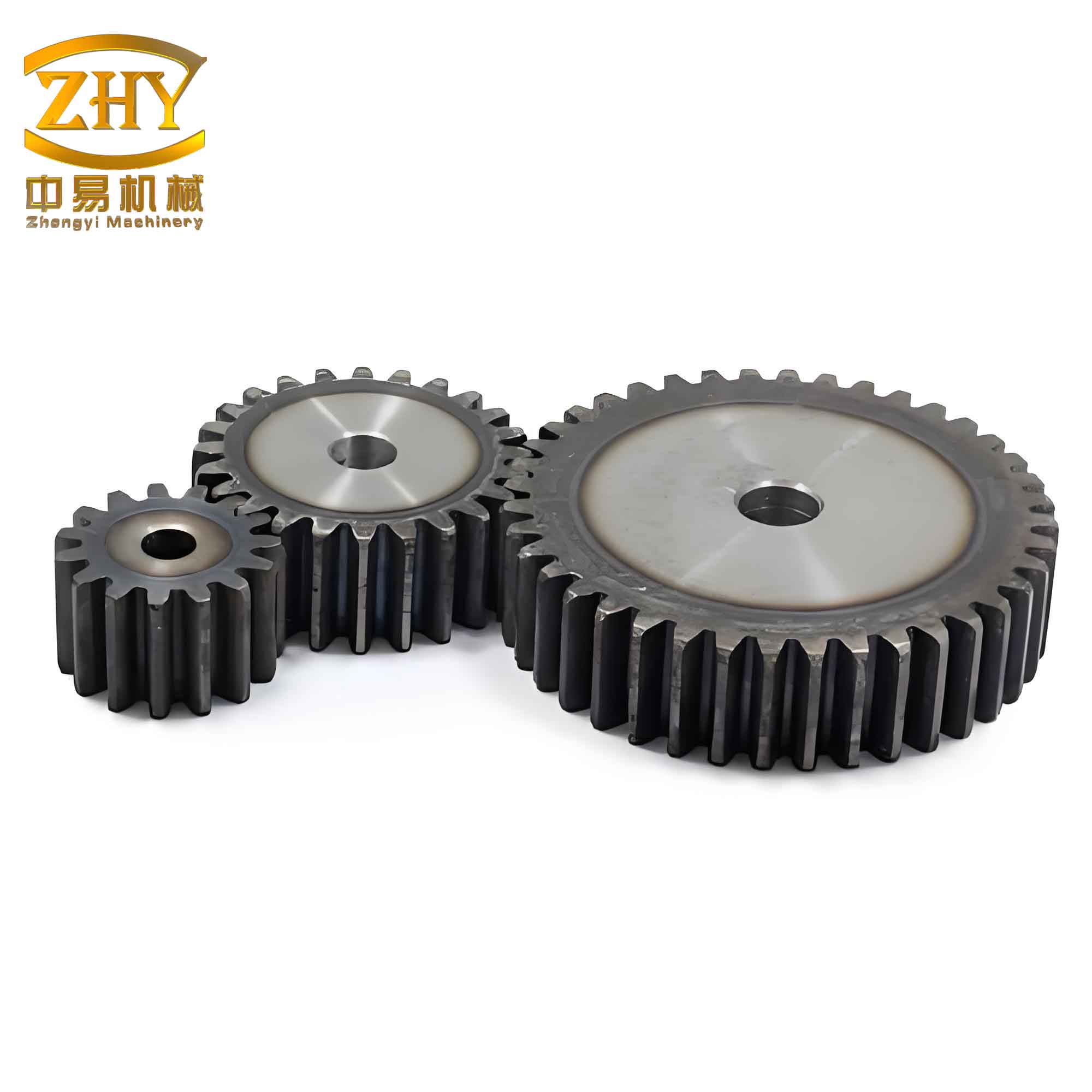
To set the stage, let’s consider the basic dynamics of cylindrical gears. The motion of gear pairs can be described using a single-degree-of-freedom (SDOF) model, which simplifies the system while capturing essential dynamic features. The equation of motion is given by:
$$ m_e \ddot{x}(t) + c \dot{x}(t) + k(t) f(x) = F_m + F_h(t) $$
where \( m_e \) is the equivalent mass, \( c \) is the damping coefficient, \( k(t) \) is the time-varying mesh stiffness, \( f(x) \) is the backlash function, \( F_m \) is the equivalent external excitation, and \( F_h(t) \) is the internal excitation due to transmission error. For normalization, we define dimensionless parameters: natural frequency \( \omega_n = \sqrt{K_m / m_e} \), where \( K_m \) is the average mesh stiffness; dimensionless time \( \tau = \omega_n t \); nominal length \( l \); and dimensionless displacement \( \bar{x}(\tau) = x(t)/l \). The dimensionless form becomes:
$$ \bar{x}” + 2\zeta \bar{x}’ + K(\tau) f(\bar{x}) = \bar{F}_m + \bar{F}_h(\tau) $$
with \( \zeta = c/(2\sqrt{K_m m_e}) \), \( K(\tau) = k(t)/K_m \), \( \bar{F}_m = F_m/(K_m l) \), and \( \bar{F}_h(\tau) = (f_h \omega_h^2 / K_m) \cos(\omega_h \tau + \psi) \). This model serves as the foundation for analyzing dynamic responses under wear conditions.
The core of this analysis lies in calculating the mesh stiffness of cylindrical gears, which is directly affected by surface wear. For high contact ratio cylindrical gears, the mesh stiffness varies with time due to multiple tooth pairs in contact. The total mesh stiffness \( K(t) \) can be expressed as a superposition of individual tooth stiffnesses. Using the energy method, the stiffness components for a single tooth—bending stiffness \( k_b \), shear stiffness \( k_s \), axial compression stiffness \( k_a \), contact stiffness \( k_h \), and fillet foundation stiffness \( k_f \)—are computed. For a gear pair, the single tooth mesh stiffness \( k(t) \) is:
$$ \frac{1}{k(t)} = \sum_{i=1}^{2} \left( \frac{1}{k_{b,i}} + \frac{1}{k_{s,i}} + \frac{1}{k_{a,i}} + \frac{1}{k_{f,i}} \right) + \frac{1}{k_h} $$
where \( i=1,2 \) denote the driving and driven cylindrical gears, respectively. The parameters for a typical gear pair are listed in Table 1.
| Parameter | Driving Gear | Driven Gear |
|---|---|---|
| Number of Teeth, \( z \) | 32 | 25 |
| Module, \( m \) (mm) | 3.25 | 3.25 |
| Pressure Angle at Pitch Circle, \( \alpha_0 \) (°) | 20 | 20 |
| Addendum Coefficient | 1.35 | 1.35 |
| Elastic Modulus, \( E \) (N/mm²) | 220,600 | |
| Poisson’s Ratio, \( \nu \) | 0.3 | |
| Face Width, \( L \) (mm) | 20 | |
Surface wear on cylindrical gears is modeled using the Archard wear equation, which relates wear volume to load, sliding distance, and material properties. For constant load conditions, the wear depth \( h \) at a point on the tooth surface is given by:
$$ h = \frac{2 a \lambda n t I_h}{\epsilon_\alpha} $$
where \( a \) is the equivalent contact half-width, \( \lambda \) is the sliding coefficient, \( n \) is the rotational speed, \( t \) is the operating time, \( \epsilon_\alpha \) is the contact ratio, and \( I_h \) is the wear rate. The sliding coefficient \( \lambda \) is computed based on gear geometry, and the wear rate \( I_h \) depends on material properties and lubrication conditions. For the cylindrical gears considered, with a driven gear speed of 600 rpm and torque of 50 N·m, the wear distribution over the tooth profile is non-uniform. As shown in Table 2, wear depth varies with pressure angle, reaching a minimum at the pitch point.
| Pressure Angle, \( \alpha \) (°) | Wear Depth on Driving Gear, \( h \) (μm) | Wear Depth on Driven Gear, \( h \) (μm) |
|---|---|---|
| 15 | 1.2 | 1.5 |
| 20 | 0.8 | 1.0 |
| 25 | 1.0 | 1.3 |
| 30 | 1.4 | 1.8 |
Integrating wear into mesh stiffness calculation involves modifying the tooth profile geometry. The worn profile reduces the effective tooth thickness, thereby decreasing bending, shear, and axial stiffness components. For high contact ratio cylindrical gears, the total mesh stiffness \( K(t) \) is piecewise due to alternating two-tooth and three-tooth contact zones. The contact ratio is \( \epsilon = 2.23 \), so three-tooth contact occurs in intervals \( [nT, nT + (\epsilon-2)T] \) and two-tooth contact in \( [nT + (\epsilon-2)T, (n+1)T] \), where \( T \) is the mesh period and \( n \) is an integer. The total stiffness can be expressed as:
$$ K(t) =
\begin{cases}
k(Y(t)) + k(Y(t)+T) + k(Y(t)+2T), & \text{for } 0 \leq Y(t) \leq \epsilon-2 \\
k(Y(t)) + k(Y(t)+T), & \text{for } \epsilon-2 \leq Y(t) \leq 1
\end{cases} $$
with \( Y(t) = \mod(t, T)/T \). Here, \( k(\cdot) \) is the single tooth mesh stiffness, fitted as a function of engagement position. Under wear, \( k(\cdot) \) decreases non-uniformly, leading to a reduction in \( K(t) \). For instance, after \( 2 \times 10^6 \) cycles, \( K(t) \) decreases by 0.23%; after \( 6 \times 10^6 \) cycles, by 0.72%; and after \( 10^7 \) cycles, by 1.26%. This gradual decline impacts dynamic responses, especially in light load conditions.
To analyze dynamics, we solve the dimensionless SDOF equation numerically. Parameters are set as: internal excitation amplitude \( f_h = 0.1 \), external excitation \( \bar{F}_m = 0.04 \) (light load) or \( 0.08 \) (heavy load), internal frequency \( \omega_h = 1 \), backlash \( b = 0.5 \), and damping ratio \( \zeta = 0.05 \). The time-varying stiffness \( K(\tau) \) incorporates wear effects based on cycle counts. Results are presented through time histories, Poincaré maps, and frequency spectra.
Under light load (\( \bar{F}_m = 0.04 \)), the dynamic behavior of cylindrical gears is highly sensitive to wear. Initially, with no wear, the system exhibits quasi-periodic motion, as indicated by a time history with periodic oscillations and a Poincaré map with five distinct point clusters. The frequency spectrum shows a primary peak at the mesh frequency and subharmonics. As wear increases after \( 2 \times 10^6 \) cycles, the system transitions to chaotic motion, characterized by aperiodic time history, a Poincaré map with scattered points, and a broadband frequency spectrum with increased noise. After \( 6 \times 10^6 \) cycles, the motion becomes approximately periodic again, with a Poincaré map showing clustered points and reduced noise. Finally, at \( 10^7 \) cycles, chaos reemerges. This sequence—quasi-period → chaos → approximate period → chaos—highlights the complex nonlinear dynamics induced by wear in cylindrical gears.
In contrast, under heavy load (\( \bar{F}_m = 0.08 \)), the dynamics of cylindrical gears remain largely unaffected by wear. Regardless of wear level, the system maintains periodic motion, specifically a 2-period cycle, as seen in consistent time histories, Poincaré maps with two points, and spectra with dominant mesh harmonics. This insensitivity is attributed to the dominating effect of external load over stiffness variations caused by wear. Essentially, in heavily loaded cylindrical gears, the system operates in a regime where nonlinearities from backlash and stiffness fluctuations are suppressed, leading to stable periodic behavior.
The implications of these findings are significant for the design and maintenance of cylindrical gears. For high contact ratio cylindrical gears operating under light loads, wear monitoring is crucial, as small stiffness changes can trigger chaotic vibrations, accelerating fatigue and failure. Preventive measures, such as surface treatments or lubrication optimization, can mitigate wear. For heavy-load applications, while wear may have minimal dynamic impact, it still affects load distribution and stress, so regular inspection is advised. Future work could explore more detailed wear models, including thermal effects and lubricant degradation, to further enhance the predictive accuracy for cylindrical gears.
In conclusion, this study has demonstrated that surface wear profoundly influences the dynamic behavior of high contact ratio spur cylindrical gears, particularly under light loading conditions. Through the integration of the Archard wear model and energy-based stiffness calculations, we quantified wear-induced stiffness reduction and its nonlinear dynamic consequences. The results underscore the importance of considering wear in gear design and condition monitoring. By understanding these effects, engineers can develop more robust cylindrical gear systems that maintain performance over extended operational lifetimes, ensuring reliability in critical mechanical applications.
From a broader perspective, the methodology presented here can be extended to other types of cylindrical gears, such as helical or bevel gears, with appropriate modifications. The use of advanced computational tools, including finite element analysis and machine learning, could further refine wear predictions and dynamic simulations. As industries move towards smarter and more efficient machinery, such analyses will play a pivotal role in advancing gear technology and reducing downtime. Ultimately, the insights gained contribute to the sustainable operation of mechanical systems, highlighting the enduring relevance of cylindrical gears in engineering.