
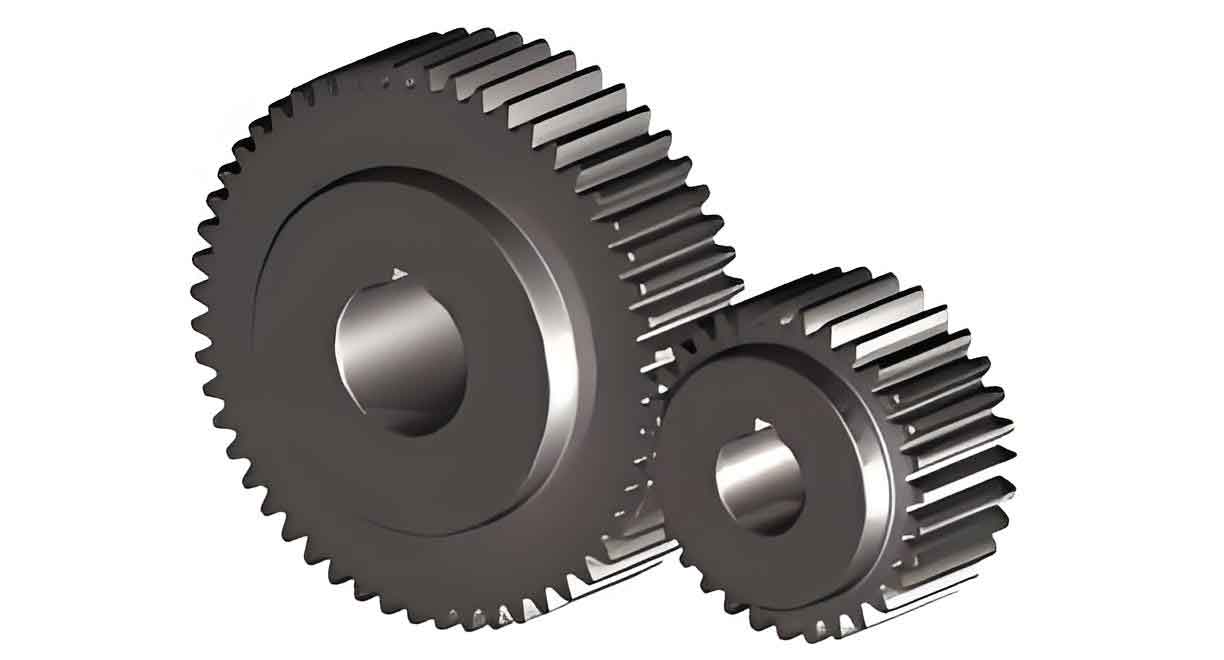
This study investigates the dynamic behavior of high contact ratio spur gears under tooth surface wear. By integrating Archard’s wear model with energy-based stiffness calculations, we establish a comprehensive framework for analyzing wear-induced changes in gear meshing characteristics.
1. Dynamic Model Formulation
The single-degree-of-freedom dynamic equation for spur gear systems is expressed as:
$$m_e\ddot{x}(t) + c\dot{x}(t) + k(t)f(x) = F_m + F_h(t)$$
Where:
- $m_e$ = equivalent mass
- $c$ = damping coefficient
- $k(t)$ = time-varying mesh stiffness
- $F_m$ = mean load component
The dimensionless form becomes:
$$\ddot{\bar{x}} + 2\xi\dot{\bar{x}} + \bar{K}(\tau)\bar{f}(\bar{x}) = \bar{F}_m + \bar{F}_h(\tau)$$
with dimensionless parameters:
$$\xi = \frac{c}{2\sqrt{K_m m_e}},\ \bar{K}(\tau) = \frac{k(t)}{K_m},\ \tau = \omega_n t$$
2. Wear Characterization
Using Archard’s wear model for spur gear analysis:
$$h = \frac{2a\lambda n t}{\varepsilon_\alpha}I_h$$
| Parameter | Value |
|---|---|
| Module | 3.25 mm |
| Pressure Angle | 20° |
| Contact Ratio | 2.23 |
| Young’s Modulus | 206 GPa |
Wear distribution characteristics:
| Cycles (×10⁶) | Max Wear (μm) |
|---|---|
| 2 | 12.4 |
| 6 | 37.8 |
| 10 | 63.2 |
3. Mesh Stiffness Calculation
Total mesh stiffness for high contact ratio spur gears:
$$K(t) = \begin{cases}
\sum_{i=1}^3 k_i(t) & 0 \leq \tau \leq (\varepsilon-2)T \\
\sum_{i=1}^2 k_i(t) & (\varepsilon-2)T \leq \tau \leq T
\end{cases}$$
Component stiffness terms include:
$$k = \left(\frac{1}{k_h} + \frac{1}{k_{b1}+k_{s1}+k_{a1}} + \frac{1}{k_{b2}+k_{s2}+k_{a2}}\right)^{-1}$$
4. Dynamic Response Analysis
Key findings for spur gear dynamics under wear:
| Condition | Wear State | System Behavior |
|---|---|---|
| Light Load | N=2×10⁶ | Chaotic |
| N=6×10⁶ | Quasi-periodic | |
| N=10⁷ | Chaotic | |
| Heavy Load | All Cases | Periodic |
Characteristic frequency relationships:
$$\omega_h/\omega_n = \begin{cases}
1.0 & \text{Primary resonance} \\
0.2 & \text{Subharmonic}
\end{cases}$$
5. Conclusion
This investigation of spur gear dynamics reveals:
- Light-load systems show sensitivity to wear progression (quasi-periodic ↔ chaotic transitions)
- Heavy-load conditions maintain periodic behavior despite wear
- Contact ratio significantly influences stability thresholds
The developed model enables accurate prediction of spur gear performance degradation, particularly valuable for high contact ratio applications requiring prolonged service life.