
In mechanical engineering, spur gears are widely used due to their simplicity and efficiency. High contact ratio spur gears, characterized by a contact ratio greater than 2, offer superior dynamic performance and reduced noise, making them ideal for high-precision applications. However, surface wear over time can significantly alter their dynamic behavior, leading to unexpected failures. This study focuses on analyzing the dynamic response of high contact ratio spur gears under the influence of surface wear, combining theoretical modeling with numerical simulations to provide insights into wear-induced changes in gear dynamics.
The dynamic analysis of spur gears requires a comprehensive understanding of their meshing stiffness, which varies with time due to the changing number of tooth pairs in contact. Wear further complicates this by modifying the tooth profile and stiffness. Previous research has extensively studied standard spur gears, but high contact ratio variants demand specialized approaches due to their unique geometry and load distribution. This work bridges that gap by integrating wear models into stiffness calculations and examining the resulting nonlinear dynamics.
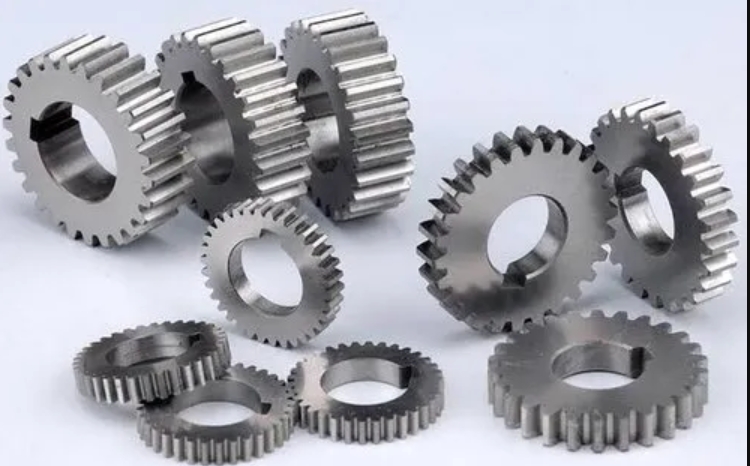
To model the system, we begin with a single-degree-of-freedom dynamic model. The equation of motion is given by:
$$ m_e \ddot{x}(t) + c \dot{x}(t) + k(t) f(x) = F_m + F_h(t) $$
where \( m_e \) is the equivalent mass, \( c \) is the damping coefficient, \( k(t) \) is the time-varying meshing stiffness, \( f(x) \) is the backlash function, \( F_m \) is the constant external load, and \( F_h(t) \) represents internal excitations such as those from manufacturing errors. For normalization, we define the natural frequency \( \omega_n = \sqrt{K_m / m_e} \), where \( K_m \) is the average meshing stiffness. Using dimensionless time \( \tau = \omega_n t \) and displacement \( \bar{x}(\tau) = x(t) / l \), with \( l \) as a reference length, the equation becomes:
$$ \bar{x}” + 2\xi \bar{x}’ + \bar{k}(\tau) \bar{f}(\bar{x}) = \bar{F}_m + \bar{F}_h(\tau) $$
Here, \( \xi = c / (2 \sqrt{K_m m_e}) \) is the damping ratio, \( \bar{k}(\tau) = k(t) / K_m \), \( \bar{F}_m = F_m / (K_m l) \), and \( \bar{F}_h(\tau) = \bar{\omega}_h^2 \cos(\bar{\omega}_h \tau + \psi) \) with \( \bar{\omega}_h = \omega_h / \omega_n \). The backlash function \( \bar{f}(\bar{x}) \) is typically piecewise-linear, accounting for tooth separation under light loads.
The time-varying meshing stiffness \( k(t) \) is critical and depends on the number of teeth in contact. For high contact ratio spur gears, the contact ratio \( \epsilon \) exceeds 2, leading to two or three tooth pairs engaging simultaneously during a meshing cycle. The stiffness varies periodically, and we express it as a segmented function based on the meshing phase. If \( T \) is the meshing period and \( Y(t) = \mod(t, T) \), then:
$$ k(t) = \begin{cases}
k(Y(t)) + k(Y(t) + T) + k(Y(t) + 2T) & \text{for } 0 \leq Y(t) \leq (\epsilon – 2)T \\
k(Y(t)) + k(Y(t) + T) & \text{for } (\epsilon – 2)T \leq Y(t) \leq T
\end{cases} $$
where \( k(t) \) for a single tooth pair is derived using the energy method, considering bending, shear, axial compression, contact, and fillet foundation stiffnesses. The total stiffness for a gear pair is the sum of reciprocals of these components. For spur gears, the single-tooth stiffness \( k(t) \) can be approximated using fitted curves to simplify computations.
Surface wear is modeled using the Archard wear equation, which relates wear volume to sliding distance, load, and material properties. For a point on the tooth surface, the wear depth \( h \) after \( N \) cycles is:
$$ h = \frac{2 a \lambda n t \epsilon_\alpha I_h}{L} $$
where \( a \) is the contact half-width, \( \lambda \) is the sliding coefficient, \( n \) is the rotational speed, \( t \) is the operating time, \( \epsilon_\alpha \) is the contact ratio, \( I_h \) is the wear rate, and \( L \) is the face width. The sliding coefficient \( \lambda \) varies along the tooth profile and is calculated based on gear geometry. The wear rate \( I_h \) depends on material properties and lubrication conditions. Under constant load, wear accumulates non-uniformly, with minimal wear at the pitch point due to pure rolling and increased wear near the tip and root due to sliding.
To compute the single-tooth stiffness, we employ the energy method, which accounts for strain energy from bending, shear, and axial forces. The potential energy stored in a tooth segment is integrated along the tooth profile. For a cantilever beam model of a tooth, the bending stiffness \( k_b \), shear stiffness \( k_s \), and axial stiffness \( k_a \) are given by:
$$ \frac{F^2}{2k_b} = \int_{x_G}^{x_E} \frac{M_1^2}{2EI_{x1}} dx_1 + \int_{x_E}^{x_D} \frac{M_2^2}{2EI_{x2}} dx_2 + \int_{x_D}^{x_C} \frac{M_3^2}{2EI_{x3}} dx_3 + \int_{x_C}^{x_K} \frac{M_4^2}{2EI_{x4}} dx_4 $$
$$ \frac{F^2}{2k_s} = \int_{x_G}^{x_E} \frac{1.2 (F \cos \beta)^2}{2GA_{x1}} dx_1 + \int_{x_E}^{x_D} \frac{1.2 (F \cos \beta)^2}{2GA_{x2}} dx_2 + \int_{x_D}^{x_C} \frac{1.2 (F \cos \beta)^2}{2GA_{x3}} dx_3 + \int_{x_C}^{x_K} \frac{1.2 (F \cos \beta)^2}{2GA_{x4}} dx_4 $$
$$ \frac{F^2}{2k_a} = \int_{x_G}^{x_E} \frac{(F \sin \beta)^2}{2EA_{x1}} dx_1 + \int_{x_E}^{x_D} \frac{(F \sin \beta)^2}{2EA_{x2}} dx_2 + \int_{x_D}^{x_C} \frac{(F \sin \beta)^2}{2EA_{x3}} dx_3 + \int_{x_C}^{x_K} \frac{(F \sin \beta)^2}{2EA_{x4}} dx_4 $$
Here, \( E \) is Young’s modulus, \( G \) is the shear modulus, \( v \) is Poisson’s ratio, \( \beta \) is the pressure angle at the contact point, and \( x_G \) to \( x_K \) are coordinates defining the tooth profile segments. The moments \( M_i \) and cross-sectional areas \( A_{xi} \) vary along the tooth. The contact stiffness \( k_h \) and foundation stiffness \( k_f \) are added, leading to the single-tooth stiffness:
$$ k = \frac{1}{\frac{1}{k_h} + \frac{1}{k_{b1}} + \frac{1}{k_{b2}} + \frac{1}{k_{s1}} + \frac{1}{k_{s2}} + \frac{1}{k_{a1}} + \frac{1}{k_{a2}} + \frac{1}{k_{f1}} + \frac{1}{k_{f2}}} $$
where subscripts 1 and 2 denote the driving and driven spur gears, respectively. Wear alters the tooth profile, reducing the effective stiffness. We incorporate wear by adjusting the coordinates in the stiffness integrals based on the calculated wear depth \( h \).
For numerical analysis, we use the parameters listed in Table 1. These values represent typical high contact ratio spur gears used in industrial applications.
| Parameter | Driving Gear | Driven Gear |
|---|---|---|
| Number of Teeth, \( z \) | 32 | 25 |
| Module, \( m \) (mm) | 3.25 | 3.25 |
| Pressure Angle, \( \alpha_0 \) (degrees) | 20 | 20 |
| Addendum Coefficient | 1.35 | 1.35 |
| Profile Shift Coefficient | -0.19 | -0.14 |
| Young’s Modulus, \( E \) (GPa) | 206 | |
| Poisson’s Ratio, \( v \) | 0.3 | |
| Face Width, \( L \) (mm) | 20 | |
| Driven Gear Speed (rpm) | 600 | |
| Torque (N·m) | 50 | |
The contact ratio for this gear pair is calculated as \( \epsilon = 2.23 \), indicating that two or three tooth pairs are in contact simultaneously. The wear depth distribution along the tooth profile is shown in Table 2, which summarizes the relationship between pressure angle and wear for both spur gears after \( N = 10^6 \) cycles.
| Pressure Angle (rad) | Wear Depth, Driving Gear (μm) | Wear Depth, Driven Gear (μm) |
|---|---|---|
| 0.10 | 65.2 | 58.7 |
| 0.15 | 42.1 | 38.9 |
| 0.20 | 25.3 | 24.1 |
| 0.25 | 18.7 | 17.5 |
| 0.30 | 22.4 | 21.8 |
| 0.35 | 35.6 | 33.2 |
| 0.40 | 52.9 | 49.4 |
| 0.45 | 70.1 | 66.3 |
As observed, wear is minimal near the pitch point (pressure angle around 0.25 rad) and increases toward the tip and root. This non-uniform wear affects the meshing stiffness, as demonstrated in Table 3, which shows the percentage reduction in total meshing stiffness with increasing cycles for the spur gears.
| Number of Cycles, \( N \) | Reduction in Total Meshing Stiffness (%) |
|---|---|
| 0 | 0 |
| 2 × 10^6 | 0.23 |
| 6 × 10^6 | 0.72 |
| 10 × 10^6 | 1.26 |
The dynamic response is analyzed by solving the normalized equation using numerical methods such as the Runge-Kutta algorithm. We consider two load conditions: light load (\( \bar{F}_m = 0.04 \)) and heavy load (\( \bar{F}_m = 0.08 \)), with fixed parameters \( \bar{f}_h = 0.1 \), \( \bar{\omega}_h = 1 \), \( \bar{b} = 0.5 \), and \( \xi = 0.05 \). For light loads, the system exhibits complex behavior as wear progresses. Without wear, the time history shows periodic motion, the Poincaré map consists of discrete points indicating quasi-periodicity, and the frequency spectrum has a dominant peak at \( 0.2\bar{\omega}_h \), suggesting 5× quasi-periodic motion.
At \( N = 2 \times 10^6 \) cycles, the motion becomes chaotic: the time history is aperiodic, the Poincaré map shows scattered points forming bands, and the spectrum has broad noise. At \( N = 6 \times 10^6 \), the system returns to near-periodic motion, with the Poincaré map points clustering and reduced spectral noise. By \( N = 10^7 \), chaos reappears, evident from the disordered Poincaré map and noisy spectrum. This transition—quasi-periodic to chaotic to near-periodic to chaotic—highlights the sensitivity of spur gears to wear under light loads.
Under heavy loads, the dynamics are predominantly periodic regardless of wear. The time history, Poincaré map, and spectrum remain nearly unchanged even at high cycles, indicating that inertial forces dominate over wear-induced stiffness variations. This robustness is advantageous for applications involving high-load spur gears.
The stiffness variation due to wear can be expressed using piecewise functions. For instance, the meshing stiffness \( k(t) \) in a segment is approximated as:
$$ k(t) = A_0 + \sum_{i=1}^n A_i \cos(i\omega t + \phi_i) $$
where \( A_i \) and \( \phi_i \) are Fourier coefficients derived from curve fitting. With wear, these coefficients change, altering the dynamic response. The backlash function \( \bar{f}(\bar{x}) \) also plays a role; it is defined as:
$$ \bar{f}(\bar{x}) = \begin{cases}
\bar{x} – \bar{b} & \text{if } \bar{x} > \bar{b} \\
0 & \text{if } -\bar{b} \leq \bar{x} \leq \bar{b} \\
\bar{x} + \bar{b} & \text{if } \bar{x} < -\bar{b}
\end{cases} $$
where \( \bar{b} \) is the dimensionless backlash. This nonlinearity, combined with stiffness fluctuations, can trigger bifurcations and chaos.
In conclusion, the dynamic behavior of high contact ratio spur gears is highly sensitive to surface wear under light loads, exhibiting transitions between quasi-periodic and chaotic states. In contrast, heavy loads suppress these effects, maintaining periodic motion. This study underscores the importance of incorporating wear models into dynamic analyses for reliable gear design. Future work could explore lubricated spur gears or variable loading conditions to extend these findings.