
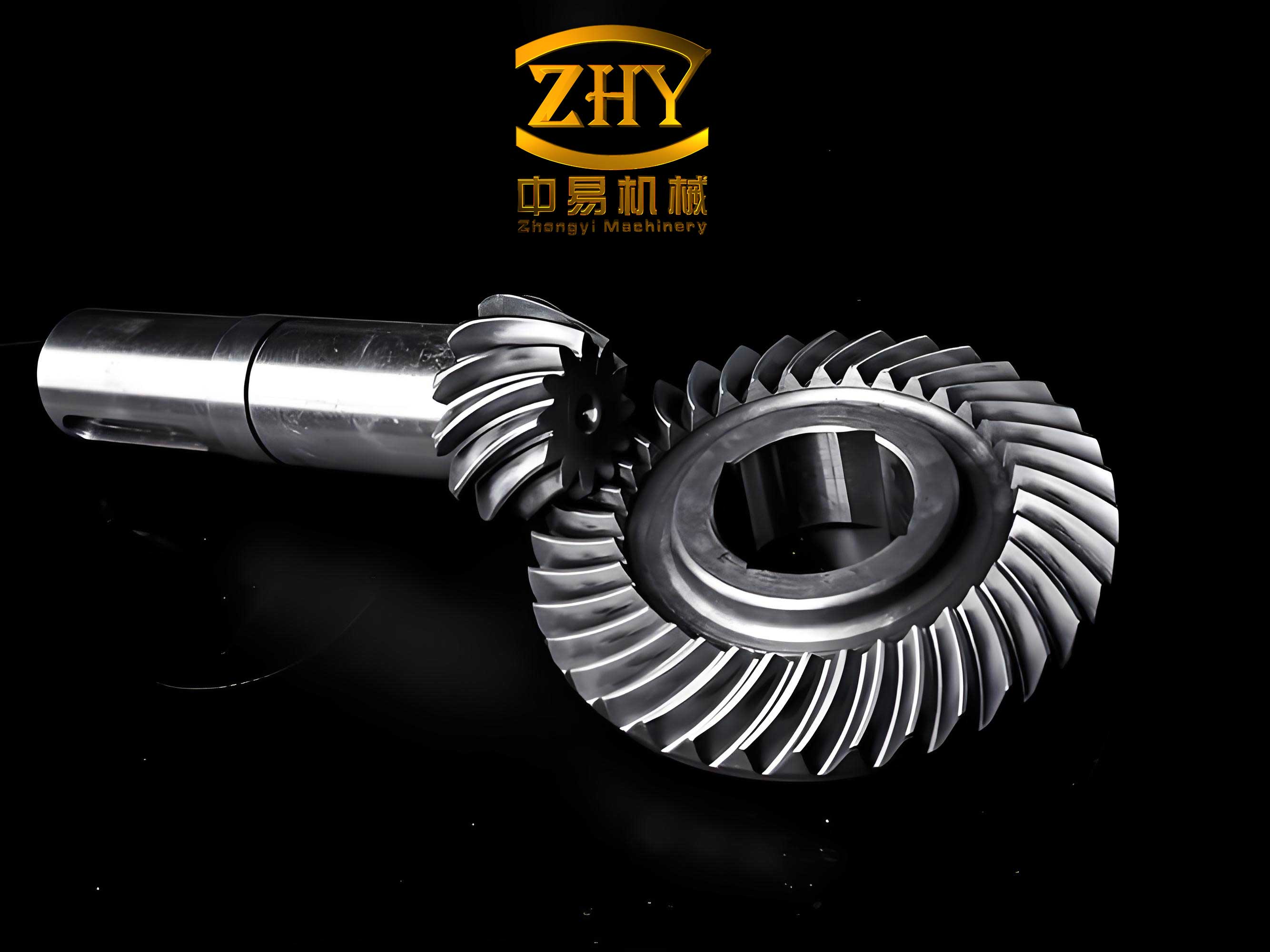
The precision finishing of spiral bevel gears is a critical process in power transmission systems, directly influencing noise, vibration, and longevity. Traditional lapping methods, while useful, often suffer from limitations such as low material removal rates and inconsistent surface quality. The introduction of ultrasonic vibration-assisted lapping presents a novel,特种加工 approach that superimposes high-frequency oscillatory motion onto the conventional gear meshing process. This hybrid excitation significantly alters the dynamic interaction between the gear teeth, leading to enhanced material removal mechanisms. The core of this process lies in the generation of dynamic lapping forces, which are the product of complex interactions between inherent gear transmission error excitations and externally applied ultrasonic vibrations. Analyzing these forces is paramount for understanding and optimizing the ultrasonic lapping of spiral bevel gears.
This article establishes a comprehensive nonlinear dynamic model for a spiral bevel gear lapping system under combined internal and external excitations. The model focuses on the torsional vibrations in the rotational direction, incorporating the essential nonlinearity caused by gear backlash. The primary goal is to derive and analyze the formula for the dynamic lapping force, which dictates the effectiveness of the finishing process. Through detailed numerical simulation, the influence of ultrasonic excitation parameters on the system’s response—from periodic motion to chaotic states—and the consequent effect on the dynamic lapping force are thoroughly investigated.
1. Dynamic Modeling of the Spiral Bevel Gear Lapping System
The lapping process for spiral bevel gears involves light loads and typically operates within a single-tooth-pair contact zone for significant portions of the mesh cycle. While the meshing stiffness of spiral bevel gear teeth is inherently time-varying, its fluctuation under lapping conditions is relatively minor compared to the influences of excitation sources. Therefore, for modeling simplicity and clarity in analyzing the dominant dynamic effects, an average constant meshing stiffness is adopted. The key nonlinearities driving the dynamic response are the static transmission error (an internal excitation due to geometric imperfections) and the gear backlash, which allows for tooth separation and impact under vibrational excitation.
The system is modeled as a two-degree-of-freedom oscillator in rotation, representing the pinion (gear 1) and the gear (gear 2). The input ultrasonic vibration is applied as an oscillatory torque on the pinion shaft, while a constant braking torque acts on the gear. The inertial effects of connected shafts are lumped into the moments of inertia of the gears themselves. The equations of motion are formulated as follows:
$$ J_1 \ddot{\theta}_1 + r_{1n_t} W_d = T_m + T_a \sin(\omega_a t) $$
$$ J_2 \ddot{\theta}_2 – r_{2n_t} W_d = -T_l $$
Where the dynamic lapping force $W_d$ at the mesh point in the direction normal to the tooth surfaces is given by:
$$ W_d = c_m (\dot{\delta}) + k_m f(\delta) $$
And the dynamic deflection $\delta$ along the line of action is:
$$ \delta = r_{1n_t} \theta_1 – r_{2n_t} \theta_2 – e(t) $$
The variables and parameters are defined in the table below:
| Symbol | Description |
|---|---|
| $J_1, J_2$ | Polar mass moments of inertia (including shafts) for pinion and gear. |
| $\theta_1, \theta_2$ | Angular displacements of pinion and gear. |
| $r_{1n_t}, r_{2n_t}$ | Projected distances from the gear centers to the line of action at the mean contact point. |
| $W_d$ | Dynamic lapping force normal to the tooth surface. |
| Mean driving torque (ultrasonic average component). | |
| $T_a$, $\omega_a$ | Amplitude and angular frequency of the ultrasonic excitation torque. |
| $T_l$ | Constant load (braking) torque. |
| $c_m$ | Meshing damping coefficient. |
| $k_m$ | Average meshing stiffness of the spiral bevel gear pair. | $e(t)$ | Static transmission error along the line of action, a primary internal excitation. |
| $f(\delta)$ | Backlash nonlinear function. |
The backlash function $f(\delta)$, representing a symmetric clearance of $2b$, is defined as:
$$ f(\delta) = \begin{cases}
\delta – b, & \delta > b \\
0, & -b \le \delta \le b \\
\delta + b, & \delta < -b
\end{cases} $$
To reduce the number of parameters and generalize the analysis, the two equations of motion are combined into a single equation in terms of the dynamic transmission error $\delta$. Defining an equivalent mass $m_{eq}$ and an equivalent force $F_{m,eq}$:
$$ m_{eq} = \frac{J_1 J_2}{J_1 (r_{2n_t})^2 + J_2 (r_{1n_t})^2}, \quad F_{m,eq} = \frac{T_m}{r_{1n_t}} = \frac{T_l}{r_{2n_t}} $$
The governing nonlinear differential equation becomes:
$$ m_{eq} \ddot{\delta} + c_m \dot{\delta} + k_m f(\delta) = F_{m,eq} + \left( \frac{T_a}{r_{1n_t}} \right) \left( \frac{J_2 (r_{1n_t})^2}{J_1 (r_{2n_t})^2 + J_2 (r_{1n_t})^2} \right) \sin(\omega_a t) – m_{eq} \ddot{e}(t) $$
It is crucial to non-dimensionalize this equation to facilitate numerical analysis and reveal scaling relationships. Introducing the non-dimensional displacement $x$, time $\tau$, and forces:
$$ x = \frac{\delta}{b}, \quad \tau = \omega_n t, \quad \omega_n = \sqrt{\frac{k_m}{m_{eq}}}, \quad \zeta = \frac{c_m}{2 \sqrt{m_{eq} k_m}} $$
$$ \bar{F}_m = \frac{F_{m,eq}}{b k_m}, \quad \bar{F}_a = \frac{T_a}{r_{1n_t} b k_m} \cdot \frac{J_2 (r_{1n_t})^2}{J_1 (r_{2n_t})^2 + J_2 (r_{1n_t})^2}, \quad \Omega = \frac{\omega_a}{\omega_n} $$
The resulting non-dimensional equation of motion is:
$$ \ddot{x} + 2\zeta \dot{x} + \bar{f}(x) = \bar{F}_m + \bar{F}_a \sin(\Omega \tau) – \frac{\ddot{e}(\tau)}{b \omega_n^2} $$
Where the derivatives are now with respect to $\tau$, and the non-dimensional backlash function is:
$$ \bar{f}(x) = \begin{cases}
x – 1, & x > 1 \\
0, & -1 \le x \le 1 \\
x + 1, & x < -1
\end{cases} $$
The non-dimensional dynamic lapping force, which is the primary metric for process effectiveness, is directly proportional to the system’s response:
$$ \bar{W}_d = 2\zeta \dot{x} + \bar{f}(x) $$
This force $\bar{W}_d$ is the key output. Its magnitude and character (continuous vs. impact) directly influence the material removal rate during the ultrasonic lapping of the spiral bevel gear. The term $-\ddot{e}(\tau)/(b \omega_n^2)$ represents the internal excitation from the spiral bevel gear’s transmission error, typically at the gear mesh frequency. The term $\bar{F}_a \sin(\Omega \tau)$ represents the external ultrasonic excitation, which has a much higher frequency $\Omega$.
2. Numerical Simulation and Analysis of Dynamic Lapping Forces
To investigate the behavior of the spiral bevel gear lapping system, a numerical case study is performed. The parameters for the example spiral bevel gear pair are listed in the table below. The transmission error $e(t)$ is derived from the gear’s geometry and Tooth Contact Analysis (TCA). For this analysis, a segment of the unloaded transmission error function from the single-pair contact zone is used, approximated by a periodic function at the mesh frequency.
| Parameter | Symbol | Value |
|---|---|---|
| Number of gear teeth | $z_1$ | 32 |
| Number of pinion teeth | $z_2$ | 25 |
| Damping ratio | $\zeta$ | 0.04 |
| Average mesh stiffness | $k_m$ | 31.2 MN/m |
| Equivalent pinion radius | $r_{1n_t}$ | 0.0384 m |
| Equivalent gear radius | $r_{2n_t}$ | 0.0300 m |
| Nominal backlash (half) | $b$ | 0.05 mm |
| Gear moment of inertia | $J_1$ | 0.0050 kg·m² |
| Pinion moment of inertia | $J_2$ | 0.0036 kg·m² |
| Mean driving torque | $T_m$ | 4.0 N·m |
| Ultrasonic frequency | $f_a$ | 21 kHz |
The system of equations is solved using a 4th-order variable-step Runge-Kutta numerical integration scheme. To ensure accuracy for the high-frequency ultrasonic excitation, a very small time step is used. Transient responses are discarded, and the steady-state behavior is analyzed using phase portraits and Poincaré maps, sampled at the period of the ultrasonic excitation ($\tau_s = 2\pi/\Omega$). The analysis proceeds by incrementally increasing the ultrasonic excitation amplitude $T_a$.
2.1 Baseline Case: Lapping Without Ultrasonic Excitation ($T_a = 0$)
In the absence of ultrasonic excitation, the spiral bevel gear lapping system is driven solely by the internal transmission error excitation. The non-dimensional equation simplifies to:
$$ \ddot{x} + 2\zeta \dot{x} + \bar{f}(x) = \bar{F}_m – \frac{\ddot{e}(\tau)}{b \omega_n^2} $$
For the given parameters and a modest mean force $\bar{F}_m$, the system response is a periodic motion synchronized with the transmission error period (the mesh cycle). Crucially, the dynamic displacement $x(\tau)$ remains entirely within the range $-1 \le x \le 1$. This means the gear teeth remain in contact at all times ($\bar{f}(x)=x$), and the system behaves linearly. The phase portrait is a closed, smooth curve, and the Poincaré map consists of a single, isolated point. The dynamic lapping force $\bar{W}_d$ in this regime is relatively low and varies smoothly, resulting in a gentle, traditional lapping action with limited potential for aggressive material removal on the spiral bevel gear surfaces.
2.2 Lapping with Moderate Ultrasonic Excitation ($T_a = 10$ N·m)
Introducing ultrasonic excitation significantly alters the dynamics. With $T_a = 10$ N·m, the combined internal and high-frequency external excitation pumps energy into the system. The response remains periodic, locked to a subharmonic of the ultrasonic frequency (in this case, the period equal to one mesh cycle). However, the oscillation amplitude of $x(\tau)$ increases sufficiently to periodically exceed the backlash boundaries $x = \pm 1$.
The phase portrait now shows sharp corners or discontinuities in the velocity $\dot{x}$ at the boundaries, indicative of impacts. The Poincaré map still shows a finite set of discrete points, confirming periodic motion. The function $\bar{f}(x)$ now switches between its linear and dead-zone regimes. The dynamic lapping force $\bar{W}_d$ is no longer smooth; it features sharp pulses corresponding to tooth impacts when contact is re-established after a brief separation. These impact forces, superimposed on the smoother meshing forces, significantly increase the peak and RMS values of the lapping force. This is the primary mechanism enhancement in ultrasonic lapping of spiral bevel gears: the periodic impacts generated by the ultrasonic vibration create intense, localized pressure pulses that promote microfracture and material removal on the tooth flanks.
2.3 Lapping with High Ultrasonic Excitation ($T_a = 16.5$ N·m)
As the ultrasonic excitation amplitude $T_a$ is increased further, the system undergoes a bifurcation into a chaotic state. At $T_a = 16.5$ N·m, the response becomes aperiodic and highly sensitive to initial conditions. The phase portrait fills a bounded region of the phase space with a complex, non-repeating trajectory. The corresponding Poincaré map, instead of showing a few points or a simple closed curve, reveals a complex fractal-like structure of points, which is a hallmark of chaotic dynamics.
In this chaotic regime, the dynamic interaction between the spiral bevel gear teeth is extremely irregular. Periods of continuous contact, single-sided impacts, and double-sided impacts (rattling) occur in an unpredictable sequence. The time history of the dynamic lapping force $\bar{W}_d$ becomes broadband and noisy, containing a wide spectrum of frequencies. While the force peaks can be exceptionally high, the process may become less controllable. This state might be undesirable for precise finishing but demonstrates the profound nonlinear effect the ultrasonic excitation has on the spiral bevel gear lapping system. The transition to chaos marks a fundamental change in the system’s energy dissipation and force generation mechanisms.
The relationship between the ultrasonic excitation amplitude and the character of the dynamic response for the spiral bevel gear system can be summarized as follows:
| Excitation Amplitude $T_a$ | System State | Tooth Contact Regime | Dynamic Lapping Force $\bar{W}_d$ Character |
|---|---|---|---|
| $T_a = 0$ | Linear Periodic | Permanent contact, no separation. | Smooth, periodic, low amplitude. |
| $T_a = 10$ N·m | Nonlinear Periodic | Periodic separation and single-sided impacts. | Periodic with sharp impact pulses, moderate-high amplitude. |
| $T_a = 16.5$ N·m | Chaotic | Aperiodic sequences of contact, separation, and double-sided impacts. | Broadband, noisy, with very high intermittent peaks. |
3. Discussion on the Role of Ultrasonic Excitation in Spiral Bevel Gear Lapping
The analysis clearly demonstrates that ultrasonic excitation transforms the dynamics of a spiral bevel gear lapping system. The primary beneficial effect is the generation of significant dynamic lapping forces through a transition from a linear, always-in-contact state to a nonlinear, impacting state. The key formula $\bar{W}_d = 2\zeta \dot{x} + \bar{f}(x)$ shows that these forces are amplified by high velocities ($\dot{x}$) during impacts and by the nonlinear stiffness function $\bar{f}(x)$ jumping from zero to a finite value upon re-contact.
The material removal in lapping is often modeled as being proportional to the product of the interfacial friction coefficient and the normal contact force. Therefore, by dramatically increasing the peak and RMS values of the normal dynamic lapping force $\bar{W}_d$, ultrasonic excitation directly enhances the material removal rate. Furthermore, the repetitive impacts can help break up oxides and promote abrasive action, leading to a more effective finishing process for the complex tooth surfaces of a spiral bevel gear.
The choice of ultrasonic excitation amplitude $T_a$ is critical. It must be high enough to ensure periodic impacts (driving the system into the desired nonlinear periodic state) but not so high as to induce chaotic motion, which, while generating high forces, could lead to unstable, uneven finishing or even surface damage on the spiral bevel gear. The optimal operating point likely lies within the stable periodic impact regime, just below the onset of chaos. This model provides a theoretical framework for selecting such parameters by predicting the system’s dynamic state based on $T_a$, $T_m$, backlash $b$, and the spiral bevel gear’s own error excitation $e(t)$.
4. Conclusion
This study developed a nonlinear dynamic model for analyzing the ultrasonic vibration-assisted lapping process of spiral bevel gears. The model integrates both the geometric transmission error inherent to the spiral bevel gear pair and the external high-frequency excitation from an ultrasonic transducer. The central outcome is the derivation and analysis of the dynamic lapping force, which governs the finishing effectiveness.
The numerical simulations lead to two fundamental conclusions regarding the ultrasonic lapping of spiral bevel gears. First, compared to conventional lapping, ultrasonic excitation induces tooth separation and impacts, significantly amplifying the dynamic lapping forces. This amplification is the core mechanism that improves material removal rates and finishing efficiency. Second, as the ultrasonic excitation amplitude increases, the spiral bevel gear lapping system undergoes a distinct transition from linear periodic motion, to nonlinear periodic motion with impacts, and finally to chaotic motion. This bifurcation sequence underscores the strongly nonlinear nature of the process and highlights the importance of carefully controlling the excitation amplitude to maintain stable, productive lapping conditions in the periodic impact regime.
The model and analysis presented here form a theoretical foundation for understanding and optimizing the ultrasonic lapping process for spiral bevel gears, offering insights into force generation, system stability, and parameter selection for this advanced manufacturing technique.