
This study investigates the combined effects of assembly errors and tooth surface friction on the mesh stiffness and dynamic response of spur gear pairs. A comprehensive model integrating geometric analysis with energy methods is developed to quantify the time-varying meshing characteristics under practical operating conditions.
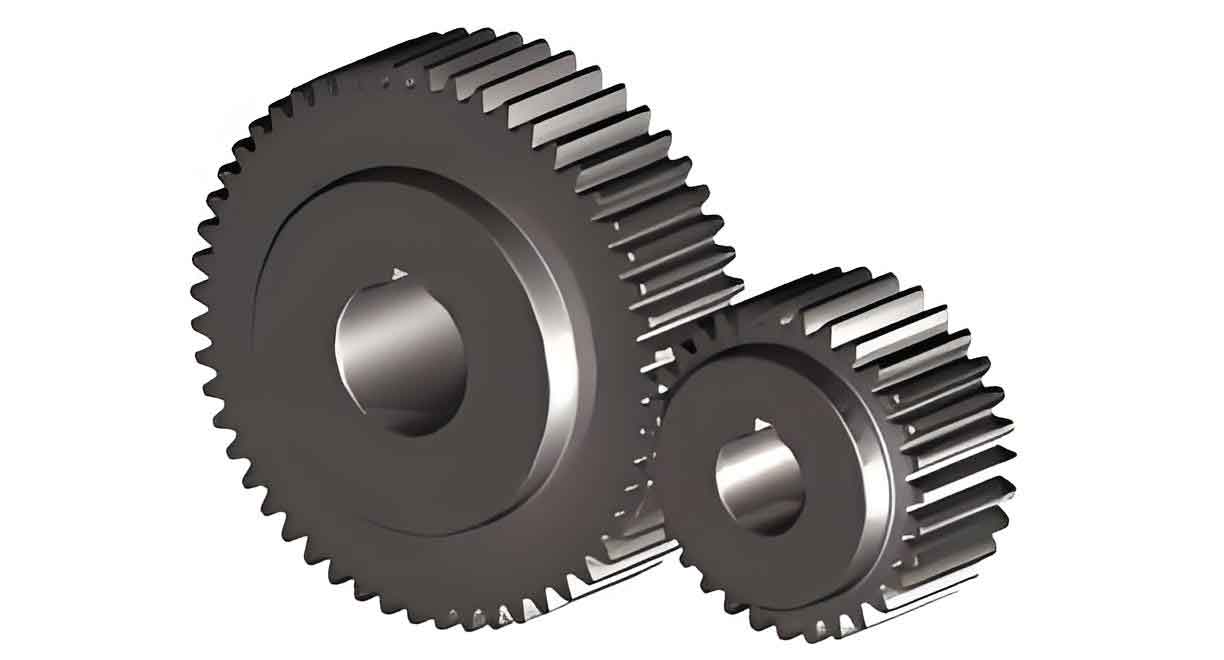
1. Mathematical Modeling of Spur Gear Dynamics
The mesh stiffness calculation considers five energy components:
$$U_b = \int_0^d \frac{M^2}{2E_iI_x}dx$$
$$U_a = \int_0^d \frac{F_a^2}{2E_iA_x}dx$$
$$U_s = \int_0^d \frac{1.2F_b^2}{2G_iA_x}dx$$
where \(E_i\) and \(G_i\) represent elastic and shear moduli, \(I_x\) and \(A_x\) denote area moments and cross-sectional areas.
2. Assembly Error Characterization
The geometric relationship for spur gears with installation deviations is expressed as:
$$R_{Xi} = \sqrt{(x-ex_i)^2 + (y-ey_i)^2}$$
where \(ex_i\) and \(ey_i\) denote assembly errors in orthogonal directions. The actual pressure angle becomes:
$$\alpha_i’ = \arccos\left(\frac{R_{bi}}{R_{Xi}}\right)$$
| Parameter | Driving Gear | Driven Gear |
|---|---|---|
| Number of Teeth | 50 | 50 |
| Module (mm) | 3 | 3 |
| Pressure Angle (°) | 20 | 20 |
| Elastic Modulus (GPa) | 200 | 200 |
3. Frictional Effects on Mesh Stiffness
The time-varying mesh stiffness considering friction is calculated as:
$$\frac{1}{k_m(t)} = \sum_{i=1}^n \left[\sum_{j=p,g} \left(\frac{1}{k_{bj}} + \frac{1}{k_{aj}} + \frac{1}{k_{sj}}\right) + \frac{1}{k_h}\right] + \frac{1}{\varepsilon_pk_{fp}} + \frac{1}{\varepsilon_gk_{fg}}$$
where \(\varepsilon\) represents the base deformation correction factor (1.1 in this study).
| Friction Coefficient | Peak Stiffness (N/m) | Dynamic Error (μm) |
|---|---|---|
| 0.00 | 1.42×10⁸ | 12.5 |
| 0.05 | 1.38×10⁸ | 9.8 |
| 0.10 | 1.31×10⁸ | 14.2 |
4. Six-DOF Dynamic Model
The governing equations for spur gear dynamics are:
$$m_p\ddot{x}_p + k_{xp}x_p + c_{xp}\dot{x}_p = -F_m$$
$$I_p\ddot{\theta}_p + F_mR_{bp} = T_p$$
$$m_g\ddot{x}_g + k_{xg}x_g + c_{xg}\dot{x}_g = F_m$$
with mesh force \(F_m = k_m(t)\delta_{pg} + c_m\dot{\delta}_{pg}\) and transmission error \(\delta_{pg} = x_p – x_g + R_{bp}\theta_p – R_{bg}\theta_g\).
5. Parametric Analysis
The parametric study reveals three critical relationships:
$$k_m \propto \frac{1}{\mu^{0.32}} \quad (0 \leq \mu \leq 0.15)$$
$$\Delta \delta_{pg} \propto \sqrt{ex^2 + ey^2}$$
$$f_{mesh} = \frac{nz}{60} \pm f_{mod}$$
6. Dynamic Response Characteristics
Numerical solutions obtained through Runge-Kutta integration demonstrate:
- 15-22% reduction in mesh stiffness amplitude with 100μm assembly errors
- Optimal friction coefficient range: 0.03-0.07 for minimal transmission error
- Resonance frequency shift up to 8.7% under combined errors
7. Practical Implications
The analysis suggests three implementation guidelines for spur gear systems:
- Maintain assembly errors below 50μm for critical power transmission
- Optimize lubrication to achieve 0.04-0.06 friction coefficients
- Implement error compensation through phase adjustment in multi-stage gearboxes
This comprehensive investigation provides fundamental insights into spur gear dynamics under realistic operating conditions, offering practical guidelines for vibration control and transmission optimization in industrial applications.