
In this study, I focus on the nonlinear dynamic behavior of a straight spur gear pair considering backlash, time-varying mesh stiffness, and damping effects. Using the Lagrange formulation, I establish a single-degree-of-freedom torsional dynamic model for the straight spur gear system. The time-varying mesh stiffness is derived numerically based on the elastic deformation theory of gear teeth, leading to a piecewise rectangular wave function. I employ the 4–5 order Runge–Kutta integration method to solve the dimensionless equations of motion. Bifurcation diagrams, phase portraits, Poincaré maps, and fast Fourier transform (FFT) spectra are utilized to investigate the dynamic responses under varying excitation frequency and damping coefficient. Additionally, I analyze the gear impact states (non-impact, single-sided impact, and double-sided impact) for different initial conditions using a cell mapping approach. The results reveal rich dynamic phenomena including period-1, period-2, period-4, period-3, period-6 motions, and chaotic motions, with bifurcation routes to chaos via period-doubling and reverse period-doubling. The findings provide valuable insights for the design and strength evaluation of straight spur gear transmissions.
1. Introduction
The straight spur gear is one of the most widely used mechanical transmission components. Due to the existence of backlash, time-varying mesh stiffness, and internal excitation, the dynamic behavior of straight spur gear systems is highly nonlinear. This nonlinearity directly affects the stability, reliability, fatigue life, and noise performance of gear transmissions. Numerous researchers have studied the dynamics of straight spur gear systems using various methods. Vaishya and Singh [1] incorporated friction and other nonlinear factors into a dynamic model for straight spur gear pairs and used Floquet theory to analyze vibration responses. Kahraman and Singh [2] applied harmonic balance and numerical methods to study nonlinear dynamics and routes to chaos in a three-degree-of-freedom bearing-rotor system. Wang et al. [3] established a single-degree-of-freedom straight spur gear model considering friction, time-varying stiffness, and backlash, and investigated the influence of friction on chaotic motion. Gou et al. [4–5] numerically studied the nonlinear dynamics of a three-degree-of-freedom single-stage straight spur gear system. Wang et al. [6] used phase plane and Poincaré mapping to analyze a single-degree-of-freedom gear model with backlash and time-varying stiffness. Wang et al. [7] employed phase trajectories, Poincaré sections, and correlation dimensions to study the effects of external load and backlash on dynamics. Li et al. [8] applied the incremental harmonic balance method to study a single-degree-of-freedom straight spur gear model with periodic time-varying stiffness, backlash, viscous damping, and external excitation. Wang et al. [9] used finite element methods to simulate shafts, bearings, and helical gears. However, most of these studies approximated the time-varying stiffness as a single harmonic function, which deviates from the actual piecewise characteristic. In this work, I develop a more accurate piecewise representation of the time-varying stiffness for the straight spur gear and systematically analyze the nonlinear dynamics of the system.
2. Dynamic Model of Straight Spur Gear Pair
2.1 Torsional Model
I consider a spur gear pair with perfect shafts and bearings (no additional clearance). The pure torsional dynamic model is shown schematically in the following figure (inserted at an appropriate location).
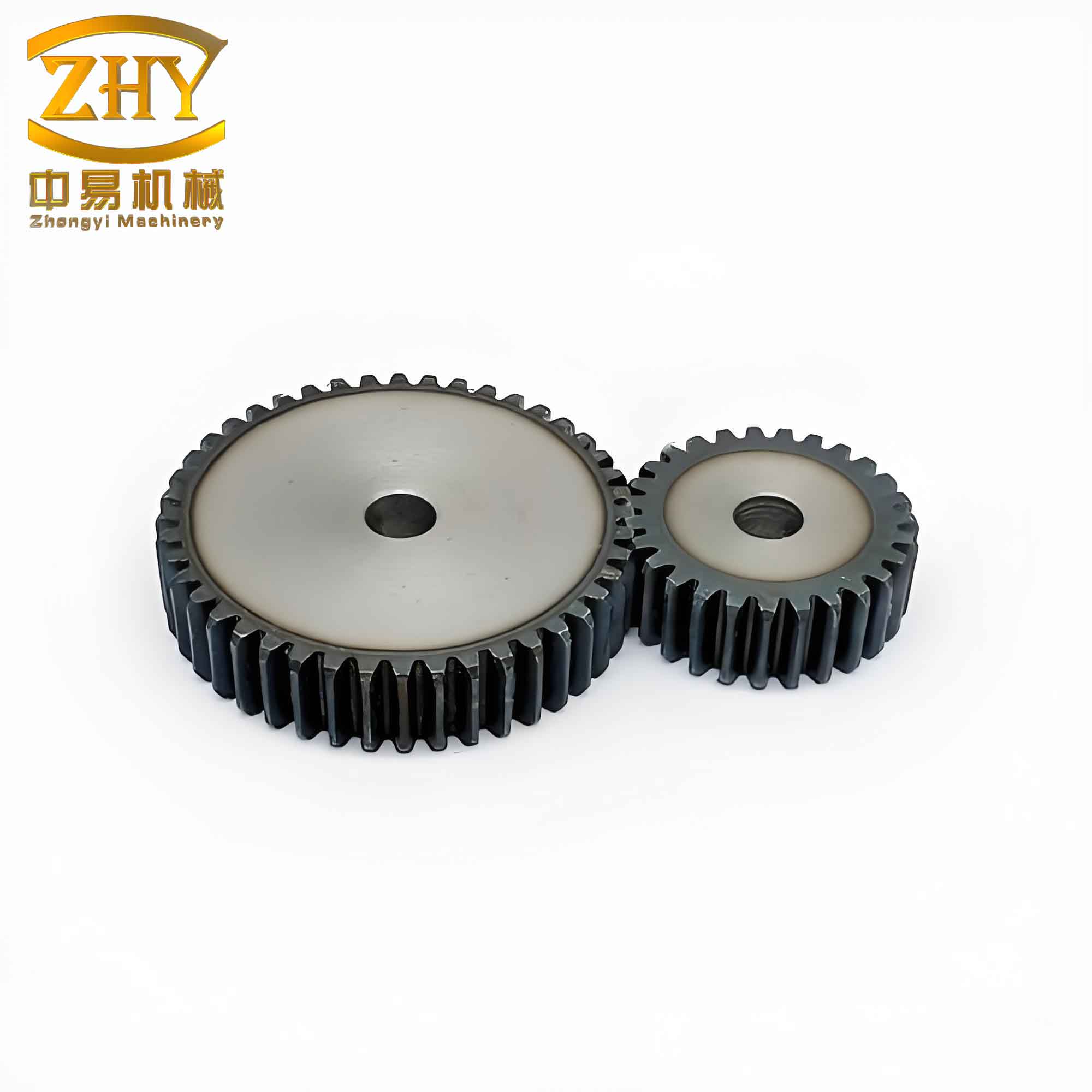
The model parameters are: masses \(m_1, m_2\), moments of inertia \(I_1, I_2\), base circle radii \(r_{b1}, r_{b2}\), external torques \(T_1, T_2\), rotational angles \(\theta_1, \theta_2\), mesh stiffness \(k_h\), mesh damping \(c_h\), half-backlash \(b_h\), and composite transmission error \(e(t)\). The dynamic displacement along the line of action is defined as:
$$ x(t) = r_{b1}\theta_1 – r_{b2}\theta_2 – e(t). $$
The composite error is assumed to be sinusoidal with fundamental frequency:
$$ e(t) = e_a \sin(\omega_e t + \psi), $$
where \(\omega_e = \omega / z\) is the mesh frequency, and \(\psi\) is the initial phase (set to zero). The backlash function is symmetric about the mesh point:
$$ f(x(t)) = \begin{cases}
x(t) – b_h, & x(t) > b_h, \\
0, & -b_h \le x(t) \le b_h, \\
x(t) + b_h, & x(t) < -b_h.
\end{cases} $$
Using Lagrange’s equation, I derive the equations of motion:
$$ I_1 \ddot{\theta}_1 + r_{b1} c_h \dot{f}(x) + r_{b1} k_h f(x) = T_1(t), $$
$$ I_2 \ddot{\theta}_2 + r_{b2} c_h \dot{f}(x) + r_{b2} k_h f(x) = -T_2(t). $$
Neglecting external fluctuating components, and combining the two equations into a single-order equation in terms of \(x(t)\) yields:
$$ m_e \ddot{x} + c_m \dot{x} + k_h f(x) = F_m – m_e \ddot{e}(t), $$
where:
$$ m_e = \frac{1}{\frac{r_{b1}^2}{I_1} + \frac{r_{b2}^2}{I_2}}, \quad F_m = \frac{T_{1m}}{r_{b1}} = \frac{T_{2m}}{r_{b2}}. $$
2.2 Dimensionless Formulation
Introducing the dimensionless variables:
$$ X = \frac{x}{b_h}, \quad \tau = \Omega_h t, \quad \Omega_h = \frac{\omega_h}{\omega_n}, \quad \omega_n = \sqrt{\frac{k_m}{m_e}}, \quad \zeta = \frac{c_h}{2m_e \omega_n}, $$
$$ F_m = \frac{F_m}{b_h k_m}, \quad F_{ah} = \frac{e_a}{b_h}, \quad k’_m(\tau) = \frac{k_h}{k_m}. $$
The dimensionless equation becomes:
$$ \ddot{X} + 2\zeta \dot{X} + k’_m(\tau) f(X) = F_m + F_{ah} \Omega_h^2 \sin(\Omega_h \tau + \phi_h), $$
with the dimensionless backlash function:
$$ f(X) = \begin{cases}
X – 1, & X > 1, \\
0, & -1 \le X \le 1, \\
X + 1, & X < -1.
\end{cases} $$
3. Time-Varying Mesh Stiffness
During the meshing process of straight spur gears, the number of tooth pairs in contact varies periodically, leading to time-varying mesh stiffness. I compute the stiffness based on the elastic deformation theory proposed by Nagaga [10], considering bending deformation, shear deformation, fillet foundation deformation, and Hertzian contact deformation. For a gear pair with tooth numbers \(z_1 = 34\) and \(z_2 = 34, 44, 54\), the dimensionless time-varying stiffness (normalized by the average stiffness \(k_m\)) is shown in the following table (representative values). The stiffness waveform is a rectangular wave due to the alternation between single-tooth and double-tooth contact zones.
| Contact Ratio \(\varepsilon\) | Double-tooth Region (0 ≤ τ < ε-1) | Single-tooth Region (ε-1 ≤ τ < 1) |
|---|---|---|
| 1.68 | \(1 + a\) | \(1 – b\) |
| a = 0.116, b = 0.414 |
Thus, I model the dimensionless stiffness as:
$$ k’_m(\tau) = \begin{cases}
1 + a, & 0 \le \tau < \varepsilon – 1, \\
1 – b, & \varepsilon – 1 \le \tau < 1,
\end{cases} $$
where \(\varepsilon\) is the contact ratio, and \(a, b\) are constants determined by the gear geometry. This representation accurately captures the piecewise nature of the mesh stiffness for the straight spur gear.
4. Numerical Analysis
4.1 State Equations and Poincaré Section
Let \(x_1 = X\), \(x_2 = \dot{X}\). The state equations for the straight spur gear system are:
$$ \begin{cases}
\dot{x}_1 = x_2, \\
\dot{x}_2 = F_m + F_{ah} \Omega_h^2 \sin(\Omega_h \tau + \phi_h) – k’_m(\tau) f(x_1) – 2\zeta x_2.
\end{cases} $$
I define the Poincaré section as \(\Sigma = \{ (x_1, x_2, \theta) \in \mathbb{R}^2 \times S, \, \theta = nT_h \}\), where \(T_h = 2\pi/\Omega_h\). The system parameters are: \(F_m = 0.1\), \(F_{ah} = 0.2\), \(\phi_h = 0\), \(\varepsilon = 1.68\), \(a = 0.116\), \(b = 0.414\). Initial conditions are set to zero unless specified. I use a variable-step 4–5 order Runge–Kutta method for numerical integration.
4.2 Effect of Excitation Frequency \(\Omega_h\)
With damping \(\zeta = 0.02\), I vary \(\Omega_h\) from 0.7 to 1.7. The bifurcation diagram is shown in Figure (omitted). Key observations are summarized in the following table.
| Range of \(\Omega_h\) | Motion Type | Characteristics |
|---|---|---|
| 0.7 ≤ Ω_h < 0.799 | Period-1 | Elliptical phase portrait; discrete spectrum at nΩ_h; single Poincaré point |
| 0.799 ≤ Ω_h < 0.865 | Period-2 | Period-doubling bifurcation; two Poincaré points |
| 0.865 ≤ Ω_h < 1.028 | Period-4 | Phase portrait with two loops; spectrum at nΩ_h/4; four Poincaré points |
| 1.028 ≤ Ω_h < 1.191 | Period-2 | Reverse period-doubling from period-4 |
| 1.191 ≤ Ω_h ≤ 1.459 | Complex (period-3, period-6, chaos) | At Ω_h=1.3: period-3; at Ω_h=1.442: period-6; at Ω_h=1.219: chaotic – dense Poincaré points, continuous spectrum |
| 1.459 < Ω_h ≤ 1.555 | Period-2 | Recovery from chaotic regime |
| 1.555 < Ω_h ≤ 1.7 | Period-1 | Stable single-cycle motion |
Thus, the straight spur gear system undergoes period-doubling bifurcations to chaos and then reverse period-doubling to period-1 as the excitation frequency increases.
4.3 Effect of Damping \(\zeta\)
Fixing \(\Omega_h = 0.7\), I vary \(\zeta\) from 0 to 0.025. The bifurcation diagram reveals:
| Range of \(\zeta\) | Motion Type | Details |
|---|---|---|
| 0 ≤ ζ < 0.00275 | Chaotic | Continuous spectrum; phase trajectories non-repeating; dense Poincaré points |
| 0.00275 ≤ ζ < 0.0165 | Period-3 | Three intertwined ellipses; discrete spectrum at nΩ_h/3; three Poincaré points |
| 0.0165 ≤ ζ ≤ 0.025 | Period-1 | Stable single-cycle motion |
This indicates that increasing damping stabilizes the straight spur gear system, transitioning from chaos to period-3 and finally to period-1.
5. Gear Impact State Analysis
Depending on the initial conditions, the straight spur gear may exhibit three types of impact states (see Figure in model): non-impact (type I, single-sided contact), single-sided impact (type II, teeth separate but only one side impacts), and double-sided impact (type III, teeth separate and impact both drive and coast sides). The classification criteria based on the dimensionless displacement \(x_1\) are:
$$ \begin{cases}
x_{1min} \ge 1 & \text{non-impact}, \\
1 > x_{1min} \ge -1 \ \cup \ x_{1max} \ge 1 & \text{single-sided impact}, \\
x_{1min} < -1 \ \cup \ x_{1max} \ge 1 & \text{double-sided impact}.
\end{cases} $$
For the period-1 motion at \(\Omega_h = 0.7\) and \(\zeta = 0.02\), I select 100×100 initial points uniformly in the region \([-2,2] \times [-2,1]\) and simulate the system. The resulting impact state diagram (not shown in text) indicates that even for a stable period-1 motion, the gear pair always remains in either single-sided or double-sided impact depending on the initial conditions. No non-impact region is observed. This highlights the sensitivity of the straight spur gear system to initial conditions.
6. Conclusion
In this work, I developed a nonlinear dynamic model for a straight spur gear pair incorporating backlash, time-varying mesh stiffness, and damping. The time-varying stiffness was realistically represented by a rectangular wave derived from numerical tooth deformation calculations. Using bifurcation analysis, phase portraits, Poincaré maps, and FFT spectra, I systematically studied the dynamic behavior of the straight spur gear system.
The following conclusions are drawn:
- As the excitation frequency increases, the straight spur gear system undergoes a period-doubling route to chaos (period-1 → period-2 → period-4 → chaos) and then reverses back to period-4, period-2, and period-1 motions.
- Damping plays a stabilizing role; increasing damping suppresses chaos and leads to period-3 and finally period-1 motion.
- The straight spur gear system is highly sensitive to initial conditions. Even in stable period-1 motion, the impact state (single-sided or double-sided) varies with initial displacement and velocity.
- The piecewise stiffness model provides a more accurate representation than single-harmonic approximations for straight spur gear dynamics.
These results offer guidance for the rational selection of gear parameters (e.g., contact ratio, damping) to avoid undesirable impact and chaotic vibrations, thereby improving the performance and reliability of straight spur gear transmissions.