
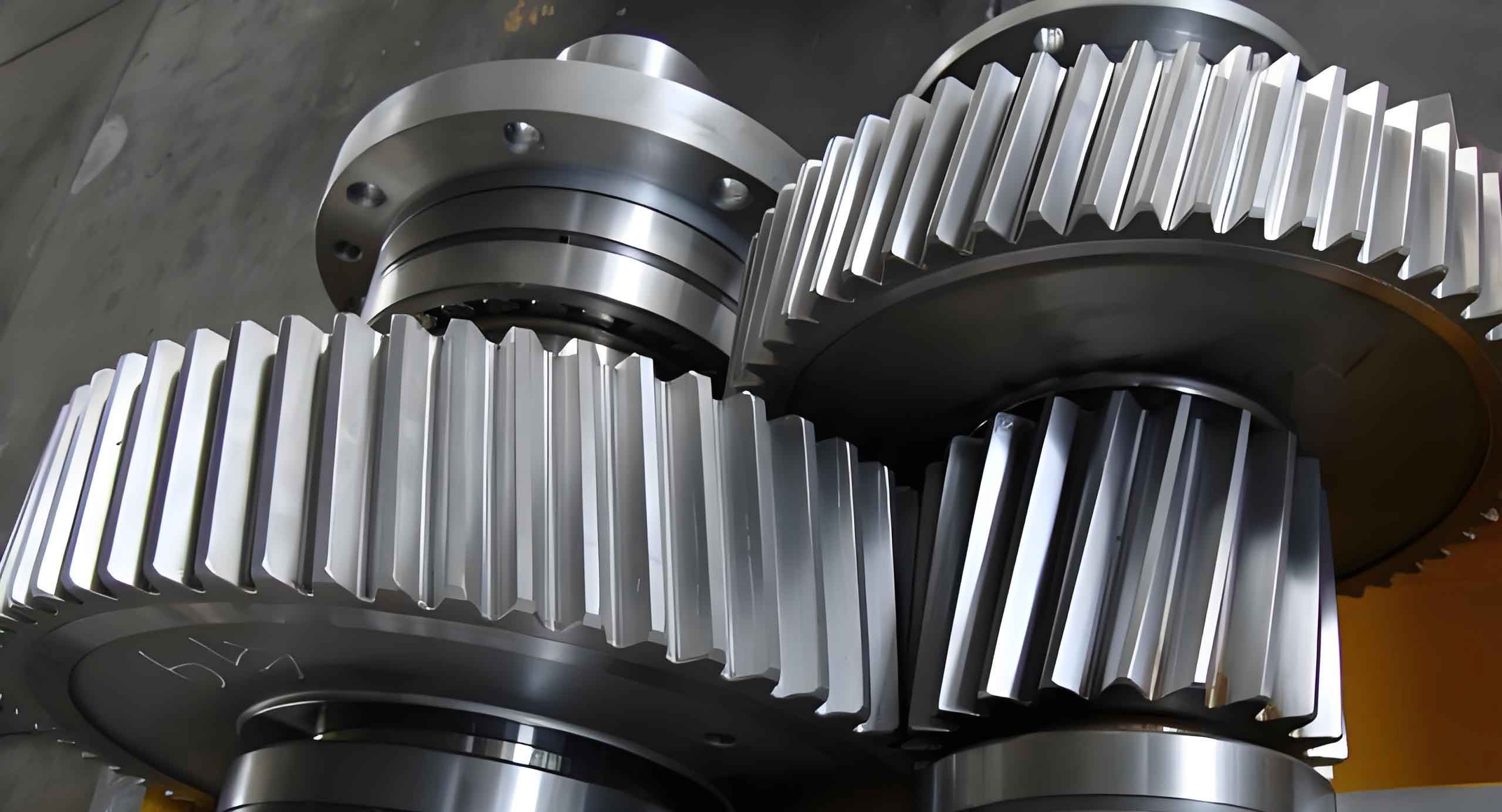
In modern mechanical transmission systems, helical gears are widely used due to their high load-bearing capacity, smooth operation, and reduced noise. However, with the increasing demand for compact and efficient designs, asymmetric helical gears with a small number of teeth have emerged as a promising solution. These gears offer advantages such as reduced volume and enhanced strength, but their dynamic characteristics, particularly the elastic contact impact caused by instantaneous normal relative velocity, require thorough investigation to ensure system stability. This study focuses on the dynamic behavior of asymmetric helical gears with a small number of teeth using finite element analysis via LS-DYNA. By considering factors like friction and damping, I analyze dynamic tooth root bending stress, dynamic transmission error, and transient impact phenomena. The goal is to provide insights into the design and optimization of such helical gear systems for improved performance and reliability.
The dynamic analysis of helical gears is complex due to internal excitations such as time-varying mesh stiffness, dynamic transmission error, and meshing impacts. Traditional standards like ISO and GB often yield conservative estimates for gear strength, highlighting the need for advanced simulation techniques. In this work, I develop a finite element dynamic contact model based on elastomeric contact-impact dynamics equations. This model allows for a comprehensive examination of the helical gear’s behavior under various operating conditions. Key aspects include the distribution of dynamic tooth root bending stress over a meshing cycle, comparison of static and dynamic stresses, and the influence of operational parameters on bending strength. Additionally, I explore the elastic contact impact resulting from instantaneous normal relative velocity differences at contact points, analyzing how impact force, stress, and time vary with rotational speed and impact position (tooth root, pitch circle, tooth top). The findings are compared between asymmetric and symmetric helical gears to underscore the benefits of asymmetric designs.
To begin, let me outline the theoretical foundation for the contact-impact dynamics of elastic bodies. In a helical gear pair, the interaction between teeth can be modeled as two elastic bodies in contact, with local coordinates defined at the contact surface. The system involves three states: separation, sticking, and sliding, each governed by specific equations. The general dynamics equation for the gear system is derived from the principles of elastodynamics. For two elastic bodies in contact, as shown in Figure 1 (though not referenced explicitly), I establish a global coordinate system (O-XYZ) and a local coordinate system (o-nts) on the contact surface, where n is the normal direction, and t and s are tangential directions. The contact-impact dynamics can be described using the following equations.
The motion equation for an elastic body is given by:
$$\sigma_{ij,j} + \rho f_i = \rho \ddot{x}_i$$
where $\sigma_{ij,j}$ is the Cauchy stress tensor, $\rho$ is the density, $f_i$ is the body force per unit mass, and $\ddot{x}_i$ is the acceleration. The geometric equation relates strain to displacement:
$$\epsilon_{ij} = \frac{1}{2}(u_{i,j} + u_{j,i})$$
where $\epsilon_{ij}$ is the strain tensor and $u_{i,j}$ is the displacement gradient. The constitutive equation for linear elasticity is:
$$\sigma_{ij} = \lambda \epsilon_{kk} \delta_{ij} + 2\mu \epsilon_{ij}$$
with $\sigma_{kk} = (3\lambda + 2\mu) \epsilon_{kk} = 3K \epsilon_{kk}$, where $\lambda$ and $\mu$ are Lamé constants, $\delta_{ij}$ is the Kronecker delta, and $K$ is the bulk modulus. The Lamé constants are defined as $\lambda = \frac{Ev}{(1+v)(1-2v)}$ and $\mu = \frac{E}{1+v}$, with $E$ being Young’s modulus and $v$ Poisson’s ratio.
For the gear contact system, the dynamics equation in matrix form is:
$$M_i \ddot{U}_i + C_i \dot{U}_i + K_i U_i = F_i$$
where $M_i$, $C_i$, and $K_i$ are the mass, damping, and stiffness matrices, respectively; $F_i$ is the contact force vector; and $\ddot{U}_i$, $\dot{U}_i$, and $U_i$ are the acceleration, velocity, and displacement vectors. This equation forms the basis for the finite element analysis of the helical gear pair.
Next, I develop the finite element dynamic contact model for the asymmetric helical gear with a small number of teeth. Using LS-DYNA, I employ SOLID164 elements for the gear bodies and SHELL163 elements for the inner rings to apply rotational constraints. The material properties are set for normalized 45# steel, and the geometric parameters are summarized in Table 1. The dynamic contact model includes full-tooth representations to ensure accuracy, with localized mesh refinement at the tooth roots to capture stress concentrations effectively.
| Parameter | Value | Parameter | Value |
|---|---|---|---|
| Number of teeth, z1/z2 | 6/12 | Module, mn (mm) | 10 |
| Addendum coefficient, h*na | 0.95 | Face width, b (mm) | 20 |
| Pressure angle, αnd/αnc (°) | 30/20 | Profile shift, x1/x2 | 0.25/-0.25 |
| Helix angle, β (°) | 20 | – | – |
| Parameter | Value | Parameter | Value |
|---|---|---|---|
| Density, ρ (kg/m³) | 7800 | Young’s modulus, E (Pa) | 2.1 × 10¹¹ |
| Poisson’s ratio, ν | 0.3 | Specific heat capacity, c (J/(kg·K)) | 460 |
| Thermal conductivity (W/(m·K)) | 48 | – | – |
The model simulation involves applying a rotational speed to the pinion (driving gear) and a load torque to the gear (driven gear). Friction is incorporated using a coefficient of μ = 0.05, based on empirical formulas like Buckingham’s, to account for surface interactions. The solving process in LS-DYNA uses 1000 load steps to capture the dynamic meshing behavior accurately. For instance, at a torque of 200 N·m and a speed of 500 rpm, I obtain equivalent stress contours at different time steps, illustrating the stress distribution during meshing. The helical gear teeth experience varying stress levels as the contact point moves from the root to the tip, with peak stresses occurring at specific rotational angles.
In analyzing dynamic tooth root bending stress, I focus on the von Mises stress, which represents the combined effect of multi-axial stresses. The stress distribution over a meshing cycle shows that for the driving helical gear, the maximum compressive stress is 85.79 MPa and the maximum tensile stress is 64.86 MPa, with compressive stresses generally higher than tensile stresses. This aligns with analytical predictions for asymmetric helical gears. Comparing static and dynamic analyses reveals that dynamic stresses are significantly larger due to vibrational and impact effects. Specifically, the dynamic tooth root bending stress for the driving gear is 65.12 MPa versus 46.54 MPa statically—an increase of 39.92%. For the driven helical gear, dynamic stress is 43.84 MPa compared to 32.65 MPa statically, a 34.27% increase. This underscores the importance of dynamic analysis in helical gear design.
The influence of operational parameters on tooth root bending stress is further investigated. Table 3 summarizes the maximum dynamic tooth root bending stresses under varying torques and speeds. As torque increases from 100 to 400 N·m at a constant speed of 500 rpm, the stress rises from 39.10 to 119.5 MPa. Conversely, at a constant torque of 200 N·m, increasing speed from 600 to 1500 rpm leads to stress increases from 65.98 to 133.12 MPa. These trends indicate that both torque and speed elevate stress, but speed has a more pronounced effect on system stability. The stress curves maintain similar shapes with torque variations but become more erratic at higher speeds, suggesting increased impact and vibration in the helical gear system.
| Torque (N·m) | Speed (rpm) | Max Stress (MPa) | Notes |
|---|---|---|---|
| 100 | 500 | 39.10 | Driving gear |
| 200 | 500 | 64.96 | Driving gear |
| 300 | 500 | 93.03 | Driving gear |
| 400 | 500 | 119.5 | Driving gear |
| 200 | 600 | 65.98 | Driving gear |
| 200 | 900 | 74.06 | Driving gear |
| 200 | 1200 | 87.60 | Driving gear |
| 200 | 1500 | 133.12 | Driving gear |
To quantify the relationship, I derive an empirical formula for dynamic tooth root bending stress $\sigma_b$ as a function of torque $T$ and speed $n$:
$$\sigma_b = k_1 T + k_2 n + k_3 T n + \sigma_0$$
where $k_1$, $k_2$, $k_3$ are coefficients, and $\sigma_0$ is the base stress. From the data, $k_1 \approx 0.2$ MPa/N·m, $k_2 \approx 0.05$ MPa/rpm, and $k_3 \approx 0.001$ MPa/(N·m·rpm) for this helical gear configuration. This highlights the nonlinear interaction between parameters.
Moving to dynamic transmission error (DTE), this is defined as the angular difference between the actual and theoretical meshing points. It serves as a key indicator of gear transmission smoothness. In my analysis, DTE is computed from the nodal displacements of the driven gear’s inner ring. Under a speed of 1500 rpm and torque of 200 N·m, the DTE exhibits periodic fluctuations correlated with mesh stiffness variations. Specifically, DTE is smaller in double-tooth contact regions due to higher stiffness and larger in single-tooth contact regions. The DTE curve shows an initial phase of剧烈波动 (severe fluctuations) followed by a平稳增加 (steady increase) phase. For example, at torques of 100, 200, 300, and 400 N·m, the DTE amplitudes are 0.0118, 0.0125, 0.0129, and 0.0132 rad, respectively. The steady-state entry angle decreases with increasing torque, indicating that heavier loads promote earlier stabilization. Speed variations, however, do not significantly affect DTE amplitude but delay the steady-state entry; at speeds of 600, 900, 1200, and 1500 rpm, the entry angles are 0.0239, 0.0385, 0.0537, and 0.0763 rad, respectively.
The relationship between meshing force and DTE is also examined. The meshing force peaks and troughs correspond directly to DTE突跃 (jumps), validating the internal excitation model. This correlation emphasizes the importance of controlling DTE in helical gear systems to reduce noise and vibration. The DTE can be expressed mathematically as:
$$\text{DTE} = \theta_{\text{actual}} – \theta_{\text{theoretical}} = \sum_{i=1}^{n} \left( \frac{\Delta F_i}{k_i} \right)$$
where $\theta$ are angular positions, $\Delta F_i$ is the dynamic meshing force variation, and $k_i$ is the time-varying mesh stiffness of the helical gear pair.
Now, let me delve into the transient impact analysis of the helical gear. Unlike meshing impacts due to entry/exit or backlash, this focuses on elastic contact impact caused by instantaneous normal relative velocity differences at contact points. When the driving helical gear undergoes a sudden speed change, a法向相对速度 (normal relative velocity) $\Delta v$ arises, leading to冲击碰撞 (impact collision). The impact model treats the gear teeth as elastic bodies, with the contact force dominating during the short impact duration. I analyze this by setting the driving gear with an initial velocity impacting the driven gear, neglecting backlash and deformation effects initially.
The impact stress, force, and time are studied as functions of impact position and speed. For impact positions at the tooth root, pitch circle, and tooth tip, the impact stress is highest at the tooth tip and lowest at the pitch circle. This is attributed to the shorter line of action near the tip and root compared to the pitch circle in helical gears. Table 4 summarizes the impact stress maxima at different speeds and positions. At a given speed, impact stress increases linearly with speed, as per impact mechanics theory. For example, at 200 rpm, impact stresses are 150 MPa (root), 120 MPa (pitch circle), and 180 MPa (tip). Impact time, defined as the duration where contact pressure exceeds 20 MPa, decreases with increasing speed and is shortest at the pitch circle.
| Impact Position | Speed (rpm) | Impact Stress (MPa) | Impact Time (ms) |
|---|---|---|---|
| Tooth Root | 100 | 100 | 1.5 |
| Tooth Root | 200 | 150 | 1.2 |
| Tooth Root | 300 | 200 | 1.0 |
| Pitch Circle | 100 | 80 | 1.0 |
| Pitch Circle | 200 | 120 | 0.8 |
| Pitch Circle | 300 | 160 | 0.6 |
| Tooth Tip | 100 | 120 | 1.8 |
| Tooth Tip | 200 | 180 | 1.5 |
| Tooth Tip | 300 | 240 | 1.2 |
The impact force $F_{\text{impact}}$ can be estimated using the impulse-momentum principle:
$$F_{\text{impact}} = \frac{m \Delta v}{t_{\text{impact}}}$$
where $m$ is the effective mass of the helical gear tooth, $\Delta v$ is the normal relative velocity, and $t_{\text{impact}}$ is the impact time. This shows an inverse relationship between force and time, explaining why higher speeds yield shorter impact times and higher stresses.
Furthermore, I compare the impact stress between asymmetric helical gears (pressure angles 30°/20°) and symmetric helical gears (pressure angles 20°/20°) at the tooth tip position. As shown in Table 5, the asymmetric helical gear exhibits lower impact stresses across all speeds, with reductions of 1.86% to 9.91% compared to the symmetric gear. This demonstrates the advantage of asymmetric designs in enhancing contact fatigue strength for helical gear systems.
| Gear Type | Pressure Angles (°) | Speed (rpm) | Max Impact Stress (MPa) | Reduction (%) |
|---|---|---|---|---|
| Symmetric Helical Gear | 20/20 | 100 | 402.05 | – |
| Asymmetric Helical Gear | 30/20 | 100 | 394.58 | 1.86 |
| Symmetric Helical Gear | 20/20 | 200 | 433.69 | – |
| Asymmetric Helical Gear | 30/20 | 200 | 413.10 | 4.75 |
| Symmetric Helical Gear | 20/20 | 300 | 463.89 | – |
| Asymmetric Helical Gear | 30/20 | 300 | 435.73 | 6.07 |
| Symmetric Helical Gear | 20/20 | 400 | 508.01 | – |
| Asymmetric Helical Gear | 30/20 | 400 | 457.69 | 9.91 |
The reduction in impact stress for asymmetric helical gears can be attributed to optimized tooth geometry, which distributes loads more evenly. This is crucial for applications where helical gears are subjected to frequent start-stop cycles or variable loads. The pressure angle asymmetry modifies the contact pattern, reducing stress concentrations and improving durability.
In conclusion, my analysis of asymmetric helical gears with a small number of teeth using LS-DYNA reveals several key insights. The dynamic tooth root bending stress in helical gears is higher than static stress by 30-40%, with compressive stresses exceeding tensile stresses. Operational parameters like torque and speed significantly influence stress levels, with speed having a more dramatic effect on system stability. The dynamic transmission error of helical gears shows distinct phases of fluctuation and steady increase, with amplitude rising with torque and entry angle delaying with speed. Transient impact analysis indicates that impact stress is highest at the tooth tip and lowest at the pitch circle, with asymmetric helical gears offering reduced impact stress compared to symmetric designs. These findings underscore the importance of dynamic simulation in helical gear design, enabling better performance, reliability, and longevity. Future work could explore thermal effects or lubricated conditions to further refine the model for real-world helical gear applications.
To summarize mathematically, the overall dynamic response of the helical gear system can be encapsulated by the following integrated equation:
$$\sigma_{\text{total}} = \sqrt{\sigma_b^2 + \sigma_{\text{impact}}^2 + \frac{E \cdot \text{DTE}}{R}}$$
where $\sigma_b$ is the bending stress, $\sigma_{\text{impact}}$ is the impact stress, $E$ is Young’s modulus, DTE is the dynamic transmission error, and $R$ is a geometric factor specific to the helical gear. This holistic approach aids in optimizing helical gear designs for diverse engineering applications.