
In the field of precision engineering, the dynamic performance of mechanical systems is critical for ensuring accuracy and reliability. As a researcher focused on gear transmission systems, I have dedicated significant effort to analyzing the dynamic characteristics of a bevel gear transmission performance tester. This instrument is designed to measure transmission error, vibration, and noise in bevel gear pairs, which are essential components in various industrial applications such as automotive differentials and aerospace systems. The tester’s ability to simulate real-world operating conditions makes it invaluable for quality control and performance optimization. However, during operation, vibrations induced by gear meshing and motor rotation can adversely affect measurement precision, potentially leading to resonance that compromises data integrity. Therefore, a comprehensive dynamic analysis is necessary to identify modal parameters, assess harmonic responses, and guide structural improvements. This article presents a detailed investigation using finite element simulation and experimental modal analysis, with an emphasis on the bevel gear tester’s behavior under working conditions. By integrating theoretical models, numerical simulations, and practical tests, I aim to provide insights that enhance the tester’s design and operational stability.
The core of this analysis lies in understanding the vibrational dynamics of the bevel gear tester. The instrument consists of a rigid bed, two motorized spindles that act as drive and load axes, and linear adjustment mechanisms for setting gear installation distances. The bevel gears are mounted on these spindles, and high-precision rotary encoders capture angular positions to compute transmission error. Additionally, triaxial accelerometers are attached near the spindle bearings to monitor vibration signals in X, Y, and Z directions. Given the complexity of the structure—comprising numerous components and interfaces—a pure numerical approach may not fully capture its dynamic behavior. Thus, I combine finite element analysis (FEA) with experimental modal testing to validate and refine the model. The primary objectives are to determine natural frequencies, mode shapes, and harmonic responses, thereby identifying critical resonance zones that must be avoided during operation. This work underscores the importance of dynamic characterization in precision instruments, especially for bevel gear systems where meshing forces can excite structural modes.
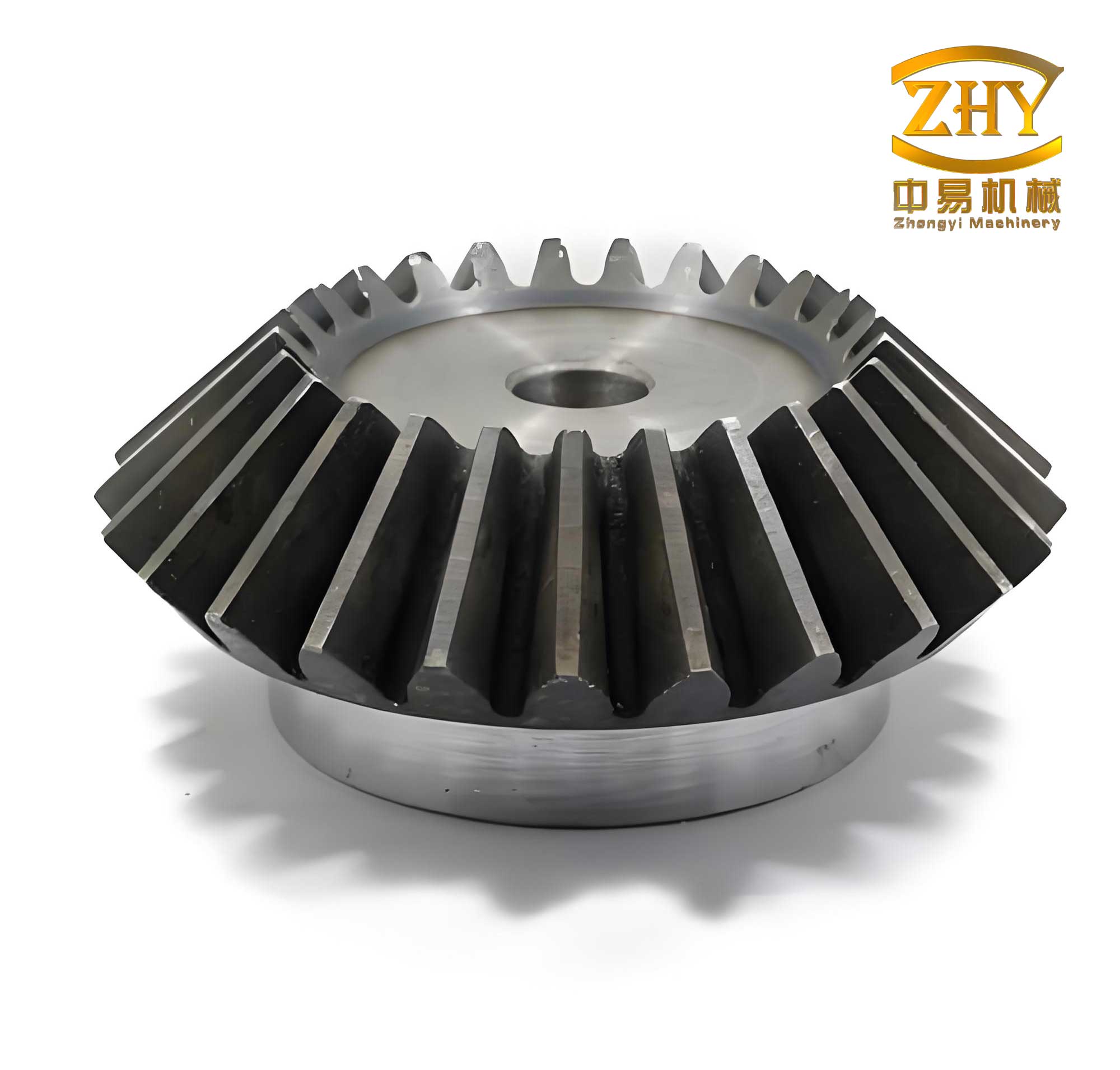
The theoretical foundation for dynamic analysis begins with the equations of motion for a multi-degree-of-freedom linear system. For the bevel gear tester, the governing differential equation can be expressed as:
$$ M \ddot{X} + C \dot{X} + KX = F(t) $$
where \( M \) is the mass matrix, \( C \) is the damping matrix, \( K \) is the stiffness matrix, \( X \) is the displacement vector, and \( F(t) \) is the external force vector. In many mechanical systems, including this bevel gear tester, damping effects are relatively small and can be neglected for modal analysis, simplifying the equation to:
$$ M \ddot{X} + KX = 0 $$
Solving this eigenvalue problem yields the natural frequencies \( \omega_i \) and mode shapes. The characteristic equation is:
$$ |K – \omega^2 M| = 0 $$
The natural frequencies are given by \( \omega_i = \sqrt{K_i / M_i} \), where \( i \) ranges from 1 to \( n \) (the number of degrees of freedom). These frequencies depend solely on the system’s mass and stiffness distributions. For the bevel gear tester, the first few modes are most relevant, as they are more easily excited by operational forces.
To assess the system’s response under periodic loads, such as those from bevel gear meshing, harmonic response analysis is conducted. Assuming a harmonic excitation force \( F_0 \cos(\omega t) \), the steady-state response can be derived. The equation of motion becomes:
$$ M \ddot{X} + KX = F_0 \cos(\omega t) $$
By solving this, the displacement response \( X(t) \) in the frequency domain is obtained. This analysis helps identify frequencies at which the structure exhibits peak displacements, indicating potential resonance. For the bevel gear tester, the meshing forces generate excitations at the gear rotational frequency and its multiples, making harmonic response crucial for avoiding resonant conditions.
The bevel gear transmission performance tester features a robust design to accommodate various bevel gear sizes and configurations. The main structure is constructed from gray cast iron HT300, providing high stiffness and damping capacity, while the spindles and rails are made of 45 steel for enhanced strength. The material properties are summarized in Table 1.
| Material | Elastic Modulus (MPa) | Density (kg/m³) | Poisson’s Ratio |
|---|---|---|---|
| Gray Cast Iron HT300 | 1.3 × 10⁵ | 7300 | 0.25 |
| 45 Steel | 2.07 × 10⁵ | 7800 | 0.30 |
In terms of functionality, the tester measures transmission error by comparing the angular positions of the drive and driven bevel gears using rotary encoders. Vibration and noise are captured via accelerometers, and the system allows for adjustment of gear mounting distances to optimize meshing. The dynamic performance is critical because vibrations from the bevel gear pair can couple with structural modes, amplifying errors. Therefore, understanding the modal characteristics is essential for designing a tester that minimizes internal vibrations and ensures accurate measurements.
For the finite element analysis, I developed a simplified 3D model of the bevel gear tester using Solid Edge, omitting minor components like screws and chains to reduce computational complexity while retaining essential dynamics. The model was imported into ANSYS Workbench, where material properties were assigned, and a hex-dominant mesh was generated with refinement in critical areas such as the spindle interfaces. Boundary conditions simulated the tester resting on pads at four corners, fixed to represent grounding. The modal analysis focused on the first six natural frequencies, as higher modes have negligible impact on operational dynamics. The results are presented in Table 2.
| Mode Order | Natural Frequency (Hz) |
|---|---|
| 1 | 49.989 |
| 2 | 120.51 |
| 3 | 214.08 |
| 4 | 306.85 |
| 5 | 363.83 |
| 6 | 403.01 |
The first two mode shapes are particularly relevant for the bevel gear tester. Mode 1 involves bending of the bed in the ZX plane, coupled with swinging of the drive spindle along the X-axis. Mode 2 exhibits torsional deformation of the bed along the Z-axis, with the driven spindle oscillating in the Y-direction. These modes indicate that the spindles—critical for holding the bevel gears—are susceptible to vibration, which could misalign gear meshing and degrade transmission error measurements. The finite element model thus highlights potential weak points in the structure.
Harmonic response analysis was performed to evaluate the tester’s behavior under simulated working loads. The bevel gear meshing forces were simplified into axial and radial components based on a typical torque of 10 Nm. For the drive spindle, the axial force was 77 N and radial force 26 N; for the driven spindle, axial force was 83 N and radial force 83 N. The analysis spanned 0 to 250 Hz with 100 steps, capturing displacement responses in X, Y, and Z directions. The results, shown in Figure 1 (simulated curve), reveal peak displacements at around 49 Hz, corresponding to the first natural frequency. This confirms that excitations near this frequency can induce resonance, emphasizing the need to avoid operational speeds that generate such frequencies. Additional peaks between 102.5 Hz and 130 Hz align with the second mode, though with lower amplitude, indicating lesser but still significant susceptibility.
To validate the finite element results, experimental modal analysis was conducted using impact hammer testing. Triaxial accelerometers were placed at 435 points on the tester’s surface, with excitation applied at multiple locations using a rubber-tipped hammer to capture low-frequency responses. Data acquisition was performed with DASP V10 software, and modal parameters were extracted using the Eigenvalue Realization Algorithm (ERA) and Polyreference Least Squares Complex Frequency (PolyLSCF) method. The experimental natural frequencies for the first six modes are listed in Table 3.
| Mode Order | Natural Frequency (Hz) | Damping Ratio (%) |
|---|---|---|
| 1 | 44.7 | 9.079 |
| 2 | 106.4 | 2.922 |
| 3 | 204.1 | 2.376 |
| 4 | 292.9 | 3.626 |
| 5 | 347.3 | 2.012 |
| 6 | 455.3 | 1.769 |
The experimental mode shapes corroborate the finite element findings: Mode 1 shows bed bending and spindle swinging, while Mode 2 involves bed torsion and spindle oscillation. The close agreement between simulation and experiment, with frequency errors under 10%, validates the finite element model. Notably, the experimental modes exhibit more pronounced spindle vibrations, likely due to less rigid constraints at the rail interfaces in reality. This underscores the importance of reinforcing spindle attachments to mitigate dynamic deflections in bevel gear testing.
Building on modal insights, I conducted vibration tests under operational conditions to assess the tester’s response during actual bevel gear meshing. Triaxial accelerometers were mounted on the drive and driven spindle faces, and data were collected at various rotational speeds. For instance, at 80 rpm, the time-domain acceleration signals revealed periodic impacts corresponding to gear meshing events. The maximum and root-mean-square (RMS) values for acceleration components are summarized in Table 4.
| Spindle | Direction | Max Acceleration (m/s²) | RMS Acceleration (m/s²) |
|---|---|---|---|
| Drive Spindle | Axial (X) | 1.44528 | 0.27131 |
| Radial (Y) | 2.56405 | 0.25221 | |
| Vertical (Z) | 4.56577 | 0.70105 | |
| Driven Spindle | Radial (Y) | 1.82868 | 0.12947 |
| Vertical (Z) | 1.20822 | 0.07454 | |
| Axial (X) | 0.63764 | 0.08604 |
The axial direction on the drive spindle showed the highest vibration levels, aligning with the first mode shape where axial swinging predominates. To delve deeper, I performed frequency-domain analysis using Fast Fourier Transform (FFT) and envelope demodulation techniques. The envelope spectrum at 80 rpm revealed dominant peaks at 1.34 Hz (rotational frequency of the bevel gear), 13.53 Hz (meshing frequency), and 26.78 Hz (second harmonic of meshing frequency). Similar patterns were observed at higher speeds: at 120 rpm, peaks at 2.05 Hz, 20.56 Hz, and 39.23 Hz; at 140 rpm, peaks at 2.37 Hz, 23.32 Hz, and 46.63 Hz. These frequencies correspond to the bevel gear’s rotational and meshing fundamentals, with sidebands spaced at the rotational frequency, indicating modulation effects from gear defects or misalignment.
The harmonic response analysis indicated that the first natural frequency around 44.7 Hz is a critical resonance zone. Since the operational frequencies (rotational and meshing) for typical bevel gear tests are below 50 Hz, there is a risk of overlap. For example, at very high speeds, the meshing frequency could approach 44.7 Hz, potentially exciting resonance. Therefore, it is imperative to avoid operating conditions where the meshing frequency or its harmonics coincide with the first natural frequency. This can be achieved by selecting gear parameters or speeds that keep excitation frequencies outside this range. Additionally, structural modifications, such as stiffening the spindle-bed connections, could shift the natural frequencies higher, reducing susceptibility.
The dynamic analysis of the bevel gear transmission performance tester reveals several key findings. First, the finite element and experimental modal analyses consistently identify the first natural frequency at approximately 44.7 Hz, with mode shapes involving bed bending and spindle oscillations. Second, harmonic response simulations show peak displacements near this frequency, confirming its resonance potential. Third, vibration tests under working conditions highlight that the dominant excitations stem from bevel gear rotational and meshing frequencies, which must be kept distinct from the first natural frequency to prevent resonance. These insights emphasize the importance of dynamic characterization in precision instruments for bevel gear systems. Future work could focus on optimizing the tester’s structure—perhaps through material selection or damping enhancements—to elevate natural frequencies and improve robustness. By integrating dynamic considerations into design and operation, the accuracy and reliability of bevel gear performance testing can be significantly enhanced, contributing to advancements in gear technology and industrial applications.
In conclusion, this comprehensive dynamic analysis underscores the interplay between structural modes and operational vibrations in a bevel gear transmission performance tester. Through a combination of theoretical modeling, finite element simulation, and experimental validation, I have identified critical resonance frequencies and provided guidelines for avoiding them during bevel gear testing. The methodologies employed here can be extended to other precision mechanical systems, highlighting the value of dynamic analysis in ensuring measurement fidelity and system longevity. As bevel gears continue to play a vital role in power transmission, tools like this tester—and their optimized dynamic performance—will remain essential for quality assurance and innovation.