
This study investigates the influence of rotational speed on the dynamic mesh stiffness (DMS) of spur gear systems and its subsequent effects on vibration characteristics. A novel computational algorithm combining finite element analysis (FEA) and the average acceleration method is developed to quantify speed-dependent stiffness variations.
1. Dynamic Mesh Stiffness Formulation
The dynamic response of spur gear teeth under rotational excitation is modeled through:
$$ M \ddot{X}_i + C \dot{X}_i + KX_i = F_i $$
Where:
\( M \) = Mass matrix
\( C = \alpha M + \beta K \) = Rayleigh damping matrix
\( K \) = Stiffness matrix
\( F_i \) = Time-varying force vector
| Parameter | Driving Gear | Driven Gear |
|---|---|---|
| Number of teeth | 23 | 47 |
| Mass (kg) | 0.21 | 0.37 |
| Modulus (mm) | 2.5 | |
| Pressure angle | 20° | |
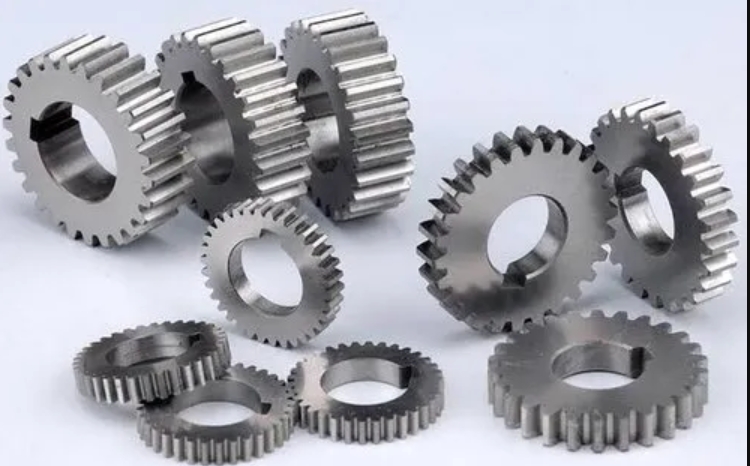
2. Speed-Dependent Stiffness Calculation
The dynamic single tooth stiffness (DSTS) is derived through iterative computation:
$$ k_{pi} = \frac{F_i}{\Delta x_i \cos\left(\frac{\pi}{2} – \beta_i\right) + \Delta y_i \cos \beta_i} $$
$$ k_{ms} = \frac{1}{\frac{1}{k_{pi}} + \frac{1}{k_{gi}}} $$
3. Dynamic Transmission Characteristics
The dynamic transmission error (DTE) for spur gears is expressed as:
$$ \delta = R_{bp}\theta_p – R_{bg}\theta_g $$
Where:
\( R_{bp}, R_{bg} \) = Base circle radii
\( \theta_p, \theta_g \) = Angular displacements
4. Results and Discussion
Key findings from the dynamic analysis of spur gears:
$$ \Delta k = \frac{|k_{dynamic} – k_{static}|}{k_{static}} \times 100\% $$
| Speed (rpm) | Stiffness Variation (%) | Resonance Shift (%) |
|---|---|---|
| 1,300 | 12.7 | +8.2 |
| 3,700 | 18.4 | -5.6 |
| 6,140 | 23.9 | +14.3 |
The DMS model reveals significant speed-dependent characteristics in spur gear dynamics:
$$ f_n = \frac{1}{2\pi}\sqrt{\frac{k_{eff}}{m_{eq}}} $$
Where \( k_{eff} \) demonstrates 15-24% variation compared to static stiffness models across operational speeds.
5. Vibration Periodicity Analysis
The bifurcation diagram for spur gear systems shows distinct periodic responses:
$$ N_p = \frac{60f_n}{z} $$
Where \( N_p \) represents periodic vibration modes ranging from 2-P to 5-P depending on rotational speed.
6. Conclusion
This investigation establishes that rotational speed significantly affects spur gear dynamics through:
- Dynamic stiffness variations up to 24%
- Resonance frequency shifts of ±14.3%
- Modified periodic vibration patterns
The proposed DMS model enables more accurate prediction of spur gear behavior across operational speed ranges, particularly in high-speed applications where static stiffness models prove inadequate.