
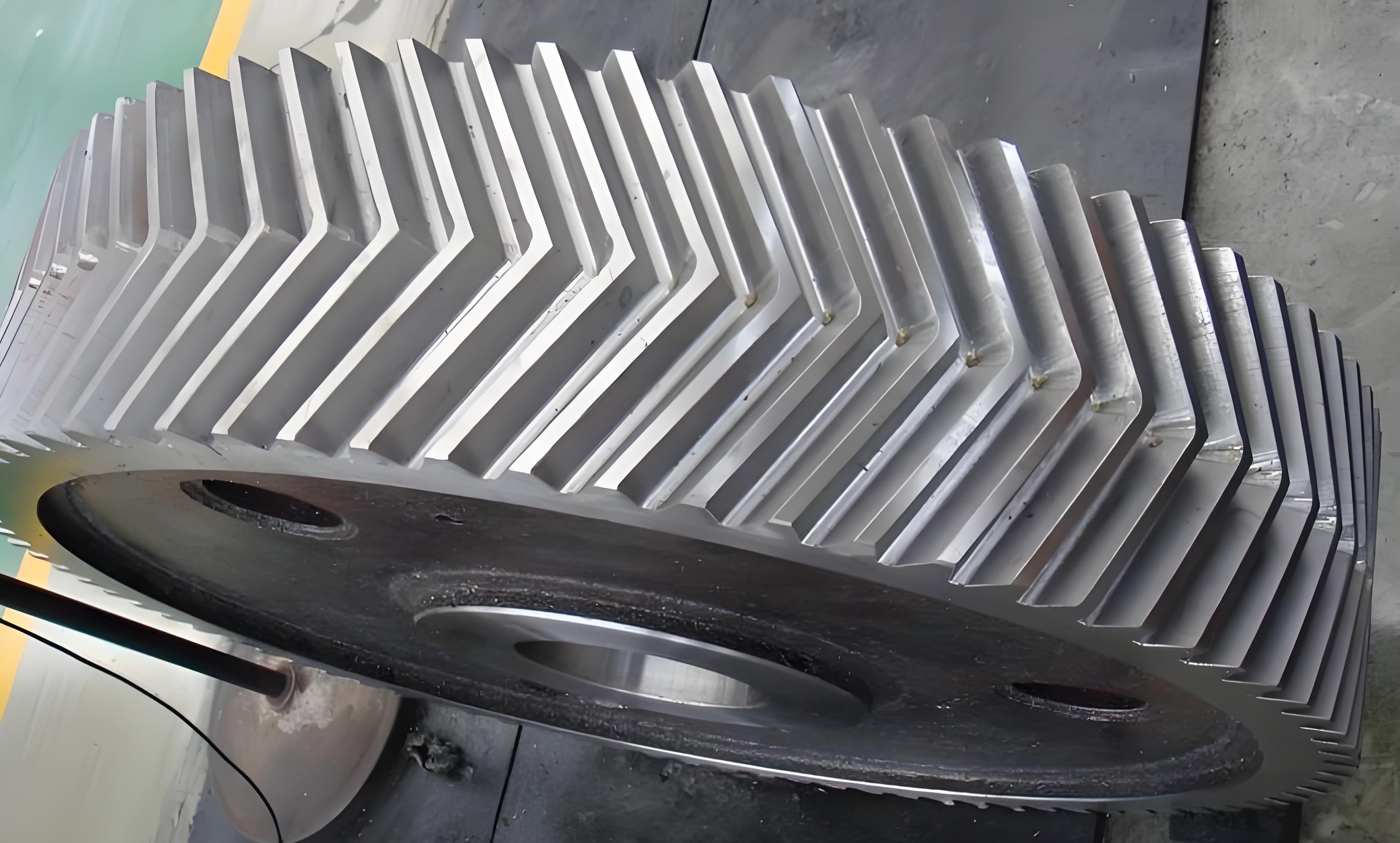
The analysis of dynamic behavior in power transmission systems is fundamental for achieving designs with low noise, high reliability, and extended operational life. Among various gear types, herringbone gears are particularly valued in heavy-duty applications such as marine propulsion, mining machinery, and special-purpose equipment. Their distinctive double-helical design inherently cancels out axial forces, leading to superior load-carrying capacity and smoother operation compared to single helical gears. However, the dynamic performance of these systems is significantly influenced by internal excitations arising from manufacturing imperfections, assembly errors, and the inherent periodicity of the meshing process. Traditional dynamic models often treat these excitations—namely, time-varying mesh stiffness and transmission error—as deterministic quantities. In reality, due to the stochastic nature of manufacturing and assembly processes, these internal excitations possess a random component. This randomness can profoundly affect the dynamic forces within the gear train, influencing vibration levels, fatigue life, and overall system reliability. Therefore, a comprehensive dynamic analysis must account for this randomness to accurately predict system behavior and lay the groundwork for robust optimization. This article delves into the nonlinear dynamic characteristics of a two-stage split herringbone gear transmission system, with a specific focus on modeling and analyzing the effects of random internal excitations.
System Configuration and Dynamic Modeling
The specific system under investigation is a two-stage split-path herringbone gear train commonly employed in high-torque, low-speed applications. The kinematic configuration is designed to distribute load and potentially reduce system size. A representative layout involves an input stage and an output stage, where the power flow is split through two parallel paths in at least one stage to improve load sharing and reliability. In such configurations, the intermediate shaft is typically axially fixed, while the high-speed input and low-speed output shafts are often axially free to accommodate thermal expansion and mounting tolerances inherent in herringbone gears.
To develop a predictive dynamic model, several assumptions are made. The gear bodies are considered rigid, as their deformations are generally small compared to those of the teeth, shafts, and bearings. The flexibility is concentrated in the meshing teeth, the supporting shafts (including torsional, bending, and axial deformations), and the bearing assemblies. Damping, gravitational forces, and friction between meshing teeth are neglected for model simplification, as the primary focus is on the forced response due to stiffness and error excitations. Crucially, the model incorporates key nonlinearities and excitations: time-varying mesh stiffness, static transmission error (STE) which represents kinematic imperfections, axial displacement excitation due to manufacturing errors in the herringbone teeth, and gear backlash which introduces a piecewise-linear nonlinearity.
The dynamic model is essentially a lumped-parameter, bearing-gear coupled system. A fixed coordinate system is established at the theoretical center of each gear. The generalized coordinate vector for the system includes the transverse displacements (perpendicular to the shaft axis and in the plane of action) and the torsional rotations of each gear, as well as the axial displacements of gears where axial freedom exists. For a herringbone gear pair \(k\), the total meshing deformation \(\delta_{jk}\) on the left (\(j=L\)) and right (\(j=R\)) flanks is a function of the transverse displacements \(y_i\), rotational displacements \(\theta_i\), and the composite static transmission error \(e_{jk}\).
$$
\delta_{jI} = y_1 – y_3 – \theta_1 r_{b1} + \theta_3 r_{b3} – e_{jI}\cos\beta_{bI}
$$
$$
\delta_{jII} = y_2 – y_4 – \theta_2 r_{b2} + \theta_4 r_{b4} – e_{jII}\cos\beta_{bII}
$$
$$
\delta_{jIII} = y_5 – y_6 + \theta_5 r_{b5} – \theta_6 r_{b6} – e_{jIII}\cos\beta_{bIII}
$$
Here, \(r_{bi}\) is the base radius and \(\beta_{bk}\) is the base helix angle for the gears in pair \(k\). The meshing force \(F_{jk}\) on each flank is then calculated considering backlash \(b_k\):
$$ F_{jk} =
\begin{cases}
k_{jk} \delta_{jk}, & \delta_{jk} \geq 0 \\
0, & -b_k \cos\beta_{bk} \leq \delta_{jk} < 0 \\
k_{jk} (b_k \cos\beta_{bk} + \delta_{jk}), & \delta_{jk} < -b_k \cos\beta_{bk}
\end{cases}
$$
where \(k_{jk}\) is the time-varying mesh stiffness for flank \(j\) of pair \(k\). The total meshing force for a herringbone pair has components in the transverse direction (\(F_{vyk}\)) and the axial direction (\(F_{vzk}\)), which are summed from the left and right flank forces:
$$ F_{vyk} = F_{Lk} + F_{Rk} $$
$$ F_{vzk} = (F_{Lk} – F_{Rk}) \tan\beta_{bk} \quad \text{(for certain gear orientations)} $$
Applying Newton’s second law to each gear mass yields the system of nonlinear differential equations of motion. These equations couple the torsional, transverse, and axial vibrations through the meshing forces and the bearing/shaft support stiffnesses (\(ky_i\), \(kz_i\), \(kt_i\)). The final matrix form of the equations is:
$$ \mathbf{M}\ddot{\mathbf{q}} + \mathbf{K}(t, \mathbf{q})\mathbf{q} = \mathbf{F}_m(t, \mathbf{q}) + \mathbf{F}_e $$
where \(\mathbf{M}\) is the mass/inertia matrix, \(\mathbf{K}\) is the stiffness matrix containing both linear support stiffness and the parametric excitation from \(k_{jk}(t)\), \(\mathbf{F}_m\) is the nonlinear meshing force vector dependent on backlash and deformation, and \(\mathbf{F}_e\) represents external torques (\(T_d\), \(T_L\)) and error excitations.
Analysis of Stochastic Internal Excitations
The internal excitations in gear systems are not purely deterministic. Manufacturing variations introduce randomness in both the gear tooth geometry (affecting mesh stiffness) and the kinematic accuracy (affecting transmission error).
1. Random Mesh Stiffness Excitation:
The total mesh stiffness \(k(t)\) for a gear pair can be decomposed into a mean component, deterministic periodic components (harmonics of the mesh frequency), and a random component.
$$ k(t) = k_m + \sum_{i=1}^{N} k_{ai} \sin(2\pi i f_m t + \phi_{ki}) + k_r(t) $$
Here, \(k_m\) is the average mesh stiffness, \(k_{ai}\) and \(\phi_{ki}\) are the amplitude and phase of the \(i\)-th harmonic, \(f_m\) is the gear mesh frequency, and \(k_r(t)\) is the random component. This random component arises from stochastic variations in tooth profile, lead, and spacing errors. It is often modeled as a stationary Gaussian process bounded within physical limits, effectively following a truncated normal distribution. Its probability density function is:
$$ f(k_r) = \frac{1}{\alpha \sigma \sqrt{2\pi}} e^{-\frac{1}{2}\left(\frac{k_r – \mu}{\sigma}\right)^2}, \quad k_r \in [k_{rl}, k_{ru}] $$
where \(\mu\) and \(\sigma\) are the mean and standard deviation of the underlying normal distribution, \(k_{rl}\) and \(k_{ru}\) are the lower and upper truncation bounds, and \(\alpha\) is a normalization constant ensuring the integral over the truncated domain equals one.
2. Random Transmission Error Excitation:
The composite static transmission error \(e(t)\) is a primary source of vibration excitation. It aggregates errors from gear eccentricity \(e_r\), pitch deviation \(f_{pt}\), and profile deviation \(f_{f\alpha}\). Its formulation also includes deterministic periodic parts and a random part.
$$ e(t) = e_r \sin(2\pi f_c t + \delta) + \sum_{i=1}^{N} e_{ai} \sin(2\pi i f_m t + \phi_{ei}) + e_r(t) $$
In this equation, \(f_c\) is the rotational frequency of the gear, \(\delta\) is the eccentricity phase angle, \(e_{ai}\) and \(\phi_{ei}\) are related to pitch/profile error harmonics, and \(e_r(t)\) is the random component representing the stochastic part of tooth-to-tooth variations. Similar to mesh stiffness, \(e_r(t)\) can be modeled by a truncated normal distribution. The interaction of these random excitations with system nonlinearities like backlash leads to complex stochastic dynamic responses.
Numerical Simulation and Dynamic Response Analysis
The nonlinear stochastic differential equations of motion are solved using numerical integration methods, such as the Runge-Kutta family of algorithms. To analyze the effect of randomness, a Monte Carlo Simulation (MCS) approach is employed. Multiple simulation runs are performed, each with a different realization of the random sequences for \(k_r(t)\) and \(e_r(t)\) drawn from their respective statistical distributions. The results from these runs are then aggregated to compute statistical characteristics (mean, standard deviation, extreme values) of the dynamic response, such as dynamic mesh force and dynamic bearing force.
For illustration, consider a two-stage split herringbone gear system with parameters representative of a heavy-duty application. The basic geometric and inertial parameters for such a system might be as follows:
| Parameter | Stage 1 (Input) | Stage 2 (Output) |
|---|---|---|
| Pinion/Gear Teeth (z1/z2, z3/z4, z5/z6) | 19 / 84, 17 / 78 | – |
| Face Width (mm) | 80, 75 | 210, 200 |
| Normal Module (mm) | 6 | 9 |
| Helix Angle (deg) | 28.0 | 31.2 |
| Mass (kg) | 8.2, 83.9 | 57, 495.6 |
| Moment of Inertia (kg·m²) | 0.017, 3.416 | 0.316, 41.76 |
Assuming an input speed of 1750 rpm and an input torque of 2225 Nm, the dynamic analysis proceeds. The time history and frequency spectrum of the dynamic mesh force in a key gear pair (e.g., the high-speed pair) are examined under different conditions.
Case 1: Effect of Random Mesh Stiffness (Ignoring Backlash and STE):
When backlash and transmission error are neglected, the system exhibits linear parametric vibration due to \(k(t)\). Introducing randomness in mesh stiffness (\(k_r(t) \neq 0\)) increases the amplitude of the dynamic mesh force compared to the purely deterministic case (\(k_r(t) = 0\)). The increase is more pronounced in the high-speed stage, which operates at a higher mesh frequency and carries a lower load, making it more sensitive to stiffness variations. The frequency spectrum shows that random stiffness not only increases the amplitude at the primary meshing harmonics but can also excite new frequency components, indicating a broadening of the system’s response due to the stochastic parametric excitation.
Case 2: Effect of Random Mesh Stiffness (With Backlash):
Including backlash nonlinearity significantly alters the response. The dynamic mesh force waveform shows periods of tooth separation (backlash nonlinearity active) and impacts. When random stiffness is superimposed, these nonlinear events become more erratic. The amplitude fluctuation increases markedly, and instances of contact on the non-driving flank may occur. The frequency spectrum develops a more complex structure, with increased energy across a wider band, including lower frequencies, due to the modulation caused by random stiffness variations on the nonlinear impact sequence.
Case 3: Effect of Random Transmission Error (Ignoring Stiffness Variation and Backlash):
Considering random transmission error \(e_r(t)\) as the sole stochastic input (with constant average stiffness and no backlash) also leads to an increase in dynamic force amplitude. The effect on the amplitude can be more significant than that of random stiffness alone for comparable levels of randomness. New spectral lines appear at frequencies not present in the deterministic error spectrum, directly contributed by the random error component.
Case 4: Combined Nonlinearities and Randomness:
The most realistic scenario involves both backlash nonlinearity and random transmission error. The dynamic response shows severe force fluctuations, pronounced jump phenomena, and frequent tooth separations and reversals. The frequency spectrum is rich in components, with the randomness in error significantly affecting the higher frequency content. This case highlights the critical interaction between geometric nonlinearity (backlash) and stochastic kinematic excitation.
Statistical Characterization of Dynamic Forces
To quantitatively assess the impact of internal excitation randomness, the statistical features of the dynamic response are computed via MCS. Key metrics include the mean (expected value), standard deviation, and coefficient of variation (standard deviation divided by mean) of the dynamic mesh and bearing forces.
A parametric study can be conducted by varying the standard deviation \(\sigma_e\) of the random transmission error component. The results typically show a distinct trend:
| Error Std. Dev. (\(\sigma_e\)) Level | Dynamic Mesh Force Mean | Dynamic Mesh Force Std. Dev. | Dynamic Bearing Force Mean | Coefficient of Variation |
|---|---|---|---|---|
| Low | Nearly Constant | Small Increase | Small Increase | Small Increase |
| High | Nearly Constant | Sharp Increase | Significant Increase | Significant Increase |
The mean dynamic mesh force remains relatively stable because it is primarily governed by the transmitted load (torque). However, its standard deviation increases with \(\sigma_e\), indicating larger force oscillations. The mean dynamic bearing force increases because the bearing reactions must balance the increased oscillatory mesh forces. The coefficient of variation for both forces rises significantly at higher \(\sigma_e\), signaling greater relative uncertainty and dynamic overload risk. A similar trend is observed when increasing the standard deviation \(\sigma_k\) of the random mesh stiffness component. Beyond a critical level of randomness, the system frequently experiences loss of contact and severe impacts, causing a dramatic escalation in force amplitudes and variability.
The relationship between the standard deviation of the random excitation \(\sigma_x\) (where \(x\) is \(e\) or \(k\)) and the standard deviation of the dynamic force response \(\sigma_F\) can often be approximated by a nonlinear function, which can be fitted from MCS data:
$$ \sigma_F \approx \beta_1 \sigma_x + \beta_2 \sigma_x^2 $$
where \(\beta_1\) and \(\beta_2\) are coefficients dependent on system parameters and operating conditions. The quadratic term becomes significant as \(\sigma_x\) grows, capturing the intensified nonlinear dynamic effects.
Discussion and Engineering Implications
The analysis underscores that the randomness in internal excitations, stemming from the inherent variability in manufacturing herringbone gears, is not a secondary effect but a primary factor influencing dynamic performance. Ignoring this randomness can lead to an underestimation of dynamic loads, potentially resulting in under-designed components, higher-than-expected noise levels, and reduced fatigue life.
The sensitivity of the system is highly dependent on operating conditions. High-speed stages in herringbone gear trains are particularly vulnerable to the effects of random internal excitations due to their higher meshing frequencies and the potential for lighter loading per tooth. The presence of backlash exacerbates the situation, transforming stochastic variations into impulsive loads.
From a design perspective, these findings highlight several important considerations:
1. Tolerance Specification: The statistical analysis provides a rationale for tightening manufacturing tolerances on parameters that influence transmission error and tooth stiffness consistency. The cost-benefit trade-off can be evaluated by linking tolerance levels (affecting \(\sigma_e, \sigma_k\)) to the predicted distribution of dynamic loads and subsequent reliability metrics.
2. Dynamic Factor and Safety Margins: Traditional deterministic dynamic factor calculations should be supplemented with probabilistic assessments. Design safety margins may need to be increased to account for the dispersion in dynamic forces caused by excitation randomness.
3. System Nonlinearity Management: Since backlash interacts strongly with random excitations, precise control of backlash during assembly and the potential application of profile modifications to mitigate transmission error become even more critical for herringbone gear systems.
4. Foundation for Reliability-Based Design Optimization (RBDO): The methodology of coupling a nonlinear dynamic model with Monte Carlo simulation to obtain force statistics forms the direct input for probabilistic strength and fatigue analysis. This enables true RBDO, where the goal is to maximize reliability or minimize probability of failure under stochastic operating conditions.
Conclusion
This exploration into the dynamics of two-stage split herringbone gear trains under random internal excitations leads to several key conclusions. A comprehensive bearing-gear coupled nonlinear dynamic model is essential, incorporating time-varying mesh stiffness, static transmission error, axial excitations, and backlash nonlinearity. Crucially, both mesh stiffness and transmission error excitations must be modeled to include stochastic components, accurately represented by truncated normal distributions, to reflect real-world manufacturing variations. The dynamic response of herringbone gear systems, including mesh and bearing forces, is significantly amplified by the randomness of these internal excitations. This amplification is more severe in high-speed stages and is profoundly exacerbated by the presence of backlash, leading to complex nonlinear stochastic responses characterized by increased force amplitudes, richer spectral content, and the potential for chaotic motion.
Monte Carlo simulation is an effective tool for quantifying the statistical characteristics of the dynamic response. The results demonstrate that while the mean dynamic mesh force remains tied to the load torque, its standard deviation and the mean bearing force increase substantially with the level of excitation randomness. This analysis provides a critical foundation for moving beyond deterministic design approaches. It enables the development of robust optimization strategies and dynamic reliability assessments for herringbone gear transmissions, ensuring their performance and longevity in demanding applications where accounting for real-world variability is paramount. Future work may involve experimental validation of these models, inclusion of more complex damping models, and the extension of the analysis to study the effects of random external loads in conjunction with random internal excitations.