
Rack and pinion mechanisms are widely used in various industrial and military applications due to their compact structure, high transmission accuracy, and excellent motion reversal capability. Understanding the dynamic behavior of these systems is crucial for minimizing vibration, noise, and wear, thereby extending the service life of the components. In this study, we investigate the dynamic characteristics of a rack and pinion gear system under grease lubrication, considering the coupled effects of structural time-varying mesh stiffness and transient thermal elastohydrodynamic lubrication (TEHL) stiffness. We develop a comprehensive model that integrates the dynamics of the rack and pinion mechanism with the lubrication behavior of grease, and analyze key parameters such as mesh stiffness, film thickness, pressure, temperature, and friction coefficient.
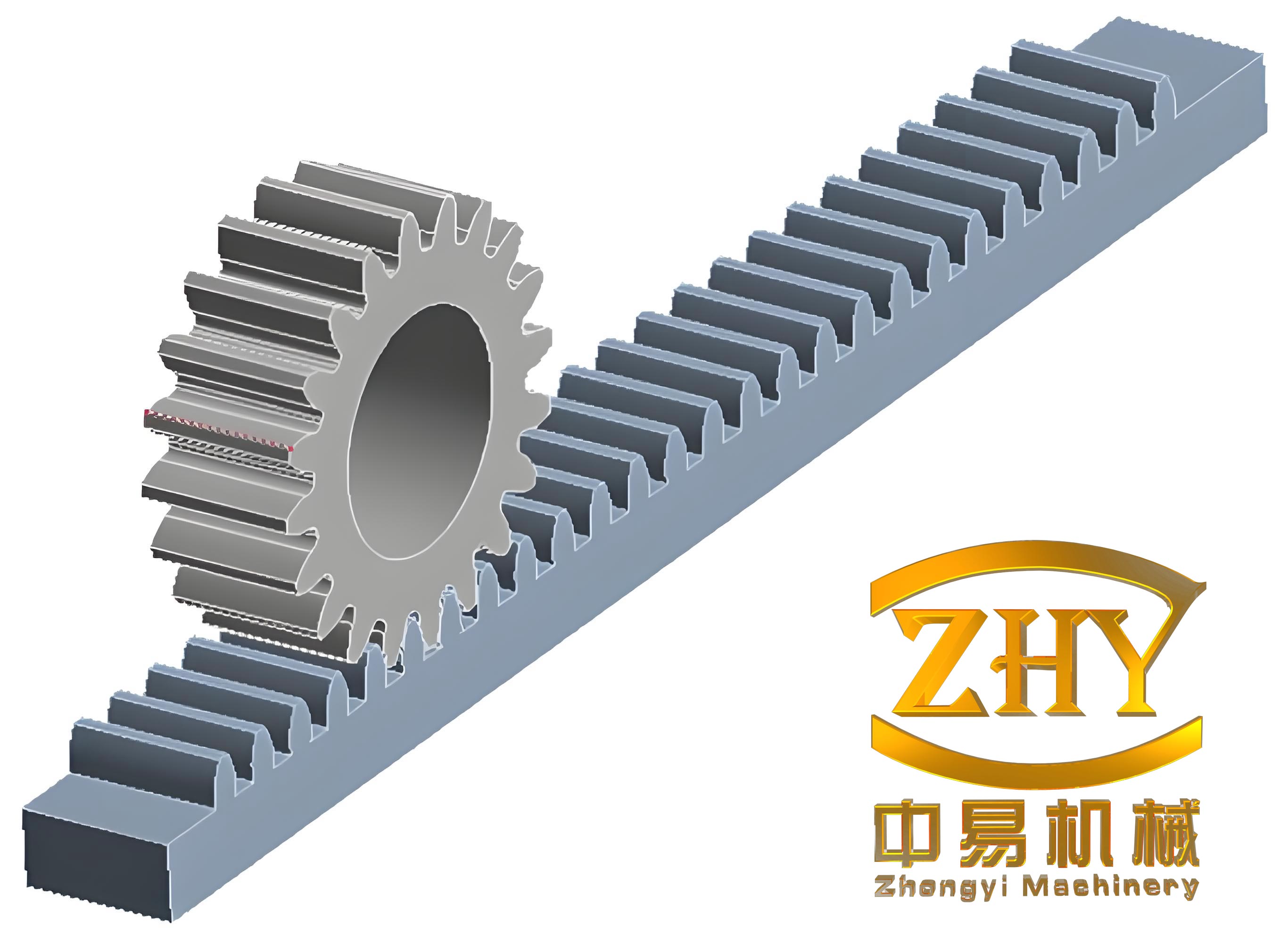
The rack and pinion gear system consists of a pinion gear that engages with two racks: an upper rack and a lower rack. The pinion is driven by an external force, and its rotation translates into linear motion of the upper rack. The dynamic behavior of the system is governed by the interactions between the mechanical components and the lubricating grease. We consider multiple degrees of freedom, including the translational and rotational motions of the pinion and the translational motion of the upper rack. The equations of motion are derived based on a lumped parameter model, accounting for the time-varying mesh stiffness and the friction forces at the engagement points.
The motion equations for the rack and pinion system are expressed as follows. For the upper rack:
$$m_r \ddot{x}_r = \sum_{j=1}^{N_U} \left( F’_{g2,j} \cos \alpha – F’_{f2,j} \sin \alpha \right),$$
for the pinion gear in translation:
$$m_p \ddot{x}_p = F_T + \sum_{j=1}^{N_L} \left( -F_{g1,j} \cos \alpha – F_{f1,j} \sin \alpha \right) + \sum_{j=1}^{N_U} \left( -F_{g2,j} \cos \alpha + F_{f2,j} \sin \alpha \right),$$
and for the pinion gear in rotation:
$$I_p \ddot{\theta}_p = \sum_{j=1}^{N_U} \left( F_{g2,j} r_b – F_{f2,j} \xi_{2,j} \right) – \sum_{j=1}^{N_L} \left( F_{g1,j} r_b + F_{f1,j} \xi_{1,j} \right).$$
Here, $m_r$ and $m_p$ are the masses of the upper rack and pinion, respectively; $I_p$ is the moment of inertia of the pinion; $x_r$, $x_p$, and $\theta_p$ are the displacements and rotation angle; $F_{g}$ and $F_{f}$ represent the normal mesh force and friction force; $N_U$ and $N_L$ denote the number of engaging tooth pairs on the upper and lower sides; $\alpha$ is the pressure angle; $r_b$ is the base radius; and $\xi$ is the distance from the mesh point to the base circle tangent point. The dynamic transmission error $\delta$ is defined as $\delta = (x_p – x_r) \cos \alpha + r_b \theta_p$ for the upper rack and pinion engagement.
The mesh stiffness in a rack and pinion gear system is a critical parameter that influences the dynamic response. Traditional models often consider only the structural stiffness, but in lubricated conditions, the grease film contributes to the overall stiffness. We propose a coupled structure-grease film mesh stiffness model that incorporates both the structural flexibility and the TEHL stiffness. The total mesh stiffness $K^S$ for a tooth pair is given by:
$$\frac{1}{K^S_i} = \frac{1}{K^B_i} + \frac{1}{K^C_i},$$
where $K^B_i$ is the structural stiffness without coupling effects, and $K^C_i$ is the coupling stiffness due to adjacent teeth. The structural stiffness components include bending, shear, axial compression, and foundation stiffnesses. For example, the bending stiffness $k_t$ is calculated as:
$$\frac{1}{k_t} = \frac{1}{k_b} + \frac{1}{k_s} + \frac{1}{k_a},$$
with $k_b$, $k_s$, and $k_a$ representing the bending, shear, and axial stiffnesses, respectively. The foundation stiffness for the pinion and rack are expressed as:
$$\frac{1}{k^p_{f,i}} = \frac{\cos^2 \alpha_i}{E b} \left( L^p_1 \left( \frac{u_i}{s_f} \right)^2 + M^p_1 \left( \frac{u_i}{s_f} \right) + P^p_1 \left( 1 + Q^p_1 \tan^2 \alpha_1 \right) \right),$$
and
$$\frac{1}{k^r_{f,i}} = \frac{\cos^2 \alpha_i}{E b} \left( L^r_1 \left( \frac{u_i}{a} \right)^2 + M^r_1 \left( \frac{u_i}{a} \right) + L^{Hr}_1 \left( \frac{u_i^2}{a H_0} \right) + M^{Hr}_1 \left( \frac{u_i}{H_0} \right) + P^r_1 \tan^2 \alpha_i + Q^r_1 \right).$$
The coefficients $L$, $M$, $P$, $Q$, etc., are constants dependent on the geometry of the rack and pinion gear. The coupling stiffness between tooth pairs is considered to account for the interaction during double-tooth engagement.
The grease lubrication in the rack and pinion system is modeled using the transient TEHL theory. The Reynolds equation for the power-law grease is derived as:
$$\frac{\partial \rho G_R}{\partial x} – v_m \frac{\partial}{\partial x} (\rho h) – \frac{\partial}{\partial t} (\rho h) = 0,$$
with
$$G_R = 0.5 \frac{n+1}{n} \frac{n}{2n+1} h^{\frac{2n+1}{n}} \left( \frac{1}{\phi} \frac{\partial p}{\partial x} \right)^{\frac{1}{n}},$$
where $\rho$ is the density, $p$ is the pressure, $\phi$ is the plastic viscosity, $n$ is the plasticity index, $v_m$ is the entrainment velocity, and $h$ is the film thickness. The entrainment velocity for the upper rack and pinion engagement is given by:
$$v_m = \frac{\dot{\theta}_p \xi_{1,i} + \dot{x}_p \sin \alpha}{2},$$
and for the lower rack and pinion engagement by:
$$v_m = \frac{\dot{\theta}_p \xi_{2,i} + (\dot{x}_r – \dot{x}_p) \sin \alpha}{2}.$$
The film thickness equation includes the rigid center film thickness $h_o$, the geometric gap, and the elastic deformation $v$:
$$h(x,t) = h_o(t) + \frac{x^2}{2 R_x(t)} + v(x,t),$$
where $R_x(t)$ is the equivalent radius of curvature, and $v(x,t)$ is computed as:
$$v(x,t) = -\frac{2}{\pi E’} \int_{x_{in}}^{x_{out}} p(s,t) \ln (s-x)^2 ds.$$
The density and viscosity of the grease are pressure- and temperature-dependent, expressed as:
$$\rho = \rho_0 \left( 1 + \frac{0.6 \times 10^{-9} p}{1 + 1.7 \times 10^{-9} p} – \rho_T (T – T_0) \right),$$
and
$$\phi = \phi_0 \exp \left( \left( \ln \phi_0 + 9.67 \right) \left( \left( 1 + 5.1 \times 10^{-9} p \right)^{z_0} \left( \frac{T – 138}{T_0 – 138} \right)^{s_0} – 1 \right) \right).$$
The energy equation for the grease film is:
$$\rho c_R \left( \frac{\partial T}{\partial t} + u \frac{\partial T}{\partial x} + w \frac{\partial T}{\partial z} \right) = k_R \frac{\partial^2 T}{\partial z^2} – \frac{T}{\rho} \frac{\partial \rho}{\partial T} \left( \frac{\partial p}{\partial t} + u \frac{\partial p}{\partial x} \right) + \phi \left( \frac{\partial u}{\partial z} \right)^{1 + \frac{1}{n}},$$
with boundary conditions for the gear and rack surfaces:
$$T_g = \frac{k_R}{\sqrt{\pi \rho_g c_g k_g u_g}} \int_{-\infty}^{x} \frac{\partial T}{\partial z} \Big|_{z=h} \frac{ds}{\sqrt{x-s}} + T_0,$$
and
$$T_r = \frac{k_R}{\sqrt{\pi \rho_r c_r k_r u_r}} \int_{-\infty}^{x} \frac{\partial T}{\partial z} \Big|_{z=0} \frac{ds}{\sqrt{x-s}} + T_0.$$
The velocity components $u$ and $w$ are derived from the flow continuity. The friction force in the rack and pinion system consists of boundary friction and viscous friction:
$$F_f = f_{asp} + f_v,$$
where
$$f_v = \int_{x_{in}}^{x_{out}} \phi \left( \frac{\partial u}{\partial z} \right)^n \Big|_{z=0/h} dx,$$
and
$$f_{asp} = k_{asp} \iint_{A_c} p_{asp} dA_c.$$
The asperity contact pressure $p_{asp}$ is given by:
$$p_{asp} = \frac{8 \sqrt{2 \pi}}{15} (\eta \gamma \sigma)^2 E’ F_{2.5}(H_\sigma),$$
with $H_\sigma = \bar{h} / \sigma$, and $F_{2.5}(H_\sigma)$ defined as:
$$F_{2.5}(H_\sigma) = \begin{cases} A (4 – H_\sigma)^Z, & H_\sigma \leq 4, \\ 0, & H_\sigma > 4. \end{cases}$$
The numerical solution of the coupled dynamics and lubrication model involves an iterative process. We use the Runge-Kutta-Fehlberg method to solve the equations of motion, and a multi-grid method with DC-FFT for the pressure and temperature fields. The convergence criteria for pressure, temperature, and error balance are set to $1 \times 10^{-4}$, $1 \times 10^{-3}$, and $1 \times 10^{-4}$, respectively.
The structural parameters of the rack and pinion gear system are listed in the following table:
| Parameter | Value |
|---|---|
| Pinion mass, $m_p$ (kg) | 4.91 |
| Pinion moment of inertia, $I_p$ (kg·m²) | 4.2 × 10⁻⁴ |
| Upper rack mass, $m_r$ (kg) | 12.91 |
| Module, $m$ (mm) | 3 |
| Number of teeth, $z$ | 20 |
| Face width, $b$ (mm) | 20 |
| Elastic modulus, $E$ (GPa) | 207 |
| Poisson’s ratio, $\mu$ | 0.3 |
| Backlash, $2\bar{D}$ (mm) | 0.10 |
The rheological parameters of the grease and thermodynamic properties are summarized below:
| Material | Specific Heat, $c$ (J·kg⁻¹·K⁻¹) | Thermal Conductivity, $k$ (W·m⁻¹·K⁻¹) | Density, $\rho$ (kg·m⁻³) | Thermal Expansion, $\rho_T$ (m·K⁻¹) | Plastic Viscosity, $\phi_0$ (Pa·sⁿ) | Plasticity Index, $n$ |
|---|---|---|---|---|---|---|
| Pinion | 470 | 46 | 7850 | – | – | – |
| Rack | 470 | 46 | 7850 | – | – | – |
| Grease | 1646 | 0.14 | 880 | 0.00065 | 8.634 | 0.754 |
In the dynamic analysis of the rack and pinion system, we examine the motion characteristics, mesh stiffness, grease film behavior, and friction. The displacement and velocity of the upper rack show fluctuations due to the nonlinear dynamics of the system. For instance, during the acceleration phase, the velocity oscillates with an amplitude of up to 0.5 m/s, while in the deceleration phase, the oscillations become more pronounced due to transitions between tooth flank and backside contact.
The total mesh stiffness in the rack and pinion gear engagement is lower than the structural stiffness when grease lubrication is considered. The reduction in stiffness is more significant at lower normal forces. For example, in the second tooth engagement cycle, the stiffness decreases by up to 30% compared to the structural stiffness, with high-frequency fluctuations amplitude of $1.1 \times 10^8$ N/m. The center film thickness and center pressure also exhibit dynamic variations. As the equivalent radius of curvature increases from 1.48 mm to 17.16 mm, the center film thickness rises from 29 nm to 334 nm, while the center pressure drops from 0.948 GPa to 0.509 GPa.
The worst lubrication conditions in the rack and pinion system occur near the base circle of the pinion tooth, where the film thickness is minimal, and the temperature and pressure are highest. For instance, at point A in the second tooth engagement, the maximum pressure reaches 1.285 GPa, the minimum film thickness is 29 nm, and the temperature rise is 64.8 K. In the eighth tooth engagement, which includes transitions between flank and backside contact, the center pressure fluctuates up to 2.299 GPa, and the film thickness varies between 162 nm and 334 nm.
The friction coefficient in the rack and pinion gear system varies with the operational conditions. During high-speed periods, the friction coefficient is below 0.08, but it increases during start-up and shutdown. Near the pitch point, where the sliding velocity approaches zero, the friction coefficient drops significantly. The overall friction coefficient shows high-frequency oscillations, with amplitudes up to 0.14 in some cases.
We validate our coupled model by comparing it with finite element analysis (FEM) results. The mesh stiffness from our model agrees well with FEM, with errors less than 3.5% in transition regions and below 2% in other areas. The FEM results confirm that the grease film reduces the mesh stiffness and that the stiffness decreases with lower engagement forces.
In conclusion, the dynamic characteristics of the rack and pinion mechanism are significantly influenced by grease lubrication. The coupled structure-grease film model provides a more accurate representation of the system behavior, highlighting the importance of considering TEHL effects in design and analysis. The rack and pinion gear system exhibits complex dynamics, including stiffness variations, film thickness fluctuations, and friction changes, which must be accounted for to optimize performance and durability. Future work could focus on wear prediction and the effects of different grease formulations on the rack and pinion system’s behavior.