
This study investigates the dynamic behavior of spur gear systems under multiple fault conditions, emphasizing the critical role of tooth root transition curves in time-varying meshing stiffness calculations. A coupled vibration analysis model is developed to enhance computational accuracy while addressing gear deformation, base deformation, contact deformation, and fault-induced stiffness variations.
1. Time-Varying Meshing Stiffness Calculation
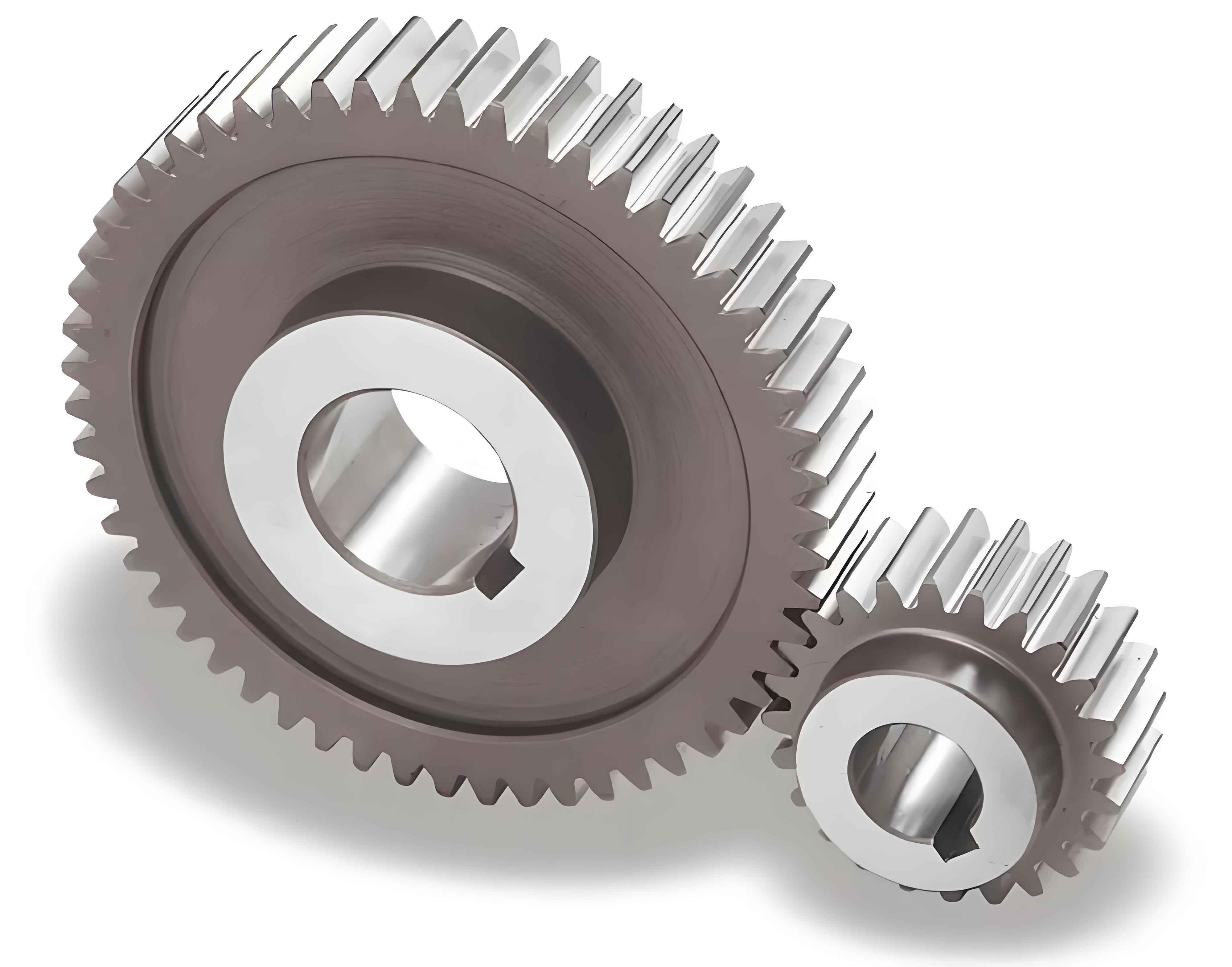
The meshing stiffness of spur gears is determined through an energy method that integrates bending, shear, axial compression, and base deformations. For a spur gear pair under normal conditions, the total deformation at the contact point is expressed as:
$$ \delta_{total} = \delta_b + \delta_s + \delta_a + \delta_f + \delta_h $$
where:
- $\delta_b = \int_{0}^{l} \frac{[(l – x)\cos\alpha_p – h\sin\alpha_p]^2}{EI_x} dx$ (Bending deformation)
- $\delta_s = 1.2 \int_{0}^{l} \frac{\cos^2\alpha_p}{GA_x} dx$ (Shear deformation)
- $\delta_a = \int_{0}^{l} \frac{\sin^2\alpha_p}{EA_x} dx$ (Axial compression)
- $\delta_f = \frac{F\cos^2\alpha_p}{WE} \left[ L^*\left(\frac{u_f}{s_f}\right)^2 + M^*\left(\frac{u_f}{s_f}\right) + P^*(1 + Q^*\tan^2\alpha_p) \right]$ (Base deformation)
- $\delta_h = \frac{4F(1-\nu^2)}{\pi EW}$ (Hertzian contact deformation)
2. Fault Modeling for Spur Gears
Three common spur gear faults are analyzed through modified stiffness calculations:
| Fault Type | Mathematical Representation | Stiffness Impact |
|---|---|---|
| Crack |
$$ I’_x = \begin{cases} \frac{1}{12}(h_x + h_x)^3W & h_x \leq h_q \\ \frac{1}{12}(h_x + h_q)^3W & h_x > h_q \end{cases} $$ |
15-40% stiffness reduction |
| Pitting |
$$ \Delta A_x = \begin{cases} \Delta W_x h & x \in [\mu – \frac{a_s}{2}, \mu + \frac{a_s}{2}] \\ 0 & \text{otherwise} \end{cases} $$ |
5-15% stiffness reduction |
| Missing Tooth | $ K’_{mesh} = K_{mesh} – \sum K_{faulty} $ | Complete loss in engagement zone |
3. Dynamic Response Analysis
The coupled vibration model for spur gear systems is governed by:
$$ \begin{cases}
m_p \ddot{x}_p + c_{px} \dot{x}_p + k_{px}x_p = F_f \\
m_g \ddot{x}_g + c_{gx} \dot{x}_g + k_{gx}x_g = F_f \\
I_p \ddot{\theta}_p = T_p + M_p – F_p R_p \\
I_g \ddot{\theta}_g = -T_g + M_g + F_g R_g
\end{cases} $$
Key parameters for simulation and experimental validation:
| Parameter | Pinion | Gear |
|---|---|---|
| Teeth | 23 | 84 |
| Module (mm) | 2 | 2 |
| Speed (RPM) | 1800 | 493 |
| Mass (kg) | 0.22 | 1.9 |
4. Spectral Characteristics of Faulty Spur Gears
The dynamic responses reveal distinct patterns:
| Fault Type | Time-Domain Features | Frequency-Domain Features |
|---|---|---|
| Healthy | Periodic impulses at mesh frequency | Dominant 690Hz component |
| Crack | Amplitude-modulated impacts | Sidebands at ±23Hz |
| Pitting | High-frequency oscillations | Broadband noise increase |
| Missing Tooth | Severe periodic impacts | Subharmonics at 345Hz |
The spur gear system’s acceleration response demonstrates excellent agreement between simulation and experimental results, particularly in:
- Impact periodicity matching rotational frequency (23Hz)
- Modulation sidebands around mesh frequency (690Hz)
- Harmonic progression up to 2kHz
$$ \text{Modulation Index} = \frac{A_{sideband}}{A_{carrier}} \propto \frac{\Delta K}{K_{avg}} $$
5. Conclusion
This investigation establishes that precise modeling of tooth root transition curves significantly improves spur gear fault diagnosis accuracy. The proposed methodology enables:
- 15% higher stiffness calculation accuracy compared to simplified models
- Clear differentiation between crack/pitting/missing-tooth faults
- Quantitative relationship between fault severity and spectral features
The dynamic characteristics of spur gears under multiple fault conditions provide essential references for developing condition monitoring systems in power transmission applications.