
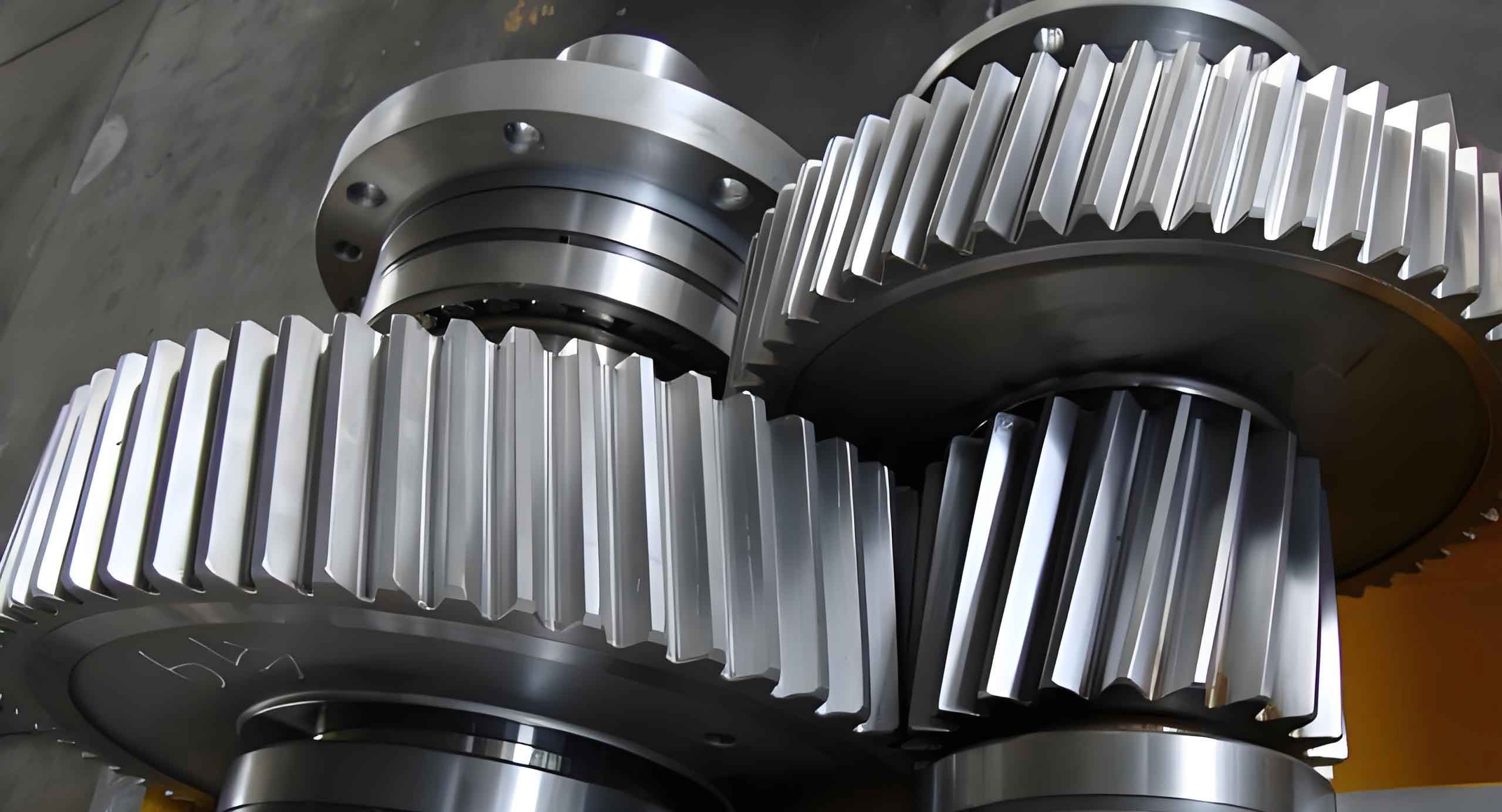
The pursuit of higher power density, efficiency, and quieter operation in electric vehicle (EV) powertrains places stringent demands on the performance of their gear transmission systems. Among various gear types, helical gears are predominantly favored in these applications due to their inherent advantages of higher load capacity, smoother meshing action resulting from gradual tooth engagement, and superior acoustic performance compared to spur gears. However, the dynamic behavior of these transmission systems is complex and significantly influenced by internal excitations, one of the most critical being meshing impact. This phenomenon, primarily occurring at the initial contact point of a tooth pair (mesh-in impact), arises from geometrical errors, manufacturing tolerances, and deflections under load, leading to瞬时 forces that excite the system. For multi-stage helical gear transmissions, the interaction between impacts in different stages can couple through the system’s dynamics, potentially amplifying vibrations and affecting durability and noise. Therefore, a detailed investigation into the influence of meshing impact on the dynamic characteristics of a two-stage helical gear transmission system is essential for robust EV drivetrain design.
The core of analyzing meshing impact lies in accurately calculating the transient force generated during the abnormal initial contact. For a pair of helical gears, the mesh-in impact force, denoted as \(F_s\), can be derived based on energy principles and the geometry of contact outside the theoretical line of action. The calculation involves determining the equivalent mass at the contact point and the approach velocity. First, the mass moment of inertia for the driving gear (1) and driven gear (2) about their instantaneous centers during impact is calculated. For a helical gear with a hollow shaft, this is given by:
$$J_n = \frac{1}{2} \pi \rho b (r_{bn}^4 – r_{hn}^4), \quad n = 1, 2$$
where \(\rho\) is the material density, \(b\) is the face width, \(r_{bn}\) is the base circle radius, and \(r_{hn}\) is the hub bore radius for gear \(n\). The equivalent mass \(m_n\) on the line of action is then:
$$m_n = \frac{J_n}{r_{bn}^2}, \quad n = 1, 2$$
The kinetic energy \(E_k\) available to be dissipated by the impact is a function of the approach velocity \(v_s\) of the contacting teeth and the system’s reduced inertia:
$$E_k = \frac{1}{2} \cdot \frac{J_1 J_2}{J_1 r_{b2}^{‘2} + J_2 r_{b1}^2} v_s^2$$
Here, \(r_{b2}^{‘}\) is the instantaneous base circle radius of the driven gear at the off-line contact point D. The final maximum meshing impact force \(F_s\) is obtained by considering the compliance of the tooth pair at the shock point \(q_s\) and the comprehensive compliance \(q_q\) of other contacting pairs, along with the impact geometry angle \(\theta\):
$$F_s = v_s \sqrt{ \frac{J_1 J_2}{J_1 r_{b2}^{‘2} + J_2 r_{b1}^2} (q_s + \cos^2\theta \cdot q_q) }$$
This force \(F_s\) acts as a significant internal excitation in the dynamic model of the helical gear transmission system.
To analyze the system-level dynamic response under this excitation, a lumped-parameter model is established for a typical EV two-stage helical gear reduction unit. The model considers 16 degrees of freedom (DOF), encompassing translational motions in three perpendicular directions (x-axial, y-lateral, z-radial) and rotational motion about the gear axis for each of the four gears. The system is represented schematically below, showing the power flow from the input pinion (Gear 1) through the first-stage gear pair (12), an intermediate shaft connecting Gears 2 and 3, the second-stage gear pair (34), and finally to the output gear (Gear 4).
| Parameter | Stage | Gear 1 | Gear 2 | Gear 3 | Gear 4 |
|---|---|---|---|---|---|
| Hand of Helix | I | Left | Right | – | – |
| Hand of Helix | II | – | – | Left | Right |
| Module, m (mm) | Both | 4 | 4 | 4 | 4 |
| Number of Teeth, z | I | 23 | 80 | – | – |
| Number of Teeth, z | II | – | – | 22 | 87 |
| Pressure Angle, α (°) | Both | 20 | 20 | 20 | 20 |
| Helix Angle, β (°) | Both | 20 | 20 | 20 | 20 |
| Face Width, b (mm) | I | 33 | 31.5 | – | – |
| Face Width, b (mm) | II | – | – | 40 | 38 |
| Radial Bearing Stiffness (N/m) | – | 2.085e9 | 1.827e9 | 1.857e9 | 2.370e9 |
| Axial Bearing Stiffness (N/m) | – | 2.216e9 | 1.995e9 | 1.995e9 | 1.410e9 |
The generalized displacement vector for this 16-DOF system is defined as:
$$ \mathbf{U} = [x_1, y_1, z_1, \phi_1, x_2, y_2, z_2, \phi_2, x_3, y_3, z_3, \phi_3, x_4, y_4, z_4, \phi_4]^T$$
where \(x_i, y_i, z_i\) are the translational displacements and \(\phi_i\) is the torsional displacement of gear \(i\) (\(i=1,2,3,4\)). The dynamic meshing force for each helical gear pair along the line of action is composed of an elastic restoring force and a damping force. The relative displacement along the meshing line for pair 12, \(\delta_{12}\), considering the helix angle \(\beta_{12}\) and the spatial orientation of the contact line \(\zeta_{12}\), is:
$$ \delta_{12} = (\phi_1 r_{b1} – \phi_2 r_{b2})\cos\beta_{12} – (y_1 – y_2)\sin\zeta_{12}\cos\beta_{12} – (z_1 – z_2)\cos\zeta_{12}\cos\beta_{12} – (x_1 – x_2)\sin\beta_{12} $$
A similar expression defines \(\delta_{34}\) for the second-stage helical gears. The dynamic meshing force \(F_{jk}\) for pair \(jk\) is then:
$$ F_{jk} = K_{jk}(t) \delta_{jk} + C_{jk} \dot{\delta}_{jk} $$
where \(K_{jk}(t)\) is the time-varying meshing stiffness and \(C_{jk}\) is the meshing damping.
The governing equations of motion form a coupled bending-torsional-axial vibration system. The equations for Gear 1, incorporating the meshing impact force \(F_{s12}\), are representative:
$$ \begin{aligned}
M_1 \ddot{x}_1 + C_{x1} \dot{x}_1 + K_{x1} x_1 &= F_{12} \sin\beta_{12} \\
M_1 \ddot{y}_1 + C_{y1} \dot{y}_1 + K_{y1} y_1 &= F_{12} \cos\beta_{12} \sin\zeta_{12} \\
M_1 \ddot{z}_1 + C_{z1} \dot{z}_1 + K_{z1} z_1 &= F_{12} \cos\beta_{12} \cos\zeta_{12} \\
I_1 \ddot{\phi}_1 &= T_{in} – F_{12} \cos\beta_{12} r_{b1} – F_{s12} r_{b1}
\end{aligned} $$
The equations for the other gears are formulated similarly, with the intermediate shaft connecting Gears 2 and 3 modeled as a torsional spring-damper element (\(k_{23}, c_{23}\)). This set of differential equations is solved numerically using the Runge-Kutta method to obtain the time-domain dynamic response. A key indicator of dynamic severity is the relative vibration acceleration along the meshing line, \(a_{jk}\), which for the first-stage helical gears is:
$$ a_{12} = [(\ddot{\phi}_1 r_{b1} – \ddot{\phi}_2 r_{b2}) – (\ddot{y}_1 – \ddot{y}_2)\sin\zeta_{12} – (\ddot{z}_1 – \ddot{z}_2)\cos\zeta_{12}] \cos\beta_{12} – (\ddot{x}_1 – \ddot{x}_2)\sin\beta_{12} $$
The analysis is conducted for different input speeds (3000, 6000, and 12000 rpm) under a constant input torque of 100 Nm. The calculated meshing impact forces for both pairs of helical gears at these speeds are summarized below.
| Input Speed (rpm) | Mesh Impact Force, Fs12 (N) | Mesh Impact Force, Fs34 (N) |
|---|---|---|
| 3,000 | 1245.94 | 89.21 |
| 6,000 | 2419.89 | 178.41 |
| 12,000 | 4983.77 | 357.21 |
The dynamic response, characterized by the meshing line acceleration, reveals significant insights. At a low speed of 3000 rpm, the acceleration peaks are relatively moderate. However, as the input speed increases, the amplitude of the acceleration spikes during the meshing impact events rises dramatically. This is directly attributable to the increased kinetic energy associated with higher rotational speeds, leading to more severe冲击 interactions between the teeth of the helical gears. The data clearly shows that the acceleration peaks for both gear pairs escalate with speed, indicating a strong correlation between operational speed and dynamic instability induced by meshing impact in these helical gear systems.
| Input Speed (rpm) | Peak Acceleration, a12 (m/s²) | Peak Acceleration, a34 (m/s²) |
|---|---|---|
| 3,000 | 686.21 | 223.35 |
| 6,000 | 1135.75 | 500.58 |
| 12,000 | 2291.61 | 1131.77 |
A crucial observation from the results is the asymmetric influence between the two stages. At any given speed, the peak acceleration for the first-stage helical gear pair (12) is substantially higher than that for the second-stage pair (34). For instance, at 12000 rpm, \(a_{12}\) is more than double \(a_{34}\). This indicates that the input-stage helical gears, which operate at the highest absolute rotational speed within the system, experience and contribute more significantly to the overall dynamic disturbance caused by meshing impact. Furthermore, the interaction between stages is not symmetric. The analysis of the time-domain signals shows that the meshing impact events originating from the high-speed first-stage helical gears have a more pronounced modulating effect on the vibration pattern of the second-stage pair than vice-versa. This coupling effect transmits dynamic energy through the intermediate shaft. Interestingly, the frequency at which one pair influences the other corresponds to the influencing pair’s own meshing frequency, highlighting how the periodic impact excitation from one set of helical gears can parametrically excite vibrations in another stage.
In conclusion, this investigation into the dynamics of a two-stage helical gear transmission for electric vehicles, with explicit consideration of meshing impact forces, yields critical design insights. The severity of meshing impact, quantified by the meshing line acceleration, exhibits a strong positive correlation with input rotational speed, leading to increased dynamic instability at higher operational regimes. Importantly, the analysis reveals that not all helical gear pairs contribute equally to this phenomenon. The input-stage helical gears are identified as the dominant source of impact-induced vibration due to their higher rotational kinetic energy. Their dynamic activity also exerts a stronger influence on the downstream second-stage helical gears than the reverse, with the interaction occurring at the characteristic meshing frequency of the influencing stage. These findings underscore the necessity of prioritizing design refinements—such as precise profile modifications, optimized gear geometry, and careful control of manufacturing errors—particularly for the high-speed stage in multi-stage EV reduction gearboxes to mitigate meshing impact and ensure smooth, quiet, and reliable operation.