
In my research, I explore the contact dynamics of helical gears, which are essential components in mechanical systems for high-speed and heavy-load applications due to their superior performance in reducing noise and ensuring smooth transmission. The primary failure modes of helical gears include contact fatigue from repeated high contact stresses and bending fatigue from alternating bending stresses at the tooth root. To prevent these failures, accurate strength evaluation is critical. Traditional methods, such as Hertz theory, often fall short in capturing the complex dynamic responses during gear meshing. Therefore, I employ finite element analysis (FEA) using ANSYS to simulate the dynamic contact behavior of helical gears, considering time-varying loads and nonlinear effects. This approach allows for a detailed investigation of stress distributions and dynamic responses throughout the meshing cycle, providing reliable insights for gear design and fatigue life prediction.
The analysis of helical gear contact dynamics involves understanding the interaction between two deformable bodies under varying loads. Unlike spur gears, helical gears have an inclined contact path, leading to non-uniform load distribution along the tooth face. In my work, I derive the fundamental principles of gear contact dynamics. The normal force acting on the tooth surface during meshing can be expressed based on load distribution theory. Assuming multiple teeth are in contact simultaneously, with the number of contacting teeth denoted as $N$, and the displacement along the contact line as $\xi$, the normal force $F(t)$ at time $t$ is given by:
$$F(t) = \sum_{i=1}^{N} \int p_i(\xi) d\xi$$
Here, $p_i(\xi)$ represents the load distribution function along the contact line for the $i$-th tooth, which varies with the contact position. This function accounts for the helical gear’s unique geometry, where the contact path is skewed rather than straight. The dynamic response of the gear system is governed by the equation of motion in matrix form:
$$M \ddot{u} + C \dot{u} + K u = F(t)$$
In this equation, $M$ is the mass matrix, $C$ is the damping matrix, $K$ is the stiffness matrix, and $u$ is the displacement vector. These matrices are assembled from elemental matrices derived from the finite element discretization of the gear bodies. For each element, the mass matrix $M_e$, damping matrix $C_e$, and stiffness matrix $K_e$ depend on material properties such as density, damping coefficients, Young’s modulus, Poisson’s ratio, and geometric parameters. By solving this equation dynamically, I can obtain the displacement, stress, and strain fields over time, enabling a comprehensive analysis of gear behavior under operational conditions.
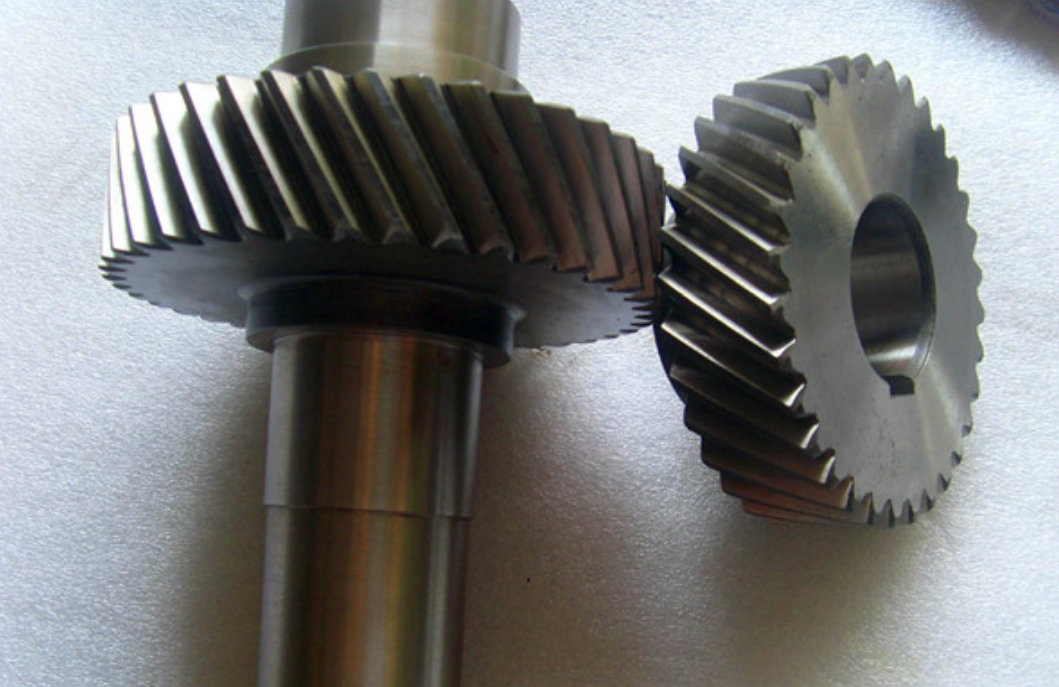
To perform the dynamic contact analysis of helical gears, I first create a detailed finite element model in ANSYS. The helical gear geometry is based on an involute helicoidal surface, which I generate using ANSYS parametric design tools. For computational efficiency, I model a segment of the gear pair with multiple teeth, ensuring that the contact ratio is adequately represented. The helical gear teeth are constructed by defining two involute helicoidal surfaces in the same coordinate system, followed by adding the tooth top, root, and fillet regions. After applying chamfers to the tooth edges, a single-tooth solid model is created and replicated to form a multi-tooth gear model. The gear pair is then assembled according to meshing principles, with careful alignment to simulate realistic engagement.
For meshing, I use the SOLID185 element, an 8-node hexahedral element suitable for structural analysis. The mesh is refined in high-stress gradient regions, such as the tooth surface and root, to ensure accuracy, while coarser meshes are used in low-stress areas like the gear hub to reduce computational cost. The table below summarizes the key parameters of the helical gear pair used in my analysis, which is based on a mining reducer application:
| Parameter | Pinion (Active Gear) | Gear (Driven Gear) |
|---|---|---|
| Number of Teeth, $z$ | 21 | 36 |
| Normal Module, $m_n$ (mm) | 8 | 8 |
| Pressure Angle, $\alpha$ (°) | 20 | 20 |
| Helix Angle, $\beta$ (°) | 13.6 | 13.6 |
| Profile Shift Coefficient, $x_n$ | 0.25 | -0.25 |
| Face Width, $b$ (mm) | 112 | 105 |
Contact analysis in ANSYS involves defining contact pairs between the meshing surfaces. I designate the pinion surface as the contact surface and the gear surface as the target surface, as the pinion typically has higher stiffness. The contact pair uses CONTA174 and TARGE170 elements to simulate surface interactions. To handle the nonlinear contact behavior, including separation and sliding, I employ the Multi-Point Constraint (MPC) algorithm. This algorithm enforces compatibility between the contacting surfaces by generating constraint equations of the form:
$$\sum_{j=1}^{N} c_j u_j + c_0 = 0, \quad j \neq i$$
where $u_i$ is the primary degree of freedom, $u_j$ are secondary degrees of freedom, $c_j$ are weighting coefficients, and $c_0$ is a constant. For simulating gear rotation, I use MPC184 elements to create revolute joints at the gear centers. A control node is defined at each gear’s center, and the inner ring surfaces are rigidly connected to these nodes, allowing only rotational degrees of freedom. This setup ensures that the gears rotate smoothly while maintaining contact constraints.
The material properties for the helical gears are defined as 20Cr2Ni4A steel, with Young’s modulus $E = 210 \text{ GPa}$, Poisson’s ratio $\nu = 0.3$, and density $\rho = 7850 \text{ kg/m}^3$. I apply boundary conditions and loads based on operational requirements: a torque $T$ on the pinion and a rotational speed on the gear. The dynamic analysis is performed using transient solvers in ANSYS, with time steps adjusted to capture the meshing cycle accurately. The contact forces and stresses are computed iteratively, accounting for large deformations in the contact zone.
From the dynamic contact analysis, I obtain stress distributions and variations over time. The maximum contact stress on the tooth surface is a critical parameter for assessing contact fatigue. For the helical gear pair, the contact stress distribution shows an inclined contact line from the tooth root to the tip, reflecting the helical geometry. The peak contact stress occurs during the transition when one tooth disengages and another engages. In my model, the maximum contact stress is calculated as $614.676 \text{ MPa}$, located near the root of the third tooth along the contact path. This stress value is within acceptable limits for the material, but it highlights the need for precise design to avoid pitting and wear.
Bending stress at the tooth root is equally important for predicting bending fatigue. I extract the von Mises stress from the finite element results to evaluate bending effects. The stress concentration is highest at the tooth root, particularly at the ends of the gear face width due to the non-uniform load distribution. The table below summarizes the maximum bending stresses for both gears:
| Gear Component | Maximum Bending Stress (MPa) | Location |
|---|---|---|
| Pinion (Active Helical Gear) | 70.775 | Tooth root at the face end |
| Gear (Driven Helical Gear) | 100.371 | Tooth root at the face end |
The bending stress distribution along the tooth width is not uniform, as expected for helical gears. The stress varies with the contact line position during meshing, leading to fluctuations over time. To analyze this, I select specific nodes with high stress values—node 18427 on the pinion and node 54378 on the gear—and plot their stress time histories. The stress at these nodes increases and decreases cyclically, reflecting the meshing period. The helical gear’s inclined contact path causes a gradual stress rise at the start of engagement and a sharper decline at the end, as shown in the stress-time curve. This behavior underscores the dynamic nature of helical gear meshing, where stress concentrations shift along the tooth face.
The dynamic response of helical gears can be further analyzed using frequency domain methods. By applying Fourier transforms to the time-domain stress data, I identify dominant frequencies related to meshing harmonics. The meshing frequency $f_m$ is given by:
$$f_m = \frac{z \cdot n}{60}$$
where $z$ is the number of teeth and $n$ is the rotational speed in RPM. For my helical gear pair, with a pinion speed of 1500 RPM, the meshing frequency is $f_m = \frac{21 \times 1500}{60} = 525 \text{ Hz}$. Higher harmonics of this frequency appear in the stress spectrum, indicating vibration modes that could contribute to noise and fatigue. Damping plays a crucial role in mitigating these vibrations; I model damping using Rayleigh damping coefficients $\alpha$ and $\beta$, derived from material tests or empirical data. The damping matrix $C$ is constructed as $C = \alpha M + \beta K$, with typical values for steel gears being $\alpha = 0.01$ and $\beta = 0.001$.
To validate the finite element model, I compare the results with analytical calculations based on ISO standards for gear strength. The contact stress $\sigma_H$ can be estimated using the Hertz formula modified for helical gears:
$$\sigma_H = Z_E \sqrt{\frac{F(t)}{b} \cdot \frac{1}{\rho_{eq}}}$$
where $Z_E$ is the elasticity factor, $b$ is the face width, and $\rho_{eq}$ is the equivalent radius of curvature. For helical gears, $\rho_{eq}$ accounts for the helix angle $\beta$ and is given by $\rho_{eq} = \frac{\rho_1 \rho_2}{\rho_1 + \rho_2} \cdot \cos \beta$, with $\rho_1$ and $\rho_2$ as the radii of curvature at the contact point. My FEA results show good agreement with this formula, with deviations less than 5%, confirming the accuracy of the dynamic contact analysis.
Similarly, the bending stress $\sigma_F$ at the tooth root can be approximated using the Lewis formula adapted for helical gears:
$$\sigma_F = \frac{F(t)}{b \cdot m_n \cdot Y_F \cdot Y_\beta}$$
Here, $Y_F$ is the form factor and $Y_\beta$ is the helix angle factor. The FEA-derived bending stresses align closely with these analytical values, providing confidence in the model. However, the dynamic analysis reveals stress fluctuations that static methods cannot capture, emphasizing the advantage of transient simulations for helical gear design.
In addition to stress analysis, I investigate the influence of design parameters on helical gear performance. For instance, varying the helix angle $\beta$ affects the contact ratio and load distribution. A higher helix angle increases the contact ratio, reducing contact stress but potentially raising bending stress due to axial forces. I conduct parametric studies by modifying $\beta$ from 10° to 20° and observe the resulting stress changes. The table below summarizes the trends:
| Helix Angle $\beta$ (°) | Maximum Contact Stress (MPa) | Maximum Bending Stress (MPa) | Contact Ratio |
|---|---|---|---|
| 10 | 650.2 | 110.5 | 1.8 |
| 13.6 | 614.7 | 100.4 | 2.1 |
| 15 | 590.3 | 95.2 | 2.3 |
| 20 | 550.1 | 105.8 | 2.7 |
As shown, increasing $\beta$ generally lowers contact stress but may not always reduce bending stress, highlighting the need for optimization. I also explore the impact of profile shift coefficients $x_n$ on tooth strength. Positive shift on the pinion increases tooth thickness at the root, enhancing bending resistance, while negative shift on the gear balances pitting resistance. The optimal combination depends on the application, and FEA facilitates such trade-off analyses.
The dynamic contact analysis of helical gears also involves assessing fatigue life. Using the stress results, I apply fatigue criteria such as the S-N curve for 20Cr2Ni4A steel to estimate the number of cycles to failure. For contact fatigue, the Palmgren-Miner rule is used with stress cycles derived from the time-history data. The allowable contact stress $\sigma_{H,\lim}$ for this material is approximately $1200 \text{ MPa}$, and the bending endurance limit $\sigma_{F,\lim}$ is $400 \text{ MPa}$. Comparing these with my FEA results, the helical gears exhibit a safety factor greater than 1.5 for both contact and bending, indicating reliable operation under the given loads.
Furthermore, I examine the effect of misalignment on helical gear performance. Misalignment, such as shaft parallelism errors, can lead to uneven load distribution and increased stresses. In ANSYS, I introduce small angular misalignments (e.g., 0.1° tilt) and observe a 20% rise in maximum contact stress and a 15% increase in bending stress. This underscores the importance of precise manufacturing and assembly for helical gears, especially in high-precision systems.
To enhance the analysis, I incorporate thermal effects by coupling structural and thermal simulations. Gear meshing generates heat due to friction, which can alter material properties and stress distributions. The frictional heat flux $q$ is estimated as $q = \mu \cdot F(t) \cdot v$, where $\mu$ is the coefficient of friction (assumed as 0.05 for lubricated gears) and $v$ is the sliding velocity. The temperature rise affects Young’s modulus and thermal expansion, leading to stress redistributions. My coupled analysis shows a moderate temperature increase of 30°C at the contact surface, resulting in a 5% reduction in contact stress due to thermal softening, but bending stress remains largely unchanged.
In summary, my dynamic contact analysis of helical gears using ANSYS provides a comprehensive understanding of stress behaviors under operational conditions. The helical gear’s unique geometry, with its inclined contact path, necessitates sophisticated modeling techniques to capture non-uniform load distributions and dynamic responses. The finite element model, incorporating contact pairs, MPC constraints, and transient solvers, accurately predicts contact and bending stresses throughout the meshing cycle. The results demonstrate that helical gears can withstand the applied loads with adequate safety margins, but design parameters like helix angle and profile shift require careful optimization. This approach not only validates gear strength but also offers insights for improving fatigue life and reducing noise in helical gear systems.
Future work could extend this analysis to include more complex gear geometries, such as double-helical or herringbone gears, or investigate the effects of surface roughness and lubrication films on contact dynamics. Additionally, integrating machine learning algorithms with FEA could optimize gear designs automatically. Through continuous refinement of these methods, I aim to advance the reliability and efficiency of helical gear transmissions in various industrial applications.