
In mechanical transmission systems, the worm gear drive stands out due to its compact structure, high load-bearing capacity, and smooth operation, making it indispensable in automotive, lifting, and transportation industries. The performance and longevity of these systems are critically influenced by the fatigue wear and contact characteristics of the worm gear pair. As such, a thorough investigation into the dynamic contact behavior of involute worm gear drives is essential. While static finite element methods have been widely employed to study contact stresses in gear pairs, they are limited to fixed positions and cannot capture the transient stress variations during actual operation. Therefore, dynamic analysis becomes imperative to understand the continuous strength fluctuations and meshing force changes throughout the engagement cycle. In this work, we adopt an integrated approach combining dynamic contact finite element analysis and multi-body dynamics simulation to comprehensively analyze the involute worm gear drive, providing deeper insights for design optimization and reliability enhancement.
The core of any accurate simulation lies in the precise geometric modeling of the worm and worm wheel. The involute worm is essentially a helical gear with a small number of teeth and a large helix angle. Its tooth surface can be generated by considering the machining process, where a straight-edged trapezoidal tool is used in a lathe. The tooth surface is formed by sweeping the tool profile along a helical path. The mathematical representation of the worm surface is fundamental. For a right-handed involute worm, the parametric equation of the tooth surface in the worm coordinate system \( S_1(o_1x_1y_1z_1) \) can be derived. Let \( p \) be the helical parameter and \( \theta \) the rotation angle of the tool around the worm axis. The surface equation is:
$$ \mathbf{r}_1(u, \theta) = \begin{bmatrix} (r_b \cos u + p \theta \sin u) \\ (r_b \sin u – p \theta \cos u) \\ p \theta \end{bmatrix} $$
where \( r_b \) is the radius of the base circle, and \( u \) is a parameter related to the involute development. For a left-handed worm, the term \( p\theta \) is simply replaced by \( -p\theta \). The axial tooth profile of the involute cylindrical worm, which is crucial for modeling, is given by the parametric equations:
$$ r = r_b \sqrt{1 + t^2} $$
$$ z = p (\arctan t – t + \theta_0) $$
Here, \( t \) is an iteration parameter, and \( \theta_0 \) is an initial angle parameter. To obtain the worm wheel tooth surface, coordinate transformation from the worm system to the worm wheel system \( S_2(o_2x_2y_2z_2) \) is required. The transformation involves the center distance \( a \) and the rotation angles \( \phi_1 \) and \( \phi_2 \) of the worm and worm wheel, respectively. After transformation, the worm wheel tooth surface equation becomes:
$$ \mathbf{r}_2(u, \theta, \phi_1) = \mathbf{M}_{21}(\phi_1) \cdot \mathbf{r}_1(u, \theta) $$
where \( \mathbf{M}_{21} \) is the homogeneous transformation matrix from \( S_1 \) to \( S_2 \). This matrix accounts for the spatial relationship between the two components, defined by the shaft angle (typically 90°) and the gear ratio. These equations form the mathematical backbone for generating accurate 3D models.
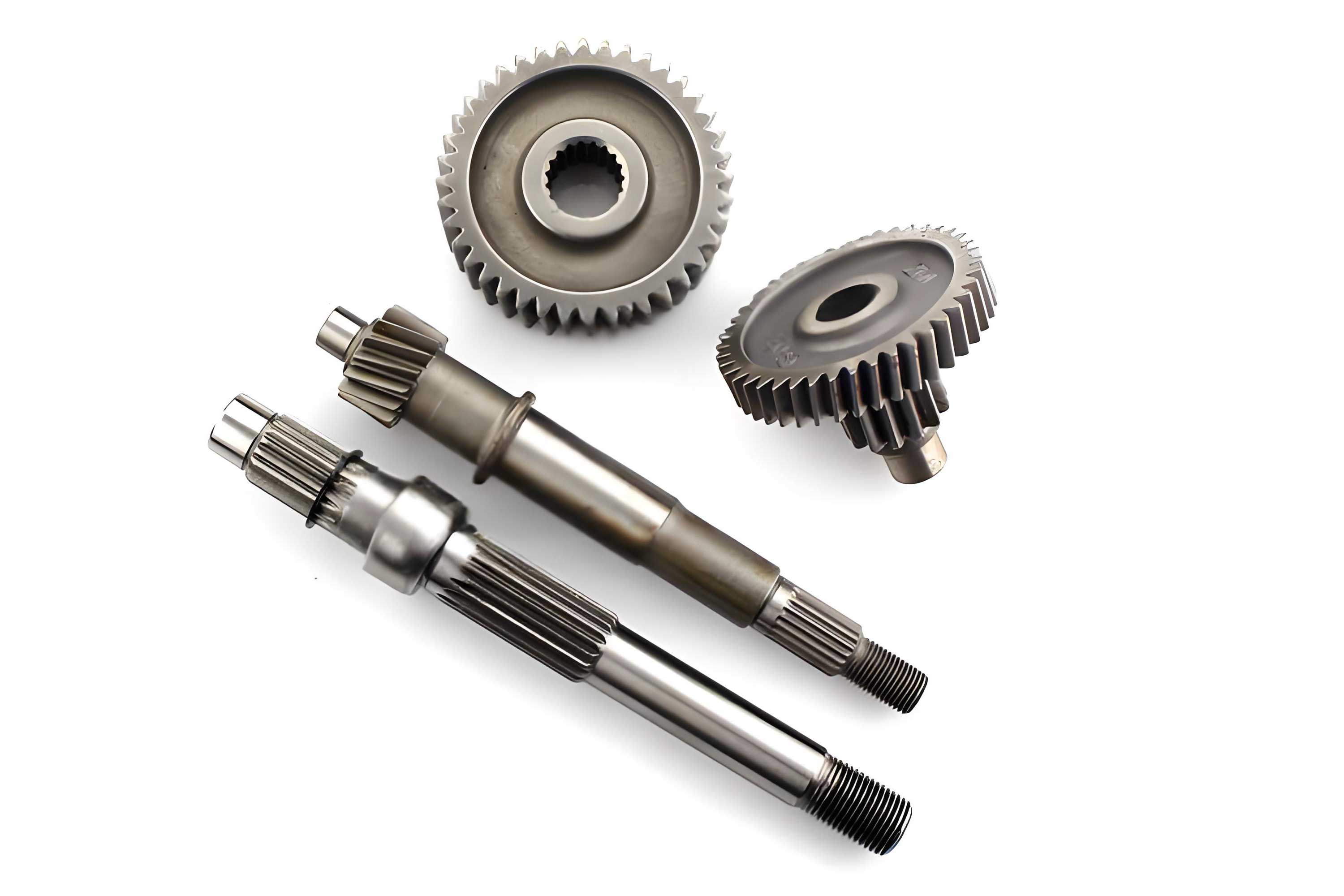
We implemented these equations in MATLAB to generate discrete point clouds representing the precise tooth geometries of both the worm and the worm wheel. The point clouds were then imported into SolidWorks, where solid models were constructed using loft and sweep features. The assembly was created by aligning the worm and worm wheel according to their theoretical mesh position. The primary geometric parameters for the worm gear drive model studied in this analysis are summarized in the table below. This specific worm gear drive configuration represents a common design used in medium-duty industrial applications.
| Component | Number of Teeth (z) | Module (m) [mm] | Pressure Angle (α) [°] | Diameter Factor (q) | Center Distance (a) [mm] |
|---|---|---|---|---|---|
| Worm | 1 | 10 | 20 | 9 | 200 |
| Worm Wheel | 41 | 10 | 20 | – |
The success of a dynamic contact analysis heavily depends on the proper pre-processing steps within the finite element environment. We imported the assembled worm gear drive model into ANSYS Workbench for this purpose. The first step was to assign appropriate material properties. The worm gear drive components must withstand significant sliding friction and contact stresses. Therefore, the worm was modeled as 40Cr alloy steel, known for its high strength and hardenability, while the worm wheel was modeled as cast aluminum bronze (ZCuAl10Fe3), chosen for its excellent anti-friction and anti-galling properties against steel. The material properties are critical inputs for the simulation.
| Component | Material | Density (ρ) [kg/m³] | Young’s Modulus (E) [GPa] | Poisson’s Ratio (ν) |
|---|---|---|---|---|
| Worm | 40Cr Steel | 7850 | 206 | 0.277 |
| Worm Wheel | Cast Aluminum Bronze | 7850 | 119 | 0.330 |
Meshing is a crucial step. Given the complex, spatially curved surfaces of the worm gear drive teeth, we employed a tetrahedral mesh with the Patch Conforming algorithm. To ensure accuracy in the contact region without making the model computationally prohibitive, a localized mesh refinement was applied to the active tooth flanks of both the worm and the worm wheel. Furthermore, to reduce solve time while preserving result fidelity, the model was simplified by removing non-participating portions of the gears, focusing only on several teeth around the mesh zone. The contact pair was defined with the worm tooth surface as the contact body and the worm wheel tooth surface as the target body. A frictional contact formulation was used, with a static and dynamic friction coefficient of 0.15, simulating typical lubricated conditions for a worm gear drive. The normal contact behavior was set to be “Augmented Lagrange” formulation, which is robust for problems involving large deformations and sliding.
Boundary conditions and loads were applied to mimic real operating conditions. The worm shaft was constrained to allow only rotation about its axis, while all translational degrees of freedom were fixed. Similarly, the worm wheel shaft was constrained to rotate only about its axis. A rotational velocity of 1450 rpm (approximately \(151.84 \, \text{rad/s}\)) was applied to the worm as the input motion. The output load was calculated based on the input power and efficiency. For an input power \( P = 15 \, \text{kW} \) and an estimated efficiency \( \eta = 0.7 \) for this worm gear drive, the output torque \( T_2 \) on the worm wheel is given by:
$$ T_2 = \frac{P \cdot \eta \cdot 60}{2 \pi n_2} $$
where \( n_2 \) is the output speed in rpm, calculated from the gear ratio \( i = 41 \) as \( n_2 = n_1 / i = 1450 / 41 \approx 35.37 \, \text{rpm} \). Therefore,
$$ T_2 = \frac{15000 \times 0.7 \times 60}{2 \pi \times 35.37} \approx 2835 \, \text{N·m} $$
This torque was applied as a remote moment on the worm wheel’s cylindrical hub. The dynamic analysis was set to simulate one complete engagement cycle of the worm gear drive, which corresponds to the worm wheel rotating by one tooth pitch. The time for this cycle at the given input speed is \( \Delta t = (60 / n_1) / z_1 = (60 / 1450) / 1 \approx 0.0414 \, \text{s} \). To capture the transient phenomena adequately, we set the total analysis time to 0.05s with 250 time steps, ensuring high temporal resolution.
The dynamic finite element analysis solved the transient structural equations, yielding time-varying stress and deformation fields. The contact stress distribution on the worm wheel at three distinct instants during the mesh cycle is particularly informative. At the initial contact point (entry), the contact area is minimal, leading to a highly concentrated stress zone. As the worm gear drive rotates and more of the tooth surfaces come into contact, the contact area increases, reducing the peak contact pressure but distributing the load over a broader region. The maximum von Mises stress consistently appeared near the tooth tip region on the worm wheel, indicative of high contact pressure. Conversely, the maximum bending stress concentration was observed at the root fillet of the worm wheel tooth, which is a critical location for fatigue crack initiation. This dynamic stress evolution underscores the importance of analyzing the worm gear drive under motion rather than in a static position.
To complement the stress analysis and directly obtain the meshing forces, which are vital for vibration and durability studies, we performed a multi-body dynamics simulation using ADAMS. The same SolidWorks model was exported and imported into ADAMS to create a virtual prototype of the worm gear drive. After defining the material densities, we created revolute joints at the centers of both the worm and the worm wheel, connecting them to the ground. The critical step was defining the contact force between the gear teeth. We used the IMPACT function model, which is based on a spring-damper formulation. The contact force \( F_c \) is calculated as:
$$ F_c = \begin{cases}
k \cdot (q_0 – q)^e – C \cdot \dot{q} \cdot STEP(q, q_0 – d, 1, q_0, 0), & \text{if } q < q_0 \\
0, & \text{if } q \ge q_0
\end{cases} $$
where \( q \) is the instantaneous distance between contact points, \( q_0 \) is the initial distance (free contact distance), \( k \) is the contact stiffness, \( e \) is the force exponent (typically 1.5 for metallic contact), \( C \) is the damping coefficient, and \( d \) is the penetration depth at which full damping is applied. The STEP function ensures a smooth transition. The contact stiffness \( k \) was derived from the material properties and estimated contact geometry. For two cylinders in contact, an approximate formula is:
$$ k = \frac{4}{3} E^* \sqrt{R^*} $$
where \( \frac{1}{E^*} = \frac{1-\nu_1^2}{E_1} + \frac{1-\nu_2^2}{E_2} \) and \( \frac{1}{R^*} = \frac{1}{R_1} + \frac{1}{R_2} \). For our worm gear drive, the radii \( R_1 \) and \( R_2 \) are the effective radii of curvature at the contact point. A value of \( 1.0 \times 10^5 \, \text{N/mm} \) was used for \( k \). Friction was included using the Coulomb model with a static coefficient of 0.1 and a dynamic coefficient of 0.05. The worm was driven with a rotational speed of 1450 rpm, and the worm wheel was subjected to the same resistive torque of 2835 N·m calculated earlier.
The ADAMS simulation provided clear dynamic output. The worm wheel’s angular velocity showed a steady-state average of approximately 35.4 rpm, which matches the theoretical value with an error of less than 0.1%, validating the geometric and kinematic accuracy of our worm gear drive virtual model. The time history of the meshing force, measured at the contact interface, revealed significant insights. Upon startup, a sharp impulse force exceeding 2500 N was observed due to the initial impact and acceleration of the worm gear drive system. After this transient phase, the meshing force settled into a periodic fluctuation with an average value around 500 N. The fluctuation pattern corresponds to the variation in the instantaneous number of tooth pairs in contact and the changing contact line geometry throughout the mesh cycle. The maximum force consistently occurred at the moment a new tooth pair initiated contact, confirming that the entry region is the most critically loaded zone in this involute worm gear drive. This has direct implications for design, suggesting that profile modifications or lead corrections at the tooth tips could help mitigate this peak load and improve life.
The integration of dynamic FEA and MBD simulation offers a powerful framework for analyzing complex mechanical systems like the worm gear drive. The finite element analysis provided detailed, localized stress information crucial for strength and fatigue assessment, while the multi-body dynamics simulation efficiently captured the global system dynamics and force transmission. The combined results lead to several important conclusions regarding the behavior of the involute worm gear drive. Firstly, the contact and bending stress states are highly transient, varying significantly with the angular position of the gears. A static analysis at a single position would miss these variations and potentially underestimate peak stresses. Secondly, stress concentrations are predictable: maximum contact pressure occurs near the tooth tip, and maximum bending stress occurs at the root fillet. These are the prime locations for failure modes like pitting and bending fatigue in a worm gear drive. Thirdly, the meshing force is not constant but exhibits cyclical variations with distinct peaks at the entry point of engagement. This dynamic force is a primary excitation source for noise and vibration in worm gear drive systems.
From a broader perspective, this methodology can be extended to optimize worm gear drive designs. Parameters such as pressure angle, module, lead angle, and profile modifications can be varied virtually, and their effect on dynamic stress and meshing forces can be assessed rapidly, reducing the need for costly physical prototyping. Future work could involve incorporating thermal effects due to the significant frictional heating in worm gear drives or studying the influence of manufacturing errors and assembly misalignments on the dynamic response. Furthermore, coupling the dynamic meshing forces from ADAMS back into a more detailed finite element model for a full-system stress analysis could provide even more comprehensive insights. In summary, the dynamic contact analysis presented here forms a solid foundation for advancing the design, reliability, and performance of involute worm gear drives across numerous industrial applications.
To encapsulate the key parameters and findings, several summary tables are provided below. These tables consolidate the input data and core results from our investigation into the dynamic behavior of the involute worm gear drive.
| Aspect | Parameter / Value | Description/Implication |
|---|---|---|
| Kinematic Input | Worm Speed: 1450 rpm | Standard motor input speed for the application. |
| Gear Ratio | i = 41 | Provides high speed reduction in a single stage. |
| Calculated Output | Worm Wheel Speed: ~35.37 rpm | Matches theoretical value, validating model kinematics. |
| Output Load | Torque: 2835 N·m | Derived from input power (15 kW) and efficiency (0.7). |
| Peak Meshing Force | >2500 N (initial); ~500 N (steady avg) | Initial impact force is high; steady-state force fluctuates cyclically. |
| Critical Stress Locations | Tooth Tip (contact); Root Fillet (bending) | Identifies zones requiring careful design and heat treatment. |
| Analysis Method | Integrated FEA (ANSYS) & MBD (ADAMS) | Provides both local stress details and global force dynamics. |
The mathematical core of the worm gear drive modeling involves several key equations that define the geometry and contact. For reference, the primary equations used are consolidated here.
1. Worm Surface Equation (Right-Hand):
$$ \mathbf{r}_1(u, \theta) = \begin{bmatrix} r_b \cos u + p \theta \sin u \\ r_b \sin u – p \theta \cos u \\ p \theta \end{bmatrix} $$
2. Axial Profile Parameters:
$$ r = r_b \sqrt{1 + t^2}, \quad z = p (\arctan t – t + \theta_0) $$
3. Contact Stiffness Estimation:
$$ k = \frac{4}{3} E^* \sqrt{R^*}, \quad \frac{1}{E^*} = \sum_{i=1}^2 \frac{1-\nu_i^2}{E_i}, \quad \frac{1}{R^*} = \sum_{i=1}^2 \frac{1}{R_i} $$
4. Output Torque Calculation:
$$ T_2 = \frac{P \cdot \eta \cdot 60}{2 \pi n_2} $$
These formulae are essential for anyone seeking to replicate or build upon this analysis of an involute worm gear drive.
In conclusion, through a rigorous process of mathematical modeling, dynamic finite element analysis, and multi-body dynamics simulation, we have gained a comprehensive understanding of the transient contact stresses and meshing forces in an involute worm gear drive. The results highlight the dynamic nature of the loading and pinpoint critical stress areas. This work demonstrates that an integrated simulation approach is highly effective for the analysis and design optimization of worm gear drives, ultimately contributing to the development of more reliable and efficient mechanical transmission systems.