
The reliable and efficient transmission of power in modern machinery is a cornerstone of industrial advancement. Among the various components enabling this, helical gears hold a position of critical importance due to their superior performance characteristics. The inherent geometry of helical gears, with teeth cut at an angle to the axis of rotation, promotes smoother and quieter operation compared to their spur gear counterparts. This is primarily due to a gradual engagement and disengagement process, leading to higher contact ratios and reduced acoustic emissions. However, this performance advantage is intrinsically linked to the complex three-dimensional nature of the tooth contact. As industrial demands push machinery towards higher speeds, heavier loads, and greater reliability, understanding and accurately predicting the stresses experienced by gear teeth under dynamic operating conditions becomes paramount. The contact stress on the tooth flank is not merely a static load; it is a dynamically varying entity, pulsating with each meshing cycle due to time-varying stiffness, manufacturing imperfections, and system vibrations. This dynamic contact stress is the primary driver behind several debilitating failure modes such as pitting, spalling, and scuffing. Therefore, developing robust methodologies to calculate and analyze the dynamic contact stress in helical gears is essential for predictive maintenance, optimal design, and ensuring the longevity of power transmission systems.
The analysis begins with a fundamental understanding of the forces at play. In a meshing pair of helical gears, the force is transmitted along a three-dimensional path. The dynamic meshing force, which fluctuates during operation, is the primary input for any stress calculation. To accurately capture this force, a comprehensive dynamic model of the gear pair is necessary. This model must account for the system’s vibrations, which are excited by inherent characteristics of the gear mesh itself.
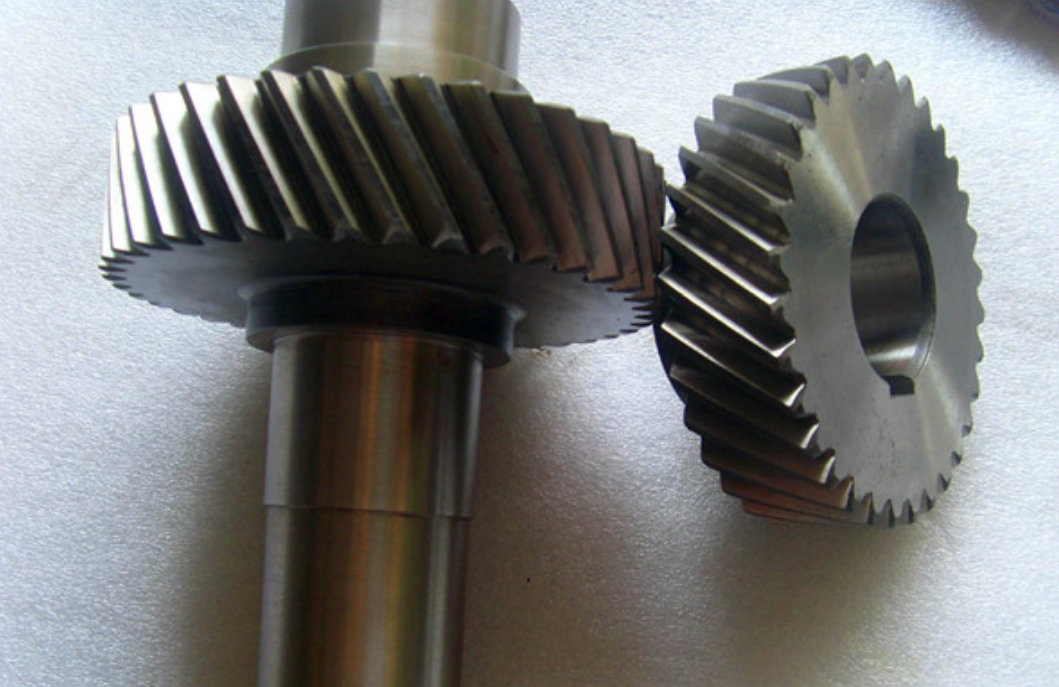
Two primary sources of excitation are considered paramount in such models. First is the time-varying mesh stiffness. As the number of teeth in contact changes throughout the meshing cycle—for instance, alternating between two and three pairs for many helical gears—the overall stiffness of the gear pair fluctuates. This variation acts as a parametric excitation within the system. Second is the meshing impact excitation, often resulting from geometrical errors, deflections, or the phenomenon known as “tip relief” or “corner contact,” where the incoming tooth makes initial contact outside the theoretical path of contact. To incorporate the axial forces generated by the helix angle, a six-degree-of-freedom (6-DOF) bending-torsion-axial coupling vibration model is widely adopted. This model typically considers the translational motions in the radial (y) and axial (z) directions, as well as the rotational motion (θ) for both the driving and driven helical gears. The supporting bearings, crucial for system dynamics, are modeled as equivalent spring-damper elements in these directions. The governing equations of motion for such a system can be derived from Newton’s second law.
For the pinion (driving gear), the equations are:
$$
m_p \ddot{y}_p + c_{py} \dot{y}_p + k_{py} y_p = -F_n \cos\beta
$$
$$
m_p \ddot{z}_p + c_{pz} \dot{z}_p + k_{pz} z_p = -F_n \sin\beta
$$
$$
I_p \ddot{\theta}_p = -F_n R_p \cos\beta + T_p – F_s(t) R_p
$$
And for the gear (driven member):
$$
m_g \ddot{y}_g + c_{gy} \dot{y}_g + k_{gy} y_g = F_n \cos\beta
$$
$$
m_g \ddot{z}_g + c_{gz} \dot{z}_g + k_{gz} z_g = F_n \sin\beta
$$
$$
I_g \ddot{\theta}_g = F_n R_g \cos\beta – T_g + F_s(t) R_g
$$
In these equations, \(m\), \(I\), and \(R\) represent the equivalent mass, moment of inertia, and base circle radius, respectively. The subscripts \(p\) and \(g\) denote the pinion and gear. \(c\) and \(k\) are the equivalent damping and stiffness coefficients of the bearings in the radial (y) and axial (z) directions. \(\beta\) is the helix angle, \(T\) is the applied torque, and \(F_s(t)\) represents the impact force due to off-line-of-action meshing, often calculated based on the approach velocity and system compliance. The central variable, \(F_n(t)\), is the dynamic normal mesh force along the line of action, expressed as:
$$
F_n(t) = c_m \dot{\lambda}(t) + k_m(t) \lambda(t)
$$
where \(k_m(t)\) is the time-varying mesh stiffness, \(c_m\) is the mesh damping, and \(\lambda(t)\) is the relative dynamic displacement along the line of action, accounting for translational and rotational motions:
$$
\lambda(t) = \cos\beta (y_p – y_g + R_p\theta_p – R_g\theta_g) + \sin\beta (z_p – z_g)
$$
Solving this system of coupled differential equations using numerical integration methods (like the Runge-Kutta method) yields the time-history of the dynamic mesh force \(F_n(t)\), which serves as the foundational load input for subsequent contact stress analysis.
| Parameter | Pinion (Driver) | Gear (Driven) |
|---|---|---|
| Normal Module (mm) | 6 | |
| Transverse Pressure Angle (°) | 20 | |
| Helix Angle, β (°) | 14.43 | |
| Number of Teeth, Z | 17 | 44 |
| Face Width, B (mm) | 55 | 55 |
| Material Density (g/cm³) | 7.85 | |
| Bearing Support Stiffness (N/m) | 5.9 × 10⁸ | 6.9 × 10⁸ |
| Bearing Support Damping (N·s/m) | 1.3 × 10³ | 1.6 × 10³ |
The core challenge in calculating the actual stress on a specific tooth flank lies in the fact that the total dynamic force \(F_n(t)\) is shared among the several pairs of teeth that are in simultaneous contact at any given instant. This load sharing is not uniform and changes dynamically. To address this, the concept of Loaded Tooth Contact Analysis (LTCA) is employed. LTCA is a sophisticated numerical technique that determines the load distribution among the contacting teeth by solving the system of equations enforcing compatibility of deformations and equilibrium of forces. The output is a crucial parameter: the load distribution factor, \(\zeta_i(t)\), for the \(i\)-th tooth pair. This factor represents the fraction of the total load carried by that specific pair at time \(t\).
With the dynamic load for a specific tooth pair known (\(F_{dyn, i}(t) = \zeta_i(t) F_n(t)\)), the contact stress can be evaluated. For helical gears, the contact between two teeth is generally a point contact that elastically deforms into an elliptical area. The maximum contact pressure at the center of this ellipse is given by the classical Hertzian contact theory, adapted for gear teeth. A highly effective methodology combines the dynamic load, LTCA results, and Hertzian theory. First, a unit load analysis is performed to calculate a base stress factor \(\sigma_0(t)\). This factor represents the contact stress that would occur under a unit load, purely based on the instantaneous contact geometry (curvature radii, material properties). The dynamic contact stress is then obtained by scaling this base factor with the square root of the actual dynamic load on that tooth pair (as contact stress is proportional to the square root of the load in Hertzian theory):
$$
\sigma_c(t) = \sigma_0(t) \cdot \sqrt{\zeta_i(t) F_n(t)}
$$
The base stress factor \(\sigma_0(t)\) is calculated as:
$$
\sigma_0(t) = \lambda \sqrt{ \frac{E}{l(t)} \cdot \frac{\rho_1(t) + \rho_2(t)}{\rho_1(t) \rho_2(t)} }
$$
Here, \(\lambda\) is a constant (often taken as 0.418 for steel gears), \(E\) is the combined modulus of elasticity, \(\rho_1(t)\) and \(\rho_2(t)\) are the principal radii of curvature of the pinion and gear tooth surfaces at the instantaneous contact point, and \(l(t)\) is the semi-major axis length of the instantaneous contact ellipse. This analytical-numerical approach provides a computationally efficient and physically sound method for tracking the dynamic contact stress throughout the meshing cycle of helical gears.
To validate and complement the analytical approach, a high-fidelity finite element analysis (FEA) using commercial software like Abaqus offers a powerful alternative. The process involves creating a precise three-dimensional geometric model of the gear pair. To balance computational cost and accuracy, a segment model containing 4-5 teeth on each gear is often sufficient, as it can capture the multi-pair contact scenario typical in helical gears. This model is discretized into a fine mesh, with particular refinement in the potential contact regions to accurately resolve stress gradients.
The dynamic simulation is set up as a transient analysis. A reference point is created at the center of each gear and coupled to the nodes on its inner bore surface. A constant rotational speed is applied to the pinion’s reference point, while a constant load torque is applied to the gear’s reference point, accurately reflecting real operating conditions. The explicit dynamics solver (Abaqus/Explicit) is well-suited for this type of event as it can efficiently handle the complex, changing contact conditions. The contact interaction between all tooth flanks is defined with appropriate friction and contact properties. The solver calculates the dynamic response over time, and the output of primary interest is the “Contact Pressure” (CPRESS) history at the nodes on the tooth flanks. This pressure directly corresponds to the Hertzian contact stress. By extracting this data for a specific tooth as it goes through the complete meshing cycle—from initial contact to final recess—the dynamic contact stress curve is obtained.
To demonstrate and compare these methodologies, an analysis was performed on a single-stage helical gear pair with the parameters detailed in the table above. The pinion speed was set to 2000 RPM. Three different load cases were investigated: 800 N·m, 1200 N·m, and 1600 N·m of transmitted torque.
The dynamic mesh force \(F_n(t)\) was first calculated by solving the 6-DOF system model. Subsequently, the LTCA-based method and the Abaqus FEA method were used to compute the dynamic contact stress for a representative tooth. For benchmark comparison, the quasi-static contact stress was also calculated using the AGMA 2001 standard formula (AGMA 6011-I03 can also be referenced for high-speed units):
$$
\sigma_H = Z_E Z_H Z_\epsilon \sqrt{ \frac{K F_t}{b d_1} \cdot \frac{u+1}{u} }
$$
where \(Z_E\), \(Z_H\), and \(Z_\epsilon\) are the elastic coefficient, zone factor, and contact ratio factor, respectively; \(K\) is the dynamic factor; \(F_t\) is the tangential load; \(b\) is the face width; \(d_1\) is the pinion pitch diameter; and \(u\) is the gear ratio. The AGMA result provides a single, nominal static stress value for comparison against the peak values from the dynamic methods.
The results from both dynamic methods for the three load cases are summarized below. The “Peak Dynamic Stress” refers to the maximum value observed in the oscillating stress curve over a full meshing cycle.
| Load Torque | Method | Peak Dynamic Stress (MPa) | Deviation from AGMA | Max Curve Deviation Between Methods |
|---|---|---|---|---|
| 800 N·m | LTCA-Based | 399 | +2.8% | 10.0% |
| Abaqus FEA | 344 | -11.3% | ||
| AGMA Reference | 388 MPa | |||
| 1200 N·m | LTCA-Based | 525 | +10.5% | 11.3% |
| Abaqus FEA | 541 | +13.8% | ||
| AGMA Reference | 475 MPa | |||
| 1600 N·m | LTCA-Based | 612 | +11.6% | 8.6% |
| Abaqus FEA | 576 | +5.1% | ||
| AGMA Reference | 548 MPa | |||
The analysis of the results yields several important insights. Firstly, both dynamic methods predict oscillating contact stresses, confirming that the loading on helical gear teeth is inherently dynamic, not static. The peak values from both methods show reasonable agreement with the AGMA standard calculation, with deviations generally within a 14% band. This range is acceptable given that AGMA provides a simplified, factored estimate for design purposes, while the dynamic methods simulate the actual physical process with higher fidelity. The positive deviations at higher loads suggest that dynamic effects (like vibration amplification) may lead to stresses exceeding the nominal AGMA prediction.
Secondly, the comparison between the LTCA-based analytical method and the Abaqus FEA method shows a very good correlation. The peak stress values and the overall shape of the dynamic stress curves are similar across all load cases, with a maximum discrepancy in the curve profiles of 11.3%. This strong agreement serves as a mutual validation of both approaches. The LTCA-based method offers significant computational efficiency and deep insight into load sharing mechanisms, making it excellent for parametric studies and design iteration. The Abaqus FEA method, while more computationally intensive, provides a highly detailed and visual result, including full-field stress distributions and the ability to model complex boundary conditions or material nonlinearities with high accuracy.
In conclusion, the accurate prediction of dynamic contact stress is vital for the modern design and analysis of helical gears operating under demanding conditions. The integration of a system-level dynamic model to obtain the fluctuating mesh force, coupled with a detailed load distribution analysis (LTCA) and Hertzian contact theory, provides a powerful and validated analytical framework. This methodology is effectively complemented by high-fidelity explicit dynamic finite element analysis. The strong concordance between the results from these two independent approaches, and their reasonable alignment with established industry standards, confirms their effectiveness and reliability. These tools enable engineers to move beyond static approximations, allowing for the prediction of dynamic stress peaks, analysis of transmission error under load, and ultimately, the optimization of helical gear designs for enhanced durability, efficiency, and performance in a wide range of mechanical power transmission applications.