
In modern industrial development, gear transmission systems serve as critical components for power transmission, increasingly moving toward high-speed and high-efficiency applications. Enhancing load-carrying capacity while reducing noise and vibration during operation remains a primary challenge in gear design. The tooth profile and distribution of contact forces directly influence operational performance and service life. Analyzing the static and dynamic behaviors of spur gears during meshing, along with the stress distribution around the teeth, holds significant importance for gear design and strength assessment. For spur gears, Hertzian contact theory is commonly employed for theoretical analysis. However, practical factors such as deformation due to meshing forces, temperature rise, manufacturing inaccuracies, and assembly errors introduce gaps and impact during meshing, leading to discrepancies between theoretical predictions and actual performance. Gear meshing inherently presents a dynamic contact problem, where contact force distribution affects the overall working state. This study utilizes the finite element method (FEM) within ANSYS to simulate stress distribution between spur gears during motion, providing a theoretical basis for gear design calculations.
Gear transmission operates through the alternating meshing of two gears. As the driving gear rotates clockwise and the driven gear counterclockwise, the meshing point traverses along the line of action from the initial contact to the termination point. This process involves transitions between single-tooth and double-tooth contact zones, causing instantaneous changes in meshing stiffness. These variations induce impact effects and elastic deformation, resulting in time-dependent load application points and distribution. The dynamic nature of spur gears necessitates advanced simulation techniques to capture stress variations accurately.
The finite element model for spur gears involves several steps: generating tooth profile curves, constructing geometric models, meshing, and defining boundary conditions. For dynamic contact analysis, mesh quality is paramount, as it directly influences numerical results. In the meshing region and tooth root areas—where stress and displacement gradients are high—a finer mesh density is essential. Conversely, regions with lesser load impact can employ coarser meshes, with transitional elements bridging the differences. This approach ensures computational efficiency while maintaining accuracy.
To illustrate, consider a pair of spur gears from a reducer, with both gears made of 45# steel. The key parameters are summarized in Table 1.
| Parameter | Value |
|---|---|
| Module | 2.5 mm |
| Pressure Angle | 20° |
| Number of Teeth (Gear 1) | 31 |
| Number of Teeth (Gear 2) | 115 |
| Addendum Coefficient | 1.0 |
| Elastic Modulus | 206 GPa |
| Poisson’s Ratio | 0.3 |
| Density | 7890 kg/m³ |
The three-dimensional model of spur gears is created using CAD software, ensuring accurate tooth geometry based on involute profiles. The finite element mesh, as shown in the model, emphasizes refinement in critical areas like the tooth root and contact zones. For dynamic analysis, boundary conditions must account for rotational motion. Since solid elements lack rotational degrees of freedom, rotation is applied via the inner cylindrical surface of the driving gear, while torque is applied to the driven gear’s inner surface. All other degrees of freedom are constrained to simulate realistic operation. Transient analysis settings are detailed in Table 2.
| Parameter | Value |
|---|---|
| Solution Time | 12 s |
| Initial Substep | 10 |
| Minimum Substep | 10 |
| Maximum Substep | 10 |
The Hertzian contact stress formula provides a theoretical foundation for spur gears, expressed as:
$$
\sigma_H = \sqrt{\frac{F}{\pi b} \cdot \frac{1}{\frac{1-\nu_1^2}{E_1} + \frac{1-\nu_2^2}{E_2}} \cdot \frac{1}{\rho}}
$$
where \( \sigma_H \) is the maximum contact stress, \( F \) is the normal load, \( b \) is the contact width, \( \nu_1 \) and \( \nu_2 \) are Poisson’s ratios, \( E_1 \) and \( E_2 \) are elastic moduli, and \( \rho \) is the equivalent curvature radius. However, this static formula overlooks dynamic effects, necessitating FEM for comprehensive analysis.
During simulation, the dynamic meshing process of spur gears is captured at various time steps. Stress distributions reveal that maximum contact stress occurs near the pitch circle when teeth are fully engaged. In single-tooth contact zones, stress peaks are higher compared to double-tooth contact zones, where stress distribution is more stable, indicating reduced impact during double-tooth meshing. This alternation between single and double contact in spur gears significantly influences dynamic stress patterns.
The contact stress variation over time at a specific point on the spur gears exhibits periodic peaks corresponding to single-tooth engagement phases. For instance, within the tested duration, two single-tooth contact regions appear, with similar maximum stress values, highlighting the cyclical nature of meshing in spur gears. This behavior underscores the importance of dynamic analysis for accurate stress prediction.
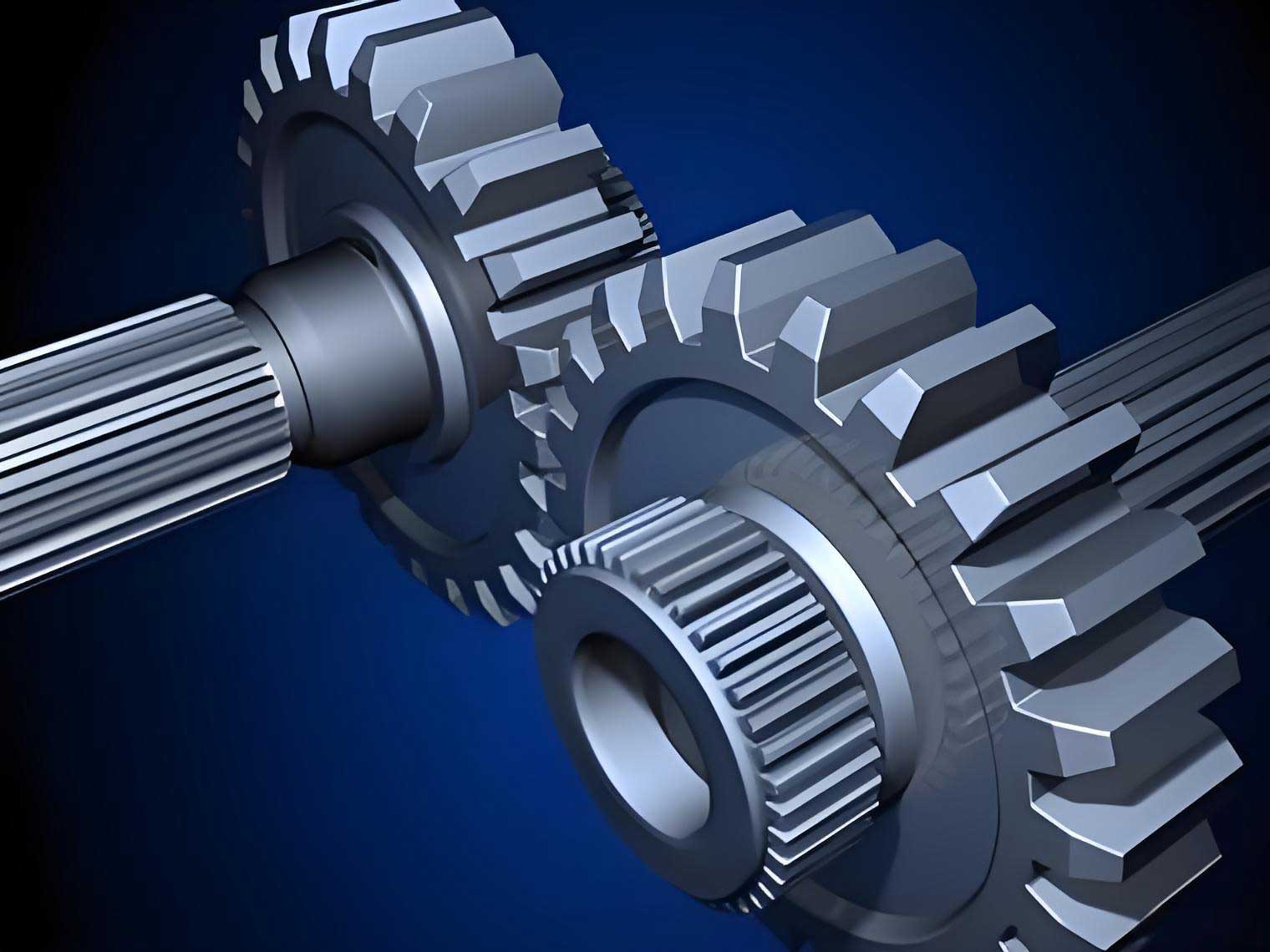
To delve deeper, the mesh strategy for spur gears involves partitioning the geometry into hexahedral and tetrahedral elements, with a focus on the contact region. Table 3 outlines the mesh statistics for the spur gear model, emphasizing density in critical areas.
| Region | Element Type | Element Size | Number of Elements |
|---|---|---|---|
| Tooth Root | Tetrahedral | 0.5 mm | ~15,000 |
| Meshing Zone | Hexahedral | 0.3 mm | ~20,000 |
| Other Areas | Tetrahedral | 2.0 mm | ~10,000 |
The dynamic response of spur gears is governed by equations of motion, which in FEM are discretized as:
$$
[M]\{\ddot{u}\} + [C]\{\dot{u}\} + [K]\{u\} = \{F(t)\}
$$
where \([M]\) is the mass matrix, \([C]\) is the damping matrix, \([K]\) is the stiffness matrix, \(\{u\}\) is the displacement vector, and \(\{F(t)\}\) is the time-dependent force vector. For spur gears, the stiffness matrix \([K]\) varies with meshing position, introducing nonlinearity due to contact.
Simulation results indicate that the maximum von Mises stress in spur gears during meshing fluctuates between 20 MPa and 42 MPa, with peaks aligning with single-tooth contact instances. The stress distribution pattern confirms that initial pitting fatigue in spur gears likely initiates near the pitch circle, consistent with empirical observations. This insight aids in designing spur gears for enhanced durability.
Further analysis involves parametric studies on spur gears to optimize design. For example, varying the module or pressure angle affects stress concentration. Table 4 summarizes the effect of different parameters on maximum contact stress for spur gears.
| Parameter Change | Effect on Max Stress | Remarks |
|---|---|---|
| Increase Module | Decreases Stress | Larger tooth size distributes load better |
| Increase Pressure Angle | Increases Stress | Higher contact forces due to steeper profiles |
| Increase Tooth Number | Decreases Stress | More teeth share load, reducing per-tooth stress |
The finite element approach for spur gears also accommodates nonlinearities such as material plasticity and large deformations. The constitutive model for 45# steel can be represented by a bilinear hardening law:
$$
\sigma = \begin{cases}
E \epsilon & \text{for } \epsilon \leq \epsilon_y \\
\sigma_y + H (\epsilon – \epsilon_y) & \text{for } \epsilon > \epsilon_y
\end{cases}
$$
where \( \sigma \) is stress, \( \epsilon \) is strain, \( E \) is Young’s modulus, \( \sigma_y \) is yield stress, \( \epsilon_y \) is yield strain, and \( H \) is hardening modulus. This allows accurate prediction of spur gear behavior under high loads.
In terms of computational efficiency, the ANSYS simulation for spur gears leverages symmetric boundary conditions and reduced integration elements to save time. The transient analysis captures multiple meshing cycles, ensuring statistical reliability. For spur gears, the time-step selection is critical; too large steps may miss impact events, while too small steps increase computation cost. A balance is achieved through adaptive stepping based on contact convergence.
The dynamic contact analysis of spur gears reveals that impact forces during meshing contribute significantly to stress peaks. The impact force can be estimated using the impulse-momentum principle:
$$
F_{\text{impact}} = \frac{m \Delta v}{\Delta t}
$$
where \( m \) is the effective mass of the spur gear tooth, \( \Delta v \) is the velocity change during impact, and \( \Delta t \) is the contact duration. This force superimposes on the static load, exacerbating stress in spur gears.
To mitigate noise and vibration in spur gears, design modifications such as profile shifting or crowning can be explored. These alter the contact pattern, potentially reducing stress concentration. Simulation allows virtual testing of such variants without physical prototypes, streamlining the design process for spur gears.
In conclusion, the finite element method provides a robust tool for analyzing dynamic contact stress in spur gears. By simulating the entire meshing process, stress distributions and variations are obtained, highlighting the influence of single and double-tooth contact zones. The results align with practical gear failure modes, such as pitting near the pitch circle. This simulation-based approach enhances the efficiency and reliability of spur gear design, enabling rapid iteration and optimization. Future work could extend to thermal-structural coupling or multi-body dynamics for comprehensive spur gear system analysis.
The versatility of FEM for spur gears is further demonstrated through sensitivity studies. For instance, the effect of misalignment on spur gear stress can be quantified. Misalignment introduces uneven load distribution, increasing local stresses. A summary is provided in Table 5.
| Type of Misalignment | Stress Increase | Mitigation Strategy |
|---|---|---|
| Parallel Offset | Up to 30% | Use crowned teeth |
| Angular Misalignment | Up to 50% | Improve assembly precision |
| Axial Displacement | Up to 20% | Implement thrust bearings |
Ultimately, the dynamic analysis of spur gears underscores the importance of considering real-world factors in design. By integrating FEM simulations, engineers can predict performance under various operating conditions, leading to more durable and efficient spur gear systems. The continuous advancement in computational power will further refine these analyses, making spur gears even more reliable for high-demand applications.