
In modern automotive engineering, the demand for high-performance, compact, and efficient drivetrains has never been greater. Among the key components meeting this demand is the hypoid gear pair, widely used in automotive final drives and differentials. The unique geometry of a hypoid gear set, characterized by an offset between the pinion and gear axes, offers significant advantages: it allows for a lower pinion position, increasing ground clearance and vehicle stability; it enables higher spiral angles, leading to smoother and quieter operation; and it permits a lower minimum number of pinion teeth, allowing for higher reduction ratios in a single stage. However, as vehicle speeds and power densities continue to increase, the dynamic behavior of these gear sets becomes critical. Traditional static design methods or empirical estimations for dynamic loads are no longer sufficient to ensure reliability and durability under high-speed operating conditions. Excessive dynamic loads can lead to tooth breakage, premature bearing failure, or even structural damage to the gear housing. Therefore, a precise analytical method for calculating the dynamic loads in a hypoid gear transmission system is essential for modern dynamic design and analysis. This article presents a comprehensive dynamic model and a method for calculating the dynamic load and dynamic load factor for a hypoid gear drive system.
Dynamic Model of the Hypoid Gear Transmission System
To accurately capture the dynamic interactions, a multi-degree-of-freedom (DOF) model of the complete hypoid gear transmission system is established. The model considers the vibrations of both the pinion and gear not only in the torsional direction but also in their supporting translational directions. The following assumptions are made: the friction forces on the tooth flanks are neglected; the resultant meshing force acts at the midpoint of the face width along the common normal of the tooth surfaces. This normal force \( F_n \) can be resolved into three orthogonal components: a tangential force \( F_t \), a radial force \( F_r \), and an axial force \( F_a \). It is important to note that for a hypoid gear pair, the magnitudes and directions of \( F_t \) and \( F_r \) are generally not equal for the pinion and the gear due to the shaft offset and differing spiral angles.
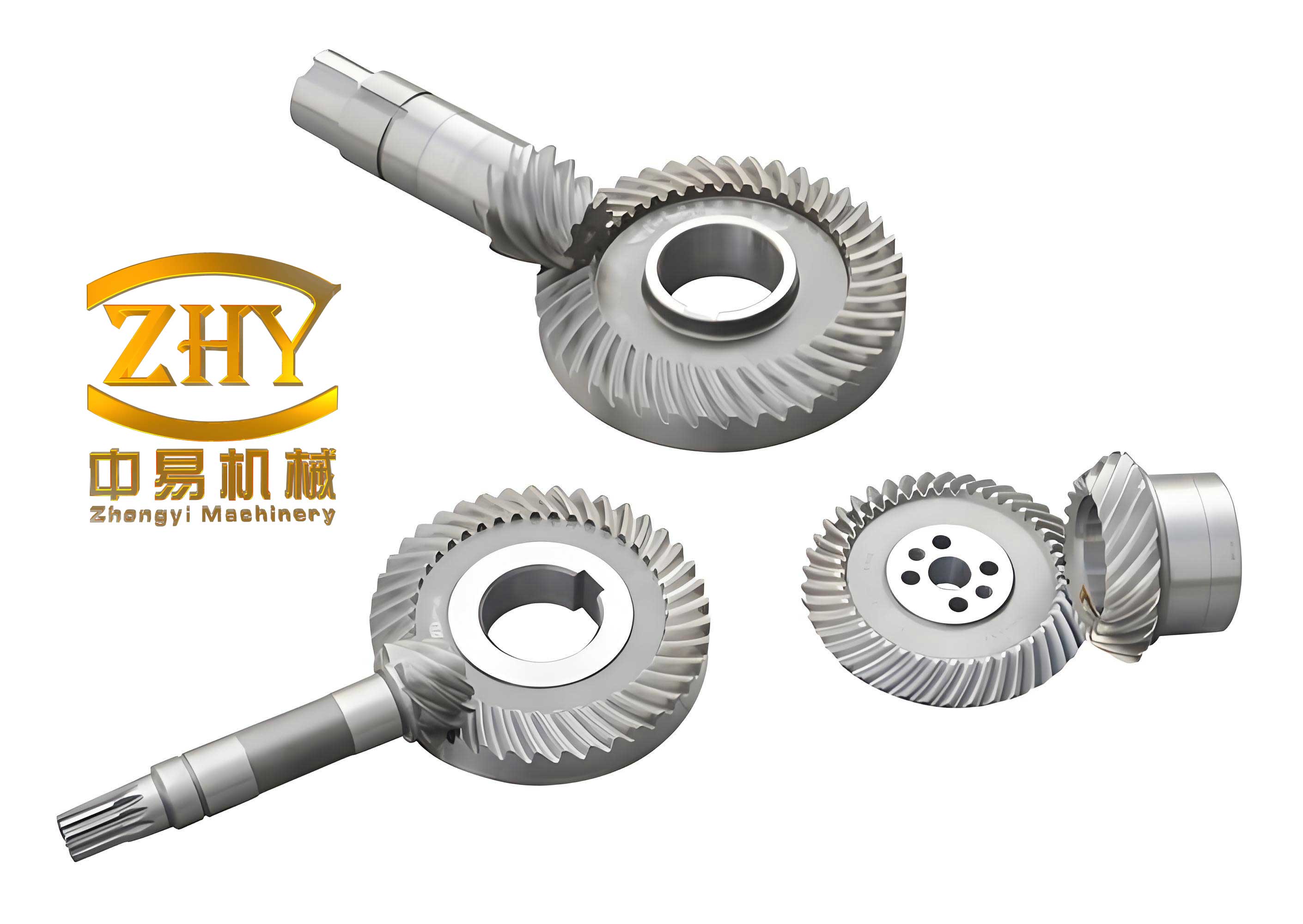
For each gear (pinion ‘p’ and gear ‘g’), the considered degrees of freedom are:
- \( \theta_i \): Small angular displacement in the rotational direction.
- \( x_i \): Small translational displacement of the gear center in the tangential direction.
- \( y_i \): Small translational displacement of the gear center in the radial direction.
- \( z_i \): Small translational displacement of the gear center in the axial direction.
Additionally, the angular displacements of the input mass \( \theta_m \) and the output mass \( \theta_L \) are considered, resulting in a total of 10 degrees of freedom for the system. The time-varying mesh stiffness is denoted as \( k(t) \), which is a periodic function of the gear rotation angle (and hence time under constant speed). The relative damping between the gears due to friction, oil churning, etc., is represented by \( c \). For simplicity, this damping is treated as viscous with a constant damping ratio \( \zeta \). Each gear is supported by stiffnesses \( k_{xi}, k_{yi}, k_{zi} \) in the \( x, y, z \) directions, respectively, which represent the combined stiffness of the shafts and bearings. The input and output masses are connected to the pinion and gear via torsional stiffnesses \( k_{mp} \) and \( k_{gL} \). This configuration constitutes the complete dynamic model for the hypoid gear system.
System Parameters
The analysis is performed on a specific hypoid gear pair. The geometric parameters are summarized in Table 1. The structural support diagram shows both the pinion and gear employ a straddle-mounted (double-supported) design. The mass and inertia parameters of the system components are listed in Table 2, and the stiffness parameters are listed in Table 3.
| Parameter | Pinion | Gear | Unit |
|---|---|---|---|
| Number of Teeth, \( Z \) | 11 | 41 | – |
| Pitch Diameter, \( d_m \) | 57.15 | 215.9 | mm |
| Offset, \( E \) | 30.0 | mm | |
| Mean Spiral Angle, \( \beta \) | 50° | 30° | deg |
| Mean Pressure Angle, \( \alpha_n \) | 19° | deg | |
| Face Cone Angle | 21°22′ | 68°29′ | deg |
| Root Cone Angle | 17°39′ | 65°15′ | deg |
| Cutter Radius | 114.3 | mm | |
| Face Width | 38 | 38 | mm |
| Accuracy Grade | 6 | – | |
| Load Torque, \( T_L \) | 2000 | N·m | |
| Component | Symbol | Value | Unit |
|---|---|---|---|
| Pinion Mass | \( m_p \) | 1.5 | kg |
| Gear Mass | \( m_g \) | 15.0 | kg |
| Pinion Mass Moment of Inertia | \( I_p \) | 0.0012 | kg·m² |
| Gear Mass Moment of Inertia | \( I_g \) | 0.25 | kg·m² |
| Input Mass Moment of Inertia | \( I_m \) | 0.002 | kg·m² |
| Output Mass Moment of Inertia | \( I_L \) | 0.05 | kg·m² |
| Stiffness Type | Symbol | Value | Unit |
|---|---|---|---|
| Pinion Support Stiffness (x, y, z) | \( k_{xp}, k_{yp}, k_{zp} \) | \( 1.0 \times 10^8 \) | N/m |
| Gear Support Stiffness (x, y, z) | \( k_{xg}, k_{yg}, k_{zg} \) | \( 2.0 \times 10^8 \) | N/m |
| Input Shaft Torsional Stiffness | \( k_{mp} \) | \( 5.0 \times 10^4 \) | N·m/rad |
| Output Shaft Torsional Stiffness | \( k_{gL} \) | \( 1.0 \times 10^5 \) | N·m/rad |
| Mean Mesh Stiffness | \( \bar{k} \) | \( 2.5 \times 10^8 \) | N/m |
Equations of Motion for the Hypoid Gear Drive
The normal mesh force \( F_n \) is decomposed along the coordinate directions of each gear. The direction cosines depend on the pressure angles (\( \alpha_p, \alpha_g \)), spiral angles, and cone angles. The scalar components for the pinion can be expressed as:
$$ F_{tp} = F_n \cos \alpha_p \cos \beta_p $$
$$ F_{rp} = F_n (\cos \alpha_p \sin \beta_p \sin \Gamma_p + \sin \alpha_p \cos \Gamma_p) $$
$$ F_{ap} = F_n (\cos \alpha_p \sin \beta_p \cos \Gamma_p – \sin \alpha_p \sin \Gamma_p) $$
Similar expressions hold for the gear, using its respective angles \( \alpha_g, \beta_g, \gamma_g \). Here, \( \Gamma_p \) is the pinion pitch cone angle and \( \gamma_g \) is the gear root cone angle.
The relative displacement \( \delta_n \) along the line of action between the two gears has components from all degrees of freedom. For the pinion, the contribution to \( \delta_n \) is:
$$ \delta_{np} = \theta_p r_{bp} + x_p \cos \psi_p + y_p \sin \psi_p \sin \Gamma_p + z_p \sin \psi_p \cos \Gamma_p $$
where \( r_{bp} \) is the base circle radius at the mid-face, and \( \psi_p \) is an angle related to the pressure angle. A similar expression \( \delta_{ng} \) exists for the gear.
The elastic mesh force from the tooth pair is proportional to the difference between the relative displacement and the composite manufacturing error \( e(t) \). Considering multiple tooth pairs in contact:
$$ F_{ne} = \sum_{j=1}^{N} k_j(t) [\delta_n(t) – e_j(t)] $$
where \( N \) is the number of simultaneous tooth pairs, \( k_j(t) \) is the time-varying stiffness of the j-th pair, and \( e_j(t) \) is its error. The damping force is:
$$ F_{nc} = c \dot{\delta}_n(t) $$
Thus, the total dynamic mesh force is \( F_n = F_{ne} + F_{nc} \).
Applying Newton’s second law to each degree of freedom by projecting the forces \( F_{ne} \) and \( F_{nc} \) through the appropriate direction cosines, and including the restoring forces from the support and shaft stiffnesses, leads to the system’s equations of motion. They can be written in a compact matrix form:
$$ \mathbf{M} \ddot{\mathbf{X}}(t) + \mathbf{C} \dot{\mathbf{X}}(t) + [\mathbf{K}_s + \mathbf{K}_m(t)] \mathbf{X}(t) = \mathbf{F}_0 + \mathbf{F}_e(t) $$
where:
- \( \mathbf{X}(t) = [\theta_m, \theta_p, x_p, y_p, z_p, \theta_g, x_g, y_g, z_g, \theta_L]^T \) is the displacement vector.
- \( \mathbf{M} \) and \( \mathbf{C} \) are the constant mass and damping matrices.
- \( \mathbf{K}_s \) is the constant structural stiffness matrix from supports and shafts.
- \( \mathbf{K}_m(t) \) is the time-periodic mesh stiffness matrix, responsible for parametric excitation.
- \( \mathbf{F}_0 \) is the constant force vector from the static load torque \( T_L \).
- \( \mathbf{F}_e(t) \) is the excitation force vector due to transmission errors \( e_j(t) \).
This equation represents a linear system with parametric excitation (from \( \mathbf{K}_m(t) \)) and external excitation (from \( \mathbf{F}_e(t) \)).
Solution Method for the Parametrically Excited Equations
To solve the system of equations, a simplification is employed. The dynamic response \( \mathbf{X}(t) \) is separated into a mean (static) component \( \bar{\mathbf{X}} \) and a dynamic variation component \( \Delta \mathbf{X}(t) \):
$$ \mathbf{X}(t) = \bar{\mathbf{X}} + \Delta \mathbf{X}(t) $$
The mean component satisfies the static equilibrium:
$$ \mathbf{K}_s \bar{\mathbf{X}} + \bar{\mathbf{K}}_m \bar{\mathbf{X}} = \mathbf{F}_0 $$
where \( \bar{\mathbf{K}}_m \) is the mean value of the periodic mesh stiffness matrix \( \mathbf{K}_m(t) \).
Substituting the separated form into the original equation of motion and subtracting the static equilibrium equation, while neglecting second-order terms involving the product \( \mathbf{K}_m(t) \Delta \mathbf{X}(t) \), yields a linearized equation for the dynamic component:
$$ \mathbf{M} \Delta \ddot{\mathbf{X}}(t) + \mathbf{C} \Delta \dot{\mathbf{X}}(t) + [\mathbf{K}_s + \bar{\mathbf{K}}_m] \Delta \mathbf{X}(t) = \Delta \mathbf{F}(t) $$
where the dynamic excitation force \( \Delta \mathbf{F}(t) \) is derived from the product of the fluctuating part of the mesh stiffness and the mean deflection, plus the error excitation:
$$ \Delta \mathbf{F}(t) \approx -[\mathbf{K}_m(t) – \bar{\mathbf{K}}_m] \bar{\mathbf{X}} + \mathbf{F}_e(t) $$
The key component of this excitation can be shown to be proportional to the transmission error under load. The transmission error \( TE(\theta) \) is defined as the deviation of the gear’s angular position from its ideal, perfectly conjugate position when loaded by the static torque \( T_L \). It is a primary source of vibration in geared systems.
The simplified equation is now a linear time-invariant (LTI) system forced by a periodic excitation \( \Delta \mathbf{F}(t) \). This can be solved efficiently using the modal superposition method. The natural frequencies and mode shapes of the system are found from the homogeneous part of the LTI equation. The periodic excitation \( \Delta \mathbf{F}(t) \) is expanded into a Fourier series. The steady-state dynamic response \( \Delta \mathbf{X}(t) \) is then obtained by summing the responses to each harmonic component of the excitation. Finally, the total dynamic mesh force \( F_{n,dynamic}(t) \) is calculated from \( \mathbf{X}(t) = \bar{\mathbf{X}} + \Delta \mathbf{X}(t) \).
Vibration Excitation Characteristics in Hypoid Gear Drives
The primary dynamic excitation for the hypoid gear system under constant load and speed is the loaded transmission error (LTE). As derived, the dominant term in \( \Delta \mathbf{F}(t) \) is:
$$ \Delta F_{key}(t) = \bar{k} \cdot LTE(t) $$
where \( \bar{k} \) is the average mesh stiffness and \( LTE(t) \) is the loaded transmission error as a function of time (or pinion rotation angle). This relationship highlights the parametric nature of the excitation: the hypoid gear mesh stiffness \( k(t) \) modulates the static force path, and the transmission error \( e(t) \) acts as a direct displacement excitation. The loaded transmission error is a consequence of gear tooth deflections under load and manufacturing inaccuracies. It must be calculated considering the complex three-dimensional contact in a hypoid gear pair, typically using specialized loaded tooth contact analysis (LTCA) software or detailed finite element methods.
For the example hypoid gear pair, the calculated loaded transmission error over one mesh cycle is shown in the figure below (conceptually). It is a periodic function whose fundamental frequency is the gear mesh frequency \( f_m = Z_p \times n_p / 60 \), where \( n_p \) is the pinion speed in RPM. The shape and amplitude of the LTE curve are critical determinants of the system’s dynamic response.
[Conceptual description of the LTE waveform: The LTE curve exhibits periodic variations with peaks and valleys corresponding to the change in the number of tooth pairs in contact and the shift of the contact pattern across the tooth flank.]
Dynamic Load and Dynamic Load Factor for Hypoid Gears
Once the dynamic response \( \Delta \mathbf{X}(t) \) is solved, the total instantaneous mesh force \( F_n(t) \) is computed. The dynamic component of this force, \( \Delta F_n(t) = F_n(t) – \bar{F}_n \), is the dynamic load on the hypoid gear teeth. \( \bar{F}_n \) is the static mesh force calculated from the load torque \( T_L \).
Figure X below conceptually shows the dynamic load waveform on the hypoid gear teeth at a pinion speed of 5000 RPM. The waveform oscillates around the static load value at the mesh frequency and its harmonics, with its amplitude heavily influenced by the system’s resonance characteristics.
[Conceptual description of the dynamic load waveform: The plot shows a fluctuating force vs. time. The mean value is the static load. The amplitude of fluctuation depends on proximity to resonance.]
A key design metric is the Dynamic Load Factor (Kv), defined as the ratio of the maximum dynamic mesh force to the static mesh force:
$$ K_v = \frac{\max(F_n(t))}{\bar{F}_n} = 1 + \frac{\max(\Delta F_n(t))}{\bar{F}_n} $$
By performing the dynamic analysis across a range of input speeds, the dynamic load factor curve can be generated.
Figure Y shows a conceptual dynamic load factor curve for the example hypoid gear drive. The following critical regions are typically observed:
- Resonance Peaks from Bearing/Shaft Vibrations: Peaks at lower speeds (e.g., around 2000 RPM and 4000 RPM in the conceptual plot) correspond to resonances of the system where the mesh frequency excites one of the translational or rotational modes associated with the shaft/bearing supports.
- Primary Torsional Resonance: A very large peak (e.g., near 6000 RPM) occurs when the mesh frequency coincides with the fundamental natural frequency of the system’s torsional mode, where the pinion and gear vibrate predominantly in opposition in the rotational direction. This is often the most critical resonance for a hypoid gear system.
- Higher-Order Parametric Resonances: Smaller peaks may appear (e.g., near 3000 RPM) at frequencies that are fractions (like 1/2, 1/3) of the primary torsional resonance. These are characteristic of parametrically excited systems and are related to the time-varying stiffness \( k(t) \).
For modern passenger cars, final drive input speeds can exceed 10,000 RPM. Therefore, understanding the location and magnitude of these resonance peaks is essential for designing a hypoid gear drive that operates reliably within its intended speed range, avoiding excessive dynamic loads that lead to fatigue failure.
Conclusion
This analysis establishes a comprehensive framework for dynamic load calculation in hypoid gear transmissions. A detailed multi-degree-of-freedom dynamic model was developed, incorporating torsional, radial, tangential, and axial vibrations for both the pinion and gear, along with their supporting structures. The equations of motion for this parametrically excited system were derived and a practical linearization solution method was presented, transforming the problem into a solvable linear time-invariant system with periodic forcing.
The core excitation mechanism was identified as the loaded transmission error, which, when multiplied by the mean mesh stiffness, provides the primary dynamic forcing function. The parametric excitation due to time-varying mesh stiffness also plays a significant role. The dynamic load factor curve, calculated across the operational speed range, reveals critical resonance zones: one primary resonance related to the torsional mode of the gear pair and several others related to supporting structure modes. These resonances dictate the maximum dynamic loads experienced by the hypoid gear teeth. This methodology provides a vital analytical foundation for the dynamic design and validation of high-speed hypoid gear drives, moving beyond traditional static design to ensure durability and performance in demanding automotive applications.