
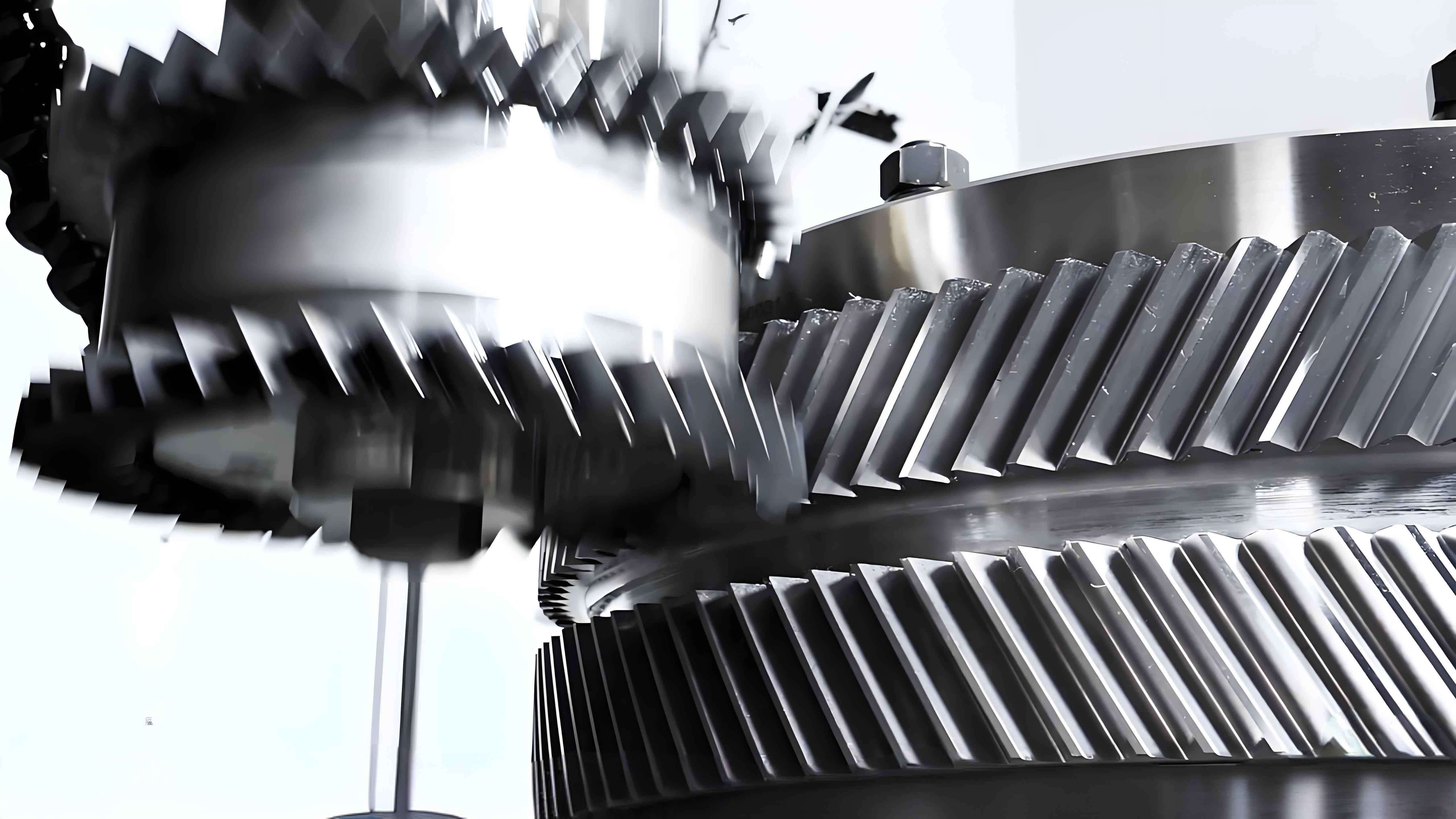
The quest for compact, high-power-density, and reliable transmission systems in demanding applications like aero-engines, marine propulsion, and heavy lifting machinery has led to the widespread adoption of planetary gear trains. Among these, the encased differential herringbone gear train represents a sophisticated and highly efficient architecture. This system ingeniously combines a two-degree-of-freedom differential planetary stage (the differential stage) with a single-degree-of-freedom star gear train (the encased stage), creating a power-split and power-merge configuration that offers exceptional torque capacity within a constrained volume.
At the heart of its performance lies the principle of load sharing among multiple planet or star gears. The uniform distribution of transmitted load across these parallel paths is paramount; it directly governs the system’s operational life, reliability, vibrational noise characteristics, and overall efficiency. Consequently, understanding and optimizing the dynamic load-sharing behavior is a critical engineering challenge. Manufacturing inaccuracies and assembly imperfections, manifesting as gear errors, are primary sources of excitation that disrupt ideal load sharing. These errors introduce periodic displacement fluctuations in the gear mesh, acting as a forcing function within the dynamic system. Analyzing the sensitivity of the encased differential herringbone gear train to specific error types, such as run-out (eccentricity) errors and meshing-frequency (transmission error) errors, provides invaluable guidance for setting manufacturing tolerances, selecting appropriate precision grades, and implementing effective floating components for load equalization.
This article presents a detailed investigation into the dynamic load-sharing characteristics of an encased differential herringbone gear transmission. A comprehensive lumped-parameter dynamic model is developed, solved, and utilized to dissect the distinct influences of run-out and meshing-frequency errors on the load distribution across both the differential and encased stages.
System Configuration and Operational Principle
The encased differential herringbone gear train, as analyzed here, consists of two integrally coupled stages. The system’s schematic layout is as follows:
- Differential Stage: This is a 2K-H type planetary gear set. It comprises a central sun gear (Zs1), N planet gears (Zpi, i=1,…,N), and a ring gear (Zr1), all mounted within a planet carrier (H). The carrier H and the ring gear Zr1 are the two output members of this differential stage.
- Encased Stage: This is a simple star gear train. It includes a central sun gear (Zs2), M star gears (Zmj, j=1,…,M), and a ring gear (Zr2). The ring gear Zr2 is typically fixed, and the star gears rotate about their own axes but do not revolve around the sun gear.
- Coupling and Floating Elements: The two stages are connected through intermediate floating components to facilitate load sharing. The ring gear (Zr1) of the differential stage is connected to a floating gear element (Zg1), which in turn connects to a floating ring (Zf1). This floating ring is linked to the sun gear (Zs2) of the encased stage. Similarly, the ring gear (Zr2) of the encased stage is connected to another set of floating components (Zg2 and Zf2). The final output is taken from the planet carrier H and the floating ring Zf2, which are both connected to the output shaft L.
Power flow begins with an input torque applied to the differential sun gear Zs1. The power splits, flowing partly through the planet gears to the carrier H and partly to the ring gear Zr1. The power from Zr1 is transmitted through the floating assembly (Zg1, Zf1) to drive the encased stage sun gear Zs2. Within the encased stage, power is transmitted from Zs2 through the star gears Zmj to the fixed ring gear Zr2 and its floating assembly. Finally, the power from the carrier H and the power reacted through the encased stage’s floating ring Zf2 merge at the output shaft L. The use of herringbone gears throughout is critical for canceling out axial thrust loads and allowing for high torque transmission with smoother engagement characteristics compared to single helical gears.
Development of the Dynamic Model
The analysis is based on a lumped-parameter modeling approach, which represents the inertia, stiffness, and damping properties of the system at discrete points. The model incorporates several key physical phenomena to ensure fidelity:
- Time-varying mesh stiffness of all herringbone gear pairs.
- Elastic deformation of the support bearings for the central members (sun and ring gears).
- Excitation from gear errors: run-out (eccentricity) and meshing-frequency (transmission) errors.
- The influence of intermediate floating components (double-tooth couplings) as essential flexible elements for load equalization.
- Damping in the gear meshes.
Model Degrees of Freedom and Coordinate Systems
The system has a total of (18 + N + M) degrees of freedom (DOF). The generalized displacement vector X is defined as:
$$ \mathbf{X} = \{ x_{s1}, H_{s1}, V_{s1}, x_{pi}, x_{r1}, H_{r1}, V_{r1}, x_{g1}, x_{f1}, x_{s2}, H_{s2}, V_{s2}, x_{mj}, x_{r2}, H_{r2}, V_{r2}, x_{g2}, x_{f2}, x_H, x_L \}^T $$
Where:
| Symbol | Description |
|---|---|
| $x_{s1}, x_{pi}, x_{r1}, x_{s2}, x_{mj}, x_{r2}$ | Torsional line displacements (along base circle) of the respective gears. |
| $H_{s1}, V_{s1}, H_{r1}, V_{r1}$ | Lateral (H) and vertical (V) displacements of the differential stage sun and ring gear centers in a rotating coordinate frame attached to the planet carrier H. |
| $H_{s2}, V_{s2}, H_{r2}, V_{r2}$ | Lateral and vertical displacements of the encased stage sun and ring gear centers in a fixed coordinate frame. |
| $x_{g1}, x_{f1}, x_{g2}, x_{f2}$ | Torsional line displacements (along pitch circle) of the intermediate floating components. |
| $x_H$ | Tangential line displacement of the planet carrier H at the planet pin radius. |
| $x_L$ | Tangential line displacement at the output shaft connection point. |
Gear Mesh Elastic Force and Damping Force
The elastic force in a gear mesh is a function of the relative displacement of the mating gears along the line of action, the time-varying mesh stiffness, and the composite error. For the sun-planet (s-p) mesh in the differential stage, the force $P_{spi}$ is given by:
$$ P_{spi} = K_{spi}(t) \cdot \delta_{spi} $$
$$ \delta_{spi} = \left[ x_{s1} – x_{pi} + H_{s1}\cos\left(\frac{\pi}{2} – \alpha_1 + \psi_i\right) + V_{s1}\cos\left(\alpha_1 – \psi_i\right) – e_{spi}(t) \right] $$
where $K_{spi}(t)$ is the time-varying mesh stiffness, $\alpha_1$ is the pressure angle, $\psi_i = 2\pi(i-1)/N$ is the planet position angle, and $e_{spi}(t)$ is the equivalent static transmission error (STE) excitation on the line of action, encompassing both run-out and meshing-frequency errors. Similar equations define the forces for the planet-ring ($P_{rpi}$), sun-star ($P_{smj}$), and star-ring ($P_{rmj}$) meshes.
The corresponding damping force $D_{spi}$ is proportional to the time derivative of the deflection along the line of action:
$$ D_{spi} = C_{sp} \cdot \dot{\delta}_{spi} $$
where $C_{sp}$ is the mesh damping coefficient, often expressed as a fraction of critical damping. The total dynamic mesh force is the sum $P_{spi} + D_{spi}$.
Time-Varying Mesh Stiffness of Herringbone Gears
Calculating the time-varying mesh stiffness for herringbone gears is fundamental to an accurate dynamic model. A herringbone gear can be treated as two identical helical gears with opposite hands of helix joined together. Therefore, its mesh stiffness can be calculated by considering the two helical halves acting in parallel. The mesh stiffness for a helical gear pair can be represented by a Fourier series expansion:
$$ k_{mesh}(t) = k_0 \left[ 1 + \sum_{q=1}^{\infty} A_q \cos(q\omega_m t – \phi_q) + B_q \sin(q\omega_m t – \phi_q) \right] \cdot L_m $$
where $k_0$ is the average mesh stiffness, $\omega_m$ is the gear mesh frequency, $A_q$ and $B_q$ are Fourier coefficients representing the stiffness variation, $\phi_q$ is the mesh phase difference between different planet/star gears, and $L_m$ is an effective face width parameter. For a herringbone gear, the total mesh stiffness $K(t)$ is approximately twice the stiffness of one helical half, assuming perfect symmetry and load sharing between the two halves. The mesh phase relationships between the multiple planet/star gears and between the internal and external meshes of the same planet gear are crucial and are calculated based on gear tooth counts and assembly angles.
Error Excitation Modeling
Gear errors are modeled as displacement excitations along the line of action. Two primary types are considered:
- Run-Out (Eccentricity) Error ($E$): This represents the radial offset of the gear’s geometric center from its rotational center, caused by manufacturing inaccuracies or mounting imperfections. It generates a once-per-revolution excitation.
- Meshing-Frequency Error ($E_{mf}$): This represents the composite transmission error due to tooth profile deviations, pitch errors, and lead errors. It generates a periodic excitation at the gear mesh frequency and its harmonics.
The equivalent displacement error $e(t)$ on the line of action for a given mesh is the superposition of the projections of the individual gear eccentricities and the inherent transmission error of the gear pair. For the sun-planet mesh:
$$ e_{spi}(t) = E_{spi} \sin(\omega_{m1} t + \varphi_{spi}) – E_{pi} \sin(\omega_{p\_H} t + \varphi_{pi} – \alpha_1) – E_{s1} \sin\left( \omega_{s\_H} t – \psi_i – \varphi_{s1} + \alpha_1 \right) $$
where $E_{spi}$ is the meshing-frequency error amplitude, $E_{s1}$ and $E_{pi}$ are the sun and planet gear eccentricity amplitudes, $\omega_{m1}$ is the differential stage mesh frequency, $\omega_{s\_H}$ and $\omega_{p\_H}$ are the relative rotational frequencies of the sun and planet with respect to the carrier, and $\varphi$ terms are phase angles.
System Equations of Motion
Applying Newton’s second law to each mass element (gear, carrier, floating component) in each degree of freedom leads to the system’s equations of motion. They can be collectively written in matrix form as:
$$ \mathbf{M} \ddot{\mathbf{X}} + \mathbf{C} \dot{\mathbf{X}} + \mathbf{K}(t) \mathbf{X} = \mathbf{F}(t) $$
Where $\mathbf{M}$ is the mass matrix, $\mathbf{C}$ is the damping matrix, $\mathbf{K}(t)$ is the stiffness matrix (which is time-periodic due to $K_{mesh}(t)$), and $\mathbf{F}(t)$ is the force vector containing static load terms, error excitations $e(t)$ and their derivatives, and gravitational forces on the non-rotating members of the encased stage.
The equations for key components include:
- Sun Gear (Differential Stage): Torsional, lateral, and vertical equilibrium equations involving the sum of mesh forces from all N planet gears, support bearing forces, and inertial terms.
- Planet Gear: Torsional equilibrium equation involving the net force from the sun-planet and planet-ring meshes.
- Ring Gear (Differential Stage): Torsional equilibrium involving the sum of planet-ring mesh forces and the connection force to the floating component $Z_{g1}$, plus lateral/vertical bearing equations.
- Floating Components: Torsional equations modeling the flexible connections (e.g., $K_{g1q}$, $K_{f1q}$) between ring gears and floating rings.
- Planet Carrier and Output Shaft: Equations governing the motion of the carrier H and the final output shaft L, which connect to the rest of the system through torsional stiffnesses $K_{HL}$ and $K_{f2L}$.
Solution Methodology and Load Sharing Coefficient
The system of equations is a set of linear differential equations with periodic coefficients due to $K(t)$. A modified Fourier series approach is employed for efficient and stable solution. The time-varying stiffness matrix is separated into a constant average part $\bar{\mathbf{K}}$ and a fluctuating part $\Delta \mathbf{K}(t)$:
$$ \mathbf{K}(t) = \bar{\mathbf{K}} + \Delta \mathbf{K}(t) $$
Similarly, the displacement response is separated into a static deflection $\bar{\mathbf{X}}$ due to the average load and a dynamic variation $\Delta \mathbf{X}(t)$:
$$ \mathbf{X}(t) = \bar{\mathbf{X}} + \Delta \mathbf{X}(t) $$
Substituting into the equation of motion and recognizing that $\bar{\mathbf{K}}\bar{\mathbf{X}} = \mathbf{F}_{static}$, a linearized equation for the dynamic component is obtained:
$$ \mathbf{M} \Delta\ddot{\mathbf{X}} + \mathbf{C} \Delta\dot{\mathbf{X}} + \bar{\mathbf{K}} \Delta \mathbf{X} = \mathbf{F}_{dynamic}(t) $$
where $\mathbf{F}_{dynamic}(t)$ contains the excitations from stiffness variation $\Delta \mathbf{K}(t)\bar{\mathbf{X}}$, error terms $e(t)$, and gravity. The fluctuating mesh stiffness and error terms in $\mathbf{F}_{dynamic}(t)$ are expanded into Fourier series. The frequency response of the system to each harmonic component (mesh frequency harmonics, rotational frequency harmonics) is calculated. The total time-domain dynamic response $\Delta \mathbf{X}(t)$ is then reconstructed by superposition of these harmonic responses.
The final dynamic mesh force for each gear pair, e.g., $F_{spi}^{dynamic}(t) = P_{spi}(t) + D_{spi}(t)$, is calculated by substituting the total response $\mathbf{X}(t)$ into the elastic force and damping force equations. The maximum dynamic mesh force for each planet/star gear over a meshing cycle is identified.
The Dynamic Load Sharing Coefficient (LSC) is the key metric for evaluating uniformity. For the differential stage with N planets, the LSC for the sun-planet meshes is defined as:
$$ LSC_{sp}^k = \frac{N \cdot \max(F_{spi}^{dynamic}(t))_k}{\sum_{i=1}^{N} \max(F_{spi}^{dynamic}(t))_k} \quad \text{for the k-th mesh cycle} $$
$$ LSC_{sp} = \max_k\left( |LSC_{sp}^k – 1| \right) + 1 $$
A perfectly even load distribution yields an LSC of 1.0. A value greater than 1.0 indicates uneven sharing, with a higher value signifying worse distribution. The stage’s overall LSC is the maximum of the LSCs calculated for its external (sun-planet) and internal (planet-ring) meshes.
Analysis of Error Effects on Load Sharing
The investigation focuses on a specific high-power transmission case with the following key parameters:
| Parameter | Differential Stage | Encased Stage |
|---|---|---|
| Module | 7 mm | 7 mm |
| Number of Planets/Stars (N, M) | 3 | 5 |
| Sun Gear Teeth (Zs) | 37 | 71 |
| Planet/Star Gear Teeth (Zp, Zm) | 56 | 39 |
| Ring Gear Teeth (Zr) | 149 | 149 |
| Helix Angle (β) | 22° | 22° |
| Nominal Input Speed/Power | 3000 rpm / 20,000 kW | |
The support stiffness for central members is set to $3 \times 10^8$ N/m. The baseline error values used are: gear eccentricity $E = 20 \mu m$ and meshing-frequency error $E_{mf} = 8 \mu m$.
Effect of Run-Out Error in Isolation
To isolate the effect of run-out error, the meshing-frequency error is set to zero. With only eccentricity errors present, the calculated load sharing coefficients are:
$$ LSC_{diff}^{run-out-only} \approx 1.023 $$
$$ LSC_{enc}^{run-out-only} \approx 1.146 $$
The results show that the encased stage is significantly more sensitive to run-out errors than the differential stage. This can be attributed to the load equalization mechanism. Both stages employ floating sun and ring gears (central members) to compensate for errors. However, the effectiveness of this floating compensation diminishes when the number of load paths (planets/stars) exceeds three. The differential stage has 3 planets (N=3), where central floating is quite effective. The encased stage has 5 stars (M=5), where the same floating mechanism is less capable of correcting the load imbalance induced by eccentricities, leading to a higher LSC.
Effect of Meshing-Frequency Error in Isolation
Conversely, to isolate the effect of meshing-frequency error, the eccentricity errors are set to zero. With only transmission errors present, the load sharing coefficients are:
$$ LSC_{diff}^{mesh-err-only} \approx 1.291 $$
$$ LSC_{enc}^{mesh-err-only} \approx 1.007 $$
Here, the trend is dramatically reversed. The differential stage shows extreme sensitivity to meshing-frequency errors, while the encased stage remains nearly perfectly balanced. The primary reason is the significant difference in the load level carried by the gear meshes in each stage. From fundamental planetary gear theory, the torque passing through the encased stage sun gear $Z_{s2}$ is much larger than that passing through the differential stage sun gear $Z_{s1}$, specifically by a factor related to the ratio $Z_{r1}/Z_{s1}$. A fundamental characteristic of gear systems is that load sharing tends to improve with increasing nominal load. The high load in the encased stage meshes effectively “swamps” the displacement perturbations caused by typical meshing-frequency errors, forcing a more even distribution. The lower-loaded differential stage meshes are far more susceptible to these errors, resulting in poor load sharing.
Combined Effect and Parametric Sensitivity
Under the combined action of both error types (E=20 μm, Emf=8 μm), the load sharing coefficients are:
$$ LSC_{diff}^{combined} \approx 1.292 $$
$$ LSC_{enc}^{combined} \approx 1.144 $$
The differential stage LSC is dominated by the meshing-frequency error, showing little change from its “mesh-err-only” value. The encased stage LSC is dominated by the run-out error, closely matching its “run-out-only” value. This confirms the decoupled nature of the primary influences: differential stage LSC is governed by meshing-frequency error, while encased stage LSC is governed by run-out error.
Parametric studies further illustrate this:
1. Varying Run-Out Error (with fixed $E_{mf}=8 \mu m$):
The differential stage LSC remains virtually constant near 1.29 as run-out error increases from 0 to 40 μm. In contrast, the encased stage LSC increases linearly from about 1.0 to 1.29. This is summarized by the relation:
$$ LSC_{enc} \approx 1.0 + \kappa_{run-out} \cdot E $$
where $\kappa_{run-out}$ is a positive sensitivity constant.
2. Varying Meshing-Frequency Error (with fixed $E=20 \mu m$):
The encased stage LSC remains nearly constant at 1.145 as meshing-frequency error increases. The differential stage LSC, however, shows a strong, approximately linear increase. Its behavior can be approximated by:
$$ LSC_{diff} \approx 1.02 + \kappa_{mesh} \cdot E_{mf} $$
where $\kappa_{mesh}$ is a sensitivity constant significantly larger than $\kappa_{run-out}$ for the encased stage.
| Stage | Dominant Error Influence | Primary Reason | Typical LSC Trend |
|---|---|---|---|
| Differential Stage | Meshing-Frequency Error ($E_{mf}$) | Lower nominal load per mesh path; central floating effective for N=3 against run-out. | $$ LSC_{diff} \uparrow \text{ with } E_{mf} \uparrow $$ Insensitive to $E$. |
| Encased Stage | Run-Out Error ($E$) | High nominal load negates $E_{mf}$ effects; central floating less effective for M>3 against run-out. | $$ LSC_{enc} \uparrow \text{ with } E \uparrow $$ Insensitive to $E_{mf}$. |
A critical observation is that the magnitude of the LSC for the differential stage under the influence of meshing-frequency error (e.g., ~1.29) is substantially higher than that for the encased stage under the influence of run-out error (~1.15). This indicates that meshing-frequency errors pose a more severe threat to load sharing uniformity than run-out errors in this class of transmission. Consequently, in the combined state, the differential stage consistently exhibits worse load sharing (higher LSC) than the encased stage. The uneven load distribution among the planet gears in the differential stage is a more critical design concern.
Conclusion
This comprehensive dynamic analysis of an encased differential herringbone gear train elucidates the complex and distinct roles played by manufacturing and assembly errors on load sharing performance. The use of a detailed lumped-parameter model, incorporating time-varying herringbone gear mesh stiffness, support elasticity, floating components, and explicit error excitations, allows for a clear separation of effects.
The key findings are:
- The load sharing characteristics of the two stages are governed by different types of errors. The differential stage’s load sharing coefficient is predominantly determined by meshing-frequency (transmission) errors and is highly sensitive to them, increasing linearly with the error amplitude. It remains largely unaffected by run-out errors due to the effectiveness of central floating with three planets.
- The encased stage’s load sharing coefficient is predominantly determined by run-out (eccentricity) errors and is sensitive to them, increasing with the error amplitude. It is virtually unaffected by meshing-frequency errors because the high nominal load carried by its meshes promotes natural load sharing, overwhelming the displacement perturbations from typical transmission errors.
- The influence of meshing-frequency error on the differential stage is significantly stronger than the influence of run-out error on the encased stage. Therefore, under combined error conditions typical of real systems, the differential stage consistently exhibits a higher (worse) load sharing coefficient than the encased stage. This makes the planet gear load distribution in the differential stage the more critical focus for reliability and design enhancement.
These insights have direct practical implications. For the design of such high-power herringbone gear transmissions, greater emphasis should be placed on controlling tooth profile and pitch accuracy (to minimize meshing-frequency error) for the gears in the differential stage. For the encased stage, controlling gear and mounting eccentricity becomes relatively more important. Furthermore, the results validate that simply increasing the number of load paths (e.g., using 5 stars) for strength reasons can compromise the effectiveness of common floating designs in mitigating run-out-induced imbalance, necessitating careful design of the floating elements themselves. This analysis provides a foundational framework for optimizing the dynamic performance and reliability of complex encased differential herringbone gear transmission systems.