
This study investigates the dynamic meshing characteristics and fatigue behavior of high-speed helical gears through finite element modeling, transient analysis, and fatigue life prediction. A multi-degree-of-freedom rotor-bearing system model with Timoshenko beam elements is established to analyze vibration responses under high-speed conditions.
1. Dynamic Modeling of Helical Gear System
The rotor-bearing system dynamics considers six degrees of freedom (x, y, z, θx, θy, θz) using Timoshenko beam elements. The governing equation is formulated as:
$$ M\ddot{x} + (C + \Omega G)\dot{x} + Kx = F $$
Where:
$M$ = Mass matrix
$C$ = Damping matrix
$G$ = Gyroscopic matrix
$K$ = Stiffness matrix
$\Omega$ = Rotational speed
$F$ = External force vector
2. Meshing Stiffness Calculation
The time-varying meshing stiffness of helical gears is expressed as:
$$ k(t) = k_0 L(\tau) $$
$$ L(\tau) = \left\{1 + \sum_{n=1}^{\infty} [A_n\cos(2\pi n\tau) + B_n\sin(2\pi n\tau)]\right\} L_m $$
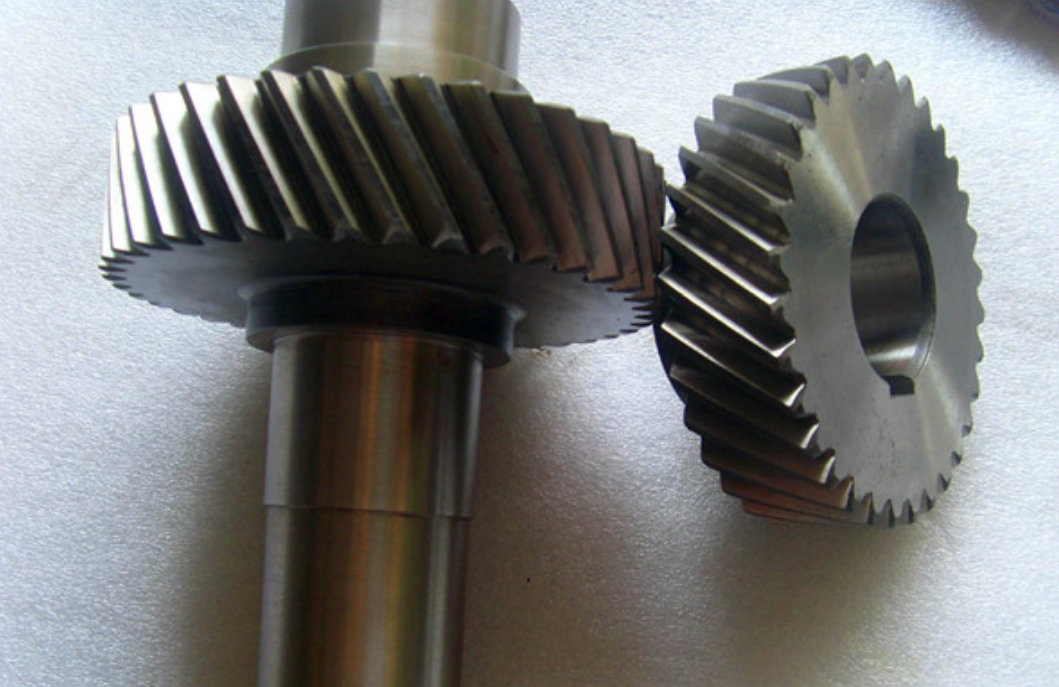
Parameters for a typical helical gear pair are listed below:
| Parameter | Pinion | Gear |
|---|---|---|
| Teeth Number (Z) | 21 | 65 |
| Module (mm) | 1.5 | 1.5 |
| Pressure Angle (°) | 20 | 20 |
| Helix Angle (°) | 25 | 25 |
| Face Width (mm) | 30 | 28 |
3. Profile Modification Strategy
Optimal modification parameters for helical gears are determined through transmission error analysis:
| Modification Type | Pinion | Gear |
|---|---|---|
| Tip Relief (μm) | – | 10 |
| Crowning (μm) | 5 | – |
| Lead Angle (arcmin) | -3 | – |
The modification reduces maximum contact stress by 9.7% and improves load distribution:
$$ \Delta \sigma_{max} = \frac{\sigma_{unmodified} – \sigma_{modified}}{\sigma_{unmodified}} \times 100\% = 9.7\% $$
4. Transient Dynamics Analysis
The Newmark-β method solves the dynamic response with following convergence criteria:
$$ \gamma = \frac{1}{2}, \quad \beta = \frac{1}{4} $$
$$ \Delta t \leq \frac{1}{20f_{max}} $$
Critical natural frequencies of the helical gear system are:
| Mode | Frequency (Hz) | Vibration Type |
|---|---|---|
| 1st | 22 | Backward Whirl |
| 2nd | 26 | Forward Whirl |
| 3rd | 59 | Backward Whirl |
5. Fatigue Life Prediction
The modified Miner’s rule estimates fatigue life using S-N curves:
$$ D = \sum \frac{n_i}{N_i} $$
$$ N = \left(\frac{\sigma_a}{\sigma_{f’}}\right)^{-b} $$
Fatigue life improvement through modification:
| Parameter | Unmodified | Modified |
|---|---|---|
| Minimum Life (cycles) | 1.2×10⁷ | 2.1×10⁷ |
| Safety Factor | 0.83 | 0.92 |
6. Stress Distribution Analysis
Von Mises stress distribution shows maximum stress reduction in modified helical gears:
$$ \sigma_{vm} = \sqrt{\frac{(\sigma_1-\sigma_2)^2 + (\sigma_2-\sigma_3)^2 + (\sigma_3-\sigma_1)^2}{2}} $$
Stress concentration factors decrease from 1.58 (unmodified) to 1.42 (modified) at tooth root.
7. Dynamic Transmission Error
Modification reduces transmission error by 15.6%:
$$ \Delta TE = \frac{TE_{unmodified} – TE_{modified}}{TE_{unmodified}} \times 100\% = 15.6\% $$
The dynamic model demonstrates that proper helical gear modification effectively reduces vibration amplitudes:
$$ X_{amp} = \frac{1}{N} \sum_{i=1}^{N} |x_i – \bar{x}| $$
8. Thermal Effects Consideration
Thermal deformation compensation in helical gears is calculated as:
$$ \delta_{thermal} = \alpha \Delta T L $$
Where:
$\alpha$ = Thermal expansion coefficient (11.7×10⁻⁶/°C for 20CrMnTiH)
$\Delta T$ = Temperature rise (°C)
$L$ = Characteristic length (mm)
9. Lubrication Analysis
Film thickness calculation for helical gear contact:
$$ h_{min} = 1.6R\left(\frac{\eta_0 u}{E’ R}\right)^{0.7} \left(\frac{w}{E’ R^2}\right)^{-0.13} $$
Where:
$\eta_0$ = Lubricant viscosity
$u$ = Rolling velocity
$E’$ = Equivalent elastic modulus
This comprehensive analysis methodology provides critical insights for optimizing helical gear performance in high-speed applications, demonstrating significant improvements in stress distribution, fatigue life, and dynamic stability through systematic profile modification.