
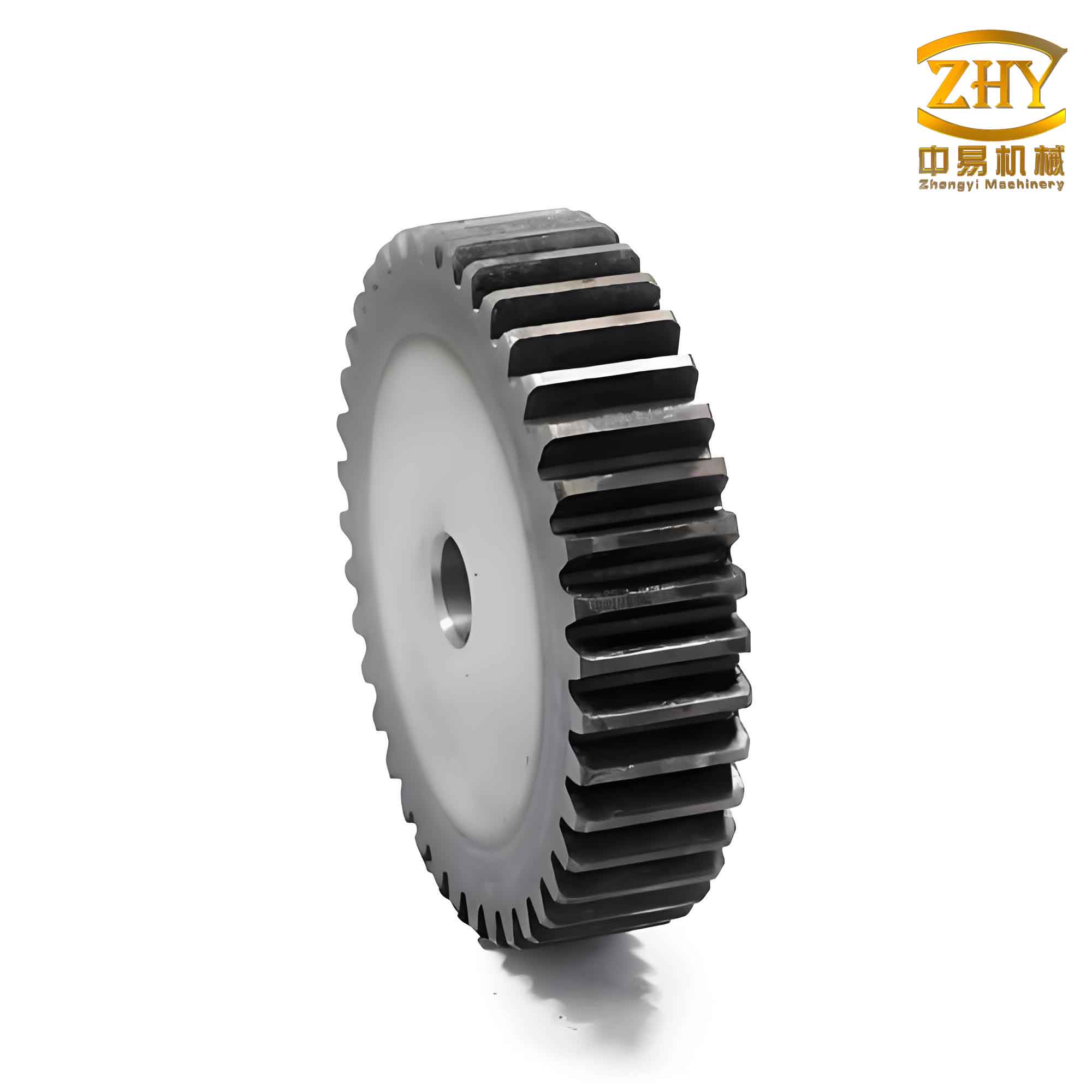
In the field of mechanical transmissions, spur and pinion gears are fundamental components due to their simplicity, efficiency, and reliability. However, the meshing process in these gears is inherently dynamic, influenced by internal excitations such as time-varying meshing stiffness (TVMS). Profile modification, which involves altering the tooth geometry through shifting coefficients, is a critical technique to enhance performance, reduce vibration, and minimize noise. This study focuses on investigating the effects of tooth profile modification on the TVMS and dynamic characteristics of spur and pinion gear systems. By developing an analytical model that accounts for various stiffness components and geometric designs, I aim to provide insights into how single and compound modifications impact gear behavior, ultimately guiding optimal design practices for improved transmission systems.
The importance of spur and pinion gears in applications ranging from automotive to industrial machinery cannot be overstated. These gears transmit power and motion through direct tooth engagement, but their operation is often marred by vibrations and noise stemming from periodic stiffness variations. Profile modification, achieved by adjusting the addendum or dedendum via modification coefficients, offers a way to tailor gear properties for specific needs. For instance, positive modification increases tooth thickness, while negative modification can enhance contact ratios. Understanding the interplay between modification parameters and dynamic responses is crucial for designing gears that are both durable and quiet. In this research, I explore these relationships through a comprehensive analytical framework, emphasizing the role of TVMS as a primary internal excitation source. By leveraging numerical simulations and statistical metrics, I evaluate how different modification strategies affect the meshing stiffness and vibrational behavior of spur and pinion gears, contributing to the advancement of gear transmission technology.
To begin, I establish a detailed analytical model for calculating the time-varying meshing stiffness (TVMS) of spur and pinion gears with profile modification. This model is based on the potential energy method, where the gear tooth is treated as a cantilever beam with varying cross-sections. The total potential energy stored during meshing comprises several components: Hertzian contact energy, bending energy, shear energy, axial compression energy, and fillet foundation energy. Each of these energies corresponds to a specific stiffness, and their contributions are combined to derive the overall TVMS. For a pair of spur and pinion gears, the stiffness can be expressed as follows:
$$U_h = \frac{F^2}{2k_h}, \quad U_b = \frac{F^2}{2k_b}, \quad U_s = \frac{F^2}{2k_s}, \quad U_a = \frac{F^2}{2k_a}, \quad U_f = \frac{F^2}{2k_f}$$
where \( F \) is the meshing force, and \( k_h, k_b, k_s, k_a, k_f \) represent Hertzian contact stiffness, bending stiffness, shear stiffness, axial compression stiffness, and fillet foundation stiffness, respectively. The total potential energy for a single gear pair is given by:
$$U = \frac{F^2}{2k} = U_h + U_{b1} + U_{s1} + U_{a1} + U_{f1} + U_{b2} + U_{s2} + U_{a2} + U_{f2}$$
This leads to the TVMS formula for single-tooth and double-tooth meshing regions:
$$k =
\begin{cases}
\frac{1}{\frac{1}{k_h} + \frac{1}{k_{b1}} + \frac{1}{k_{s1}} + \frac{1}{k_{a1}} + \frac{1}{k_{f1}} + \frac{1}{k_{b2}} + \frac{1}{k_{s2}} + \frac{1}{k_{a2}} + \frac{1}{k_{f2}}}, & \text{single-tooth pair} \\
\sum_{i=1}^{2} \frac{1}{\frac{1}{k_{h,i}} + \frac{1}{k_{b1,i}} + \frac{1}{k_{s1,i}} + \frac{1}{k_{a1,i}} + \frac{1}{k_{f1,i}} + \frac{1}{k_{b2,i}} + \frac{1}{k_{s2,i}} + \frac{1}{k_{a2,i}} + \frac{1}{k_{f2,i}}}, & \text{double-tooth pair}
\end{cases}$$
The geometric parameters for spur and pinion gears, such as tooth height and transition curves, depend on the modification coefficients. Two cases are considered: when the root circle is smaller than the base circle (Case 1) and when it is larger (Case 2). For Case 1, the tooth profile consists of an involute curve from the tip to the base circle and a transition curve below, with geometric relations defined by parameters like \( \phi_1, \phi_2, \) and \( h_1 \). The stiffness components are integrated over these regions. For example, the bending stiffness contribution is calculated as:
$$\frac{1}{k_b} = -\int_{\phi_2}^{\phi_3} \frac{3a_x (R_b – R_f \cos \phi_3) \cos \phi_1 – a_x \phi \cos \phi_1 – b_x \cos \phi_1}{2E L \left[ R_b \sin \phi_2 + r_f – \sqrt{r_f^2 – (x – d_1)^2} \right]^3} d\phi + \int_{-\phi_1}^{\phi_2} \frac{3\{1 + \cos \phi_1 [(\phi_2 – \phi) \sin \phi – \cos \phi]\}^2 (\phi_2 – \phi) \cos \phi}{2E L [\sin \phi_2 + (\phi_2 – \phi) \cos \phi]^3} d\phi$$
where \( E \) is Young’s modulus, \( L \) is the tooth width, \( R_b \) is the base circle radius, and other terms are geometric constants. Similarly, shear and axial compression stiffnesses are derived. For Case 2, where the entire profile is involute, the integrals simplify. The Hertzian contact stiffness is given by \( k_h = \frac{\pi E L}{4(1 – \nu^2)} \), with \( \nu \) as Poisson’s ratio. The fillet foundation stiffness follows Sainsot’s formula: \( \frac{1}{k_f} = \frac{\cos^2 \beta}{E L} \left[ L^* \left( \frac{u_f}{S_f} \right)^2 + M^* \left( \frac{u_f}{S_f} \right) + P^* (1 + Q^* \tan^2 \phi_1) \right] \), where \( \beta, u_f, S_f, L^*, M^*, P^*, Q^* \) are coefficients from literature.
The geometric relationships for modified spur and pinion gears are crucial, especially when the modification coefficients differ between the pinion and gear. In such cases, the pitch circle no longer coincides with the reference circle, altering the pure rolling positions. The angles \( \phi_{1,p} \) and \( \phi_{1,g} \) for the pinion and gear at meshing start are defined as:
$$\phi_{1,p} = \phi_{01,p} + \beta_p, \quad \phi_{1,g} = \phi_{01,g} – i_g \beta_g$$
where \( i_g \) is the gear ratio, and \( \phi_{01} \) are initial angles derived from geometric constraints. For instance, \( \phi_{01,p} = \tan \left( \arccos \left( \frac{R_{b,p}}{\sqrt{R_{a,g}^2 + a’^2 – 2R_{a,g} a’ \cos(\arccos(R_{b,g}/R_{a,g}) – \phi_0′)}} \right) \right) – 2\phi_{2,p} \). These angles ensure accurate modeling of the meshing process for spur and pinion gears with profile shifts.
To analyze the dynamic behavior, I adopt a six-degree-of-freedom lumped parameter model for the spur and pinion gear system. This model considers translational and rotational motions along and perpendicular to the line of action, as axial vibrations are negligible for spur gears. The equations of motion are:
$$m_p \ddot{x}_p + c_b \dot{x}_p + k_b x_p = -F_m$$
$$m_p \ddot{y}_p + c_b \dot{y}_p + k_b y_p = -F_f$$
$$I_p \ddot{\beta}_p = -F_m R_{b,p} – T_p$$
$$m_g \ddot{x}_g + c_b \dot{x}_g + k_b x_g = F_m$$
$$m_g \ddot{y}_g + c_b \dot{y}_g + k_b y_g = F_f$$
$$I_g \ddot{\beta}_g = -F_m R_{b,g} – T_g$$
Here, \( m_p, m_g \) and \( I_p, I_g \) are the masses and moments of inertia of the pinion and gear, respectively; \( c_b, k_b \) are bearing damping and stiffness; \( T_p, T_g \) are input and output torques. The meshing force \( F_m \) and friction force \( F_f \) are defined as:
$$F_m = k(t) [x_p – x_g + R_{b,g} \beta_g – e(t)] + c_m [\dot{x}_p – \dot{x}_g + \dot{R}_{b,g} \dot{\beta}_g – \dot{e}(t)]$$
$$F_f = -\mu F_m$$
where \( e(t) \) is static transmission error, \( \mu \) is friction coefficient, and \( c_m \) is meshing damping coefficient calculated as \( c_m = 2\zeta \sqrt{\bar{k}_m m} \), with \( \zeta \) as damping ratio, \( \bar{k}_m \) as average meshing stiffness, and \( m \) as equivalent mass \( m = \frac{m_p m_g}{m_p + m_g} \). The dynamic transmission error (DTE) is a key metric: \( \text{DTE} = x_p – x_g + R_{b,p} \beta_p + R_{b,g} \beta_g – e(t) \). To assess vibration, I use statistical indicators in the time domain: root mean square (RMS), square root amplitude (SRA), peak-to-peak value (PPV), and kurtosis value (KV), defined as:
$$X_{\text{rms}} = \sqrt{\frac{1}{N} \sum_{i=1}^{N} x_i^2}, \quad X_{\text{sra}} = \left( \frac{1}{N} \sum_{i=1}^{N} \sqrt{|x_i|} \right)^2$$
$$X_{\text{ppv}} = \max(x_i) – \min(x_i), \quad X_{\text{kv}} = \frac{1}{N} \sum_{i=1}^{N} \left( \frac{x_i – \bar{x}}{\sigma} \right)^4$$
where \( \bar{x} \) is mean acceleration and \( \sigma \) is standard deviation. These indicators help quantify the effects of profile modification on spur and pinion gear dynamics.
For the case studies, I consider a spur and pinion gear pair with parameters as listed in Table 1. These values are typical for industrial applications and serve as a baseline for evaluating modification effects.
| Parameter | Pinion | Gear |
|---|---|---|
| Number of Teeth | 22 | 133 |
| Module (mm) | 5 | 5 |
| Tooth Width (mm) | 70 | 70 |
| Pressure Angle (°) | 20 | 20 |
| Addendum Coefficient | 1.1 | 1.1 |
| Dedendum Coefficient | 0.25 | 0.25 |
| Young’s Modulus (GPa) | 206 | 206 |
| Poisson’s Ratio | 0.3 | 0.3 |
| Density (kg/m³) | 7850 | 7850 |
| Bearing Stiffness (N/m) | 1 × 10¹⁰ | |
| Mass (kg) | 3.08 | 147.61 |
| Moment of Inertia (kg·m²) | 6.66 × 10⁻⁹ | 8.936 |
First, I analyze single profile modification, focusing on the pinion. Positive modification coefficients (e.g., 0, 0.1, 0.2, 0.3, 0.4, 0.5) are examined for their impact on single-tooth stiffness. The results, summarized in Table 2, show that positive modification increases tooth thickness but reduces stiffness in certain meshing phases. The TVMS for the spur and pinion gear pair decreases with higher positive coefficients, as illustrated in Figure 9 from the reference. The mean and standard deviation of TVMS exhibit nonlinear trends: mean stiffness declines slowly for small modifications but accelerates for larger ones, while standard deviation rises sharply initially then plateaus. Statistical indicators for DTE, under damping ratios \( \zeta = 0.07, 0.08, 0.09, 0.1 \), indicate that positive modification generally exacerbates vibration, with RMS and SRA increasing monotonically. For instance, at \( \zeta = 0.1 \), a modification coefficient of 0.5 raises RMS by about 15% compared to the unmodified case.
| Modification Coefficient | Single-Tooth Stiffness Change (%) | TVMS Mean (N/m) | TVMS Std Dev (N/m) | DTE RMS Increase (%) |
|---|---|---|---|---|
| 0.0 | 0.0 | 1.640 × 10⁹ | 2.40 × 10⁸ | 0.0 |
| 0.1 | +5.2 | 1.625 × 10⁹ | 2.65 × 10⁸ | +3.1 |
| 0.2 | +9.8 | 1.605 × 10⁹ | 2.85 × 10⁸ | +6.7 |
| 0.3 | +13.5 | 1.580 × 10⁹ | 3.00 × 10⁸ | +10.5 |
| 0.4 | +16.1 | 1.550 × 10⁹ | 3.10 × 10⁸ | +14.2 |
| 0.5 | +18.0 | 1.515 × 10⁹ | 3.15 × 10⁸ | +18.0 |
Negative modification coefficients (e.g., 0, -0.1, -0.2, -0.3, -0.4, -0.5) are then evaluated. Contrary to positive shifts, negative modification enhances tooth stiffness and improves contact ratio. As shown in Table 3, single-tooth stiffness decreases in magnitude but TVMS increases overall due to better load distribution. The mean TVMS rises linearly with more negative coefficients, while standard deviation decreases steadily. This leads to smoother operation, with DTE statistical indicators showing reductions in RMS and SRA. For example, at \( \zeta = 0.1 \), a coefficient of -0.5 lowers RMS by approximately 2%, indicating vibration suppression. The KV values change minimally, suggesting that negative modification does not significantly alter peak intensities but stabilizes the meshing process.
| Modification Coefficient | Single-Tooth Stiffness Change (%) | TVMS Mean (N/m) | TVMS Std Dev (N/m) | DTE RMS Decrease (%) |
|---|---|---|---|---|
| 0.0 | 0.0 | 1.640 × 10⁹ | 2.40 × 10⁸ | 0.0 |
| -0.1 | -1.5 | 1.650 × 10⁹ | 2.30 × 10⁸ | -0.8 |
| -0.2 | -2.9 | 1.660 × 10⁹ | 2.20 × 10⁸ | -1.5 |
| -0.3 | -4.2 | 1.670 × 10⁹ | 2.10 × 10⁸ | -2.1 |
| -0.4 | -5.3 | 1.680 × 10⁹ | 2.00 × 10⁸ | -2.6 |
| -0.5 | -6.2 | 1.690 × 10⁹ | 1.90 × 10⁸ | -3.0 |
Next, I investigate compound modification, where both spur and pinion gears are modified. Two common types are analyzed: S-gearing (with non-zero total modification coefficient) and s0-gearing (with zero total coefficient). For S-gearing, positive total coefficients (e.g., pinion +0.4, gear +0.1) reduce TVMS and contact ratio, intensifying vibrations, while negative total coefficients (e.g., pinion +0.1, gear -0.6) increase TVMS and contact ratio, damping vibrations. s0-gearing, with equal but opposite coefficients (e.g., pinion +0.1, gear -0.1), has minimal impact on TVMS but affects dynamic characteristics due to asymmetric shifts. Table 4 summarizes the TVMS and DTE responses for different compound modifications under \( \zeta = 0.1 \). The results highlight that negative compound modifications are beneficial for reducing vibration in spur and pinion gear systems, whereas positive ones should be used cautiously.
| Modification Type | Pinion Coefficient | Gear Coefficient | Total Coefficient | TVMS Mean (N/m) | DTE RMS Change (%) | Contact Ratio |
|---|---|---|---|---|---|---|
| S-gearing (Positive) | +0.4 | +0.1 | +0.5 | 1.50 × 10⁹ | +12.5 | 1.45 |
| S-gearing (Positive) | +0.2 | +0.1 | +0.3 | 1.55 × 10⁹ | +8.3 | 1.50 |
| S-gearing (Negative) | +0.1 | -0.6 | -0.5 | 1.70 × 10⁹ | -4.2 | 1.65 |
| S-gearing (Negative) | +0.1 | -0.4 | -0.3 | 1.68 × 10⁹ | -2.9 | 1.60 |
| s0-gearing | +0.1 | -0.1 | 0.0 | 1.64 × 10⁹ | +1.2 | 1.55 |
| Standard | 0.0 | 0.0 | 0.0 | 1.64 × 10⁹ | 0.0 | 1.55 |
The dynamic responses are further analyzed through frequency spectra and statistical metrics. For positive single modifications, the vibration amplitude at meshing frequency increases, as seen in RMS and PPV growth. Negative modifications show amplitude reduction, confirming their damping effect. In compound cases, S-gearing with negative shifts not only raises TVMS but also flattens the frequency spectrum, indicating smoother operation. The kurtosis values reveal that positive modifications make the vibration signal more peaked, implying higher impact forces, while negative modifications lead to a more uniform distribution. These insights are vital for designing spur and pinion gears that meet specific noise and vibration criteria.
In conclusion, this study establishes a robust analytical model for evaluating the meshing dynamics of spur and pinion gears with profile modification. The TVMS model, incorporating Hertzian contact, bending, shear, axial compression, and fillet foundation stiffnesses, provides a accurate representation of gear behavior under various modification scenarios. Through numerical simulations, I demonstrate that single positive modification reduces tooth stiffness and TVMS, exacerbating vibrations, whereas single negative modification enhances stiffness and TVMS, promoting stability. For compound modifications, S-gearing with negative total coefficients significantly boosts TVMS and dampens vibrations, while s0-gearing has a minor effect on stiffness but alters dynamic responses. These findings underscore the importance of carefully selecting modification coefficients to optimize the performance of spur and pinion gear systems. Future work could extend this model to include thermal effects or nonlinearities, further refining gear design for advanced applications.