
In modern mechanical transmission systems, spur gears play a critical role in power transmission, particularly in vehicle reducers. However, the dynamic performance of spur gears is significantly influenced by external excitations, such as road irregularities and bridge vibrations, which introduce time-varying and stochastic components into the system. These excitations can exacerbate meshing impacts and energy losses, leading to reduced reliability and increased noise. This study focuses on analyzing the meshing impact characteristics and energy consumption of spur gears under combined time-varying and random excitations. We develop a comprehensive nonlinear dynamic model that incorporates tooth surface friction, time-varying meshing positions, and backlash effects. By employing Poincaré mapping and nonlinear vibration theory, we investigate the evolution of dynamic meshing forces and impact energy losses with respect to key parameters like meshing frequency and error amplitude. Our findings provide insights into optimizing spur gear systems for enhanced dynamic performance and durability.
The dynamic behavior of spur gears is governed by complex interactions between meshing forces, friction, and external excitations. To accurately model these interactions, we consider a simplified physical model of a spur gear pair, where the gears are assumed to be rigidly supported. The model accounts for the relative motion along the line of action, incorporating time-varying meshing stiffness, damping, and error excitations. The external load is characterized by a combination of harmonic and stochastic components, representing the time-varying and random nature of real-world operating conditions. The governing equations are derived based on Newton’s laws and transformed into dimensionless form to facilitate analysis. Key parameters include the meshing frequency $\omega$, error amplitude $\varepsilon$, and backlash $d$. The dimensionless dynamic equation is expressed as:
$$ \ddot{x} + [1 + \chi(\tau) \mu(\tau) \gamma(\tau)] [k(t) f(x) + \xi \dot{x}] = \Lambda + G [\kappa \cos(\omega t) + \Theta \zeta(i)] + \varepsilon \omega^2 \cos(\omega t) $$
where $x$ is the relative displacement along the line of action, $f(x)$ is the backlash function defined as:
$$ f(x) = \begin{cases} x – d & \text{if } x > d \\ 0 & \text{if } |x| < d \\ x + d & \text{if } x < -d \end{cases} $$
and $\zeta(i)$ represents Gaussian white noise simulated using Monte-Carlo methods. The impact dynamics are modeled by considering energy losses during tooth surface and back-side contacts, with the post-impact velocity given by:
$$ \dot{x}_+ = \sqrt{ \dot{x}_-^2 – \frac{2\xi(1+r)}{2\xi \dot{x}_- + 3k(t)} \dot{x}_-^3 } $$
where $\dot{x}_-$ and $\dot{x}_+$ are the velocities before and after impact, respectively, and $r$ is the restitution coefficient. The maximum impact energy loss $\Delta E$ is derived from this relation and used to evaluate system performance.
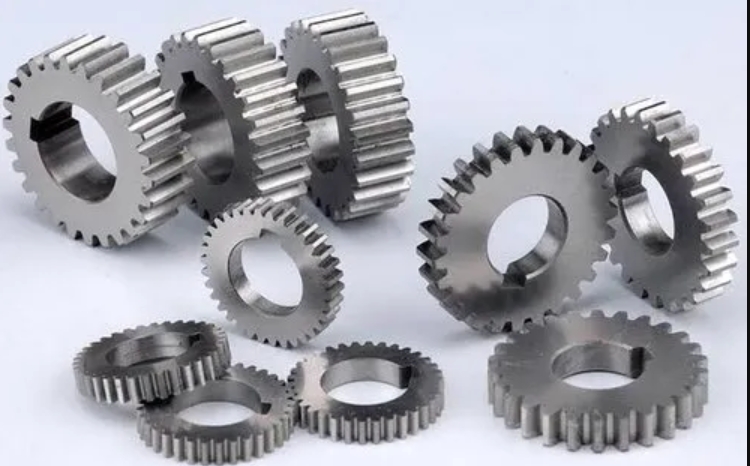
To analyze the meshing impact characteristics, we construct Poincaré mapping sections for tooth surface and back-side contacts, denoted as $\Pi_1$ and $\Pi_2$, respectively. These sections capture the dynamic behavior at the instants of impact, allowing us to study the evolution of meshing forces and energy losses. The dynamic meshing force $F_a$ is computed as:
$$ F_a = [1 + \chi(\tau) \mu(\tau) \gamma(\tau)] [k(t) f(x) + \xi \dot{x}] $$
We first examine the effects of varying the error amplitude $\varepsilon$ on the system dynamics. For a fixed meshing frequency $\omega = 1.5$, damping ratio $\xi = 0.08$, and other parameters held constant, we observe that small $\varepsilon$ values result in no impacts, with the system remaining in continuous meshing. As $\varepsilon$ increases, tooth surface impacts occur, leading to periodic and chaotic behaviors. The bifurcation diagram of meshing forces on $\Pi_1$ and $\Pi_2$ shows transitions from period-1 to period-2 motions and eventually to chaos, accompanied by significant increases in impact energy losses. For instance, at $\varepsilon \approx 0.15$, a period-doubling bifurcation occurs, and at $\varepsilon \approx 0.25$, chaos emerges, with maximum energy losses reaching up to 34 units. The following table summarizes the impact energy losses for different $\varepsilon$ ranges:
| Error Amplitude $\varepsilon$ Range | Impact Type | Maximum Energy Loss $\Delta E$ | Dynamic Behavior |
|---|---|---|---|
| 0.01 – 0.10 | No impact | 0 | Period-1 |
| 0.10 – 0.20 | Tooth surface impact | 0 – 5 | Period-2 to Chaos |
| 0.20 – 0.30 | Tooth surface and back-side impacts | 5 – 34 | Chaotic |
Next, we investigate the influence of meshing frequency $\omega$ on the spur gear dynamics, with $\varepsilon = 0.23$. As $\omega$ increases from 0.1 to 2.5, the system undergoes similar bifurcations, starting from no impacts at low frequencies to severe impacts at higher frequencies. The bifurcation diagram reveals that tooth surface impacts begin at $\omega \approx 0.8$, and back-side impacts appear at $\omega \approx 1.8$. The maximum impact energy loss peaks in the range of $\omega = 1.8$ to 2.2, where chaotic motion dominates. The table below outlines the relationship between $\omega$ and impact characteristics:
| Meshing Frequency $\omega$ Range | Impact Type | Maximum Energy Loss $\Delta E$ | Dynamic Behavior |
|---|---|---|---|
| 0.1 – 0.8 | No impact | 0 | Period-1 |
| 0.8 – 1.8 | Tooth surface impact | 0 – 10 | Period-2 to Chaos |
| 1.8 – 2.5 | Tooth surface and back-side impacts | 10 – 30 | Chaotic |
The interaction between error amplitude $\varepsilon$ and meshing frequency $\omega$ is crucial for understanding the overall energy dissipation in spur gears. We analyze the two-parameter plane $\varepsilon$-$\omega$ to map the distribution of maximum impact energy losses. The results indicate that low values of both parameters ($\varepsilon < 0.15$ and $\omega < 1.25$) result in minimal energy losses, while high values ($\varepsilon > 0.2$ and $\omega > 1.8$) lead to significant losses, exceeding 30 units. This highlights the importance of parameter matching in practical applications. For instance, in high-frequency operations, using spur gears with low error amplitudes can mitigate impact effects. Conversely, for gears with inherent errors, operating at lower frequencies reduces energy dissipation. The following equation approximates the maximum energy loss $\Delta E$ as a function of $\varepsilon$ and $\omega$ based on our simulations:
$$ \Delta E \approx \alpha \varepsilon^2 \omega^2 + \beta \varepsilon \omega + \gamma $$
where $\alpha$, $\beta$, and $\gamma$ are constants derived from curve fitting. This empirical relation aids in predicting energy losses for different operating conditions.
In conclusion, our study demonstrates that the dynamic meshing impact and energy consumption in spur gears are highly sensitive to time-varying and random excitations. The error amplitude and meshing frequency significantly influence the system’s bifurcation and chaotic behavior, which in turn affects impact forces and energy losses. By optimizing the match between these parameters, engineers can design spur gear systems with improved reliability and reduced vibration. Future work will explore the effects of lubrications and temperature variations on these dynamics to further enhance the model’s accuracy.
The nonlinear dynamics of spur gears involve complex phenomena such as bifurcations and chaos, which directly impact energy dissipation. For example, during chaotic motion, the system exhibits sensitive dependence on initial conditions, leading to unpredictable impact sequences and higher energy losses. The Poincaré sections reveal fractal-like structures in chaotic regimes, indicating the presence of strange attractors. The maximum impact energy loss $\Delta E$ can be derived from the impact velocity relation as:
$$ \Delta E = \max \left( \frac{\xi(1+r) m_{eq}}{2\xi \dot{x}_- + 3k(t)} \dot{x}_-^3 \right) $$
where $m_{eq}$ is the equivalent mass. This expression shows that energy loss scales with the cube of the impact velocity, emphasizing the critical role of velocity control in spur gear design. Additionally, the time-varying meshing stiffness $k(t)$ introduces periodic modulations that can either amplify or dampen impacts depending on the phase relationship with external excitations. The stochastic component $\zeta(i)$ adds randomness, necessitating robust design strategies for spur gears operating under uncertain conditions.
In practical applications, the findings from this study can be used to develop diagnostic tools for monitoring spur gear health. By tracking changes in impact energy losses, maintenance schedules can be optimized to prevent failures. Moreover, the model provides a foundation for active control systems that adjust operational parameters in real-time to minimize impacts. For instance, variable speed drives could be employed to avoid critical frequency ranges where energy losses peak. Overall, this research underscores the importance of considering both deterministic and stochastic factors in the dynamic analysis of spur gears, paving the way for more efficient and durable transmission systems.