
The pursuit of efficient, reliable, and quiet power transmission is a perpetual theme in mechanical engineering. Among various transmission methods, gear drives stand as a cornerstone. Researchers have extensively studied traditional gear types like spur and helical cylindrical gears to optimize their performance. A novel type of gear, the Variable Hyperbolic Circular-Arc-Tooth-Trace (VH-CATT) cylindrical gear, has emerged from the technological lineage of Gleason spiral bevel gears. This innovative design offers significant advantages, including high load-carrying capacity, superior transmission efficiency, reduced requirements for installation accuracy, and the absence of axial forces. These characteristics make VH-CATT cylindrical gears a promising candidate for advanced drivetrain applications. Current research on these gears spans their forming principle, manufacturing techniques, tooth contact analysis (TCA), meshing stiffness, impact forces, wear and lubrication, and the influence of tooth surface errors.
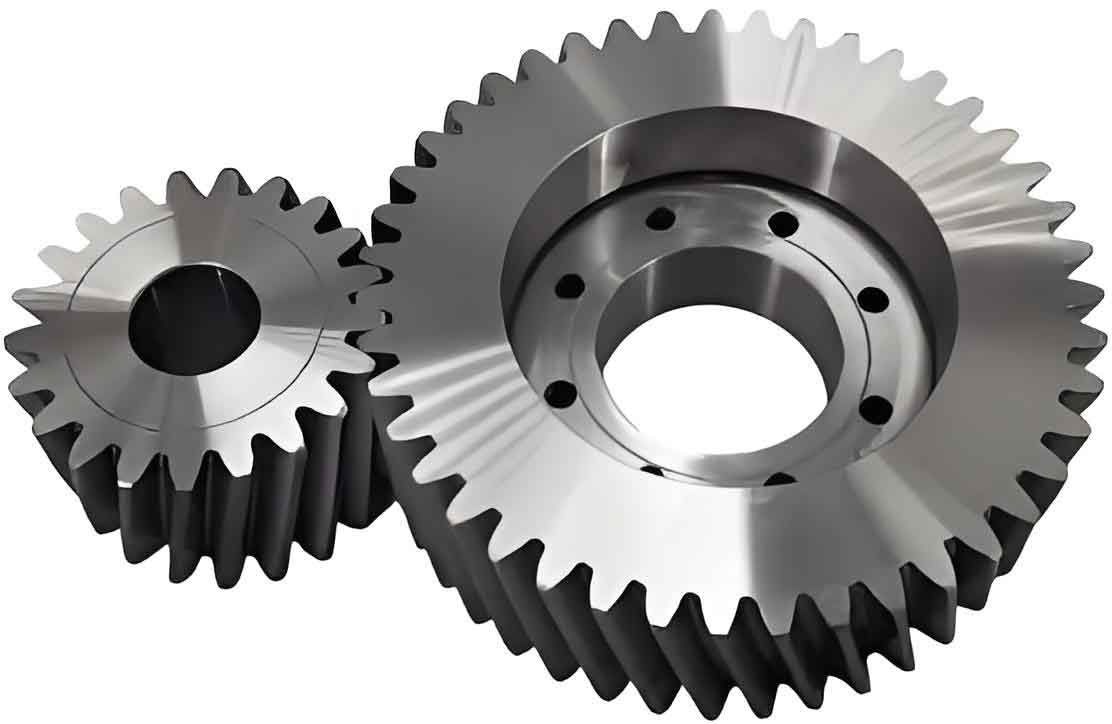
To further enhance the performance of gear transmissions, tooth surface modification is a widely adopted strategy. Modification alters the ideal tooth flank geometry to compensate for deflections under load, manufacturing errors, and alignment deviations, thereby improving load distribution, reducing transmission error, and ultimately mitigating vibration and noise. While modification techniques for conventional cylindrical gears are well-established, their application to complex-tooth-surface gears like the VH-CATT type requires dedicated investigation. This paper focuses on a modification method for VH-CATT cylindrical gears achieved by tilting the large-diameter cutter head during the milling process. We derive the mathematical model of the modified tooth surface, reconstruct the three-dimensional gear models, and employ Adams multi-body dynamics software to simulate and analyze the dynamic meshing characteristics. Specifically, we investigate the influence of different modification parameters (cutter tilt angles) on the speed fluctuation of the driven gear and the evolution of dynamic meshing forces, providing a theoretical foundation for the vibration and noise reduction design of these advanced cylindrical gears.
Theory of Tooth Surface Modification and Mathematical Modeling
Forming Principle and Modification Method
The VH-CATT cylindrical gear is manufactured using a dual-blade large-diameter cutter head in a milling process. The fundamental forming principle involves the relative motion between the rotating cutter head and the gear blank. The cutter head, which contains separate internal and external blade groups, generates the convex and concave flanks of the gear tooth simultaneously. The tooth trace (the line along the face width) is a circular arc with a variable hyperbolic curvature, giving the gear its distinctive name and properties.
The proposed modification method introduces a tilt angle to the axis of the cutter head relative to its standard position. This intentional misalignment during machining subtly alters the envelope of surfaces generated by the cutter blades, resulting in a controlled modification to the gear tooth flank. This method is akin to the ease-off modification used in hypoid gears and provides a means to optimize the contact pattern and meshing behavior under load.
Coordinate Systems and Mathematical Derivation
To mathematically describe the modified tooth surface, a series of coordinate systems are established, as shown in the schematic below, which illustrates the tilted cutter head machining setup.
The key coordinate systems include:
$$ S_c(X_c, Y_c, Z_c): $$ A coordinate system rigidly connected to the cutter head.
$$ S_t(X_t, Y_t, Z_t): $$ A coordinate system related to the tool profile.
$$ S_1(X_1, Y_1, Z_1): $$ A coordinate system rigidly connected to the gear blank.
$$ S_f(X_f, Y_f, Z_f): $$ A fixed reference coordinate system.
The surface of the cutter blade, represented in $S_t$, is a ruled surface. For a blade with a straight-line profile (simplified for derivation), its vector equation can be expressed as:
$$
\mathbf{r}_t(u) = [0, u \sin \alpha, -u \cos \alpha]^T
$$
where $u$ is the distance parameter along the blade profile from the datum point, and $\alpha$ is the tool pressure angle (cutter blade angle).
Through a series of rotational and translational transformations involving the machine-tool settings (cutter radius $R_T$, tilt angle $\lambda$, etc.) and the kinematic motion parameters (gear blank rotation angle $\phi_1$, cradle rotation angle $\psi$, etc.), the family of tool surfaces in the gear coordinate system $S_1$ is generated. The modified tooth surface is the envelope of this family of surfaces. Applying the equation of meshing, which ensures continuous tangency between the tool surface and the generated gear surface, is crucial. The condition is given by:
$$
\mathbf{n} \cdot \mathbf{v}^{(ct)} = 0
$$
where $\mathbf{n}$ is the normal vector to the tool surface and $\mathbf{v}^{(ct)}$ is the relative velocity between the cutter and the gear blank at the contact point.
Solving this system yields the mathematical model for the modified VH-CATT cylindrical gear tooth surface in $S_1$:
$$
\mathbf{r}_1(u, \theta, \phi_1) = \mathbf{M}_{1f}(\phi_1) \cdot \mathbf{M}_{ft}(\psi) \cdot \mathbf{M}_{tc}(\lambda) \cdot \mathbf{r}_c(u, \theta)
$$
with the meshing equation constraint $f(u, \theta, \phi_1)=0$. The explicit form, incorporating the tilt angle $\lambda$, is:
$$
\mathbf{r}_1(u, \theta, \phi_1) =
\begin{bmatrix}
(R_T \mp u \sin \alpha) \sin(\theta + \psi + \lambda) + (R_m \pm u \cos \alpha) \cos(\theta + \psi + \lambda) \cos \phi_1 \\
-(R_T \mp u \sin \alpha) \cos(\theta + \psi + \lambda) + (R_m \pm u \cos \alpha) \sin(\theta + \psi + \lambda) \cos \phi_1 \\
-(R_m \pm u \cos \alpha) \sin \phi_1
\end{bmatrix}
$$
where the upper sign corresponds to the convex side (external blade) and the lower sign to the concave side (internal blade). $R_m$ is the mean cone distance or a related radial parameter, and $\theta$ is a parameter related to the cutter rotation.
Three-Dimensional Model Reconstruction and Virtual Prototype
Gear Parameters and Model Generation
To analyze the dynamic performance, a specific gear pair is defined. The basic parameters are listed in the table below.
| Parameter | Symbol | Pinion (Driver) | Gear (Driven) |
|---|---|---|---|
| Number of Teeth | $z$ | 29 | 41 |
| Module | $m_n$ | 8 mm | |
| Pressure Angle | $\alpha$ | 20° | |
| Face Width | $b$ | 60 mm | |
| Nominal Cutter Radius | $R_T$ | 180 mm | |
| Cutter Tilt Angle (Modification) | $\lambda$ | Variable (0°, 1°, 2°, …, 7°) | |
Using the derived mathematical model, coordinates for discrete points on both the convex and concave tooth flanks are calculated in MATLAB for a single tooth. This point cloud data is then imported into a CAD software (e.g., Siemens NX) to generate accurate solid models of both the pinion and the gear. The process involves constructing surfaces from the points, trimming, and performing solid Boolean operations to create the full gear geometry. A sample three-dimensional model of the gear pair is reconstructed successfully using this methodology.
Adams Virtual Prototype Setup
The solid models of the pinion and gear for various modification parameters ($\lambda = 0°, 3°, 5°, 7°$, etc.) are imported into Adams/View. The virtual prototype setup involves the following steps:
- Material Properties: Both gears are assigned material properties of steel (Density: $7.8 \times 10^{-6}$ kg/mm³, Young’s Modulus: $2.07 \times 10^5$ MPa, Poisson’s Ratio: 0.3).
- Joints and Constraints: A fixed joint connects the gearbox housing (ground) to the world. A revolute joint is applied to the pinion, and another revolute joint is applied to the gear. The pinion is driven by a rotary motion with a constant angular velocity. A resistive torque of $1500$ N·m is applied to the revolute joint of the driven gear to simulate the load.
- Contact Force Definition: The core of the dynamic simulation is defining the contact force between the mating tooth flanks. Adams uses an impact-based contact algorithm. A solid-to-solid contact force is defined between all teeth of the pinion and the gear. The normal force component is typically modeled using a spring-damper model based on the Hunt-Crossley formulation:
$$F_n = k \cdot \delta^e + STEP(\delta, 0, 0, d_{max}, c_{max}) \cdot \dot{\delta}$$
where $\delta$ is the penetration depth, $\dot{\delta}$ is its time derivative, $k$ is the contact stiffness, $e$ is the force exponent (usually 1.5 for metal), and the STEP function provides a damping coefficient $c$ that activates only during penetration. - Contact Stiffness Calculation: The stiffness $k$ is critical. For two contacting cylindrical gears with curvilinear teeth, an approximate value can be derived from the Hertzian contact theory for two cylinders in line contact. The combined radius $R$ and effective modulus $E’$ are calculated first:
$$
\frac{1}{R} = \frac{1}{R_1} \pm \frac{1}{R_2}, \quad \frac{1}{E’} = \frac{1-\nu_1^2}{E_1} + \frac{1-\nu_2^2}{E_2}
$$
where $R_1$ and $R_2$ are the effective radii of curvature at the contact point for the pinion and gear, respectively. The contact stiffness can then be related to the material properties and the face width $L$ (length of contact line). A practical estimation formula used in simulations is often of the form $k = \frac{4}{3} E’ \sqrt{R} \cdot L^{0.8}$, though the exact implementation in Adams may use a simplified direct input. For our model with $E’ \approx 2.27 \times 10^5$ MPa, an appropriate stiffness value is selected to ensure stable and realistic contact simulation.
The friction force is modeled using a Coulomb friction model, though its effect on the primary dynamic meshing forces is secondary for this analysis.
Simulation Analysis of Dynamic Meshing Performance
Influence of Modification on Speed Fluctuation
Transmission error, which manifests as fluctuations in the driven gear’s speed even under a constant driver speed, is a primary source of vibration and noise in gear systems. A key objective of modification is to minimize this fluctuation. Simulations were run for gear pairs with different cutter tilt angles $\lambda$ (0°, 3°, 5°, and 7°) under the same load and input speed conditions.
The angular velocity of the driven gear was measured over several mesh cycles after the simulation reached steady-state operation. The results show that for all modification cases, the driven gear’s speed exhibits periodic fluctuations around a mean value, confirming that the transmission is stable but not perfectly uniform.
The key metrics extracted from the velocity profiles are summarized in the table below.
| Cutter Tilt Angle $\lambda$ | Max Speed (deg/s) | Min Speed (deg/s) | Mean Speed (deg/s) | Speed Deviation $(\frac{\omega_{max} – \omega_{min}}{\omega_{mean}} \times 100\%)$ |
|---|---|---|---|---|
| 0° | 2657.71 | 2224.44 | 2476.28 | 17.5% |
| 3° | 2654.44 | 2225.73 | 2475.19 | 17.3% |
| 5° | 2656.56 | 2229.99 | 2475.89 | 17.2% |
| 7° | 2658.51 | 2241.21 | 2475.78 | 16.8% |
The analysis reveals two important trends. First, the modification parameter $\lambda$ has a negligible effect on the average output speed, which remains constant for all practical purposes. This is expected as the average transmission ratio is governed by the number of teeth. Second, and more importantly, the speed deviation, which quantifies the fluctuation amplitude, changes with $\lambda$. As $\lambda$ increases from 0° to 7°, the speed deviation decreases from approximately 17.5% to 16.8%. This indicates that the appropriate introduction of a cutter tilt modification can improve the smoothness of motion transfer in VH-CATT cylindrical gears. However, the relationship is not linear, and an optimal value $\lambda_{opt}$ likely exists beyond which the fluctuation might increase again, as suggested by the principle of over-modification.
Influence of Modification on Dynamic Meshing Force
The dynamic meshing force is the internal force transmitted between the contacting teeth. Its magnitude and variation directly influence the stresses, vibrations, and noise of the gear system. We analyzed the meshing force (magnitude of the contact force vector) for a broader range of modification parameters: $\lambda = 0°, 1°, 2°, 3°, 4°, 5°, 6°, 7°$.
The meshing force signal is highly dynamic, with sharp peaks corresponding to the impact at the start of contact (meshing-in impact) and potential variations during the recess action. The key statistical measure, the average meshing force over a complete cycle, is extracted for each case and presented in the following table.
| Cutter Tilt Angle $\lambda$ | Max Force (N) | Min Force (N) | Average Force (N) |
|---|---|---|---|
| 0° | 30866.0 | 3258.5 | 17062.3 |
| 1° | 30304.5 | 3471.8 | 16888.2 |
| 2° | 30550.8 | 2245.0 | 16397.9 |
| 3° | 30143.9 | 268.0 | 15606.0 |
| 4° | 29942.2 | 562.0 | 15252.1 |
| 5° | 29829.3 | 356.8 | 15093.1 |
| 6° | 29261.3 | 289.1 | 14775.2 |
| 7° | 30913.9 | 1860.6 | 16387.3 |
The data shows a clear and significant trend. As the cutter tilt angle $\lambda$ increases from 0° to 6°, the average dynamic meshing force decreases consistently, from about 17062 N to 14775 N, a reduction of over 13%. This reduction is attributed to the modification optimizing the contact path and load sharing between teeth, reducing the effective mesh stiffness variation and the severity of impacts. Concurrently, the peak force also shows a decreasing trend within this range.
However, when $\lambda$ is increased further to 7°, the average meshing force increases again to 16387 N, and the peak force rises significantly. This demonstrates the non-monotonic relationship between modification intensity and dynamic performance. An optimal modification range (in this study, around $\lambda = 5°-6°$) exists that minimizes the dynamic load. Exceeding this optimal point leads to over-modification, which can misalign the contact conditions and reintroduce detrimental dynamic effects.
Discussion and Synthesis of Results
The simulation results from the Adams models of the modified VH-CATT cylindrical gears provide valuable insights into the interplay between geometric modification and dynamic response. The primary findings can be synthesized as follows:
- Modification Efficacy: The proposed cutter tilt method is an effective way to modify the tooth surface of VH-CATT cylindrical gears. It provides a controlled parameter ($\lambda$) to alter the meshing kinematics without changing the fundamental gear geometry (number of teeth, module).
- Optimal Modification: There exists an optimal value or range for the modification parameter $\lambda$. For the specific gear pair analyzed, the optimal performance in terms of minimizing both speed fluctuation and average dynamic meshing force appears to lie between $\lambda = 5°$ and $\lambda = 6°$. This finding underscores the importance of targeted modification design rather than arbitrary application.
- Performance Trade-offs: The relationship between $\lambda$ and dynamic performance is non-linear. While increasing $\lambda$ from zero initially improves smoothness and reduces load, excessive modification degrades performance. This creates a design optimization problem where $\lambda$ must be chosen to balance multiple criteria, potentially including contact stress and transmission error.
- Virtual Prototyping Value: The workflow of mathematical modeling, CAD reconstruction, and Adams dynamics simulation forms a powerful virtual prototyping tool. It allows for the efficient exploration of design parameters for complex cylindrical gears like the VH-CATT type before physical manufacturing, saving time and cost in the development cycle.
The mechanisms behind these trends are rooted in contact mechanics. The modification alters the unloaded contact pattern and the path of contact. An optimal modification compensates for the deflections of the teeth, shafts, and bearings under load, promoting a more uniform load distribution across the face width and a smoother transfer of load from one tooth pair to the next (lower transmission error). This reduces the dynamic increment of load (the difference between dynamic and static load) and the associated vibratory excitation.
Conclusion
This study has presented a comprehensive analysis of the dynamic meshing performance of modified Variable Hyperbolic Circular-Arc-Tooth-Trace (VH-CATT) cylindrical gears using multi-body dynamics simulation. A tooth surface modification method based on tilting the large-diameter cutter head during machining was proposed. The mathematical model of the modified tooth flank was derived based on the gear meshing theory, enabling the precise three-dimensional reconstruction of the gears.
By establishing virtual prototype models in Adams for different cutter tilt angles ($\lambda$), the dynamic behavior of the gear pairs under load was simulated. The analysis focused on two critical dynamic response metrics: the speed fluctuation of the driven gear and the evolution of the dynamic meshing force. The results clearly demonstrate that the modification parameter $\lambda$ has a significant and non-linear influence on the dynamic performance of VH-CATT cylindrical gears.
Key conclusions are:
- Appropriate modification ($\lambda$ up to an optimal point, ~5°-6° for the studied case) reduces the amplitude of driven gear speed fluctuation, indicating improved motion smoothness.
- Within the same optimal range, the average dynamic meshing force is substantially reduced, which is beneficial for lowering contact stresses, wear, and vibration excitation.
- Excessive modification ($\lambda$ too large, e.g., 7°) leads to a reversal of these benefits, increasing both force levels and fluctuation, highlighting the risk of over-modification.
This work provides a theoretical and simulation-based foundation for the design of high-performance VH-CATT cylindrical gear transmissions. The methodology and findings contribute directly to the goals of vibration and noise reduction in advanced gear systems. Future work could involve multi-objective optimization of the modification parameters considering contact stress, flash temperature, and efficiency, as well as experimental validation of the simulation predictions on physical prototypes of these innovative cylindrical gears.