
The reliable operation of mechanical transmission systems is paramount across industries such as aerospace, automotive, and heavy machinery. At the heart of many such systems lie cylindrical gears, whose health directly influences performance, safety, and operational costs. Experimental simulation of various gear failure types and severities is often prohibitively expensive and technically challenging. Therefore, developing accurate dynamic models that can simulate the vibrational behavior of cylindrical gears under different fault conditions is an essential and efficient alternative. This article details the process of constructing, refining, and validating a dynamic model for spur cylindrical gears with faults, providing a methodology to generate valuable data for fault diagnosis databases.
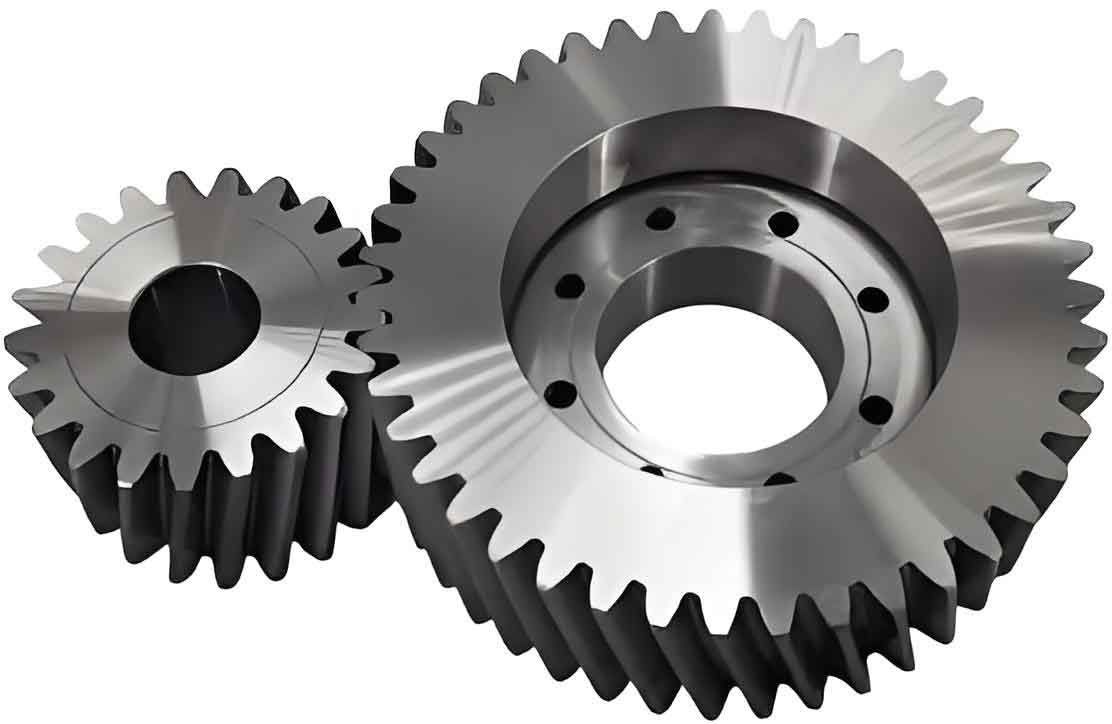
Accurate modeling begins with representing the physical system mathematically. A lumped-parameter approach is employed to create a coupled bending-torsion vibration model for a pair of spur cylindrical gears. This model considers six degrees of freedom: translational motion in the x and y directions for both the pinion and gear, and rotational motion about their respective axes. The model incorporates the elasticity of the shafts and support bearings, as well as the dynamic forces arising from gear meshing, including friction. The generalized displacement vector is defined as:
$$\{\delta\} = \{x_p, y_p, \theta_p, x_g, y_g, \theta_g\}^T$$
Here, $x$, $y$ represent translational displacements, $\theta$ represents angular displacement, and subscripts $p$ and $g$ denote the pinion and gear, respectively. The relative displacement along the line of action $y$ is a key parameter:
$$y = y_p + R_p \theta_p – y_g + R_g \theta_g$$
where $R_p$ and $R_g$ are the base circle radii. The dynamic meshing force $F_p$ acting on the pinion and the reaction force $F_g$ on the gear are given by:
$$F_p = c_m \dot{y} + k_m y, \quad F_g = -F_p$$
The term $k_m$ is the time-varying meshing stiffness, the primary internal excitation in gear dynamics, and $c_m$ is the meshing damping. The equations of motion for the 6-DOF system can be derived using Newton’s second law, considering forces from mesh stiffness, damping, support bearings, and external torques ($T_p$, $T_g$). The final system can be compactly expressed in matrix form:
$$\mathbf{M}\ddot{\boldsymbol{\delta}} + \mathbf{C}\dot{\boldsymbol{\delta}} + \mathbf{K}\boldsymbol{\delta} = \mathbf{F}$$
where $\mathbf{M}$, $\mathbf{C}$, and $\mathbf{K}$ are the mass, damping, and stiffness matrices, respectively, and $\mathbf{F}$ is the force vector containing the input and load torques. The stiffness matrix $\mathbf{K}$ is particularly important as it contains the time-varying meshing stiffness $k_m(t)$, which is influenced by gear faults.
The accurate computation of the time-varying meshing stiffness $k_m(t)$ for spur cylindrical gears is fundamental. The potential energy method, which considers various forms of elastic deformation, provides a robust analytical framework. The total compliance (inverse of stiffness) of a single tooth pair in mesh is the sum of compliances from several sources:
$$\frac{1}{K_{pair}} = \frac{1}{K_b} + \frac{1}{K_s} + \frac{1}{K_a} + \frac{1}{K_h} + \frac{1}{K_f}$$
The components represent stiffness due to bending ($K_b$), shear ($K_s$), axial compression ($K_a$), Hertzian contact deformation ($K_h$), and gear body (fillet) foundation deformation ($K_f$). These are calculated using integrals along the tooth profile. For example, the bending compliance is:
$$\frac{1}{K_b} = \int_{0}^{d} \frac{[(d-x)\cos\alpha_1 – h\sin\alpha_1]^2}{EI_x} dx$$
where $E$ is Young’s modulus, $I_x$ is the area moment of inertia at distance $x$ from the root, $d$ is the distance from the root to the load point, $\alpha_1$ is the load angle, and $h$ is a geometric parameter. The formulas for $K_s$, $K_a$, $K_h$, and $K_f$ follow similar energy principles. The total mesh stiffness for the gear pair at any instant is the sum of the stiffnesses of all tooth pairs in simultaneous contact:
$$k_m(t) = \sum_{i=1}^{N} K_{pair}^{(i)}(t)$$
where $N$ is the number of tooth pairs in contact (1 or 2 for spur gears).
Gear faults manifest as localized reductions in the effective load-carrying area, directly altering the calculated stiffness components. For a root crack, modeled as a straight line from the fillet, the effective area moment of inertia $I_x$ and cross-sectional area $A_x$ in the cracked section are modified. If a crack of length $q$ starts at a distance $h_c$ from the centerline at an angle $\alpha_c$, the effective height $h_{eff}$ at a section $x$ is reduced when $h_x > h_c – q\sin\alpha_c$. This reduced $h_{eff}$ is used to calculate a lower $I_x$ and $A_x$ in the integrals for $K_b$, $K_s$, and $K_a$, leading to a lower overall tooth stiffness when the cracked section is under load.
For pitting or spalling faults, modeled as rectangular surface patches, the effective face width $W$ is reduced in the contact compliance calculation ($K_h$), and the cross-sectional properties ($A_x$, $I_x$) are modified in the area beneath the pit for the bending, shear, and axial compliance calculations. The reductions are proportional to the pit’s dimensions (length $a_s$, width $w_s$, depth $h_s$).
| Parameter | Pinion | Gear |
|---|---|---|
| Number of Teeth | 23 | 84 |
| Module (mm) | 2 | 2 |
| Pressure Angle (°) | 20 | 20 |
| Face Width (mm) | 20 | 20 |
| Mass (kg) | 0.22 | 1.9 |
| Moment of Inertia (kg·m²) | 4.86e-5 | 3.51e-3 |
Using the parameters in Table 1, the time-varying meshing stiffness for healthy and faulty gears can be simulated. The stiffness curve for a healthy gear pair shows a periodic pattern with higher stiffness in the double-tooth contact region and lower stiffness in the single-tooth contact region. The introduction of a fault causes a distinct drop in stiffness during the meshing period of the damaged tooth.
$$
\begin{aligned}
&\text{Crack Impact: } k_{m,crack}(t) < k_{m,healthy}(t) \text{ during faulted tooth engagement.}\\
&\text{Pitting Impact: } k_{m,pit}(t) < k_{m,healthy}(t) \text{ during faulted tooth engagement.}
\end{aligned}
$$
The severity of the drop is correlated with the fault’s dimensions. For a root crack, a deeper crack ($q = 2\text{mm}$) causes a more significant stiffness reduction than a shallower one ($q = 1\text{mm}$). For pitting, both the length ($a_s$) and the width (as a percentage of face width) of the pit influence the severity of the stiffness loss. A longer or wider pit removes more material, leading to a greater compliance increase.
These fault-modulated stiffness functions $k_m(t)$ are then integrated into the system’s stiffness matrix $\mathbf{K}$ in the dynamic equation $\mathbf{M}\ddot{\boldsymbol{\delta}} + \mathbf{C}\dot{\boldsymbol{\delta}} + \mathbf{K}\boldsymbol{\delta} = \mathbf{F}$. Solving this equation numerically (e.g., using the Runge-Kutta method) yields the dynamic response—typically the vibration acceleration in the radial (y) direction. The time-domain signal for a healthy gearbox shows relatively uniform amplitude modulation at the gear mesh frequency. In contrast, a signal from a gearbox with a cracked tooth exhibits periodic impulse responses every rotation of the faulty gear. A signal from a gear with pitting shows milder periodic amplitude modulations. The frequency spectrum reveals the gear mesh frequency ($f_m$) and its harmonics. For faulty cylindrical gears, sidebands appear around the mesh frequency harmonics, spaced at the faulty gear’s rotational frequency ($f_r$), due to the periodic modulation introduced by the fault.
A critical step in creating a model that accurately reflects experimental behavior is system model updating. The support stiffness ($k_{px}, k_{py}, k_{gx}, k_{gy}$) and damping ($c_{px}, c_{py}, c_{gx}, c_{gy}$) parameters in the model are often not known precisely. These parameters significantly affect the amplitude of the vibration response measured on the gearbox housing. To calibrate the model, an experimental modal analysis (e.g., impact hammer testing) is performed on the actual gearbox structure to obtain Frequency Response Functions (FRFs). A simplified 2-DOF model of the shaft-bearing-house system is used to relate the support parameters to the theoretical FRF. An optimization problem is then solved to find the set of support stiffness and damping values that minimize the difference between the theoretical FRFs and the experimentally measured FRFs.
$$
\varepsilon = \min \sum_{i=x,y} \sum_{j=x,y} \sum_{\omega} | R_{ij}(\omega)_s – R_{ij}(\omega)_e |
$$
Here, $R_{ij}(\omega)_e$ is the experimental FRF, and $R_{ij}(\omega)_s$ is the simulated FRF from the parameterized model. The updated support parameters are then used in the full cylindrical gears dynamic model, ensuring its output aligns more closely with reality.
The validity of the overall modeling approach is tested against experimental data from a gearbox test rig. Vibration signals are acquired from gearboxes with healthy gears, gears with seeded root cracks, and gears with seeded pitting damage. The signals are processed using Time Synchronous Averaging (TSA) to enhance the gear-related components. The simulated vibration signals, generated using the updated dynamic model with the corresponding fault stiffness profiles, are compared to the experimental TSA signals.
| Fault Condition | Time-Domain Feature (Simulation vs. Experiment) | Frequency-Domain Feature (Simulation vs. Experiment) |
|---|---|---|
| Healthy Gear | Stable amplitude, no strong impulses. Good match. | Dominant mesh frequency ($f_m$) harmonics. No significant sidebands. Good match. |
| Cracked Tooth | Clear periodic impulses at gear rotation period ($1/f_r$). Good match in impulse timing. | Mesh harmonics with visible sidebands spaced at $f_r$, especially around 2$f_m$ and 3$f_m$. Good match. |
| Pitted Tooth | Milder periodic amplitude fluctuations at gear rotation period. Good match. | Mesh harmonics with less prominent $f_r$ sidebands, concentrated near harmonics. Good match. |
The close agreement between the simulated and experimental features, as summarized in Table 2, validates the fidelity of the proposed dynamic modeling framework for cylindrical gears. The model successfully captures the characteristic signatures of different fault types. Furthermore, the model can be used to simulate faults of varying severities that are difficult to replicate physically. For instance, simulations of cracks with depths from 1mm to 3mm or pits covering 20% to 60% of the face width show progressively stronger impulse amplitudes and sideband energies in the output vibration signals. This capability is invaluable for generating comprehensive datasets that span a wide fault severity spectrum.
In conclusion, the integrated methodology of fault-inclusive stiffness calculation, dynamic system modeling, and experimental parameter updating provides a powerful tool for analyzing the vibro-acoustic behavior of faulty spur cylindrical gears. The model’s accuracy, confirmed by experimental validation, allows for the reliable synthesis of vibration data under diverse fault scenarios. This addresses the core challenge of obtaining high-quality, labeled fault data for cylindrical gears through costly and time-consuming physical tests. The generated datasets are crucial for training and evaluating data-driven fault diagnosis algorithms, developing quantitative statistical health indicators, and ultimately building robust fault diagnosis databases for gear transmission systems. Future work may focus on incorporating more complex fault geometries, nonlinear effects, and the influence of varying load and speed conditions into the model to further enhance its predictive capabilities and practical utility.