
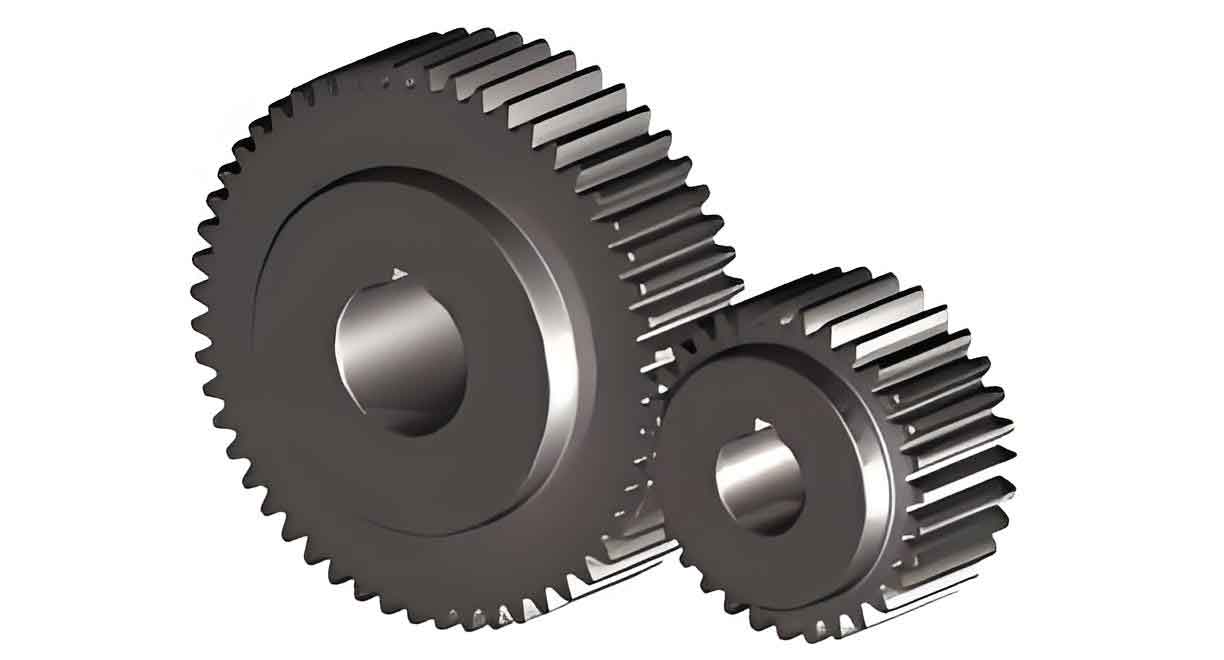
This paper presents a comprehensive dynamic model for internal spur gear systems incorporating time-varying backlash and energy dissipation. The proposed model addresses five distinct meshing states through an improved Johnson contact formulation, providing critical insights for optimizing spur gear performance under varying operational conditions.
1. Dynamic Meshing Force Formulation
The contact force model for spur gear pairs combines Johnson’s impact theory with Lankarani’s energy dissipation correction:
$$F_m = [aD(\tau) + b]LE^*\left(\frac{x}{D(\tau)}\right)^n\left[1 + \frac{3(1-c_e^2)}{4}\frac{\dot{x}}{\dot{x}^{(-)}}\right]$$
Where:
| Parameter | Expression |
|---|---|
| Contact stiffness coefficient | $a = \begin{cases} 0.965 & 50\mu m < \Delta R \leq10\ \text{mm} \\ 0.39 & 10\ \text{mm} < \Delta R <500\ \text{mm} \end{cases}$ |
| Nonlinear exponent | $n = \begin{cases} Y\Delta R^{-0.005} & 50\mu m < \Delta R \leq10\ \text{mm} \\ 1.094 & 10\ \text{mm} < \Delta R <500\ \text{mm} \end{cases}$ |
| Restitution coefficient | $c_e = 0.8$ |
2. Tribological Considerations
The EHL friction model for spur gear teeth interaction:
$$\mu_i(t) = \frac{\lambda_i(t)e^{f[S_{Ri}(t), P_{hi}(t), \eta_M, R_{aavg}]}}{P_{hi}^{b_2}S_{Ri}^{b_3}(t)}\left(\frac{v_{ei}(t)}{2}\right)^{b_6}\eta_M^{b_7}\rho_{hi}^{b_8}(t)$$
Key parameters for spur gear contact analysis:
| Parameter | Value |
|---|---|
| Dynamic viscosity | $\eta_M = 0.058$ Pa·s |
| Surface roughness | $R_{aavg} = (R_{a1} + R_{a2})/2$ |
| Hertzian pressure | $P_{hi}(t) = \frac{f_e}{\pi\sqrt{\rho_{ri}(t)(1-\nu^2)/E}}$ |
3. Multi-State Meshing Dynamics
The dimensionless governing equation for spur gear systems:
$$\ddot{x}_3 + h(\tau,x_3)\{kf[x_3,D(t)] + c\dot{x}_3\} = F + \epsilon\omega^2\cos(\omega t)$$
Five meshing states classification:
| State | Condition |
|---|---|
| Double-tooth drive-side | $x_3 \geq D_d$ |
| Single-tooth drive-side | $x_3 \geq D_s$ |
| Double-tooth back-side | $x_3 \leq -D_d$ |
| Single-tooth back-side | $x_3 \leq -D_s$ |
| Disengagement | $|x_3| < D_d$ |
4. Nonlinear Dynamics Characterization
The equivalent mass formulation for spur gear pairs:
$$m_e = \frac{I_pI_g}{R_{bp}^2I_p + R_{bg}^2I_g}$$
Critical frequency ratios governing spur gear behavior:
$$\omega = \frac{\omega_h}{\omega_n},\ \omega_n = \sqrt{\frac{k_{av}}{m_e}}$$
Key spur gear parameters used in simulations:
| Parameter | Pinion | Gear |
|---|---|---|
| Teeth | 21 | 84 |
| Module (mm) | 5 | |
| Pressure angle | 20° | |
| Face width (mm) | 50 | |
5. Bifurcation Analysis
The normalized force equation reveals complex spur gear dynamics:
$$\ddot{x} + h(\tau,x)\{k\tanh\left(\frac{x}{D}\right) + c\dot{x}\} = F + \epsilon\omega^2\cos(\omega\tau)$$
Distinct operational regimes observed in spur gear systems:
| Frequency Range | Dynamic Behavior |
|---|---|
| $\omega < 0.5$ | Periodic single-tooth meshing |
| $0.5 < \omega < 1.2$ | Double-tooth impact transitions |
| $1.2 < \omega < 2.0$ | Chaotic meshing state alternation |
| $\omega > 2.0$ | Stabilized periodic response |
The proposed model enables accurate prediction of spur gear system behavior across various meshing states, providing critical insights for design optimization and vibration control in high-performance transmission systems.