
In this study, we develop a comprehensive dynamic model for internal spur gear systems, focusing on multi-state meshing behaviors induced by time-varying backlash and energy dissipation. Spur gears are widely used in mechanical transmissions due to their simplicity and efficiency, but their dynamic performance can be significantly affected by nonlinearities such as tooth separation and back-side contact. Traditional models often overlook the energy dissipation during meshing and the explicit representation of dynamic meshing forces, leading to inaccuracies in predicting system behavior. Here, we propose an improved dynamic meshing force model based on the Johnson contact model, which accounts for energy loss and provides an explicit function for the meshing force. This approach overcomes limitations of previous models, such as the reliance on implicit functions and restrictions to low-backlash conditions. We establish a nonlinear dynamic model for internal spur gears that considers five distinct meshing states: double-tooth drive-side meshing, single-tooth drive-side meshing, double-tooth back-side meshing, single-tooth back-side meshing, and tooth disengagement. By incorporating time-varying backlash and friction effects under elastohydrodynamic lubrication, we derive dimensionless equations and analyze the system’s behavior using Poincaré maps. Our results reveal how meshing frequency influences the transition between these states, including bifurcations and chaotic motions, providing insights for optimizing gear design and reliability.
The dynamic meshing force is a critical factor in gear system analysis, as it directly affects vibration and impact behavior. Based on the Johnson contact model, we express the meshing force as an explicit function that includes energy dissipation through a restitution coefficient. For spur gears, the meshing force \( F_m \) between two teeth can be calculated as:
$$ F_m = \left[ a D(\tau) + b \right] L E^* \left( \frac{D(\tau)}{x} \right)^n \left( 1 + \frac{3(1 – c_e^2)}{4} \cdot \frac{\dot{x}}{\dot{x}^{(-)}} \right) $$
where \( D(\tau) \) is the time-varying backlash, \( L \) is the gear center distance, \( E^* = E / [2(1 – \mu^2)] \) is the composite elastic modulus, \( x \) is the relative displacement along the line of action, \( \dot{x} \) is its derivative, and \( \dot{x}^{(-)} \) is the theoretical relative velocity. The coefficients \( a \), \( b \), and \( n \) depend on the backlash range, as defined in the methodology. This formulation allows for efficient computation and accurately captures impact dynamics in spur gears.
To model the multi-state meshing behavior, we consider the geometry and forces in internal spur gear pairs. The meshing process involves periodic alternation between single and double tooth contact, influenced by the重合度 \( \varepsilon_m \). We define five meshing states based on the relative displacement \( \bar{x} \) and time-varying backlash \( \bar{D}(\tau) \):
- Double-tooth drive-side meshing: \( \bar{x} \geq \bar{D}(\tau) \) and \( n T_m \leq \tau \leq (\varepsilon_m – 1) n T_m \)
- Single-tooth drive-side meshing: \( \bar{x} \geq \bar{D}(\tau) \) and \( (\varepsilon_m – 1) n T_m \leq \tau \leq (n+1) T_m \)
- Double-tooth back-side meshing: \( \bar{x} \leq -\bar{D}(\tau) \) and \( n T_m \leq \tau \leq (\varepsilon_m – 1) n T_m \)
- Single-tooth back-side meshing: \( \bar{x} \leq -\bar{D}(\tau) \) and \( (\varepsilon_m – 1) n T_m \leq \tau \leq (n+1) T_m \)
- Tooth disengagement: \( |\bar{x}| < \bar{D}(\tau) \) and \( n T_m \leq \tau \leq (n+1) T_m \)
For each state, we derive the equations of motion considering friction and load distribution. The friction factor under elastohydrodynamic lubrication is given by:
$$ \mu_i(t) = \lambda_i(t) e^{f[SR_i(t), P_{hi}(t), \eta_M, R_{aavg}]} \frac{P_{hi}^{b_2} S R_i(t)}{b_3} \cdot \left( \frac{v_{ei}(t)}{2} \right)^{b_6} \eta_M^{b_7} \rho_{hi}^{b_8}(t) $$
where \( SR_i(t) \) is the slide-to-roll ratio, \( P_{hi}(t) \) is the Hertzian pressure, and \( \lambda_i(t) \) is the direction coefficient. This accounts for the varying friction forces during meshing in spur gears.
The generalized nonlinear dynamic equation for the system is expressed in dimensionless form as:
$$ \ddot{x}_3 + h(\tau, x_3) \left\{ k f[x_3, D(t)] + c x_3 \right\} = F + \varepsilon \omega^2 \cos(\omega t) $$
where \( x_3 \) is the dimensionless relative displacement, \( h(\tau, x_3) \) is the meshing state function, and \( f[x_3, D(t)] \) represents the meshing force function. This model allows us to analyze the system’s response under different parameters.
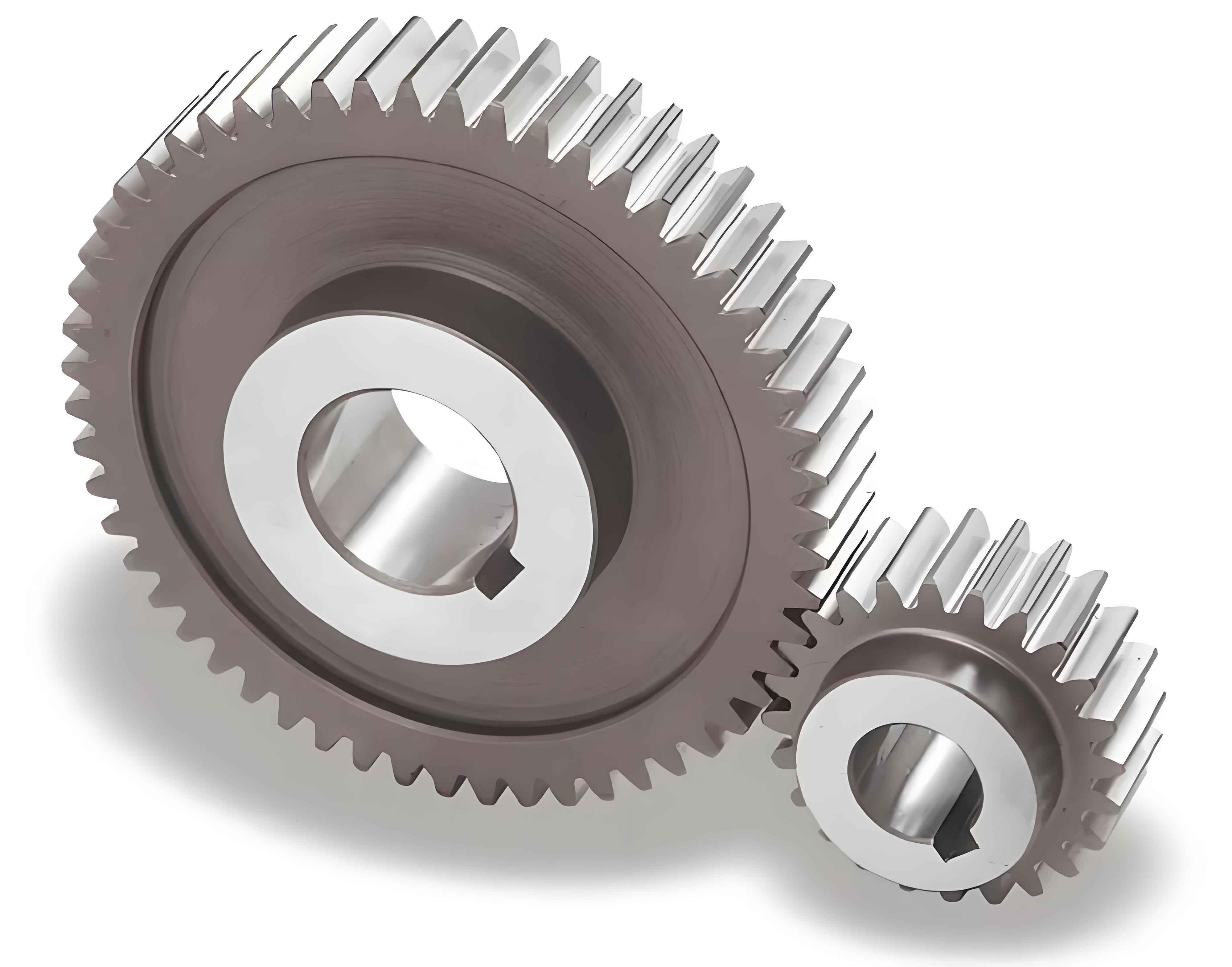
To identify the multi-state meshing behaviors, we construct five Poincaré maps: stroboscopic map \( \Sigma_n \), single-tooth drive-side map \( \Sigma_p \), single-tooth back-side map \( \Sigma_q \), double-tooth drive-side map \( \Sigma_r \), and double-tooth back-side map \( \Sigma_s \). These maps help visualize the transitions between states, denoted as \( n-p-q-r-s \), where each letter represents the number of occurrences in a cycle. For example, 1-1-0-1-0 indicates one period with single-tooth drive-side meshing, double-tooth drive-side meshing, and disengagement, but no back-side meshing.
We analyze the system with parameters such as load \( F = 0.16 \) and error amplitude \( \varepsilon = 0.23 \), varying the meshing frequency \( \omega \). The bifurcation diagrams from the Poincaré maps show that at low \( \omega \), the system exhibits stable period-1 motion with only drive-side meshing (e.g., 1-0-0-0-0). As \( \omega \) increases, transitions to period-2 and chaotic motions occur, involving disengagement and back-side meshing. For instance, at \( \omega = 0.6 \), the system shows 1-1-0-0-0 motion with periodic single-tooth disengagement. Further increases lead to 1-1-0-1-0 and 2-2-0-2-0 motions, where dynamic meshing forces periodically drop to zero, indicating impact behavior. At higher \( \omega \), chaotic regimes exhibit all five states, with forces changing direction frequently.
The phase portraits and time histories of dynamic meshing forces illustrate these behaviors. For example, in stable periods, the force remains positive, but in chaotic states, it oscillates between positive, zero, and negative values, corresponding to drive-side contact, disengagement, and back-side contact. This highlights the importance of controlling meshing frequency to avoid undesirable vibrations in spur gears.
Table 1 summarizes the key parameters used in our analysis for the spur gear system.
| Parameter | Symbol | Value |
|---|---|---|
| Number of teeth (driver) | \( z_p \) | 21 |
| Number of teeth (driven) | \( z_g \) | 84 |
| Module | \( m \) | 5 mm |
| Pressure angle | \( \alpha \) | 0.35 rad |
| Face width | \( b \) | 50 mm |
| Elastic modulus | \( E \) | 210 GPa |
| Poisson’s ratio | \( \mu \) | 0.3 |
| Meshing frequency range | \( \omega \) | 0.3 to 2.0 |
| Load | \( F \) | 0.16 |
| Error amplitude | \( \varepsilon \) | 0.23 |
The dimensionless meshing force function \( f[x_3, D(t)] \) is defined as:
$$ f[x_3, D(t)] =
\begin{cases}
K_k [x_3 – D(t)] + c_i x_3 \dot{x}_3, & \text{if } x_3 \geq D(t) \\
0, & \text{if } |x_3| < D(t) \\
K_d [x_3 + D(t)] + c_i x_3 \dot{x}_3, & \text{if } x_3 \leq -D(t)
\end{cases} $$
where \( K_k \) and \( K_d \) are the drive-side and back-side stiffness coefficients, and \( c_i \) is the damping coefficient derived from the Johnson model. This piecewise function captures the nonlinearity due to backlash in spur gears.
In the analysis, we observe that for low meshing frequencies, the system remains in drive-side meshing with no disengagement or back-side contact. As frequency increases, the dynamic meshing force direction changes, leading to disengagement and back-side impacts. For example, at \( \omega = 1.5 \), the system enters a chaotic state with all five meshing states active, resulting in complex vibration patterns. The Poincaré maps clearly show the points where transitions occur, such as from period-1 to period-2 motion through period-doubling bifurcations.
Table 2 provides an overview of the meshing states and their characteristics under varying meshing frequencies for spur gears.
| Meshing Frequency \( \omega \) | Dominant Meshing State | Dynamic Behavior |
|---|---|---|
| 0.3 | 1-0-0-0-0 (Drive-side only) | Stable period-1, no disengagement |
| 0.6 | 1-1-0-0-0 | Periodic single-tooth disengagement |
| 1.0 | 1-1-0-1-0 | Period-1 with double-tooth disengagement |
| 1.5 | 2-2-0-2-0 | Period-2 motion |
| 1.8 | n-p-q-r-s (Chaotic) | All five states active, chaotic vibrations |
| 2.0 | 1-1-0-1-0 | Stable period-1 with disengagement |
The equivalent mass \( m_e \) for the spur gear system is calculated as \( m_e = I_p I_g / (R_{bp}^2 I_p + R_{bg}^2 I_g) \), where \( I_p \) and \( I_g \) are the moments of inertia, and \( R_{bp} \) and \( R_{bg} \) are the base circle radii. This simplifies the system to a single-degree-of-freedom model for analysis.
In conclusion, our model effectively captures the multi-state meshing dynamics of internal spur gears, emphasizing the role of time-varying backlash and energy dissipation. The use of explicit meshing force functions and Poincaré maps provides a clear framework for analyzing nonlinear behaviors. This work aids in the design of spur gear systems by identifying critical parameters that influence stability and vibration, ultimately enhancing performance and durability. Future studies could extend this approach to helical gears or include thermal effects for more comprehensive analysis.