
In the field of precision transmission systems, the rotary vector reducer has emerged as a critical component due to its exceptional performance characteristics. As a development based on cycloidal drive principles, this reducer offers significant advantages such as high reduction ratios, compact design, high transmission efficiency, and substantial load-bearing capacity. These attributes have led to its widespread adoption in robotics, aerospace, and industrial automation. However, despite its growing importance, comprehensive dynamic models for predicting system behavior, particularly under operational loads, remain scarce. In this article, I will present a detailed formulation of the dynamics of a rotary vector reducer, focusing on the development of stiffness models for its key meshing pairs and the analysis of structural parameters that influence its performance. The goal is to provide a robust framework for evaluating and optimizing the design of rotary vector reducers, ultimately enhancing their reliability and efficiency in practical applications.
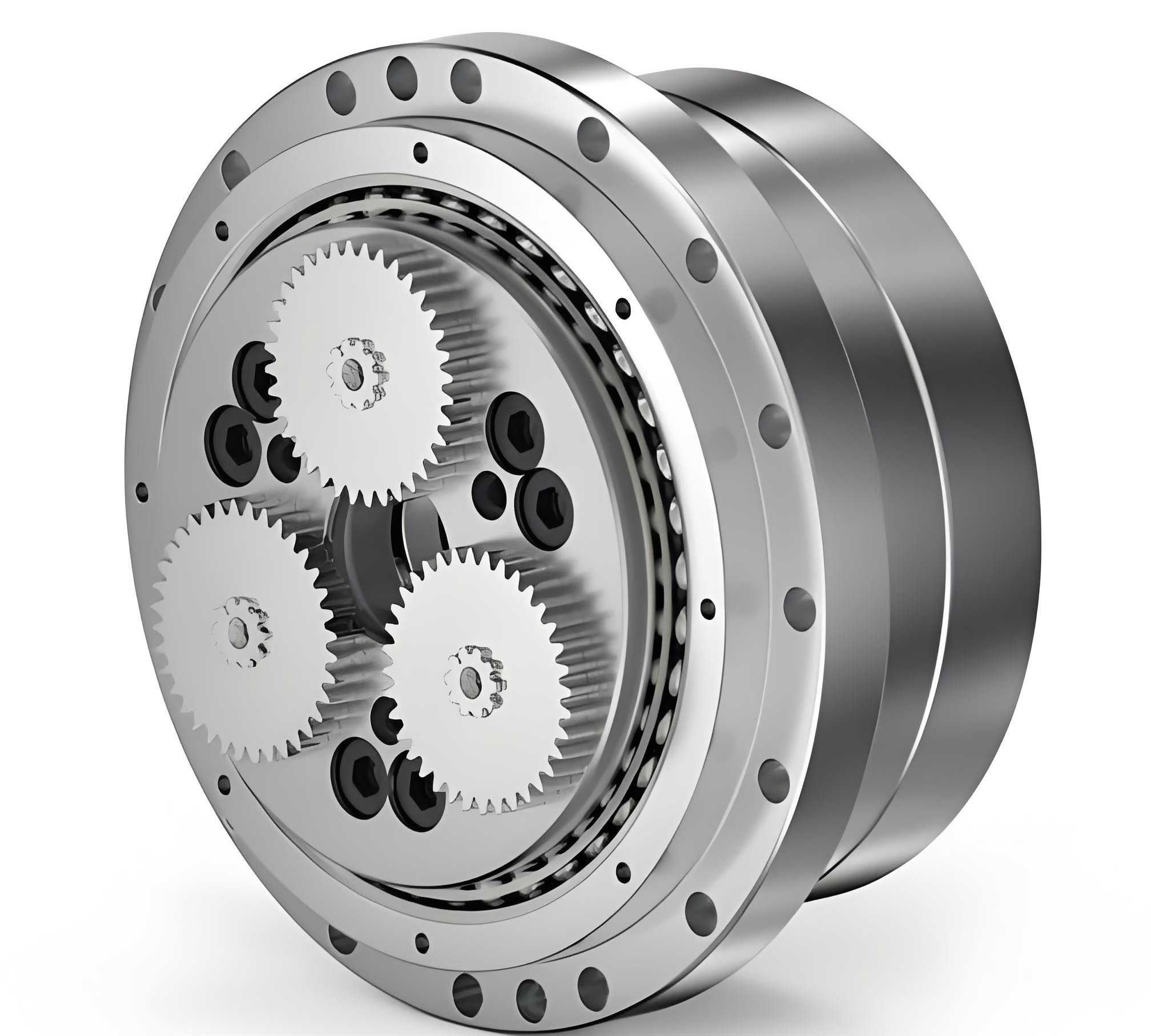
The core of my analysis lies in the accurate representation of the stiffness within the rotary vector reducer. The transmission system of a rotary vector reducer typically consists of two stages: a first-stage involute gear pair and a second-stage cycloid-needle gear pair. The dynamic response of the rotary vector reducer is heavily influenced by the time-varying stiffness of these meshing components, which can lead to vibrations and noise if not properly accounted for. Therefore, I have developed stiffness models for both pairs based on established mechanical theories. For the cycloid-needle pair, I employed the Hertz contact theory to derive expressions for single-tooth and overall equivalent torsional stiffness. For the involute gear pair, I utilized the Ishikawa formula to calculate meshing stiffness, incorporating geometric parameters such as tooth profile and contact conditions. These models form the foundation for constructing a multi-degree-of-freedom dynamic model of the entire rotary vector reducer system.
To model the cycloid-needle pair in a rotary vector reducer, I consider the elastic deformation at the contact points between the cycloid disk and the needle gears. Assuming line contact that deforms into a small rectangular area under load, the Hertz formula can be applied. The contact half-length \( L \) for the \( i \)-th contact point is given by:
$$ L = \sqrt{ \frac{4 F_i}{\pi b} \left( \frac{1 – \mu_1^2}{E_1} + \frac{1 – \mu_2^2}{E_2} \right) \frac{1}{\rho_i} } $$
where \( F_i \) is the force at the \( i \)-th contact point, \( b \) is the width of contact, \( \mu_1 \) and \( \mu_2 \) are Poisson’s ratios, \( E_1 \) and \( E_2 \) are elastic moduli, and \( \rho_i \) is the relative curvature radius. For a rotary vector reducer, the materials are often identical, simplifying the expression. The radial compression deformations for the needle and cycloid tooth lead to individual stiffness values. The single needle tooth stiffness \( C_{zi} \) is derived as:
$$ C_{zi} = \frac{\pi b E r_z}{4 \rho_i (1 – \mu^2)} $$
and the single cycloid tooth stiffness \( C_{bi} \) is:
$$ C_{bi} = \frac{\pi b E R_z S^{3/2}}{4 (1 – \mu^2) r_z T} $$
where \( r_z \) is the needle radius, \( R_z \) is the needle gear radius, \( S = 1 + K_1^2 – 2K_1 \cos \theta_b \), \( T = K_1 (1 + z_b) \cos \theta_b – (1 + z_b K_1^2) \), \( K_1 \) is the shortening coefficient, \( \theta_b \) is the rotation angle, and \( z_b \) is the number of needle teeth. The single-pair meshing stiffness \( C_{si} \) for the cycloid-needle pair in a rotary vector reducer is then the series combination:
$$ C_{si} = \frac{C_{bi} C_{zi}}{C_{bi} + C_{zi}} = \frac{\pi b E R_z S^{3/2}}{4 (1 – \mu^2) (R_z S^{3/2} + 2 r_z T)} $$
The overall equivalent torsional stiffness for the cycloid-needle transmission in a rotary vector reducer is obtained by summing the contributions from all simultaneously engaged teeth, converted to torsional stiffness via their force arms. Accounting for manufacturing and assembly errors with an adjustment factor \( \lambda \) (typically 0.6 to 0.7), the stiffness is:
$$ C_{bz} = \lambda \sum_{i=1}^{z_b/2} C_{si} L_i’^2 $$
where \( L_i’ \) is the force arm for the \( i \)-th contact point. This stiffness varies periodically with the rotation of the cycloid disk. The frequency of variation \( f \) for a rotary vector reducer is:
$$ f = \frac{n_2 z_b}{60 (z_b – z_g)} $$
where \( n_2 \) is the speed of the crankshaft and \( z_g \) is the number of cycloid disk lobes. To simplify dynamic analyses for a rotary vector reducer, I often approximate this time-varying stiffness with its average value over a cycle, as fluctuations are typically within 5%. This approximation reduces computational complexity while retaining accuracy for many engineering applications.
For the involute gear pair in the first stage of a rotary vector reducer, I applied the Ishikawa formula to model meshing stiffness. The tooth is approximated as a combination of trapezoidal and rectangular sections, as shown in the geometric representation. The stiffness components include bending, shear, and gear body deformation. The single-pair meshing stiffness \( C_s’ \) is calculated as:
$$ \frac{1}{C_s’} = \frac{1}{C_{Br1}} + \frac{1}{C_{Bt1}} + \frac{1}{C_{S1}} + \frac{1}{C_{G1}} + \frac{1}{C_{Br2}} + \frac{1}{C_{Bt2}} + \frac{1}{C_{S2}} + \frac{1}{C_{G2}} + \frac{1}{C_{PV}} $$
where the subscripts 1 and 2 refer to the two gears, and the components are defined as:
$$ C_{Br} = \frac{E b S_F^3}{12 \cos^2 \omega_x \left[ h_x h_r (h_x – h_r) + \frac{h_r^3}{3} \right]} $$
$$ C_{Bt} = \frac{E b S_F^3}{6 \cos^2 \omega_x} \frac{ \left( \frac{h_i – h_x}{h_i – h_r} \right) \left[ 4 – \left( \frac{h_i – h_x}{h_i – h_r} \right) – 2 \ln \left( \frac{h_i – h_x}{h_i – h_r} \right) – 3 \right] }{ (h_i – h_r)^3 } $$
$$ C_S = \frac{E b S_F}{2 (1 + \mu) \cos^2 \omega_x} \left[ h_r + (h_i – h_r) \ln \left( \frac{h_i – h_r}{h_i – h_x} \right) \right] $$
$$ C_G = \frac{\pi E b S_F^2}{24 h_x^2 \cos^2 \omega_x} $$
$$ C_{PV} = \frac{\pi E b}{4 (1 – \mu^2)} $$
Here, \( h_x \), \( h_r \), and \( h_i \) are geometric parameters related to tooth dimensions, \( S_F \) is the tooth root thickness, and \( \omega_x \) is the pressure angle. According to ISO 6336-1996, the total mesh stiffness for involute gears in a rotary vector reducer can be approximated by:
$$ C_d = C_s’ (0.75 \varepsilon_a + 0.25) $$
where \( \varepsilon_a \) is the contact ratio. This formulation provides a practical way to estimate the stiffness of the gear pair, which is crucial for the dynamic model of the entire rotary vector reducer.
Integrating these stiffness models, I developed a five-degree-of-freedom torsional dynamic model for a specific rotary vector reducer, the RV-6A II. The model includes the inertial effects of key components and simulates the workload using an inertial disk. The degrees of freedom correspond to the input gear, two planetary gears (mounted on crankshafts), the cycloid disk assembly, and the output needle gear shell. The stiffness matrix \( \mathbf{C}_{5 \times 5} \) for this rotary vector reducer system is:
$$ \mathbf{C}_{5 \times 5} = \begin{bmatrix}
2C_d R_1^2 & -C_d R_1 R_2 & -C_d R_1 R_2 & 0 & 0 \\
-C_d R_1 R_2 & C_d R_2^2 + C_{n1} & 0 & -C_{n1} & 0 \\
-C_d R_1 R_2 & 0 & C_d R_2^2 + C_{n1} & -C_{n1} & 0 \\
0 & -C_{n1} & -C_{n1} & 2C_{n1} + 2C_{bz} & -2C_{bz} \\
0 & 0 & 0 & -C_{bz} & 2C_{bz}
\end{bmatrix} $$
where \( R_1 \) and \( R_2 \) are base circle radii of the input and planetary gears, \( C_d \) is the involute gear pair stiffness, \( C_{n1} \) is the torsional stiffness of the crankshaft, and \( C_{bz} \) is the equivalent torsional stiffness of the cycloid-needle pair. The equation of motion for free vibration of this rotary vector reducer is:
$$ \mathbf{J}_{5 \times 5} \ddot{\boldsymbol{\theta}}_{5 \times 1} + \mathbf{D}_{5 \times 5} \dot{\boldsymbol{\theta}}_{5 \times 1} + \mathbf{C}_{5 \times 5} \boldsymbol{\theta}_{5 \times 1} = \mathbf{0} $$
where \( \mathbf{J} \) is the inertia matrix, \( \mathbf{D} \) is the damping matrix, and \( \boldsymbol{\theta} \) is the angular displacement vector. This model allows for the analysis of natural frequencies and dynamic responses, which are essential for assessing the performance and stability of the rotary vector reducer.
To understand how design choices affect the behavior of a rotary vector reducer, I conducted a parameter sensitivity analysis focusing on the cycloid-needle pair. The key structural parameters include the number of needle teeth \( z_b \), the needle gear radius \( R_z \), and the needle radius \( r_z \). Using the RV-6A II as a case study, I evaluated their impact on meshing forces and stiffness. The results are summarized in the following tables and discussed below.
| Parameter | Effect on Maximum Meshing Force | Effect on Overall Equivalent Stiffness |
|---|---|---|
| Number of needle teeth \( z_b \) | Decreases significantly as \( z_b \) increases, with diminishing returns at higher values. | Increases substantially due to more teeth sharing the load and contributing to stiffness. |
| Needle gear radius \( R_z \) | Decreases as \( R_z \) increases, especially at high-force contact points. | Generally decreases because most meshing occurs on convex curves where stiffness reduces with radius. |
| Needle radius \( r_z \) | No direct effect on meshing forces. | Increases, particularly for meshing on concave curves, but overall effect is moderate. |
For the number of needle teeth \( z_b \), I observed that increasing \( z_b \) from 20 to 60 reduces the maximum force on the cycloid disk, as the load is distributed among more teeth. However, the reduction rate slows down beyond \( z_b = 30 \), suggesting an optimal range for design efficiency. The stiffness, on the other hand, shows a consistent rise with \( z_b \), enhancing the rigidity of the rotary vector reducer. This is quantified in the following formula for single-pair stiffness variation:
$$ C_{si} \propto \frac{R_z S^{3/2}}{R_z S^{3/2} + 2 r_z T} $$
where \( S \) and \( T \) depend on \( z_b \) through the geometry. As \( z_b \) increases, \( S \) and \( T \) change, affecting the stiffness summation.
The needle gear radius \( R_z \) influences both force and stiffness. A larger \( R_z \) increases the force arm, reducing meshing forces for a given torque. However, the stiffness tends to decrease because the curvature radius \( \rho_i \) in the stiffness formula increases, reducing the contact stiffness per tooth. This trade-off is important for designing a compact yet stiff rotary vector reducer. The relationship can be seen from:
$$ C_{si} \approx \frac{\pi b E R_z S^{3/2}}{4 (1 – \mu^2) (R_z S^{3/2} + 2 r_z T)} $$
which shows that \( C_{si} \) is not monotonic with \( R_z \) but depends on the term \( R_z S^{3/2} \).
The needle radius \( r_z \) primarily affects stiffness. Increasing \( r_z \) raises the single-pair stiffness for meshing on convex curves (negative curvature), which dominates in typical engagements. However, excessive \( r_z \) can lead to undercutting or interference, so it must be chosen carefully. The stiffness variation with \( r_z \) is given by:
$$ \frac{\partial C_{si}}{\partial r_z} > 0 \quad \text{for convex contacts} $$
but the overall effect on the rotary vector reducer’s dynamic response is less pronounced compared to \( z_b \).
In addition to these parameters, I analyzed the natural frequencies of the RV-6A II rotary vector reducer using the dynamic model. The calculated frequencies are presented below:
| Mode Order | Natural Frequency (Hz) |
|---|---|
| 1 | 135 |
| 2 | 973 |
| 3 | 2,857 |
| 4 | 4,939 |
| 5 | 5,837 |
The first natural frequency, at 135 Hz, is primarily determined by the torsional stiffness of the crankshaft \( C_{n1} \), which is much lower than the gear mesh stiffnesses. This highlights that the crankshaft is often the limiting component for dynamic stiffness in a rotary vector reducer. Therefore, improving the crankshaft design—through material selection or geometric optimization—is crucial for enhancing the performance of the rotary vector reducer. The variation in cycloid-needle stiffness also introduces a stiffness excitation frequency \( f \), which should be kept away from the natural frequencies to avoid resonance. For instance, with typical parameters, \( f \) can be calculated as above, and designers should aim to increase the first-stage reduction ratio or decrease the second-stage ratio to lower \( f \), thereby minimizing vibration risks in the rotary vector reducer.
To validate the developed models, I performed dynamic characteristic tests on a prototype rotary vector reducer. The experimental setup involved measuring the frequency response under torsional excitation, with the workload simulated by an inertial disk. Repeated tests ensured data reliability. The results showed a first torsional natural frequency of approximately 128 Hz, a static torsional stiffness in the range of 75–85 N·m/rad, and a dynamic torsional stiffness around 4.83 N·m/rad. These values align closely with the predictions from my dynamic model, confirming its accuracy and practical utility for the rotary vector reducer. The slight discrepancies can be attributed to factors like damping and non-linearities not fully captured in the linear model. Nonetheless, the agreement demonstrates that the modeling approach provides a reliable tool for predicting the dynamic behavior of rotary vector reducers, aiding in design optimization and performance evaluation.
In conclusion, my analysis of the rotary vector reducer has yielded several key insights. First, the dynamic modeling framework I developed, incorporating Hertz-based cycloid-needle stiffness and Ishikawa-based involute gear stiffness, effectively captures the essential dynamics of the system. The five-degree-of-freedom torsional model offers a balance between simplicity and accuracy, making it suitable for engineering applications. Second, the parameter study reveals that increasing the number of needle teeth \( z_b \) is highly beneficial for reducing meshing forces and boosting stiffness in a rotary vector reducer, while increasing the needle gear radius \( R_z \) reduces forces but may compromise stiffness. The needle radius \( r_z \) has a moderate positive effect on stiffness but requires careful design to avoid geometric issues. Third, the crankshaft’s torsional stiffness is a critical factor determining the first natural frequency, emphasizing the need for its optimization in rotary vector reducer designs. Finally, experimental validation supports the model’s correctness, proving its value for predicting dynamic characteristics and guiding the development of high-performance rotary vector reducers. Future work could extend this model to include non-linear effects, thermal influences, and more detailed contact mechanics to further enhance the predictive capability for advanced rotary vector reducer applications.