
As a premier linear motion device, the planetary roller screw assembly has garnered significant adoption in high-performance sectors such as aerospace, defense, and precision machine tools. Its advantages stem from a multi-point contact rolling mechanism, which offers superior load capacity, positioning accuracy, stiffness, and operational lifespan compared to traditional ball screw systems. However, the long-term service of mechanical systems inevitably leads to performance degradation and failures, often accompanied by anomalous vibrations. Therefore, developing an accurate and computationally efficient dynamic model for the planetary roller screw assembly is paramount. Such a model provides the foundational theory for understanding its inherent vibration characteristics, predicting dynamic response under various operational conditions, and ultimately enabling intelligent fault diagnosis and health management. This article presents a comprehensive “Torsional-Translational-Axial” dynamic modeling approach for the planetary roller screw assembly, explicitly accounting for nonlinear factors like clearance, friction, and, critically, the time-varying nature of mesh stiffness in its transmission pairs.
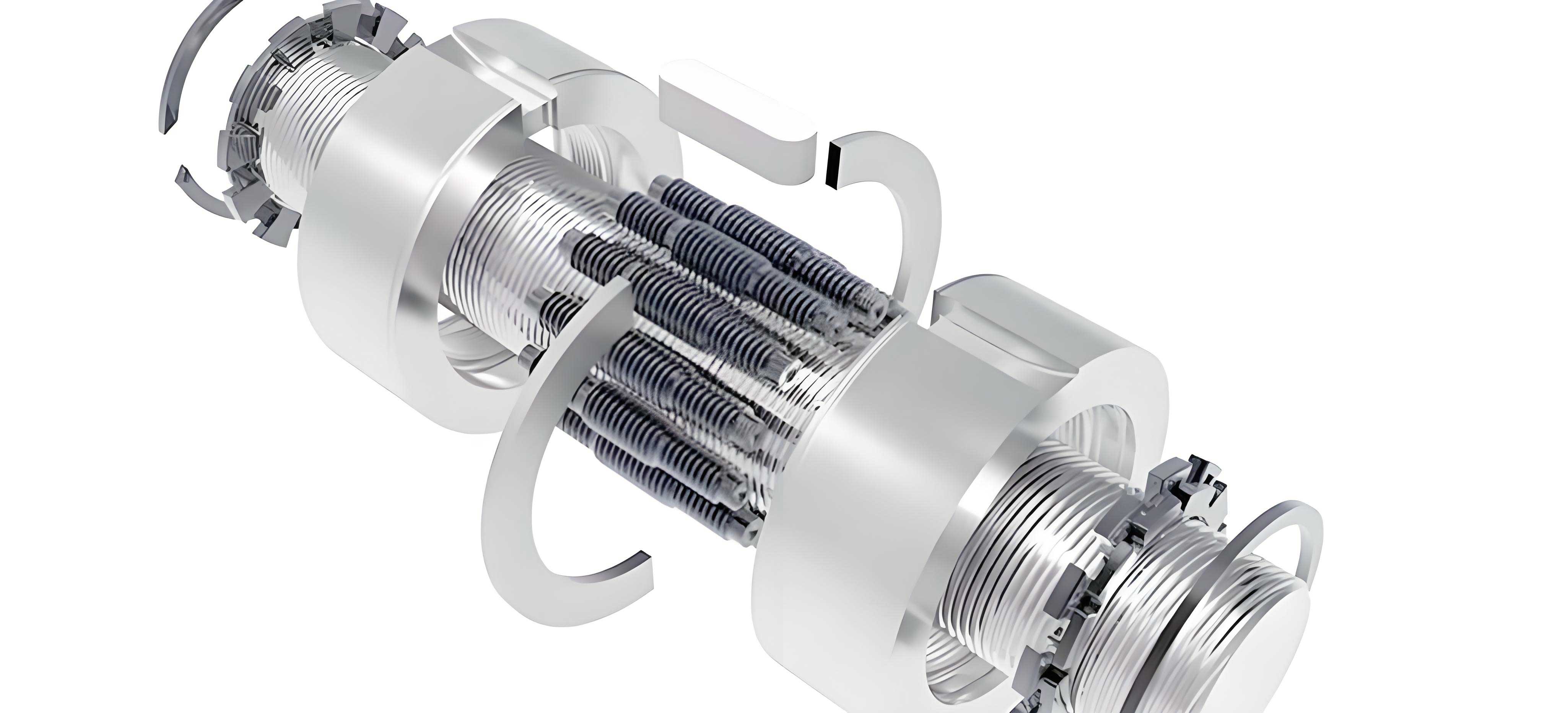
The core of a planetary roller screw assembly consists of four primary components: a central screw, multiple threaded rollers, a nut integrated with an internal ring gear, and a carrier (or cage). The screw rotates but is constrained from axial translation. The nut translates axially but is prevented from rotating. The rollers, engaged with both the screw and the nut via threaded interfaces, perform a complex epicyclic motion: they rotate about their own axes (spin), revolve around the screw axis (orbit), and translate axially with the nut. The synchronization of the rollers is maintained by a gear meshing between the ends of each roller and the internal ring gear of the nut. This intricate interaction between threaded pairs (screw-roller and roller-nut) and gear pairs (roller end gear-nut ring gear) dictates the dynamic performance of the entire planetary roller screw assembly.
1. Lumped-Parameter Dynamic Modeling Framework
To analyze the complex dynamics, a lumped-parameter model is developed, representing each major component as a rigid body with associated masses and moments of inertia. The contacts and supports are modeled using spring-damper elements. The model captures motion in three key directions for each component: two translational degrees of freedom (x, y) in the radial plane perpendicular to the screw axis, one axial translational degree of freedom (z), and one torsional/rotational degree of freedom (θ). This constitutes the “Torsional-Translational-Axial” model framework for the planetary roller screw assembly.
The following assumptions are made to render the model tractable while preserving essential physics:
- Forces acting on components are resolved into radial, tangential (circumferential), and axial components for analysis.
- All contact interfaces, including bearings and meshing pairs, are represented by linear spring and damping elements in the lumped-parameter model.
- All rollers are identical in geometry and physical properties and are uniformly distributed around the carrier.
- The nut and the internal ring gear are considered a single integrated component.
The generalized coordinates for the system are defined as follows, where the subscript \( j = s, p, ci, N \) denotes the screw, carrier, i-th roller, and nut-ring gear assembly, respectively, and \( i = 1 \) to \( n_r \), with \( n_r \) being the number of rollers.
$$
\mathbf{q} = [x_s, y_s, z_s, \theta_s, x_p, y_p, \theta_p, x_N, y_N, z_N, \theta_N, x_{c1}, y_{c1}, z_{c1}, \theta_{c1}, …, x_{cn_r}, y_{cn_r}, z_{cn_r}, \theta_{cn_r}]^T
$$
The dynamic model incorporates several stiffness and damping parameters:
- Support Stiffness & Damping (\(K_{sj}, K_{pj}, K_{Nj}, C_{sj},\) etc.): Represent the stiffness and damping at bearing supports for the screw, carrier, and nut.
- Carrier-Roller Connection Stiffness (\(K_{cp}, C_{cp}\)): Represents the connection between the roller pin and the carrier hole.
- Time-Varying Gear Mesh Stiffness (\(\tilde{K}_m(t)\)): The most critical parameter, representing the periodically changing stiffness of the engagement between the roller end gears and the nut’s internal ring gear as the number of tooth pairs in contact changes.
- Thread Pair Axial Stiffness (\(K_{sca}, K_{Nca}\)): Represents the axial stiffness of the screw-roller and roller-nut threaded contacts, influenced by Hertzian contact, tooth bending, and shaft compliance.
- Mesh Damping (\(C_m, C_{sca}, C_{Nca}\)): Empirical damping coefficients associated with the meshing interfaces.
| Symbol | Definition | Symbol | Definition |
|---|---|---|---|
| \(r_s, r_c, r_N\) | Pitch radius of screw, roller, nut | \(r_{sb}, r_{cb}, r_{Nb}\) | Base circle radius of screw, roller, nut gear |
| \(r_{pb}\) | Equivalent carrier radius (roller axis to carrier center) | \(\beta\) | Thread profile angle (typically 90°) |
| \(\lambda_s, \lambda_N\) | Thread lead angle at screw-roller and roller-nut contact | \(L_p\) | Lead of the screw (axial travel per revolution) |
| \(n_r\) | Number of rollers | \(m_j, J_j\) | Mass and mass moment of inertia of component \(j\) |
| \(\varphi_i(t)\) | Dynamic angular position of the i-th roller | \(T_s, F_a\) | Input torque on screw, Axial load on nut |
| \(b_s, b_N\) | Half-clearance in screw-roller and roller-nut thread pairs | \(b_g\) | Half-backlash in the gear pair |
2. Analysis of Nonlinear Excitation Forces and Relative Displacements
The interaction forces within a planetary roller screw assembly are highly nonlinear, primarily due to clearance, friction, and the periodic fluctuation of mesh stiffness. The direction of these forces also changes dynamically with the orbital position of each roller. Let \(\varphi_i(t)\) be the instantaneous angular position of the i-th roller relative to the global x-axis:
$$
\varphi_i(t) = \frac{2\pi}{n_r}(i-1) + \theta_p(t)
$$
The angles defining the lines of action for the various meshes are:
$$
\gamma_{si} = \Psi_{Nti} = \frac{\pi}{2} + \varphi_i(t); \quad \Psi_{Ngi} = \frac{11\pi}{18} + \varphi_i(t)
$$
where \(\gamma_{si}\) is for the screw-roller thread tangential force, \(\Psi_{Nti}\) for the roller-nut thread tangential force, and \(\Psi_{Ngi}\) for the gear mesh force. \(\alpha_0\) is the gear pressure angle.
2.1 Thread Pair Meshing Forces
The force between contacting threads is decomposed into axial (\(F_a\)), tangential/circumferential (\(F_d\)), and radial (\(F_r\)) components. The axial force is governed by the axial contact stiffness and the penetration function \(f(\delta, b)\), which accounts for clearance \(b\).
$$
f(\delta, b) =
\begin{cases}
\delta – b, & \delta > b \\
0, & |\delta| \le b \\
\delta + b, & \delta < -b
\end{cases}
$$
Screw-Roller Thread Pair: This interface involves sliding friction due to the relative lead angle. The forces are:
$$
\begin{aligned}
F_{sai} &= K_{sca} \cdot f(\delta_{saci}, b_s) + C_{sca} \dot{\delta}_{saci} \\
F_{sdi} &= f_{Rsi} \cos \lambda_s + F_{Rsi} \cos(\beta/2) \sin \lambda_s \\
F_{sri} &= F_{sai} \tan(\beta/2)
\end{aligned}
$$
Here, \(F_{Rsi} = \frac{F_{sai}}{\cos(\beta/2) \cos \lambda_s}\) is the normal contact force, and \(f_{Rsi} = \mu_{sc} F_{Rsi} \cdot \text{sign}(v_{rel})\) is the Coulomb friction force, with \(\mu_{sc}\) as the friction coefficient and \(v_{rel}\) the relative sliding velocity.
Roller-Nut Thread Pair: This interface is typically considered a pure rolling contact, so friction is neglected in the force transmission model.
$$
\begin{aligned}
F_{Nai} &= K_{Nca} \cdot f(\delta_{Naci}, b_N) + C_{Nca} \dot{\delta}_{Naci} \\
F_{Ndi} &= F_{Nai} \tan \lambda_N \\
F_{Nri} &= F_{Nai} \tan(\beta/2)
\end{aligned}
$$
2.2 Gear Pair Meshing Force
The force between the roller end gear and the nut’s ring gear is modeled using the time-varying mesh stiffness \(\tilde{K}_m(t)\).
$$
F_{Nci} = \tilde{K}_m(t) \cdot f(\delta_{Nci}, b_g) + C_m \dot{\delta}_{Nci}
$$
2.3 Relative Displacements at Meshing Interfaces
The dynamic compression \(\delta\) at each meshing interface is the relative displacement along the line of action or axial direction.
Axial displacements for thread pairs:
$$
\begin{aligned}
\delta_{saci} &= \frac{\theta_s}{2\pi} L_p – z_{ci} \\
\delta_{Naci} &= z_{ci} – z_N
\end{aligned}
$$
Dynamic transmission error for the gear pair: This is the projection of relative displacements onto the gear line of action.
$$
\begin{aligned}
\delta_{Nci} &= (x_N – x_{ci})\cos\Psi_{Ngi} – (y_N – y_{ci})\sin\Psi_{Ngi} \\
&+ r_{Nb}\theta_N – r_{cb}\theta_{ci} – r_{pb}\theta_p \cos\alpha_0
\end{aligned}
$$
3. Derivation of System Equations of Motion
Applying D’Alembert’s principle (or Newton-Euler method) to each component of the planetary roller screw assembly yields the following system of differential equations. Forces are considered positive in the positive coordinate direction, and torques are positive counterclockwise.
3.1 Nut-Ring Gear Assembly:
$$
\begin{aligned}
m_N \ddot{x}_N &+ C_N \dot{x}_N + C_{pN}(\dot{x}_N-\dot{x}_p) + K_N x_N + K_{pN}(x_N-x_p) = \sum_{i=1}^{n_r} \left[ F_{Nri}\cos\varphi_i – F_{Nci}\cos\Psi_{Ngi} + F_{Ndi}\cos\Psi_{Nti} \right] \\
m_N \ddot{y}_N &+ C_N \dot{y}_N + C_{pN}(\dot{y}_N-\dot{y}_p) + K_N y_N + K_{pN}(y_N-y_p) = \sum_{i=1}^{n_r} \left[ F_{Nri}\sin\varphi_i – F_{Nci}\sin\Psi_{Ngi} – F_{Ndi}\sin\Psi_{Nti} \right] \\
J_N \ddot{\theta}_N &+ C_{Nd}\dot{\theta}_N + C_{pNd} r_p (\dot{\theta}_N – \dot{\theta}_p) + K_{Nd} \theta_N = -r_{Nb}\sum_{i=1}^{n_r} F_{Nci} + r_N \sum_{i=1}^{n_r} F_{Ndi} \\
m_N \ddot{z}_N &+ C_{Na} \dot{z}_N = F_a + \sum_{i=1}^{n_r} F_{Nai}
\end{aligned}
$$
3.2 Screw:
$$
\begin{aligned}
m_s \ddot{x}_s &+ C_s \dot{x}_s + K_s x_s = -\sum_{i=1}^{n_r} \left[ F_{sdi}\cos\gamma_{si} + F_{sri}\cos\varphi_i \right] \\
m_s \ddot{y}_s &+ C_s \dot{y}_s + K_s y_s = -\sum_{i=1}^{n_r} \left[ F_{sdi}\sin\gamma_{si} + F_{sri}\sin\varphi_i \right] \\
J_s \ddot{\theta}_s &+ C_{sd} \dot{\theta}_s = T_s – r_s \sum_{i=1}^{n_r} F_{sdi}
\end{aligned}
$$
3.3 Carrier:
$$
\begin{aligned}
m_p \ddot{x}_p &+ C_{pN}(\dot{x}_p-\dot{x}_N) + \sum_{i=1}^{n_r} C_{cp}\left[\dot{x}_p – r_{pb}\sin\varphi_i \dot{\varphi}_i – \dot{x}_{ci}\right] + K_{pN}(x_p-x_N) \\
&+ \sum_{i=1}^{n_r} K_{cp}\left[x_p + r_{pb}\cos\varphi_i – x_{ci}\right] = 0 \\
m_p \ddot{y}_p &+ C_{pN}(\dot{y}_p-\dot{y}_N) + \sum_{i=1}^{n_r} C_{cp}\left[\dot{y}_p + r_{pb}\cos\varphi_i \dot{\varphi}_i – \dot{y}_{ci}\right] + K_{pN}(y_p-y_N) \\
&+ \sum_{i=1}^{n_r} K_{cp}\left[y_p + r_{pb}\sin\varphi_i – y_{ci}\right] = 0 \\
J_p \ddot{\theta}_p &+ C_{pNd} r_p (\dot{\theta}_p – \dot{\theta}_N) – r_{pb}\sum_{i=1}^{n_r} K_{cp}\left[x_p + r_{pb}\cos\varphi_i – x_{ci}\right]\sin\varphi_i \\
&+ r_{pb}\sum_{i=1}^{n_r} K_{cp}\left[y_p + r_{pb}\sin\varphi_i – y_{ci}\right]\cos\varphi_i = 0
\end{aligned}
$$
3.4 i-th Roller (for i = 1 to \(n_r\)):
$$
\begin{aligned}
m_c \ddot{x}_{ci} &+ C_{cp}\left[\dot{x}_{ci} – \dot{x}_p + r_{pb}\sin\varphi_i \dot{\varphi}_i\right] + K_{cp}\left[x_{ci} – x_p – r_{pb}\cos\varphi_i\right] = \\
&F_{Nci}\cos\Psi_{Ngi} + F_{sdi}\cos\gamma_{si} + F_{sri}\cos\varphi_i – F_{Nri}\cos\varphi_i – F_{Ndi}\cos\Psi_{Nti} + m_c \omega_p^2 r_{pb} \cos\varphi_i \\
m_c \ddot{y}_{ci} &+ C_{cp}\left[\dot{y}_{ci} – \dot{y}_p – r_{pb}\cos\varphi_i \dot{\varphi}_i\right] + K_{cp}\left[y_{ci} – y_p – r_{pb}\sin\varphi_i\right] = \\
&F_{Nci}\sin\Psi_{Ngi} + F_{sdi}\sin\gamma_{si} + F_{sri}\sin\varphi_i – F_{Nri}\sin\varphi_i + F_{Ndi}\sin\Psi_{Nti} + m_c \omega_p^2 r_{pb} \sin\varphi_i \\
J_c \ddot{\theta}_{ci} &= r_{cb} F_{Nci} – r_c (F_{sdi} + F_{Ndi}) \\
m_c \ddot{z}_{ci} &= F_{sai} – F_{Nai}
\end{aligned}
$$
The term \(m_c \omega_p^2 r_{pb}\) represents the centrifugal force on the roller due to its orbit around the screw axis.
4. Extraction of Time-Varying Mesh Stiffness Parameters
The dynamic excitation in a planetary roller screw assembly is dominated by the periodic fluctuation of mesh stiffness in both the gear and thread interfaces. Accurately modeling this time-variation is crucial for predicting vibration characteristics.
4.1 Gear Pair Time-Varying Mesh Stiffness
The internal gear mesh between the roller end and the nut’s ring gear is a standard involute spur gear pair. Its mesh stiffness varies periodically as the contact moves from the tip to the root of the tooth and as the number of tooth pairs in contact alternates between one and two (or more, depending on contact ratio \(\epsilon\)).
The total mesh stiffness for a single tooth pair, \(\tilde{K}_{m,single}\), is the series combination of Hertzian contact stiffness \(k_h\), and the bending, shear, and axial compressive stiffness of both the pinion (roller gear, \(k_{cp}, k_{sp}, k_{ap}\)) and the gear (ring gear, \(k_{cg}, k_{sg}, k_{ag}\)).
$$
\tilde{K}_{m,single}(t) = \left( \frac{1}{k_h} + \frac{1}{k_{cp}} + \frac{1}{k_{sp}} + \frac{1}{k_{ap}} + \frac{1}{k_{cg}} + \frac{1}{k_{sg}} + \frac{1}{k_{ag}} \right)^{-1}
$$
The individual tooth fillet stiffnesses (\(k_c, k_s, k_a\)) are calculated using the potential energy method, modeling the tooth as a non-uniform cantilever beam. The instantaneous stiffness values depend on the contact point position along the tooth profile, which is a function of gear rotation angle \(\alpha\). For the roller end gear, which often has a modified “grooved” profile to clear the threads, the effective contact face width \(L_a(x)\) varies with the contact position \(x\), adding another layer of time-variation:
$$
L_a(x) = \frac{L}{x_A – x_B}(x – x_B), \quad x \in [x_A, x_B]
$$
The overall time-varying mesh stiffness \(\tilde{K}_m(t)\) for one roller-ring gear pair is obtained by superimposing the stiffness of all tooth pairs in contact according to the phasing determined by the gear geometry and contact ratio.
For the complete planetary roller screw assembly with \(n_r\) rollers, the total gear mesh excitation is the sum of contributions from all \(n_r\) pairs. Since the rollers are spaced at equal angles, their meshing phases are staggered by \(\Delta\gamma_c = 2\pi / n_r\). This results in a complex superposition of \(n_r\) periodic stiffness functions, smoothing out but not eliminating the fundamental mesh frequency \(f_m = f_p \cdot Z_N\), where \(f_p\) is the carrier rotational frequency and \(Z_N\) is the number of teeth on the nut’s ring gear.
| Component | Symbol | Physical Meaning & Calculation Basis |
|---|---|---|
| Gear Pair | \(k_b\) | Bending stiffness (Potential Energy Method / Cantilever Beam) |
| \(k_s\) | Shear stiffness | |
| \(k_a\) | Axial compressive stiffness | |
| Gear Pair | \(k_h\) | Hertzian contact stiffness |
| Thread Pair | \(K_{ck}\) (k=s,N) | Hertzian contact stiffness in axial direction |
| \(K_{tk}\) | Thread tooth bending stiffness (Annular plate model) | |
| \(K_{Bk}\) | Shaft/body axial compressive stiffness (Hooke’s Law) |
4.2 Thread Pair Axial Mesh Stiffness
The axial stiffness of a threaded connection is a series combination of: 1) Hertzian contact stiffness at the thread flanks, 2) bending stiffness of the engaged thread teeth, and 3) axial compressive stiffness of the screw, roller, and nut body segments. For a single engaged thread tooth pair between the screw and a roller, the axial deflection \(\delta_x\) under axial load \(F_a\) is derived from Hertzian contact theory:
$$
\delta = \delta^* \left[ \frac{3 F_{n}}{2 \Sigma \rho} \left( \frac{1-\nu_c^2}{E_c} + \frac{1-\nu_R^2}{E_R} \right) \right]^{2/3} \sqrt{\frac{\Sigma \rho}{2}}, \quad \delta_x = \delta \cdot \cos(\beta/2) \cos \lambda
$$
The contact stiffness is then \(K_{ck} = F_a / \delta_x\). The thread tooth bending stiffness \(K_{tk}\) is modeled considering the thread as a tapered annular plate under radial loading. The body stiffness \(K_{Bk}\) is straightforward axial stiffness of a cylindrical shaft. The total axial stiffness for one roller is the series combination of the stiffnesses of all \(n\) engaged thread pairs along its length. Finally, the overall axial stiffness for the planetary roller screw assembly is the parallel combination of the stiffness from all \(n_r\) rollers.
5. Model Implementation, Validation, and Dynamic Analysis
The complete set of nonlinear differential equations, incorporating the time-varying stiffness models and nonlinear force functions, is solved numerically. A fourth-order Runge-Kutta (ode4) integration scheme within a MATLAB/Simulink environment is typically employed for this purpose due to its balance of accuracy and stability for such systems.
5.1 Model Validation via Kinematic Response
Initial validation focuses on the basic kinematic and transient response. A key metric is the velocity ratio between the carrier and the screw, \(\dot{\theta}_p / \dot{\theta}_s\). Under a constant screw input speed \(\dot{\theta}_s = 1 \text{ rad/s}\) and an axial load \(F_a = 100 \text{ N}\), the model’s predicted transient and steady-state response can be compared against established rigid-body dynamic models from literature. The results show excellent agreement: the response stabilizes after a brief transient period (~0.05 ms in simulation time), oscillating around a steady-state ratio defined by the geometric lead and friction conditions. This confirms the model’s fidelity in capturing the fundamental force and motion transmission within the planetary roller screw assembly.
The influence of viscous friction \(\mu_{sc}\) at the screw-roller interface is significant. Simulations with varying \(\mu_{sc}\) values (e.g., 10, 15, 20, 25 N·s/m) show that while the steady-state velocity ratio remains largely governed by geometry, a higher friction coefficient reduces the transient settling time, driving the system to steady-state more quickly.
5.2 Vibration Characteristics and Frequency Analysis
The primary advantage of the proposed model is its ability to reveal vibration characteristics. With an input screw speed of \(\dot{\theta}_s = 100 \text{ rad/s}\), the steady-state vibration of the nut is analyzed. The time-domain axial or circumferential acceleration signal of the nut is processed using a Fast Fourier Transform (FFT).
The FFT spectrum of the nut’s circumferential acceleration reveals a dominant peak at the gear mesh frequency \(f_m\). For example, with a carrier frequency \(f_p \approx 5.8 \text{ Hz}\) (derived from the screw speed and kinematic ratio) and a ring gear with \(Z_N = 65\) teeth, the mesh frequency is:
$$
f_m = f_p \times Z_N = 5.8 \times 65 \approx 377 \text{ Hz}
$$
This frequency is clearly identified in the simulation output, validating that the model successfully captures the dynamic excitation caused by the time-varying gear mesh stiffness in the planetary roller screw assembly. The axial vibration spectrum may show different characteristics, often with lower amplitude at the mesh frequency, indicating that the axial dynamics are more influenced by the thread pair stiffness and load fluctuations.
5.3 Influence of Thread Clearance on Vibration
Clearance is a critical nonlinear factor affecting the vibration signature of a planetary roller screw assembly. Wear over time increases clearance, which can degrade precision and increase noise. Simulations are conducted with different uniform thread clearances (\(b_s = b_N = 10, 20, 30 \mu m\)) to study this effect.
| Half-Clearance (\(b_s = b_N\)) | Axial Accel. Amplitude Range (mm/s²) | Dominant Vibration Frequency (Hz) | Observations |
|---|---|---|---|
| 10 µm | -830 to 1100 | 590 | Higher frequency, moderate amplitude. |
| 20 µm | -710 to 1200 | 538 | Frequency decreases, amplitude slightly increases. |
| 30 µm | -610 to 1280 | 507 | Further reduction in frequency, increase in amplitude. Impact-related nonlinearities become more pronounced. |
The results demonstrate a clear trend: increasing thread clearance leads to a decrease in the dominant vibration frequency and an increase in the vibration amplitude. This is because larger clearance introduces more “lost motion” and allows for greater impacts when the load reverses direction, exciting lower structural modes and increasing the severity of oscillations. This analysis provides crucial insight for condition monitoring, as a shift in vibration frequency and amplitude can be indicative of progressing wear in the planetary roller screw assembly.
For additional verification, a simplified finite element analysis (FEA) of a planetary roller screw assembly with 30 µm clearance was performed. The FEA-predicted dominant axial vibration frequency was 488 Hz, while the presented lumped-parameter model predicted 507 Hz. The ~4% discrepancy is acceptable and attributable to differences in modeling assumptions (e.g., continuous flexible bodies in FEA vs. lumped stiffness in dynamic model), confirming the accuracy of the proposed approach.
6. Conclusion
This article has developed and demonstrated a comprehensive “Torsional-Translational-Axial” nonlinear dynamic model for the planetary roller screw assembly. The model’s key innovation and contribution lie in the explicit integration of time-varying mesh stiffness for both the gear and thread interfaces, along with other critical nonlinearities like clearance and friction.
The main conclusions are:
- Model Accuracy and Capability: The lumped-parameter model accurately captures the transient kinematic response and, more importantly, the steady-state vibration characteristics of the planetary roller screw assembly. Validation against kinematic models and frequency analysis (showing clear excitation at the gear mesh frequency) confirms its reliability.
- Critical Role of Stiffness and Clearance: The time-varying nature of the gear mesh stiffness is the primary source of vibratory excitation at the mesh frequency. Furthermore, thread clearance is shown to be a major parameter influencing dynamic performance, with increased clearance leading to lower vibration frequencies and higher amplitudes, providing a theoretical basis for wear detection.
- Foundation for Advanced Analysis: This high-fidelity model serves as a powerful virtual platform. It enables detailed extraction of displacement, velocity, and acceleration data for all components in multiple degrees of freedom, far beyond what simple rigid-body models offer.
The presented modeling framework provides a solid theoretical foundation for subsequent research into fault diagnosis and health management of planetary roller screw assemblies. By modifying the stiffness functions or introducing localized defects (e.g., chipped gear teeth, pitted thread flanks), the model can be used to simulate fault conditions and generate corresponding vibration signatures. This paves the way for data-driven and model-based approaches to the intelligent monitoring and prognostics of these critical high-precision actuation systems.