
As a key component in modern high-precision machine tools, the performance of the motorized spindle directly determines the machining quality and efficiency, especially for complex components like spiral bevel gears. These gears are critical transmission elements found in aerospace, automotive, energy, and heavy machinery due to their high load capacity and smooth, quiet operation. The grinding process for spiral bevel gears is exceptionally demanding, requiring multi-axis CNC machines to trace complex tooth flank geometries. This places unique and stringent requirements on the grinding spindle, mandating not only high power and torque but also exceptional dynamic stability, stiffness, and precision across a defined speed range. This analysis delves into the structural design and, more importantly, the dynamic performance characterization of motorized spindles specifically engineered for spiral bevel gear grinding applications.
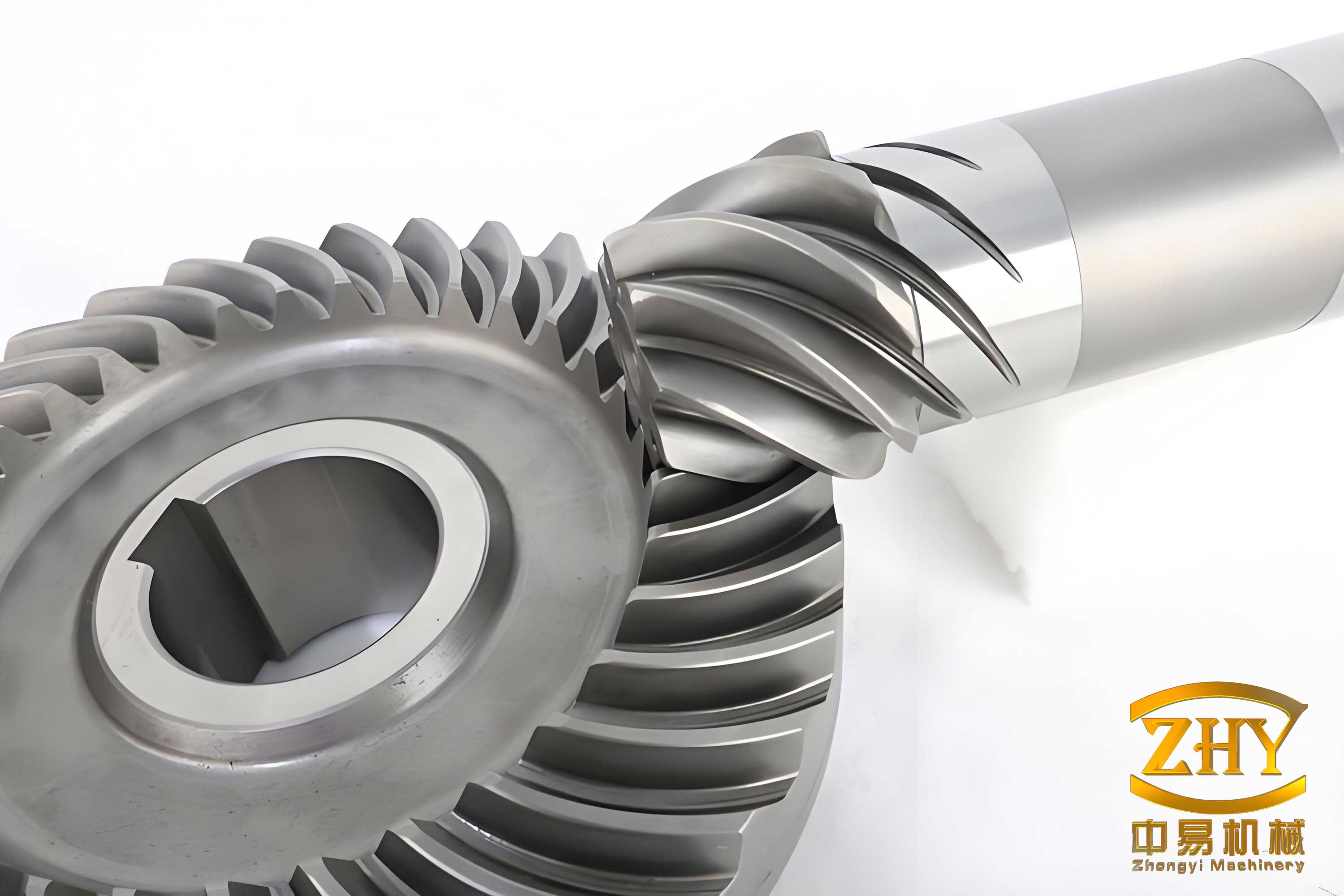
The machining of spiral bevel gears involves using a contoured grinding wheel, typically a flared cup wheel, which subjects the spindle to complex and variable cutting forces—both radial and axial. The spindle must carry the significant mass of the wheel, its adapter, and the flange, often totaling several tens of kilograms. Therefore, the selected motorized spindle must exhibit high static and dynamic rigidity, high torque at relatively lower speeds (common range: 1,000 to 8,000 rpm), and run with minimal vibration to achieve the necessary surface finish and profile accuracy on the spiral bevel gears. A model like the 300MD04Z24 spindle is designed to meet these challenges, with typical parameters including an rated power of 33 kW, a speed range of 1,500 – 3,500 rpm, and a rated torque of 150 N·m. The interface for mounting the grinding wheel is a precise 1:24 taper, with runout tolerances held within 2 µm, ensuring the grinding wheel’s precise positioning critical for accurate spiral bevel gear generation.
The structural design prioritizes rigidity and precision. The shaft diameter is maximized within constraints to enhance bending stiffness. The bearing arrangement is critical; a robust set of high-precision, preloaded angular contact ball bearings is used. For instance, a configuration might employ four bearings at the front (near the tool interface) in a DBB arrangement and two at the rear in a DB arrangement. This setup provides high radial and axial stiffness. The distance from the front bearing set to the spindle nose is minimized to reduce overhang, thereby limiting deflection at the point where the grinding wheel for spiral bevel gears is attached. The flange system is designed for flexibility, allowing the mounting of different adapter plates and wheel sizes to grind various sizes of spiral bevel gears without compromising dynamic stability.
Comprehensive Dynamic Performance Evaluation
While static parameters are important, the dynamic behavior of the spindle under operational conditions is paramount for high-precision grinding of spiral bevel gears. Dynamic performance is evaluated through several interconnected analyses: vibration spectrum analysis, dynamic stiffness measurement, and critical speed identification.
1. Vibration Spectrum Analysis
Vibration analysis is a fundamental diagnostic tool. The overall vibration velocity (e.g., measured in mm/s RMS) is a common pass/fail criterion in production. More insightfully, frequency spectrum analysis decomposes this vibration into its constituent frequencies, revealing the root cause of any excessive motion. Testing involves running the spindle at various speeds within its operational range and capturing the vibration signature.
For a spindle dedicated to grinding spiral bevel gears, the spectrum should ideally show dominant peaks only at the fundamental rotational frequency (1x RPM) and its harmonics. A prominent 1x component typically indicates residual unbalance in the rotating assembly (shaft, rotor, adapter, and simulated wheel). During testing, a spindle might show acceptable vibration levels (< 1.5 mm/s) up to a certain speed. For example, data might show elevated vibration at 3,500 rpm. This is often correctable by performing a precision balancing procedure using balancing holes in the flange. The absence of significant peaks at other frequencies (like bearing defect frequencies or electrical frequencies) is a positive indicator of good mechanical assembly and bearing condition. The table below summarizes a hypothetical vibration test profile for a spiral bevel gear grinding spindle.
| Spindle Speed (rpm) | Test Duration (min) | Overall Vibration (mm/s RMS) | Dominant Frequency Component | Assessment |
|---|---|---|---|---|
| 1,000 | 60 | 0.8 | 1x RPM (16.7 Hz) | Pass |
| 2,100 (Rated) | 60 | 1.1 | 1x RPM (35 Hz) | Pass |
| 3,000 | 60 | 1.3 | 1x RPM (50 Hz) | Pass |
| 3,500 | 120 | 1.9 (Pre-balance) | 1x RPM (58.3 Hz) | Requires Balancing |
| 3,500 | — | 1.2 (Post-balance) | 1x RPM (58.3 Hz) | Pass |
2. Dynamic Stiffness Analysis
Dynamic stiffness (Kdyn) is a measure of a structure’s resistance to dynamic forces. It is more relevant than static stiffness for grinding applications where forces are cyclical and can excite structural resonances. It is defined as the ratio of the applied dynamic force to the resulting displacement at that specific frequency: $$K_{dyn}(f) = \frac{F(f)}{X(f)}$$ where \(F(f)\) is the force amplitude and \(X(f)\) is the displacement amplitude at frequency \(f\). The inverse of stiffness is compliance. The minimum value of dynamic stiffness across a frequency range corresponds to a resonance, where the spindle is most susceptible to vibration amplification.
Testing is performed with an impact hammer and a vibration transducer. The spindle is clamped on a rigid foundation to avoid test-stand dynamics interfering. The hammer imparts a broadband force impulse, and the response is measured. A frequency analyzer calculates the Frequency Response Function (FRF), from which dynamic stiffness is derived. Tests are conducted in three principal directions: radial (vertical and horizontal) and axial.
The results are plotted as dynamic stiffness versus frequency. A good spindle for spiral bevel gear grinding will have high dynamic stiffness magnitudes and well-separated resonance frequencies that lie outside the primary excitation ranges expected during operation. The coherence function, which indicates data quality, should be close to 1 in the frequency range of interest. The following table exemplifies dynamic stiffness test results for a critical spindle interface.
| Direction | Resonance Frequency, fr (Hz) | Dynamic Stiffness at fr (N/µm) | Remarks |
|---|---|---|---|
| Vertical Radial | 40 | 80 | First bending mode dominates radial directions. Axial stiffness is generally higher. Low dynamic stiffness at resonance requires speed avoidance. |
| Horizontal Radial | 51 | 90 | |
| Axial | 103 | 145 |
The dynamic stiffness curve itself is informative. A smooth, clean curve suggests good interfacial contacts and precise bearing preload. Multiple closely spaced resonances in the low-frequency range (<150 Hz) can indicate potential instability issues during the grinding of spiral bevel gears, where force variations may occur.
3. Critical Speed Analysis
Critical speeds are rotational speeds at which the spindle’s rotational frequency coincides with a natural frequency, leading to resonance. For a flexible rotor-bearing system, there are theoretically infinite critical speeds, but only the lowest few are practically significant. Operating at or near a critical speed can cause severe vibration, affecting grind quality for spiral bevel gears and potentially damaging the spindle. The fundamental relationship is: $$n_c = 60 \times f_r$$ where \(n_c\) is the critical speed in rpm and \(f_r\) is the natural/resonance frequency in Hz.
The dynamic stiffness or compliance plot directly reveals these critical speeds as points of minimum stiffness (or maximum compliance). For a given spindle, analysis might identify the first few critical speeds. It is standard practice to avoid operating continuously within a band around each critical speed, typically 70% to 130% of \(n_c\).
From the dynamic stiffness test data, the major resonance peaks can be identified. For instance, a spindle might have its first critical speed at 3,300 rpm (from a 55 Hz resonance). Since this falls within the working range of 1,500-3,500 rpm for grinding spiral bevel gears, it must be managed. The solution is to define a “skip” or “barred” speed window in the CNC drive controller. This window is determined empirically by running the spindle through its speed range and noting the speeds where vibration exceeds a safe threshold. A window from 3,260 to 3,320 rpm might be barred. Modern drives can rapidly accelerate through this narrow range, causing no practical impact on grinding cycle times for spiral bevel gears. If the barred range were too wide, design modifications such as increased bearing preload or shaft stiffening would be necessary to shift the first critical speed higher.
| Mode | Resonance Frequency (Hz) | Critical Speed (rpm) | Relation to Operating Range (1,500-3,500 rpm) | Action |
|---|---|---|---|---|
| 1st Bending | 55 | 3,300 | Within range | Define barred speed window (e.g., 3,260-3,320 rpm) |
| 2nd Bending | 113 | 6,780 | Far above range | No action required |
| Axial / 3rd Bending | 185 | 11,100 | Far above range | No action required |
The primary excitation source that can drive resonance is the residual unbalance of the rotor assembly. As speed increases, the unbalance force \(F_u\) grows with the square of the rotational speed \(\Omega\): $$F_u = m \cdot e \cdot \Omega^2$$ where \(m\) is the unbalanced mass and \(e\) is its eccentricity. When \(\Omega\) corresponds to a critical speed, this force can cause large, damaging amplitudes. Therefore, achieving a high precision balance grade (e.g., G1.0 or better per ISO 21940) is crucial for spindles used in spiral bevel gear grinding to minimize the excitation force across the entire speed range.
Integrated Design and Performance Synthesis
The successful application of a motorized spindle in grinding spiral bevel gears hinges on the integration of all discussed aspects. The structural design sets the baseline for static stiffness and bearing life. The dynamic performance analysis—vibration, stiffness, and critical speeds—validates the design and informs operational parameters. The high-quality grinding of spiral bevel gears demands exceptionally smooth motion; thus, vibration levels must be minimized not just at a single speed but across the entire usable range, which is ensured by spectrum analysis and balancing. The complex, varying grinding forces encountered when finishing spiral bevel gear tooth flanks require the spindle to have high dynamic stiffness to avoid chatter and maintain accuracy, a property verified by impact testing. Finally, the entire operational speed range must be free of critical resonances, or they must be effectively managed through controller-based speed avoidance.
Continued research and data accumulation in this field are focused on pushing the boundaries. This includes optimizing bearing technologies (such as hybrid or magnetic bearings), implementing active cooling and thermal growth compensation for even higher stability, and developing advanced condition monitoring using the discussed dynamic metrics. Furthermore, the integration of these spindles with intelligent machining systems allows for adaptive control during the grinding of spiral bevel gears, adjusting parameters in real-time based on spindle vibration and load signals to optimize quality and tool life.
In conclusion, the motorized spindle has proven to be a superior alternative to traditional belt-driven spindles for high-precision spiral bevel gear grinding. Its compact design, direct drive efficiency, and, most importantly, its capacity for excellent dynamic performance make it an indispensable component in modern gear manufacturing. The rigorous analysis of its dynamic characteristics—encompassing vibration spectra, dynamic stiffness, and critical speeds—is not merely a quality control step but a fundamental engineering process that ensures reliability, precision, and productivity in the demanding task of producing high-performance spiral bevel gears for critical applications across industry.